

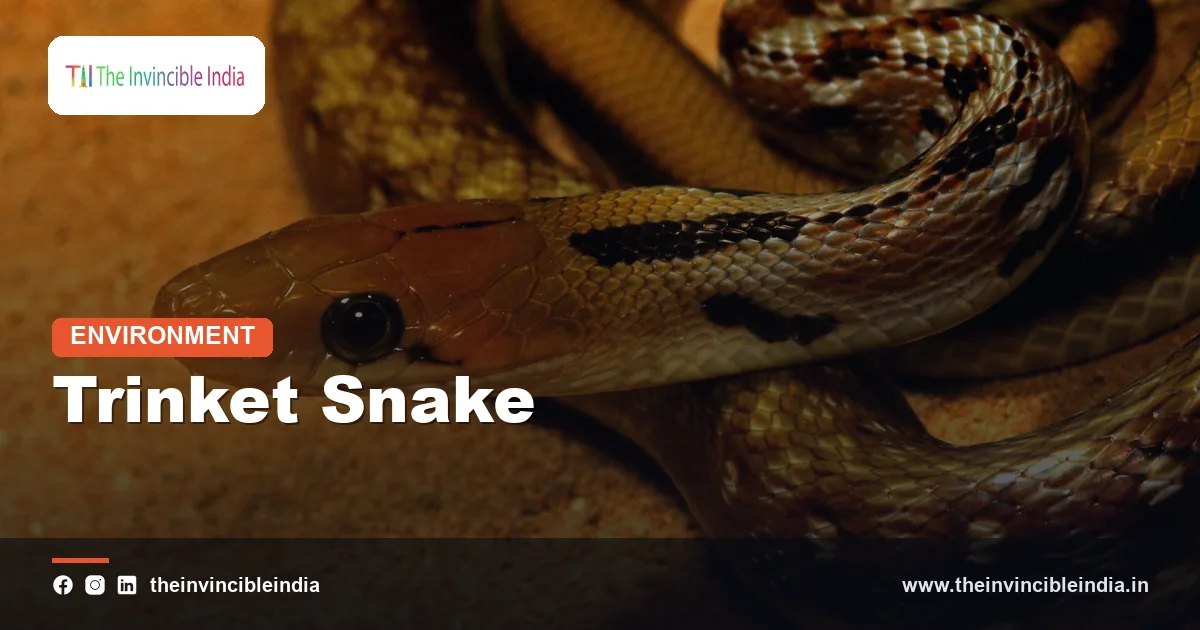
The trinket snake (Coelognathus helena) is a large, non-venomous colubrid snake common in Indian villages, farms, plantations and city outskirts, valued as a natural controller of rats and mice. Its name comes from the intricate, jewellery-like pattern of fine dark lines and cross-bars on its pale brown body, and the trinket snake is harmless to humans, calm by nature and protected by law.
Despite this, the trinket snake is often killed by people who mistake its banded or striped forms for a cobra or a krait. This explainer covers how to recognise the trinket snake, what it eats, how it behaves, where it lives in India, and why it deserves to be left alone as a free pest-control service.
| Quick Fact | Detail |
|---|---|
| Common name | Trinket snake, also known as the trinket rat snake or Indian trinket snake |
| Scientific name | Coelognathus helena |
| Family | Colubridae |
| Venom status | Non-venomous and harmless to humans |
| Typical adult length | Around 1 to 1.5 metres, sometimes more |
| Activity | Mostly active by day and at dusk; good at climbing and swimming |
| Main prey | Rats, mice, small birds, lizards and frogs |
| Reproduction | Egg-laying; a clutch of several eggs |
| Range | Much of India, Nepal, Bangladesh and Sri Lanka |
| IUCN status | Least Concern |
Key Takeaways
- The trinket snake (Coelognathus helena) is a non-venomous colubrid that poses no venom risk to people.
- A trinket snake eats mainly rats and mice, which makes it a valuable natural form of rodent control around farms, godowns and homes.
- The trinket snake exists in banded and striped colour forms, and the striped form is sometimes wrongly feared as a venomous snake.
- When threatened, a trinket snake may flatten its neck, vibrate its tail and strike, but it usually prefers to flee and bites only when cornered or handled.
- The trinket snake lives across most of India in farmland, scrub, forest edges, plantations and human settlements, and the IUCN classes it as Least Concern.
- Killing a trinket snake removes a rat predator and invites more rodents, so a trained rescuer should relocate it if it must be moved.
What is the trinket snake?
The trinket snake is a medium-to-large non-venomous snake of the genus Coelognathus in the family Colubridae, widely seen across South Asia. It is a type of rat snake, a group of snakes named for their habit of hunting rodents, and it was once placed in the genus Elaphe along with many other rat snakes.
Several subspecies are recognised, with the nominate form spread through peninsular India and other forms found in Sri Lanka and in north-eastern India and Bangladesh. The snake is slimmer and more delicate than the Indian rat snake (Ptyas mucosa), and it has a distinct pattern of fine black lines on the head and neck.
Like other colubrids, the trinket snake has no medically significant venom and no fangs for injecting it. Its teeth are small, evenly sized and meant for gripping prey, not for harming people.
Why is it called the trinket snake?
The trinket snake is called the trinket snake because its pattern of fine lines, bars and spots resembles a small ornamental piece of jewellery, or “trinket”. The markings are neat and delicate, especially on the neck and forebody, and the snake is considered one of the more elegant-looking colubrids of the region.
The scientific genus name Coelognathus refers to a feature of the jaw, and “helena” is the species epithet. Locally, the snake is also known by regional names in many Indian languages, often linked to its rat-hunting habit or its resemblance to other rat snakes.
How can you identify a trinket snake?
A trinket snake can be identified by its pale brown to olive-grey body marked with dark cross-bars or longitudinal stripes, its head with narrow black lines running backward from the eyes, its slim build and its large round pupils. The belly is plain and light, often cream or yellow.
Key identification features
- Head: slightly wider than the neck, with fine dark lines radiating from the eye and mouth; the eye is large with a round pupil.
- Body shape: long, slender and smooth-looking, with a thin tail that tapers evenly.
- Pattern: a series of dark cross-bars on the front half that merge into lines or stripes towards the rear.
- Colour: usually light brown, tan or olive-grey, sometimes with a pinkish or coppery wash.
- Posture: often holds the front of the body raised while moving through grass, and flattens the neck slightly when alarmed.
Pattern strength varies. Some trinket snakes show bold bands from neck to tail, while others show a ladder-like or striped look, and some become plainer with age. Because of this variation, a snake should never be handled just because it “looks like a trinket snake”. A photograph from a distance, passed to a local rescuer or forest officer, is the safest way to confirm identity.
What are the striped and banded forms of the trinket snake?
The trinket snake has a banded form, marked with dark cross-bars along the body, and a striped form, in which the bars blend into thin dark lines running lengthwise, and both belong to the same species. Differences in pattern are linked to region, age and individual variation.
| Form | Appearance | Commonly mistaken for |
|---|---|---|
| Banded form | Distinct dark bars on a pale brown body, strongest near the neck and front | Banded racer, wolf snake or krait |
| Striped form | Thin dark stripes or chain-like lines along the sides and back | Other striped snakes such as keelbacks |
| Faded adult | Plain brown or olive body with only traces of the pattern, especially on the rear | Indian rat snake or a juvenile cobra |
| Young snake | Brighter, cleaner bars and clearer head lines | A young krait or a young banded racer |
These variations explain why the trinket snake is so often misidentified. A striped snake with a raised head may be mistaken for a cobra, while a banded youngster may be called a “baby krait”. In both cases, the trinket snake has no venom, but a person who cannot be sure should keep at a distance.
Where does the trinket snake live?
The trinket snake lives across a wide range of habitats in India, including farmland, scrub, grassland, open forest, tea and coffee plantations, rocky hillsides and the edges of towns and villages. It tends to occur wherever rodents are common and there are places to hide, such as walls, haystacks, holes and rock piles.
The species is found in many Indian states and has been recorded in the Western Ghats, peninsular India, the plains of the north and parts of the north-east. Beyond India, it occurs in Sri Lanka, Nepal and Bangladesh. The IUCN lists the trinket snake as Least Concern because of its large range and the stability of its populations, although road traffic and persecution kill many individuals every year.
Inside homes, the trinket snake is usually found in storerooms, granaries, cowsheds, courtyards and garden walls rather than in bedrooms. It is a competent climber and may go up trees, shrubs or even roofs while hunting nests and lizards.
What does the trinket snake eat?
The trinket snake eats rats, mice and other small rodents as its main food, supplemented by lizards, frogs, small birds and eggs. This diet makes it a natural pest-control agent, particularly in grain stores, sugarcane fields, orchards and plantations.
The snake hunts actively by sight and smell, moving quickly through grass or vegetation, searching burrows and nest sites. Unlike pythons, it does not constrict heavily. It seizes prey in the mouth, holds it in coils if needed, and swallows it whole, often headfirst.
Why rodent control matters
Rodents destroy a significant share of stored and standing crops in India each year, and they carry diseases that affect people. A single trinket snake can eat many rodents over a season, and snakes reach burrows and tight gaps that cats and traps cannot. Farmers and storekeepers who allow rat snakes to remain on their land often notice fewer rats without using poison.
Rodenticides carry their own risk, because poisoned rats are eaten by owls, snakes and other animals, which spreads the poison through the food chain. A living snake population provides a steady, chemical-free limit on rodent numbers.
Is the trinket snake aggressive or dangerous?
The trinket snake is not dangerous to humans: it is non-venomous, generally calm and prefers escape over confrontation. When it feels trapped, however, it may bite, and its sharp teeth can cause shallow cuts that bleed freely but need only simple cleaning.
A threatened trinket snake may use a set of bluffing behaviours:
- Raising the front of the body and flattening the neck slightly.
- Vibrating the tail tip, which can rustle dry leaves like a rattle.
- Opening the mouth, hissing and making short forward strikes.
- Releasing musk and droppings if grabbed.
These behaviours are meant to scare off predators and are often misread as aggression. A snake that feels it has space will normally slide away. Most bites occur when people try to catch, kill or pin the snake. Washing the wound with soap and clean water, and seeing a doctor if the bite is deep or the person is not vaccinated against tetanus, is the right response.
How does the trinket snake breed?
The trinket snake breeds by laying eggs, with females depositing a clutch of several eggs in a hidden, warm site such as a hollow log, a burrow, leaf litter or a crevice in a wall. Mating usually occurs before the monsoon, and hatchlings emerge a couple of months later, with timing depending on climate and region.
Female trinket snakes do not typically guard their eggs closely. Young snakes hatch with the full pattern of an adult, often brighter, and begin feeding on small lizards and frogs before moving up to rodents as they grow. Many hatchlings are eaten by birds, mongooses, monitor lizards and other snakes, so only a small share reaches adulthood.
How do you tell a trinket snake from a cobra, krait or banded racer?
A trinket snake differs from a cobra in lacking a true hood, from a krait in having a brown rather than blue-black body and a distinct head, and from a banded racer in having fine lines on its head and a more delicate build. These differences help, but remain imperfect from a distance.
| Snake | Venom | Distinguishing hint |
|---|---|---|
| Trinket snake | None | Pale brown body with fine bars or stripes; fine black lines on head; round pupil |
| Indian cobra | Highly venomous | Broad hood with or without spectacle mark; heavier build; bulky head when hooded |
| Common krait | Highly venomous | Blue-black body with thin white bands; row of enlarged six-sided scales on the back |
| Banded racer | None | Faster and slimmer; bold bands on young snakes that fade with age; less head marking |
| Indian rat snake | None | Larger and heavier; plain or lightly marked brown; large eyes and coloured throat |
The trinket snake can spread its neck slightly, but it never forms the wide, rounded hood of a cobra. The lesson is simple: when not sure, never approach. Ask a trained person to identify the snake.
Why should the trinket snake be protected?
The trinket snake should be protected because it is harmless to people, controls rodents without chemicals and is a normal part of the food web of farms and forests. Native snakes in India are covered by the Wild Life (Protection) Act, 1972, so killing or capturing them without legal authority can attract penalties.
Protection also supports safer communities. When people kill harmless snakes, they often handle them in panic and risk bites, and they remove predators that would keep rodents and other pests down. Rescue groups across India advise that a snake seen outside or near a field should be left alone, as it will leave on its own, and that a snake inside a room should be dealt with by a trained rescuer.
Practical tips for farms and homes
- Store grain in sealed containers and clean spilled grain so that rodents are not attracted.
- Clear heaps of rubble, firewood and unused material near homes.
- Seal gaps under doors, around pipes and in compound walls.
- Keep outdoor lighting moderate, as it attracts insects and small animals.
- Wear boots and use a torch when walking at night in fields or gardens.
- Save the number of a local snake rescuer or the forest department in your phone.
If anyone is bitten by an unidentified snake, treat it as an emergency, keep the person calm and still, and go to a hospital with antivenom facilities at once. Do not kill the snake to “prove” the species, and do not use cutting, sucking, tying or home remedies.
What are the common myths about the trinket snake?
The common myths about the trinket snake are that it is venomous, that it chases people, that it drinks milk or steals eggs from homes, and that it must be killed to keep a household safe. None of these beliefs is supported by what zoologists know about the species.
Myth: the trinket snake is poisonous
The trinket snake has no medically significant venom. Its teeth are small and solid, designed to grip rodents and lizards, and a bite is no more serious than a scratch from a thorn. Folk tales that describe it as deadly usually confuse it with cobras or kraits, which look quite different once their features are known.
Myth: the trinket snake chases people
The trinket snake does not chase people. Because it moves fast and often rushes along the ground, a person who stands in the snake’s escape path may feel chased, but the animal is simply heading for cover. Giving the snake a clear route away is enough to end the encounter.
Myth: it is a mini cobra
Some people call the striped form a “mini cobra” because it can raise its head and flatten its neck. The trinket snake lacks the elongated neck ribs that make up a real hood, and it has a different head shape, large round pupils and fine lines on the head. A cobra has a heavier body and a broad, rounded hood that stays spread for long periods.
Myth: killing snakes makes villages safer
Killing trinket snakes and other rat snakes makes villages less safe in practice. These snakes feed on rodents that spoil grain and spread disease, and their removal can allow rat numbers to climb. People also face a higher risk of bites when they try to kill snakes at close range. Awareness camps by forest departments and rescue groups repeatedly stress that live rat snakes are an asset to farmers.
Bottom Line
The trinket snake is a handsome, harmless rat snake that helps farmers and households by eating rodents. Its banded and striped patterns can look alarming, but the species has no venom and flees when given a chance. Leaving it alone, or calling a trained rescuer when it is indoors, protects both people and a valuable ally.
Frequently Asked Questions
Is the trinket snake venomous?
No, the trinket snake is not venomous and is harmless to humans. It is a colubrid rat snake with small gripping teeth rather than venom fangs. A bite may cause shallow cuts that should be washed with soap and water.
What does the trinket snake eat?
The trinket snake eats mainly rats and mice, along with lizards, frogs, small birds and eggs. It hunts actively on the ground and in low vegetation and swallows prey whole. This diet makes it a helpful controller of rodents on farms and in storerooms.
How big does a trinket snake grow?
A trinket snake usually grows to about 1 to 1.5 metres, and some individuals are longer. It is slimmer than the Indian rat snake and lighter in build. Hatchlings are much smaller, and they grow steadily over the first few years.
Can a trinket snake be kept as a pet?
No, a trinket snake should not be captured or kept as a pet in India because native snakes are protected under the Wild Life (Protection) Act, 1972. Keeping wild snakes without legal authorisation can lead to penalties, and captivity stresses the animal. If a snake enters a home, call a trained rescuer who can relocate it responsibly.
Why does the trinket snake vibrate its tail?
The trinket snake vibrates its tail as a warning signal to scare off predators. On dry leaves or grass, the movement produces a rustling sound that can mimic a more dangerous snake. It is a bluff and usually means the snake would rather escape than fight.
What should I do if I find a trinket snake in my house?
Stay calm, keep a safe distance, move children and pets away and call a trained snake rescuer or the forest department. Do not try to hit, grab or corner the snake. Seal gaps and remove rodent attractants afterwards to reduce the chance of a repeat visit.
{“@context”:”https://schema.org”,”@graph”:[{“@type”:”FAQPage”,”mainEntity”:[{“@type”:”Question”,”name”:”Is the trinket snake venomous?”,”acceptedAnswer”:{“@type”:”Answer”,”text”:”No, the trinket snake is not venomous and is harmless to humans. It is a colubrid rat snake with small gripping teeth rather than venom fangs. A bite may cause shallow cuts that should be washed with soap and water.”}},{“@type”:”Question”,”name”:”What does the trinket snake eat?”,”acceptedAnswer”:{“@type”:”Answer”,”text”:”The trinket snake eats mainly rats and mice, along with lizards, frogs, small birds and eggs. It hunts actively on the ground and in low vegetation and swallows prey whole. This diet makes it a helpful controller of rodents on farms and in storerooms.”}},{“@type”:”Question”,”name”:”How big does a trinket snake grow?”,”acceptedAnswer”:{“@type”:”Answer”,”text”:”A trinket snake usually grows to about 1 to 1.5 metres, and some individuals are longer. It is slimmer than the Indian rat snake and lighter in build. Hatchlings are much smaller, and they grow steadily over the first few years.”}},{“@type”:”Question”,”name”:”Can a trinket snake be kept as a pet?”,”acceptedAnswer”:{“@type”:”Answer”,”text”:”No, a trinket snake should not be captured or kept as a pet in India because native snakes are protected under the Wild Life (Protection) Act, 1972. Keeping wild snakes without legal authorisation can lead to penalties, and captivity stresses the animal. If a snake enters a home, call a trained rescuer who can relocate it responsibly.”}},{“@type”:”Question”,”name”:”Why does the trinket snake vibrate its tail?”,”acceptedAnswer”:{“@type”:”Answer”,”text”:”The trinket snake vibrates its tail as a warning signal to scare off predators. On dry leaves or grass, the movement produces a rustling sound that can mimic a more dangerous snake. It is a bluff and usually means the snake would rather escape than fight.”}},{“@type”:”Question”,”name”:”What should I do if I find a trinket snake in my house?”,”acceptedAnswer”:{“@type”:”Answer”,”text”:”Stay calm, keep a safe distance, move children and pets away and call a trained snake rescuer or the forest department. Do not try to hit, grab or corner the snake. Seal gaps and remove rodent attractants afterwards to reduce the chance of a repeat visit.”}}]}]}


