

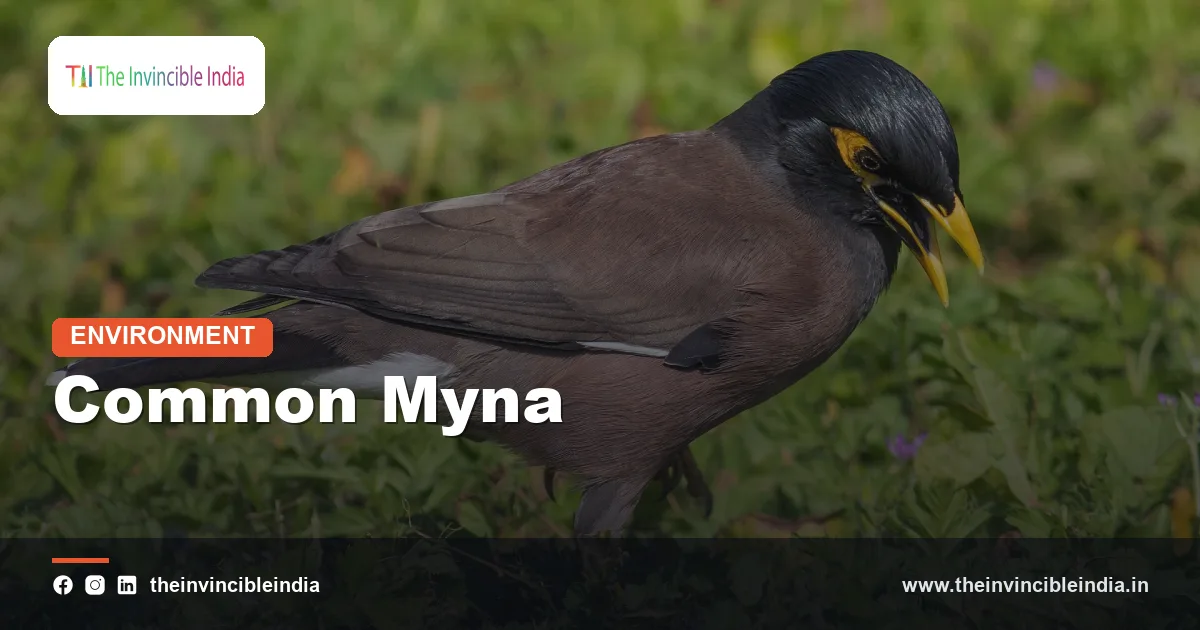
The common myna (Acridotheres tristis) is a bold, brown, yellow-billed bird of the starling family, native to South Asia and found in almost every Indian town, village and farm, and it is also listed among the world’s worst invasive alien species in the places where people have introduced it. The common myna is noisy, sociable and highly adaptable, and it is instantly recognised by a bare yellow patch of skin behind each eye and a bright yellow bill and legs.
In India the common myna is simply part of everyday life, walking on lawns, riding on cattle and nesting in the gaps of buildings. This explainer covers how to identify the common myna, what it eats, how it breeds and communicates, and why a native bird of the subcontinent has become a cautionary tale in Australia, South Africa, New Zealand and on many islands.
| Attribute | Detail |
|---|---|
| Common name | Common myna (also spelt common mynah; Hindi: maina) |
| Scientific name | Acridotheres tristis |
| Family | Sturnidae (starlings and mynas) |
| Length | Roughly 23 to 26 centimetres |
| Native range | South Asia, including India, and parts of neighbouring regions |
| Distinguishing marks | Brown body, black head, yellow bill and legs, bare yellow patch behind the eye, white wing patches in flight |
| Diet | Omnivorous: insects, fruit, grain, seeds, scraps and nectar |
| Nesting | Cavity nester in tree holes, walls, eaves and similar gaps |
| Conservation status | Widespread and common in its native range; recorded as a species of Least Concern, and listed among the world’s 100 worst invasive species |
Key Takeaways
- The common myna is a brown, yellow-billed starling relative with a bare yellow eye-patch, native to the Indian subcontinent and abundant in Indian towns.
- Common mynas are omnivores that eat insects, fruit, grain and scraps, which allows them to thrive wherever people live.
- Common mynas nest in cavities such as tree holes, wall gaps and eaves, and pairs often stay together for long periods.
- The common myna can imitate sounds and human speech, though it is a less accomplished mimic than the hill myna.
- The common myna is included among the world’s 100 worst invasive alien species because it harms native birds and agriculture in places such as Australia, South Africa and many islands.
- In India the common myna is native and ecologically useful, which shows that the same bird can be a benefit at home and a pest abroad.
What is the common myna?
The common myna is a medium-sized, omnivorous, highly social perching bird of the starling family, Sturnidae, native to the Indian subcontinent and closely associated with human settlements. The word “myna” comes from the Hindi and Sanskrit names for the group, and in much of India the bird is known as the maina.
The common myna is one of several myna species in India. Others include the bank myna, the jungle myna, the hill myna and the brahminy starling, which belongs to a related group. The common myna is the one most often seen on pavements, lawns, balconies and fields, and its adaptability to city life has made it one of the most familiar birds on the subcontinent.
It is a resident species in most of its range, meaning it stays in the same area through the year rather than migrating long distances, though local movements to follow food and roosting places are common.
How do you identify a common myna?
A common myna can be identified by its chocolate-brown body, glossy black head and neck, bright yellow bill and legs, and a bare patch of yellow skin behind each eye. In flight the bird shows broad white patches on the wings and a white tip to the tail.
Several features help to confirm the identification.
- Eye-patch: The bare yellow skin behind the eye gives the face a distinct, intense look.
- Walk: The common myna walks and struts on the ground with a confident gait, unlike birds that hop.
- Wing flash: White wing patches become visible when the bird takes off or glides.
- Size and shape: It is compact and sturdy, a little larger than a bulbul and smaller than a crow.
- Sexes: Males and females look alike, so the sexes can hardly be told apart in the field.
Young birds are duller and browner, with a less distinct black head and a paler bill. The bird that is often confused with the common myna is the bank myna, which lacks the bare eye-patch, has a pale grey-brown body and shows an orange-red patch near the eye.
Where does the common myna live in India?
The common myna lives throughout most of India, from the plains to the lower hills, in cities, villages, farmland, gardens, roadsides, railway stations and open woodland. It is especially numerous in human-modified landscapes.
The bird is a classic commensal of people, meaning it benefits from living alongside humans. It favours places with open ground to forage on and sheltered spots to nest and roost. Typical habitats include the following.
- Urban parks, lawns and pavements
- Agricultural fields, where it follows ploughs and grazing cattle
- Roadside trees, avenues and market areas
- Buildings with eaves, ledges and gaps suitable for nesting
- Village edges, orchards and water tanks
At dusk, common mynas gather in noisy communal roosts, often in large dense trees or even on city buildings and wires, sometimes with hundreds of birds in one spot. The chatter at these roosts can be loud and continues until the light fades.
What does the common myna eat?
The common myna eats almost anything, including insects, spiders, grains, fruit, flower nectar, seeds, small reptiles and human food scraps. It is an opportunistic omnivore, which is one of the main reasons for its success.
In fields, common mynas follow ploughs or grazing cattle to catch the grasshoppers and other insects that are disturbed. In towns, they scavenge around food stalls, bins and gardens. They also feed on ripe fruits such as figs, and they sometimes raid grain stores or crops. Because they eat many insects, they act as natural pest controllers in farmland, a benefit that helped lead to their deliberate introduction in other countries during the nineteenth century.
How does the common myna breed?
The common myna breeds by pairing up and nesting in a cavity, where the female lays a small clutch of pale blue or blue-green eggs, and both parents share incubation and the feeding of the chicks. Nests are built from grass, twigs, feathers and rubbish.
The details of the breeding cycle include several steps.
- Pairing: Pairs often stay together over several seasons and are frequently seen foraging side by side.
- Nest sites: Natural tree holes are used, but so are gaps in walls, roof tiles, eaves, street lamps and sometimes old woodpecker or barbet holes.
- Eggs: A typical clutch is a handful of eggs, commonly around four to six, though numbers vary.
- Incubation: Eggs hatch after roughly two weeks of incubation by both parents.
- Chicks: The young are fed insects and other food by both adults and fledge after a few weeks.
Breeding season varies by region, but it commonly peaks around spring and summer in much of India. A pair may raise more than one brood in a year when food is abundant.
Can the common myna really talk?
Yes, the common myna can imitate sounds, including some human words, but it is a modest mimic compared with the hill myna, which is the bird famed for clear human speech. In the wild, the common myna produces a varied repertoire of whistles, chuckles, squawks and gurgles.
Captive common mynas can learn to copy whistles, short phrases and household noises, and that talent is one reason they have been kept as pets in the past. Keeping wild native birds as pets is now restricted under Indian wildlife law, and capture for the pet trade is discouraged. In nature, vocal learning probably helps pairs communicate and bond. The loud, varied calls are used to defend nest sites, keep flocks in contact and warn of predators.
Why is the common myna called an invasive species?
The common myna is called an invasive species because, when people introduced it to regions outside South Asia, it spread rapidly, competed with native birds for nest holes and food, and sometimes damaged fruit crops. The International Union for Conservation of Nature (IUCN) Invasive Species Specialist Group lists it among the world’s 100 worst invasive alien species.
Deliberate introductions took place mainly in the nineteenth century, when settlers hoped the bird would control insect pests or remind them of home. Well-documented introductions include the following.
| Region | Approximate period of introduction | Reason and outcome |
|---|---|---|
| Australia (eastern coast) | 1860s | Brought to control insects in market gardens; now widespread and managed as a pest in places |
| South Africa | Late 1800s | Introduced to Natal; spread across several provinces |
| New Zealand | 1870s | Brought to control insect pests; established in the North Island |
| Hawaii and Pacific islands | Late 1800s onward | Introduced for insect control; now common on several islands |
| Indian Ocean islands | Various periods | Introduced to several islands; considered a pest on some |
The harms reported in these places include competition with native hole-nesting birds and small mammals, spreading of weeds through seeds, damage to fruit and noise nuisance. The scale of impact differs between places, and scientists still debate how severe it is in each location. The lesson drawn by conservationists is that an animal harmless at home can become a problem when it lands in a different ecosystem.
Is the common myna a pest in India?
No, the common myna is a native bird in India and is generally regarded as beneficial rather than a pest, because it eats many insects and forms part of a long-evolved ecosystem. The word invasive applies only to places outside its natural range.
In India the species has evolved with predators, competitors and parasites that keep its numbers in check. Raptors such as shikras and kites take mynas, as do cats and snakes. Other cavity nesters, including parakeets and sparrows, compete for nesting spots, and the balance is maintained by long coexistence. Occasionally, large urban roosts annoy residents through noise and droppings, but this is a local nuisance rather than an ecological problem.
Some conservation groups note that the Indian population is thought to be stable or even growing in urban areas, although no precise national count exists. Because the bird is so common, it receives less attention than rarer species, yet it remains a good indicator of how well birds can adapt to cities.
What role does the common myna play in Indian culture and ecology?
The common myna plays the role of a familiar companion bird in Indian life, appearing in folk tales, songs and everyday speech, and ecologically it acts as an insect eater and seed disperser. The bird’s chatter is part of the daily soundscape of many Indian neighbourhoods.
Ecologically, mynas disperse seeds of fruiting trees, reduce insect populations in fields, and provide food for raptors. They also share information about danger: when a predator such as a snake or cat appears, nearby mynas give loud alarm calls and may mob the intruder together. That cooperative behaviour is a good example of how social birds protect each other.
Bottom Line
The common myna is a clever, adaptable and sociable bird that thrives beside people in India and has become a warning about biological invasions elsewhere. Understanding it helps explain both the richness of urban wildlife at home and the risks of moving species around the world.
Frequently Asked Questions
What is a common myna?
A common myna is a brown, yellow-billed bird of the starling family, native to South Asia, with a bare yellow patch behind each eye. It is found across India in towns, villages and farmland. The species is omnivorous and highly sociable.
Can a common myna talk like a parrot?
The common myna can mimic some sounds and short human phrases, but it is a less skilled mimic than the hill myna. Most wild birds produce only their own whistles and chuckles. Keeping wild native birds as pets is restricted under Indian wildlife law.
Why is the common myna considered an invasive species?
The common myna is considered invasive because, outside South Asia, it has spread widely, competed with native birds for nest holes and food, and damaged some crops. The IUCN Invasive Species Specialist Group lists it among the world’s 100 worst invasive alien species. In India, where it is native, it is not regarded as invasive.
What does the common myna eat?
The common myna eats insects, fruit, grain, seeds, nectar and food scraps. It is an opportunistic omnivore. In fields it follows ploughs and cattle to catch disturbed insects.
How can I tell a common myna from a bank myna?
The common myna has a bare yellow patch behind the eye, a black head and a bright yellow bill, while the bank myna lacks the yellow patch and is paler grey-brown with an orange-red patch near the eye. The common myna is also the more widespread of the two in towns. Size is similar, so the face is the best clue.
Where does the common myna nest?
The common myna nests in cavities such as tree holes, wall gaps, eaves and street lamps. Both parents help build the nest from grass, twigs and feathers and raise the chicks. A clutch usually holds around four to six pale blue eggs.
{“@context”:”https://schema.org”,”@graph”:[{“@type”:”FAQPage”,”mainEntity”:[{“@type”:”Question”,”name”:”What is a common myna?”,”acceptedAnswer”:{“@type”:”Answer”,”text”:”A common myna is a brown, yellow-billed bird of the starling family, native to South Asia, with a bare yellow patch behind each eye. It is found across India in towns, villages and farmland. The species is omnivorous and highly sociable.”}},{“@type”:”Question”,”name”:”Can a common myna talk like a parrot?”,”acceptedAnswer”:{“@type”:”Answer”,”text”:”The common myna can mimic some sounds and short human phrases, but it is a less skilled mimic than the hill myna. Most wild birds produce only their own whistles and chuckles. Keeping wild native birds as pets is restricted under Indian wildlife law.”}},{“@type”:”Question”,”name”:”Why is the common myna considered an invasive species?”,”acceptedAnswer”:{“@type”:”Answer”,”text”:”The common myna is considered invasive because, outside South Asia, it has spread widely, competed with native birds for nest holes and food, and damaged some crops. The IUCN Invasive Species Specialist Group lists it among the world’s 100 worst invasive alien species. In India, where it is native, it is not regarded as invasive.”}},{“@type”:”Question”,”name”:”What does the common myna eat?”,”acceptedAnswer”:{“@type”:”Answer”,”text”:”The common myna eats insects, fruit, grain, seeds, nectar and food scraps. It is an opportunistic omnivore. In fields it follows ploughs and cattle to catch disturbed insects.”}},{“@type”:”Question”,”name”:”How can I tell a common myna from a bank myna?”,”acceptedAnswer”:{“@type”:”Answer”,”text”:”The common myna has a bare yellow patch behind the eye, a black head and a bright yellow bill, while the bank myna lacks the yellow patch and is paler grey-brown with an orange-red patch near the eye. The common myna is also the more widespread of the two in towns. Size is similar, so the face is the best clue.”}},{“@type”:”Question”,”name”:”Where does the common myna nest?”,”acceptedAnswer”:{“@type”:”Answer”,”text”:”The common myna nests in cavities such as tree holes, wall gaps, eaves and street lamps. Both parents help build the nest from grass, twigs and feathers and raise the chicks. A clutch usually holds around four to six pale blue eggs.”}}]}]}


