

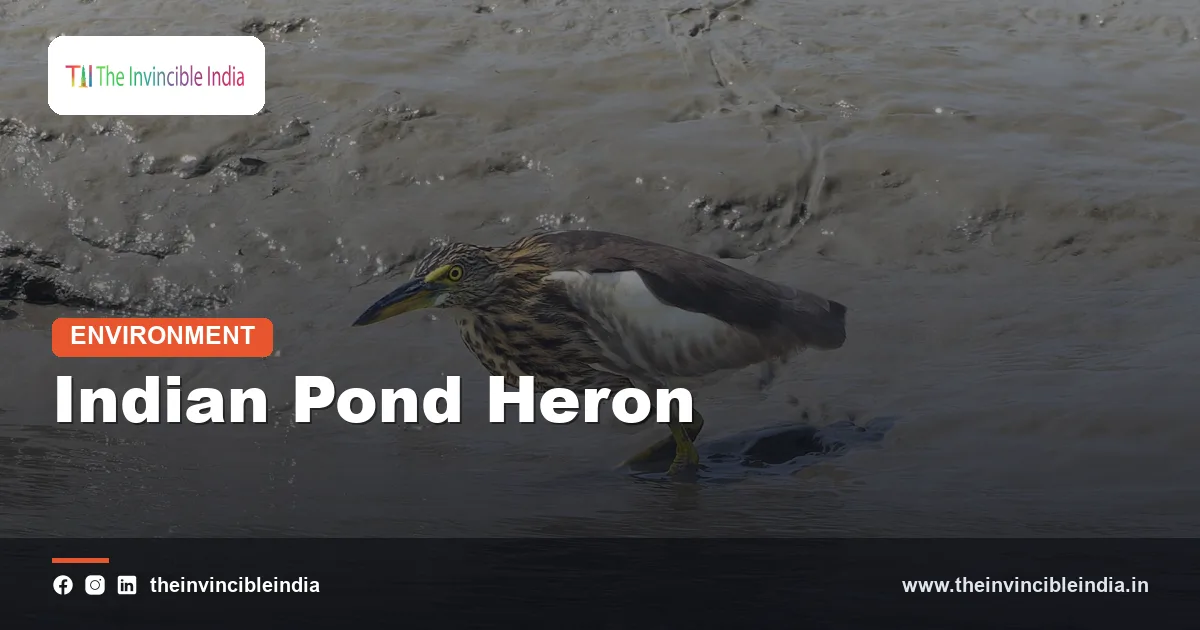
The Indian pond heron (Ardeola grayii) is a small, stocky wading bird of the heron family that lives in wetlands, paddy fields, village ponds and roadside puddles across the Indian subcontinent, and it is best known for looking drab and earthy when perched but suddenly flashing brilliant white wings when it flies. Because it is so often seen standing patiently at the edge of flooded rice fields, it is widely called the “paddybird” in India.
This guide explains what the Indian pond heron looks like, how it hunts by ambush, where it lives, how it breeds, how to separate it from lookalike birds, and why it remains one of the most reliably spotted wetland birds in the country. Last updated: 23 October 2026.
| Attribute | Detail |
|---|---|
| Common name | Indian pond heron, also called paddybird |
| Scientific name | Ardeola grayii |
| Family | Ardeidae (herons, egrets and bitterns) |
| Typical body length | Roughly 40 to 45 cm |
| Hindi names | Andha bagla (literally “blind heron”), also bagla |
| Main habitat | Freshwater wetlands, paddy fields, ponds, tanks, canals and marshes |
| Range | Indian subcontinent, from Pakistan and India to Bangladesh, Sri Lanka and Myanmar |
| Diet | Fish, frogs, crustaceans, aquatic insects and other small animals |
| IUCN status | Least Concern |
Key Takeaways
- The Indian pond heron (Ardeola grayii) is a small heron, roughly 40 to 45 cm long, found throughout most of the Indian subcontinent.
- The Indian pond heron looks streaky brown and camouflaged while at rest, but reveals bright white wings, tail and rump the moment it takes flight.
- The Indian pond heron hunts by ambush, standing almost motionless at the water’s edge and striking quickly at fish, frogs and insects that come within reach.
- In the breeding season the Indian pond heron develops a buff head and neck, a maroon-brown back and long white head plumes.
- The Indian pond heron is listed as Least Concern by the International Union for Conservation of Nature (IUCN) and is a common, widespread resident bird.
- The Hindi name “andha bagla”, meaning “blind heron”, comes from the bird’s habit of staying so still and unaware-looking that people assume it cannot see.
What is the Indian pond heron and where does it fit among herons?
The Indian pond heron is a small member of the heron family, Ardeidae, belonging to the genus Ardeola, a group of compact, short-necked herons often called pond herons. Its scientific name is Ardeola grayii, and the family it belongs to also includes the larger grey heron, the white egrets, the night herons and the secretive bitterns.
Pond herons are noticeably smaller and more thick-set than most other herons seen in India. They have a heavy bill, a relatively short neck and short legs for a heron, which suits a bird that hunts by crouching and waiting rather than by striding through deep water. The Indian pond heron is a resident bird in most of its range, which means it breeds and spends the whole year in roughly the same region, with only local movements linked to rainfall and water levels.
Other pond herons exist elsewhere in Asia and in Africa and southern Europe. They share the same body shape and the same habit of looking dull on the ground and strikingly white in the air. Within India, the Indian pond heron is by far the most commonly encountered one.
What does the Indian pond heron look like?
The Indian pond heron looks like a hunched, streaky brown-and-buff bird with a stout yellowish bill and greenish-yellow legs when it is not breeding, and it turns into a much more colourful bird in the breeding season. Its camouflage is excellent: when it stands still beside a muddy pond, many people walk past it without noticing it.
Non-breeding plumage
Outside the breeding season the Indian pond heron has a dull, earthy-brown back and a head, neck and breast heavily streaked with brown on a pale buff background. The bill is yellowish with a dark tip, and the eyes are bright yellow. This plumage blends with dry grass, mud and the shadows of aquatic vegetation.
Breeding plumage
In breeding condition the Indian pond heron develops a golden-buff head and neck, a deep maroon-brown mantle on the back and long, narrow white plumes that hang from the nape. The bill becomes more brightly coloured, and the legs may take on a reddish tone. The contrast between the buff front and the maroon back is the easiest way to recognise a bird in full breeding dress.
The white wings in flight
The most famous feature of the Indian pond heron is the sudden change when it flies. Its wings, tail and rump are white, and these show up dramatically against the brown body as the bird lifts off. This is why a seemingly brown bird can appear to turn white on the wing, and why many beginners think they have seen two different birds.
Why is the Indian pond heron called the paddybird?
The Indian pond heron is called the paddybird because it is one of the most common birds found in flooded rice paddies, where it stands in the shallow water waiting for prey. The name is used widely in English-language bird books and field guides on the subcontinent, and it reflects the close connection between this heron and traditional wet-rice farming.
In Hindi, the bird is known as “andha bagla”, which translates to “blind heron”. The name comes from the bird’s habit of standing so completely still and apparently unaware that people believed it could not see. In reality, the Indian pond heron has sharp eyesight and reacts instantly when prey or a threat appears. The stillness is a hunting strategy, not a disability.
Other languages across India have their own local names for the bird, many of which also refer to its hunched posture or its attachment to water. Folk sayings in several languages use the heron as a symbol of patience, a bird that waits calmly until its chance comes.
Where does the Indian pond heron live in India?
The Indian pond heron lives in almost every part of India that has shallow fresh water, from the plains of the Gangetic belt and the coastal lowlands to the southern peninsula and the foothills of the Himalaya. Its range extends beyond India across the subcontinent, including Pakistan, Nepal, Bangladesh, Sri Lanka and Myanmar, and it also reaches some neighbouring regions.
The bird is a habitat generalist. It uses a wide range of wet places, and it is comfortable close to people. Typical habitats include:
- Flooded rice paddies and irrigation channels in farmland.
- Village ponds, temple tanks and roadside ditches that hold water after rain.
- Lakes, reservoirs, canals and slow rivers with muddy or vegetated margins.
- Marshes, mangrove edges and tidal creeks in coastal districts.
- Urban water bodies, including park ponds and even drains in cities and towns.
The Indian pond heron generally avoids dense forest interiors and high mountain areas, but it is common at low and moderate elevations. Because it tolerates disturbance better than many other waterbirds, it is often one of the first herons to appear at a newly formed pond or a monsoon pool.
How does the Indian pond heron hunt?
The Indian pond heron hunts by ambush: it stands motionless or walks slowly at the water’s edge, then lunges forward with a quick stab of its bill when a fish, frog or insect comes within range. This sit-and-wait technique uses very little energy, and it works especially well in shallow, cluttered water where prey cannot see the bird coming.
The hunting sequence usually follows a few steps:
- The bird picks a spot beside shallow water, often under overhanging plants or in a patch of floating vegetation.
- It hunches its neck close to the body and may stay in one position for long periods.
- When prey moves near, the neck extends rapidly and the bill closes on the target.
- The bird may shake or beat larger prey before swallowing it whole.
At times the Indian pond heron also walks slowly through the shallows, peering into the water. It may stand on floating leaves or on low branches that overhang a pond. Its drab plumage helps it blend with the background while it waits, which is the main reason it is so much more effective as a still hunter than it would be as an active chaser.
What does the Indian pond heron eat?
The Indian pond heron eats small aquatic animals, mainly fish, frogs and tadpoles, crabs and other crustaceans, and a wide range of insects, including water beetles, dragonfly larvae, grasshoppers and crickets. It is an opportunistic feeder, so the actual menu changes with season and place.
In paddy fields, the Indian pond heron takes advantage of the abundance of small animals that thrive in flooded rice, including insects that can damage the crop. Around ponds it concentrates on small fish and amphibians. Near human settlements, it may pick up scraps of animal matter around fish markets and slaughter areas, and it sometimes feeds on small items thrown into water.
Because it eats many insects and other small invertebrates, the bird is often described as helpful to farmers. At the same time, it can take fish from small aquaculture ponds, and this occasionally makes it unwelcome to fish farmers. These two sides of its diet are part of why it has a mixed but generally tolerant relationship with people.
How does the Indian pond heron breed?
The Indian pond heron breeds in colonies, building a flimsy platform nest of sticks in trees, usually within a mixed group of herons and egrets, and most nesting is timed to coincide with the monsoon rains. In much of India the breeding season falls roughly between the onset of the rains and the following months, though the exact timing varies by region.
Nests and colonies
The nest is a loose platform of twigs built in trees or dense bushes, often over or near water. Pond herons commonly join mixed heronries that also include egrets, cormorants and other herons. These colonies can be noisy and crowded, and they are often located in village trees or in the trees of towns and temple compounds.
Eggs and chicks
A typical clutch contains about three to five pale greenish-blue eggs. Both parents are involved in incubation and in feeding the chicks. The young are fed at the nest with partly digested food, which the parents bring up and deliver. The chicks grow quickly, and they leave the nest only after developing flight feathers. The timing is useful because the rains bring a surge of frogs, insects and fish that give the growing chicks plenty of food.
How can you tell the Indian pond heron from similar birds?
The Indian pond heron can be told from similar herons by its small size, streaked buff-brown plumage, stout bill and the contrast of white wings in flight, but in non-breeding plumage it is easily confused with other pond herons. The table below summarises the main differences with birds that observers commonly mix up.
| Bird | Size and shape | Key identification clue | Where it is seen |
|---|---|---|---|
| Indian pond heron | Small and stocky | Streaked brown at rest, white wings in flight, buff head and maroon back when breeding | Widespread across India in ponds, paddy and marshes |
| Chinese pond heron | Similar to the Indian pond heron | Breeding birds show a dark chestnut head and breast and a slaty back; non-breeding birds are very hard to separate | Mainly a visitor in parts of eastern and north-eastern India |
| Squacco heron | Similar small build | Considered a close relative; usually paler, with a more golden tone | Local and less common in India |
| Cattle egret | Slightly larger, all-white in non-breeding dress | White body at all times with a yellow bill; never shows brown streaks | Fields and grazing land, often following cattle |
| Little egret | Slender and long-legged | Pure white, black bill and black legs with yellow feet | Wetlands, tidal flats and rivers |
| Black-crowned night heron | Stout but larger | Grey and black plumage with a dark crown and red eye | Mostly active at dusk and night |
For beginners, the safest approach is to remember that a small, brown, streaky heron standing at a pond edge in most of India is the Indian pond heron. In the east and north-east, where the Chinese pond heron may also occur, careful photographs of the breeding plumage are usually needed to be sure.
Is the Indian pond heron threatened?
The Indian pond heron is not considered threatened; the IUCN lists it as Least Concern because it is widespread, adaptable and, by most accounts, common across its range. Its population is generally thought to be large, though exact totals are not known and local numbers rise and fall with rainfall and wetland conditions.
Even so, several pressures affect the bird locally:
- Draining and filling of wetlands, village ponds and tanks for construction.
- Pollution of water by industrial effluent, sewage and agricultural chemicals, which reduces prey.
- Felling of colony trees, which can destroy nesting sites.
- Disturbance and, in some places, hunting or egg collection from colonies.
The Indian pond heron is a protected native bird under India’s Wildlife (Protection) Act, 1972, which covers the capture, killing and trade of wild birds. Protection of heronries, particularly those in village and temple trees, is often led by local communities, and such sites can support large numbers of breeding herons year after year.
Why does the Indian pond heron matter to people and wetlands?
The Indian pond heron matters because it is a very visible indicator of healthy shallow wetlands and because it helps regulate insect and small-animal populations in farmland. Its presence at a pond is a reasonable sign that the water still supports fish, frogs and invertebrates.
The bird also serves as an entry point for people interested in birdwatching. It is easy to find, often tolerant of observers and visible throughout the year, which makes it a popular subject for beginner birdwatchers and photographers. Citizen-science projects, such as national bird-count initiatives, regularly record it in large numbers.
Culturally, the heron’s stillness and patience have become part of common sayings, and its name “andha bagla” is familiar even to people who have never learnt another bird’s name. By living close to human settlements, the Indian pond heron keeps wild nature visible in everyday life, from village tanks to city park ponds.
Bottom Line
The Indian pond heron is one of the easiest birds to find and one of the most surprising to watch: a plain, hunched, camouflaged heron that turns brilliant white in flight. It is common, adaptable and useful to wetland ecosystems, which makes it a good first bird for anyone beginning to notice India’s wildlife.
Frequently Asked Questions
What is the Indian pond heron?
The Indian pond heron is a small, stocky heron with the scientific name Ardeola grayii. It lives in freshwater wetlands and paddy fields across the Indian subcontinent and is commonly called the paddybird. It is camouflaged brown when still and shows bright white wings in flight.
Why is the Indian pond heron called the paddybird?
The Indian pond heron is called the paddybird because it is so often seen standing in flooded rice fields, hunting small animals in the water. The name reflects its close association with paddy cultivation, where it finds a steady supply of insects, frogs and small fish.
Is the Indian pond heron really blind?
No, the Indian pond heron is not blind and has sharp eyesight. The Hindi name “andha bagla”, meaning “blind heron”, arose because the bird stays so still and unaware-looking that people assumed it could not see. The stillness is simply an ambush hunting technique.
What does the Indian pond heron eat?
The Indian pond heron eats small fish, frogs, tadpoles, crabs, crustaceans and many kinds of insects such as beetles, grasshoppers and dragonfly larvae. It is an opportunistic feeder, so its diet changes with season and habitat. In paddy fields it is often a useful controller of insects.
How can I tell an Indian pond heron from a cattle egret?
The Indian pond heron looks streaky brown and buff when at rest, while the cattle egret is mostly white at all times of year. The Indian pond heron is also smaller-looking and more hunched. In flight both can look white, but the pond heron’s brown back and streaked front are visible at close range.
Is the Indian pond heron an endangered bird?
No, the Indian pond heron is not endangered and is classified as Least Concern by the IUCN. It is widespread and common across the Indian subcontinent. However, loss of ponds and wetlands, pollution and felling of nesting trees can reduce numbers in particular local areas.
{“@context”:”https://schema.org”,”@graph”:[{“@type”:”FAQPage”,”mainEntity”:[{“@type”:”Question”,”name”:”What is the Indian pond heron?”,”acceptedAnswer”:{“@type”:”Answer”,”text”:”The Indian pond heron is a small, stocky heron with the scientific name Ardeola grayii. It lives in freshwater wetlands and paddy fields across the Indian subcontinent and is commonly called the paddybird. It is camouflaged brown when still and shows bright white wings in flight.”}},{“@type”:”Question”,”name”:”Why is the Indian pond heron called the paddybird?”,”acceptedAnswer”:{“@type”:”Answer”,”text”:”The Indian pond heron is called the paddybird because it is so often seen standing in flooded rice fields, hunting small animals in the water. The name reflects its close association with paddy cultivation, where it finds a steady supply of insects, frogs and small fish.”}},{“@type”:”Question”,”name”:”Is the Indian pond heron really blind?”,”acceptedAnswer”:{“@type”:”Answer”,”text”:”No, the Indian pond heron is not blind and has sharp eyesight. The Hindi name “andha bagla”, meaning “blind heron”, arose because the bird stays so still and unaware-looking that people assumed it could not see. The stillness is simply an ambush hunting technique.”}},{“@type”:”Question”,”name”:”What does the Indian pond heron eat?”,”acceptedAnswer”:{“@type”:”Answer”,”text”:”The Indian pond heron eats small fish, frogs, tadpoles, crabs, crustaceans and many kinds of insects such as beetles, grasshoppers and dragonfly larvae. It is an opportunistic feeder, so its diet changes with season and habitat. In paddy fields it is often a useful controller of insects.”}},{“@type”:”Question”,”name”:”How can I tell an Indian pond heron from a cattle egret?”,”acceptedAnswer”:{“@type”:”Answer”,”text”:”The Indian pond heron looks streaky brown and buff when at rest, while the cattle egret is mostly white at all times of year. The Indian pond heron is also smaller-looking and more hunched. In flight both can look white, but the pond heron’s brown back and streaked front are visible at close range.”}},{“@type”:”Question”,”name”:”Is the Indian pond heron an endangered bird?”,”acceptedAnswer”:{“@type”:”Answer”,”text”:”No, the Indian pond heron is not endangered and is classified as Least Concern by the IUCN. It is widespread and common across the Indian subcontinent. However, loss of ponds and wetlands, pollution and felling of nesting trees can reduce numbers in particular local areas.”}}]}]}


