

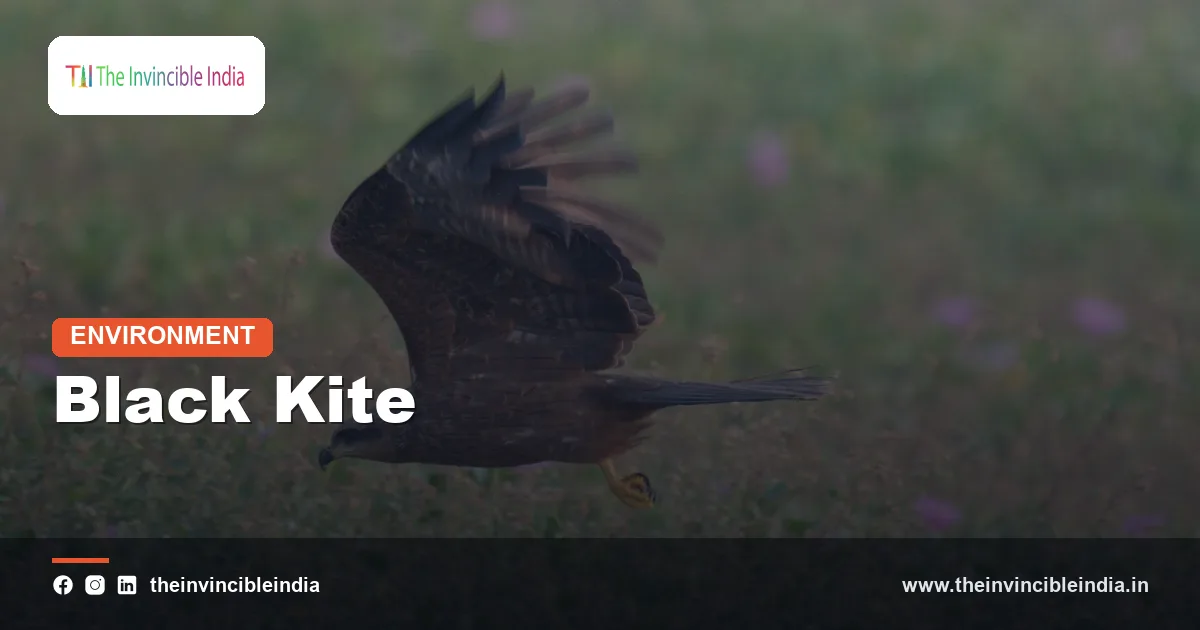
The black kite (Milvus migrans) is a medium-sized, dark-brown bird of prey with a gently forked tail that soars on rising air in large numbers over Indian cities, villages and wetlands while scavenging for food. Known in Hindi as “cheel”, it is one of the most abundant raptors in the world and certainly one of the most visible in India, where it thrives on the food that human settlements generate.
This guide explains what the black kite looks like, how it flies, what it eats, why it does so well in cities, how it breeds, how it differs from other raptors, and what role it plays in cleaning up waste. Last updated: 23 October 2026.
| Attribute | Detail |
|---|---|
| Common name | Black kite (Hindi: cheel) |
| Scientific name | Milvus migrans |
| Family | Accipitridae (hawks, eagles, kites and relatives) |
| Indian resident form | The subspecies govinda, often called the pariah kite |
| Typical body length | Roughly 55 to 60 cm, with a wingspan of around 1.4 to 1.6 m |
| Key feature | Shallowly forked tail and long, angled wings |
| Main habitat | Cities, towns, villages, rivers, lakes, coasts and garbage dumps |
| Diet | Carrion, scraps, small animals, fish, insects and stolen food |
| IUCN status | Least Concern |
Key Takeaways
- The black kite (Milvus migrans) is a medium-sized raptor, roughly 55 to 60 cm long, with a shallowly forked tail and a wingspan of about one and a half metres.
- The black kite is among the most numerous and widespread birds of prey in the world, and it is a common sight over almost every Indian city.
- The black kite is mainly a scavenger, eating dead animals, food waste and scraps, and it also hunts small animals and steals food from other birds.
- The black kite saves energy by soaring on thermals (rising columns of warm air) and steering with its tail, which acts like a rudder.
- The black kite builds a stick nest in a tree, often lined with rags and scraps of human waste, and in northern India it breeds mostly in the cooler months.
- The black kite is classified as Least Concern by the International Union for Conservation of Nature (IUCN), but it faces hazards in India from kite-flying string, pollution and poisoned carcasses.
What is the black kite?
The black kite is a medium-sized bird of prey in the family Accipitridae, the same family that includes hawks, eagles and Old World vultures. Its scientific name is Milvus migrans, and the species occurs across Europe, Africa, Asia and Australasia.
Despite its name, the black kite is more brown than black. The name is a historical one that separates it from the red kite, a related species of Europe with a more rufous colour and a deeper tail fork. Several regional forms of the black kite are recognised, and some of these are now treated by many experts as separate species.
The form resident in most of India is the subspecies Milvus migrans govinda, often known as the pariah kite or Indian black kite. It is largely non-migratory, unlike the black kites of northern Europe and Siberia, which travel long distances to warmer regions each winter. Another form, the black-eared kite, visits northern India and the Himalayan foothills in winter.
What does the black kite look like?
The black kite looks like a dark brown raptor with long, angled wings, a pale head and a tail that is slightly forked at the tip. Seen from below, it has pale patches near the wing tips and a streaked, rusty-brown underside.
Body and colour
Adult black kites of the Indian form are mostly dull brown above and slightly paler below, with fine dark streaks on the head and chest. The head often appears paler than the body. The bill is dark with a yellow base, and the legs and feet are yellow with strong black talons. Young birds have buff streaks and pale tips on their feathers, which makes them look spotted.
The forked tail
The shallow fork in the tail is the most reliable identification feature, especially when the bird is seen in flight from below. The tail appears distinctly notched when the bird is soaring, though when the bird spreads its tail fully during turns, the fork can almost disappear. This is why careful observers watch several moments of flight before deciding.
Size compared with other raptors
The black kite is bigger than a crow but smaller than most eagles and vultures. In a mixed flock of soaring birds over an Indian city, the black kite is often the most numerous raptor and is recognisable by its steady, effortless glide.
How does the black kite fly?
The black kite flies mainly by soaring on thermals, circling upward on columns of warm rising air with its wings held out and its tail twisting to steer, which allows it to travel and search for food using very little energy. Large numbers often gather in the same thermal and circle together, forming spiralling groups over cities, rubbish dumps and rivers.
Several features help the bird fly this way:
- Long, broad wings with fingered tips, which provide lift at low speeds.
- A constantly twisting tail that works as a rudder and brake.
- Keen eyesight, which lets it spot food from a great height.
- The ability to drop quickly in a steep glide to pick up food from the ground or water surface.
The black kite seldom flaps for long. When it does need to climb or manoeuvre, it uses a few quick wingbeats, then goes back to gliding. Its flight is graceful and buoyant, and this makes it easy to pick out from heavier raptors such as eagles and vultures.
What does the black kite eat?
The black kite eats whatever it can find, and it is mainly a scavenger that feeds on dead animals, kitchen and market waste, and scraps, although it also catches live prey such as fish, small birds, rodents, lizards and large insects. This opportunism is the main reason the species is so successful around people.
Common food sources in India include:
- Meat scraps and offal around butcher shops, fish markets and slaughterhouses.
- Carcasses of dead animals on roads, fields and riverbanks.
- Food waste in dumps, street stalls and open bins.
- Fish at lakes, reservoirs and harbours, taken from the surface of the water.
- Insects such as termites and locusts, especially when they emerge in large numbers.
The black kite is also known for swooping down to snatch food from the hands of people, particularly in crowded places where food is carried in the open. This behaviour has made the bird a familiar, and sometimes unwelcome, presence at picnic spots, temple complexes and markets.
What is kleptoparasitism and does the black kite do it?
Kleptoparasitism is the habit of stealing food that another animal has caught or collected, and yes, the black kite does it regularly. Black kites harass other birds, such as gulls, crows, egrets and smaller raptors, and force them to drop their meal, which the kite then catches or picks up.
This behaviour is a low-effort way of feeding. Rather than finding and killing prey, the black kite waits for another bird to do the hard work. In some places, it follows fishing birds and fishermen’s boats for the same reason.
Black kites also steal from each other and from humans. In crowded colonies at roosts or dumps, they dive at birds that have picked up large scraps. Competition for food is intense, which is why groups of black kites often squabble noisily in the air.
Why is the black kite so successful in Indian cities?
The black kite is so successful in Indian cities because cities provide plenty of waste food, tall roosting trees and buildings, and thermals rising from warm surfaces, all of which suit its scavenging, soaring way of life. Mumbai, Delhi and many other Indian cities support large populations of the species.
Several factors explain this success:
- Abundant food from open waste, meat markets and street food.
- Tall trees, buildings and towers that provide safe roosts and nest sites.
- Strong thermals over concrete and paved surfaces that make soaring easy.
- Tolerance of people and noise, together with traditions in some places of offering meat to the birds.
In several north Indian cities, there is a long-standing custom of throwing pieces of meat to kites as an act of charity or merit, which attracts large flocks. At the same time, the bird’s abundance can create problems, including bird strikes with aircraft near airports, which is why the species is frequently mentioned in aviation safety discussions.
How does the black kite breed?
The black kite breeds by building a large, untidy platform of sticks in a tree or on a structure, and in much of India nesting takes place mostly in the cooler, drier months, roughly from late winter into spring. Timing varies by region, and some pairs nest at other times of year.
Nests
The nest is made of sticks and twigs and is often lined with rags, plastic, string and other scraps collected from human surroundings. It is placed in the fork of a tall tree or on a ledge of a building. Pairs often reuse and enlarge their nests from year to year.
Eggs and young
The female usually lays two or three eggs, which are whitish with brown markings. Both parents feed and guard the young, which are fledged after several weeks. After leaving the nest, the young birds depend on their parents for some time while they learn to hunt and scavenge. Many young birds do not survive their first year, which is a normal pattern for large raptors.
The black kite often roosts communally, and hundreds of birds can gather in the same trees in the evening, especially in cities and near water.
How can you tell a black kite from other raptors?
A black kite can be told from other raptors by its brown plumage, slightly forked tail, buoyant soaring flight and its habit of gliding in groups over towns and dumps. The table below compares it with other birds of prey commonly seen over Indian cities.
| Bird | Size | Tail shape | Behaviour |
|---|---|---|---|
| Black kite | Medium | Shallow fork | Soars in groups over cities; scavenges and steals food |
| Brahminy kite | Slightly smaller | Rounded | Chestnut body and white head and breast; associated with water |
| Shikra | Small | Square, barred | Fast hunter of small birds and lizards in gardens |
| Eagles and buzzards | Medium to large | Fan-shaped | Heavier build; flies with stiffer wingbeats |
| Vultures | Large | Short and wedge-like | Bare heads; circle high over carcasses |
The best tip is to look for the long, slightly bent wings and the notched tail. Together they give the black kite a distinct silhouette, even when the bird is far away.
What role does the black kite play in cleaning up waste?
The black kite plays a role as a scavenger that removes carcasses and organic waste from the environment, and in doing so it helps reduce the spread of rotting material in towns and countryside. This service is especially noticeable in places where other scavengers, such as vultures, have become rare.
Indian vultures declined sharply from the 1990s, largely because of the veterinary drug diclofenac, which poisoned birds that fed on treated livestock carcasses. With fewer vultures available, other scavengers, including kites, crows and dogs, took on more of the work, though they cannot fully replace vultures in handling large carcasses.
The role is not without drawbacks. Scavenging birds can pick up pathogens and pollutants, and the large concentrations of birds at rubbish dumps can pose safety hazards. Even so, kites remain a visible part of the informal waste-recycling system of Indian cities.
Is the black kite under threat in India?
The black kite is not globally threatened; the IUCN lists it as Least Concern because it is widespread and numerous. Even so, individual birds face real dangers in India, and local populations can change over time.
The main hazards include:
- Injury and death from glass-coated or synthetic kite-flying string, particularly during festivals when many kites fill the sky.
- Collisions with wires, vehicles and aircraft.
- Poisoning from contaminated carcasses and polluted waste.
- Ingestion of plastic mixed with food waste.
- Loss of large trees used for roosting and nesting.
The black kite is a protected wild bird under the Wildlife (Protection) Act, 1972. Wildlife rescue groups and bird hospitals in several cities treat injured kites each year, particularly in the weeks around kite-flying festivals.
Bottom Line
The black kite is a graceful, adaptable scavenger that has turned Indian cities into home ground. It soars effortlessly, eats almost anything, and quietly clears up a share of the waste that people leave behind, while still facing dangers that come from the same human environment it relies on.
Frequently Asked Questions
What is a black kite?
A black kite is a medium-sized bird of prey, scientifically named Milvus migrans, with brown plumage and a shallowly forked tail. It soars over towns, villages and wetlands across India, where it is known in Hindi as cheel. It mainly scavenges for food.
Why are there so many black kites in Indian cities?
There are many black kites in Indian cities because cities offer abundant food waste, tall roost trees and buildings, and strong rising air for soaring. The birds also tolerate people and noise. In some places, offering meat to kites has further concentrated them.
What does the black kite eat?
The black kite eats carrion, food scraps, fish, small birds, rodents, lizards and insects. It is mainly a scavenger but will catch live prey and steal food from other birds. It sometimes snatches food directly from people in crowded places.
How can I identify a black kite in flight?
You can identify a black kite in flight by its long, angled wings, brown body and shallowly forked tail, which it twists constantly while soaring. It usually glides in circles with little flapping. Pale patches near the wing tips are also visible from below.
Is the black kite a vulture?
No, the black kite is not a vulture, although both belong to the same bird-of-prey family, Accipitridae. Vultures are larger, have bare or sparsely feathered heads and broader wings, while the black kite is smaller and has a fully feathered head and a forked tail.
Is the black kite protected in India?
Yes, the black kite is protected as a wild bird under India’s Wildlife (Protection) Act, 1972. It is classified as Least Concern by the IUCN because it is common, but individual birds are often injured by kite-flying string and other hazards.
{“@context”:”https://schema.org”,”@graph”:[{“@type”:”FAQPage”,”mainEntity”:[{“@type”:”Question”,”name”:”What is a black kite?”,”acceptedAnswer”:{“@type”:”Answer”,”text”:”A black kite is a medium-sized bird of prey, scientifically named Milvus migrans, with brown plumage and a shallowly forked tail. It soars over towns, villages and wetlands across India, where it is known in Hindi as cheel. It mainly scavenges for food.”}},{“@type”:”Question”,”name”:”Why are there so many black kites in Indian cities?”,”acceptedAnswer”:{“@type”:”Answer”,”text”:”There are many black kites in Indian cities because cities offer abundant food waste, tall roost trees and buildings, and strong rising air for soaring. The birds also tolerate people and noise. In some places, offering meat to kites has further concentrated them.”}},{“@type”:”Question”,”name”:”What does the black kite eat?”,”acceptedAnswer”:{“@type”:”Answer”,”text”:”The black kite eats carrion, food scraps, fish, small birds, rodents, lizards and insects. It is mainly a scavenger but will catch live prey and steal food from other birds. It sometimes snatches food directly from people in crowded places.”}},{“@type”:”Question”,”name”:”How can I identify a black kite in flight?”,”acceptedAnswer”:{“@type”:”Answer”,”text”:”You can identify a black kite in flight by its long, angled wings, brown body and shallowly forked tail, which it twists constantly while soaring. It usually glides in circles with little flapping. Pale patches near the wing tips are also visible from below.”}},{“@type”:”Question”,”name”:”Is the black kite a vulture?”,”acceptedAnswer”:{“@type”:”Answer”,”text”:”No, the black kite is not a vulture, although both belong to the same bird-of-prey family, Accipitridae. Vultures are larger, have bare or sparsely feathered heads and broader wings, while the black kite is smaller and has a fully feathered head and a forked tail.”}},{“@type”:”Question”,”name”:”Is the black kite protected in India?”,”acceptedAnswer”:{“@type”:”Answer”,”text”:”Yes, the black kite is protected as a wild bird under India’s Wildlife (Protection) Act, 1972. It is classified as Least Concern by the IUCN because it is common, but individual birds are often injured by kite-flying string and other hazards.”}}]}]}


