

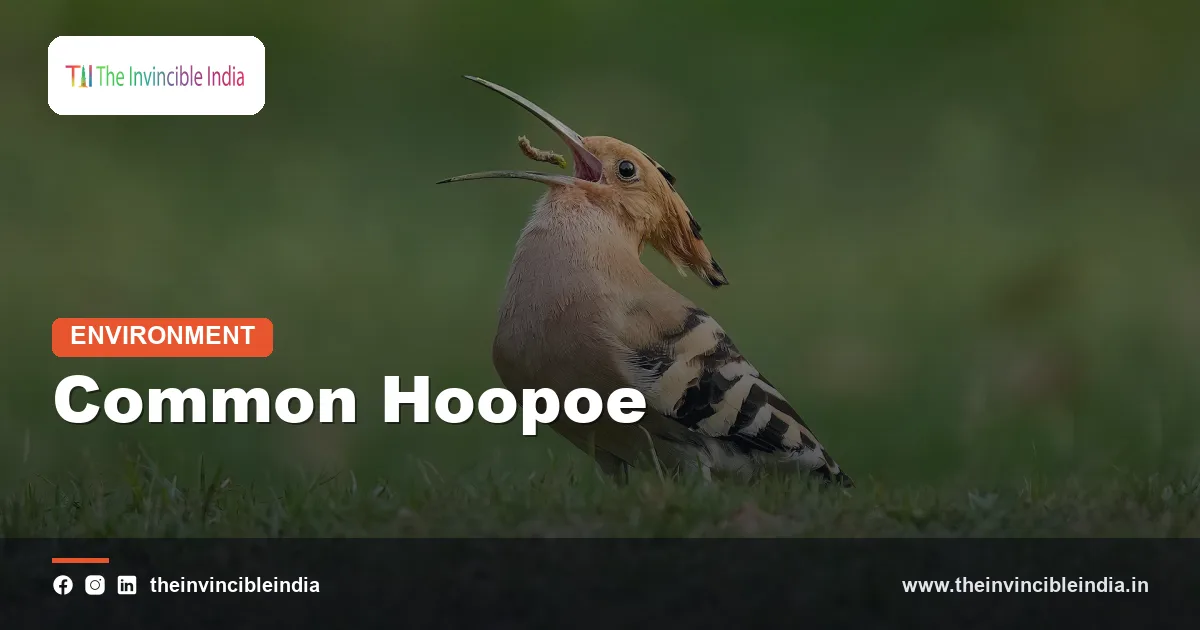
The common hoopoe (Upupa epops) is a medium-sized, cinnamon-orange bird with a long, fan-like crest tipped in black, bold black-and-white striped wings and a slender, down-curved bill, and it is a familiar resident and winter visitor on lawns, farmland and village edges across India. The common hoopoe spends much of its day walking on open ground and probing the soil for insects and grubs, and it is recognisable at a glance when it lifts its crest or takes off in a looping, butterfly-like flight.
This guide explains how to identify the common hoopoe, where it lives in India, what it eats, how it nests, what its name means and why it features so strongly in folklore and sacred literature. It is written for beginners, students and general readers.
| Attribute | Detail |
|---|---|
| Common name | Common hoopoe (also called Eurasian hoopoe) |
| Scientific name | Upupa epops |
| Family | Upupidae, the only family of hoopoes |
| Body length | About 25 to 32 centimetres, including the bill |
| Distinctive features | Orange-pink body, black-tipped erectile crest, black-and-white barred wings and back, long curved bill |
| Typical diet | Insects, larvae, grubs, mole crickets, earthworms and occasionally small reptiles |
| Nest type | Natural or artificial cavity in a tree, wall, rock crevice or building |
| Conservation status | Least Concern on the IUCN Red List |
| Range | Europe, Asia and parts of Africa; resident and migrant in India |
Key Takeaways
- The common hoopoe (Upupa epops) is easily recognised in India by its orange-pink body, black-tipped crest, striped black-and-white wings and long, curved bill.
- The common hoopoe feeds mainly on the ground, where it probes soil and leaf litter for insects, larvae and grubs.
- The common hoopoe nests in cavities such as holes in trees, walls, rocks and buildings, and the nest becomes notably foul-smelling during the breeding season.
- The common hoopoe is listed as Least Concern by the IUCN, although local populations vary and are often affected by pesticides and the loss of old nesting trees.
- The common hoopoe is called hudhud in Hindi and Urdu, a name that imitates its soft three-note call.
- The common hoopoe appears in Persian, Islamic and ancient Egyptian traditions, and it is the national bird of Israel.
What is the common hoopoe?
The common hoopoe is a ground-feeding bird belonging to the family Upupidae, and it is the best-known member of the hoopoes, a group whose scientific name for the common species is Upupa epops. The word hoopoe itself imitates the bird’s soft, repeated call, and many languages around the world use a similar-sounding name.
Scientists once grouped the hoopoe with the rollers, bee-eaters and kingfishers because of its colourful plumage and its habit of nesting in holes. Modern classification places the family Upupidae in the order Bucerotiformes, where its closest relatives include the hornbills and the wood hoopoes of Africa. This may seem surprising, but the long, curved bill and the cavity-nesting habit are features that these groups share.
Taxonomists have divided the hoopoe in different ways over the years. Some authorities recognise a single widespread species with several subspecies, while others split off separate African and Madagascan species. Birds seen in India are generally treated as part of the Eurasian group, and some are assigned to a subspecies called longirostris, but opinions on exact subspecies boundaries differ.
How can you identify a common hoopoe?
A common hoopoe can be identified by its pinkish-orange head, neck and breast, its long crest of feathers tipped in black, its zebra-striped black-and-white wings and back, and its slim, curved, pointed bill. No other common Indian bird combines these features, so identification is rarely difficult.
The crest is the most striking part of the bird. It usually lies flat along the back of the head, giving a swept-back look, and it is raised in a fan when the bird is excited, alarmed or has just landed. The black tips of the crest feathers form a bold outline, and the raised crest can look like a small headdress.
Key field marks
- Crest: orange-buff feathers with black tips and, in many birds, a thin white band below the black.
- Wings and back: broad black and white bars, very visible in flight.
- Tail: black with a broad white band across the middle.
- Bill: long, thin and gently curved downward, dark at the tip and paler at the base.
- Underparts: pinkish-buff to sandy, with faint dark streaks on the belly and flanks.
Males and females look very similar, and juveniles resemble adults but have a shorter bill and duller colour. In flight, the hoopoe’s broad, rounded wings and striped pattern produce a deeply undulating, floppy motion that is often compared with a large butterfly.
Where is the common hoopoe found in India?
The common hoopoe is found across most of India as a resident bird and as a winter visitor, and it is seen from the plains and farmlands of the north to the peninsula, with fewer records in dense forest and at very high altitudes. Some Indian birds are year-round residents, while others arrive from further north each winter, so numbers in many regions rise between about October and March.
The bird prefers open country with short vegetation and some bare ground. Typical places to see a common hoopoe include:
- Lawns, gardens, parks and university campuses.
- Farm fields, fallow land, orchards and the edges of crops.
- Village outskirts, grazing land and open scrub.
- Temple compounds, ruins and old forts with walls that offer nest holes.
- Dry, open woodland, riverbanks and the edges of roads.
Beyond India, the common hoopoe breeds across much of Europe and temperate Asia and winters in warmer parts of Asia and Africa. Many European birds make long migrations south, which means that a hoopoe seen in winter in northern India may have come from much farther away. The exact movements of different populations are not fully understood, so any statement about numbers should be treated as approximate.
What does the common hoopoe eat?
The common hoopoe eats mostly insects and other invertebrates, including beetle grubs, caterpillars, pupae, ants, termites, crickets, mole crickets and earthworms, and it occasionally takes small lizards and snails. It is therefore generally regarded as a beneficial bird for farmers and gardeners.
Prey is found by walking steadily across open ground, tilting the head and pushing the bill into the soil or beneath dry leaves and cow dung. The hoopoe often opens its bill inside the soil to widen a hole and expose hidden prey, a technique sometimes called gaping. Once a larva or insect is grasped, the bird usually tosses it into the air and catches it with a quick jerk before swallowing.
Why is the long bill useful?
The common hoopoe’s long, slender bill is an adaptation for reaching deep into soft ground, rotten wood and crevices where other birds cannot reach. The bill works like a pair of forceps, able to pick up small items precisely and to open slightly while still buried. The strong muscles that open the bill allow the bird to pry open the soil.
The hoopoe also catches insects in the open, snapping at flying prey or hopping after beetles that are exposed by ploughing. After rain, when earthworms and grubs come closer to the surface, hoopoes are particularly active on wet lawns and freshly tilled fields.
How does the common hoopoe fly and behave?
The common hoopoe flies with slow, deep wingbeats and pauses between them, creating an undulating, butterfly-like flight, and on the ground it walks or runs with short, quick steps while bobbing its head. This unhurried manner makes it easy to watch.
Several habits are typical of the species:
- Dust-bathing: hoopoes often settle in dry soil, fluff their feathers and wriggle to clean and cool themselves.
- Sunbathing: the bird sometimes spreads its wings and tail flat on the ground with the bill pointed upward, a posture thought to help with feather care and parasite control.
- Crest display: the crest rises when the bird lands, calls or senses danger, and then relaxes slowly.
- Alarm response: when a bird of prey appears, a hoopoe may freeze flat on the ground with wings spread, using its camouflage to avoid detection.
The call is a low, soft, repeated sound, usually in a series of two or three notes such as oop-oop-oop. It carries well on a still morning and is given mainly in the breeding season by males advertising their territory. The sound is the source of the bird’s common name and of its Hindi and Urdu name, hudhud.
How does the common hoopoe nest?
The common hoopoe nests in natural or man-made cavities such as holes in trees, gaps in old walls, rock crevices, termite mounds, nest boxes and spaces in buildings, and the female lays a clutch of several whitish to pale grey-blue eggs on a bed of loose material or on bare debris. The hoopoe does not usually dig its own hole, so the supply of suitable cavities matters.
In India, breeding often takes place in the warmer months, but timing varies with region and rainfall. A typical sequence is:
- The male chooses a cavity and calls from nearby to attract a female.
- The female lays several eggs, with the exact number varying between regions, commonly in the range of about four to eight.
- The female incubates alone for roughly two to three weeks, and the male brings food to her.
- After hatching, the female stays with the chicks at first, and both parents later feed the young until they leave the nest after about three to four weeks.
Why does a hoopoe nest smell bad?
A hoopoe nest smells bad because the female and the nestlings produce a dark, oily, foul-smelling secretion from the preen gland near the tail, and the nest also gathers droppings and food waste. This secretion is thought to deter predators and may help protect the eggs and chicks against bacteria. The smell is strongest during incubation and while the young are in the nest, and it fades once the family has left.
Is the common hoopoe threatened?
The common hoopoe is not globally threatened and is classified as Least Concern by the International Union for Conservation of Nature (IUCN), because it has a very large range and a large overall population. Population trends vary between regions, and in some parts of its range numbers have declined, so the status of local populations should be treated with caution.
The main pressures on hoopoes include:
- Pesticides and insecticides that reduce insect prey and may poison birds that feed on contaminated soil.
- Loss of old trees, mud walls and traditional buildings that provide nest holes.
- Intensive farming that removes grassy margins, hedgerows and bare patches used for feeding.
- Habitat change, including the paving of open ground and the conversion of lawns to hard surfaces.
- Hunting and capture in some parts of the world, though these are illegal in India.
In India the hoopoe is a native wild bird covered by the Wildlife (Protection) Act, 1972, and capturing, harming or keeping one without permission is an offence. Simple measures such as leaving old trees standing, avoiding unnecessary pesticide use and keeping some open lawn can help the species.
How is the common hoopoe different from similar Indian birds?
The common hoopoe is different from similar-looking Indian birds because of its crest, curved bill and ground-probing feeding style. The table below compares it with a few birds that are sometimes mistaken for it or that share its open-ground habits.
| Bird | Approximate size | Key feature | Feeding style |
|---|---|---|---|
| Common hoopoe | 25 to 32 cm | Orange body, black-tipped crest, striped wings, curved bill | Probes soil for grubs and insects |
| Indian roller | About 30 cm | Blue wings, brown back, no crest | Perch-hunts large insects and lizards |
| Common myna | About 23 cm | Brown body, yellow bill and eye patch | Walks and forages for insects and fruit |
| Eurasian wryneck | About 16 to 17 cm | Grey-brown barred plumage, short bill | Eats ants from the ground and bark |
| Rufous treepie | About 46 cm | Long tail, rufous body, grey head | Omnivorous, feeds in trees and on the ground |
The common hoopoe is the only one of these birds with a true crest and a long, curved bill. These features make it unmistakable even at a distance, and its flight pattern is a further clue.
Why is the common hoopoe famous in folklore and culture?
The common hoopoe is famous in folklore because it features in ancient Egyptian art, in Greek myth and drama, in Islamic tradition and in medieval Persian poetry, where it often acts as a wise messenger or guide. Its crest, striking looks and unusual habits made it an easy subject for storytellers.
- Persian literature: in the 12th-century poem The Conference of the Birds by Farid ud-Din Attar, the hoopoe leads the other birds on a journey to find their king, the Simurgh. The story is allegorical and is a classic of Sufi writing.
- Islamic tradition: the Quran describes a hoopoe, called hudhud, that brings news to the prophet Sulayman (Solomon) about the Queen of Sheba. In South Asia the bird is sometimes called Murgh-e-Sulaiman, which means Solomon’s bird.
- Ancient Egypt and Greece: the hoopoe appears in Egyptian hieroglyphs and tomb art, and Aristophanes’ comedy The Birds features a character derived from the myth of Tereus, who was transformed into a hoopoe.
- Modern symbolism: the hoopoe was chosen as the national bird of Israel in 2008 through a public vote.
The name hudhud also appears in Indian news. Cyclone Hudhud, which struck the east coast of India in October 2014, was named by Oman, a country in the region that contributes names to the cyclone list. The name links the storm to the same bird.
Where and how can you watch common hoopoes?
You can watch common hoopoes by walking slowly across short grass, farmland edges or garden lawns in the early morning, because the bird is usually visible on open ground and tolerates people at a moderate distance. Patience matters more than equipment.
Helpful tips include:
- Look for a flicker of orange and a bobbing, walking bird rather than a perched one.
- Stay still when a hoopoe approaches, since sudden movements will cause it to fly off in its undulating flight.
- Keep away from known nest holes, and never poke into a cavity to check.
- Avoid using playback calls during the breeding season, as repeated calls can stress the birds.
- Record sightings on a citizen-science platform such as eBird to support long-term monitoring.
Winter is often a particularly good season in northern India, when resident birds are joined by visitors from farther north.
Bottom Line
The common hoopoe (Upupa epops) is a distinctive, crested, ground-probing bird that lives across India as a resident and winter visitor. Its looks, soft call, foul-smelling nests and place in myth make it one of the most memorable birds a beginner can learn to recognise.
Frequently Asked Questions
What is the Hindi name of the common hoopoe?
The Hindi and Urdu name of the common hoopoe is hudhud. The name imitates the bird’s soft, repeated call, and it is also the name of the hoopoe in the Quran and in much Persian poetry.
What does a common hoopoe eat?
A common hoopoe eats mostly insects and other small invertebrates found in or near the soil. Typical foods include beetle grubs, caterpillars, ants, mole crickets and earthworms, and the bird sometimes takes small lizards.
Why does the hoopoe have a crest?
The hoopoe has a crest of feathers that it raises in excitement, alarm or display. The crest helps in communication between birds, and the black-tipped, fan-like shape is thought to play a role in courtship and in startling rivals or predators.
Is the common hoopoe a migratory bird in India?
The common hoopoe is both a resident and a winter visitor in India. Some birds stay in the same region all year, while others arrive from farther north in the colder months, so numbers are often higher between roughly October and March.
Why does a hoopoe nest smell bad?
A hoopoe nest smells bad because the female and chicks release a dark, oily secretion from the preen gland, and the nest also collects droppings and food waste. The smell is thought to deter predators and may help protect the eggs and young from microbes.
Is the hoopoe the national bird of India?
No, the hoopoe is not the national bird of India, which is the Indian peafowl. The common hoopoe is, however, the national bird of Israel, and it is a widely loved bird in India.
{“@context”:”https://schema.org”,”@graph”:[{“@type”:”FAQPage”,”mainEntity”:[{“@type”:”Question”,”name”:”What is the Hindi name of the common hoopoe?”,”acceptedAnswer”:{“@type”:”Answer”,”text”:”The Hindi and Urdu name of the common hoopoe is hudhud. The name imitates the bird’s soft, repeated call, and it is also the name of the hoopoe in the Quran and in much Persian poetry.”}},{“@type”:”Question”,”name”:”What does a common hoopoe eat?”,”acceptedAnswer”:{“@type”:”Answer”,”text”:”A common hoopoe eats mostly insects and other small invertebrates found in or near the soil. Typical foods include beetle grubs, caterpillars, ants, mole crickets and earthworms, and the bird sometimes takes small lizards.”}},{“@type”:”Question”,”name”:”Why does the hoopoe have a crest?”,”acceptedAnswer”:{“@type”:”Answer”,”text”:”The hoopoe has a crest of feathers that it raises in excitement, alarm or display. The crest helps in communication between birds, and the black-tipped, fan-like shape is thought to play a role in courtship and in startling rivals or predators.”}},{“@type”:”Question”,”name”:”Is the common hoopoe a migratory bird in India?”,”acceptedAnswer”:{“@type”:”Answer”,”text”:”The common hoopoe is both a resident and a winter visitor in India. Some birds stay in the same region all year, while others arrive from farther north in the colder months, so numbers are often higher between roughly October and March.”}},{“@type”:”Question”,”name”:”Why does a hoopoe nest smell bad?”,”acceptedAnswer”:{“@type”:”Answer”,”text”:”A hoopoe nest smells bad because the female and chicks release a dark, oily secretion from the preen gland, and the nest also collects droppings and food waste. The smell is thought to deter predators and may help protect the eggs and young from microbes.”}},{“@type”:”Question”,”name”:”Is the hoopoe the national bird of India?”,”acceptedAnswer”:{“@type”:”Answer”,”text”:”No, the hoopoe is not the national bird of India, which is the Indian peafowl. The common hoopoe is, however, the national bird of Israel, and it is a widely loved bird in India.”}}]}]}


