

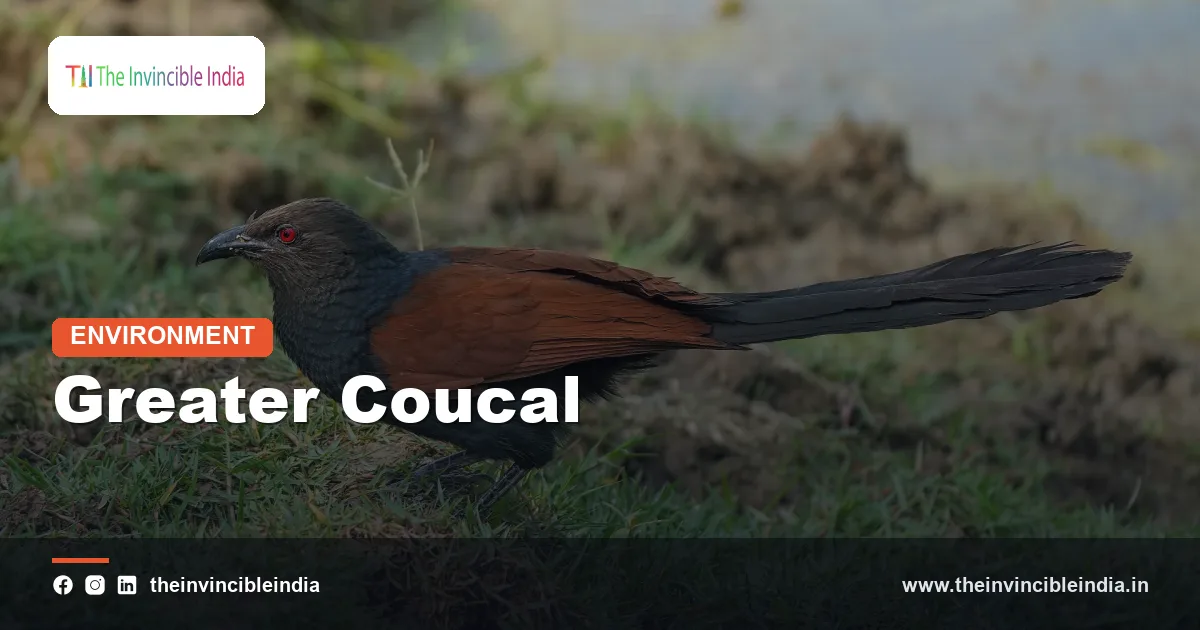
The greater coucal (Centropus sinensis) is a large, crow-sized, non-parasitic member of the cuckoo family, easily recognised in India by its glossy black body, chestnut-brown wings, long broad tail and ruby-red eyes. The greater coucal is widely known as the “crow pheasant” because it combines a crow-like black form with a pheasant-like habit of walking and running through undergrowth, and it is one of the most familiar large birds of Indian scrub, farmland edges and village groves.
Unlike the cuckoos that lay eggs in other birds’ nests, the greater coucal builds its own nest and raises its own young. Its deep, hollow “coop-coop-coop” call, heard at dawn, dusk and during the monsoon, has given it a place in rural folklore across the subcontinent. This guide explains the bird’s appearance, voice, range, diet, breeding and cultural associations, using stable and well-documented facts.
Quick Facts: Greater Coucal
| Common name | Greater coucal (also crow pheasant) |
|---|---|
| Scientific name | Centropus sinensis |
| Family | Cuculidae (cuckoos), subfamily Centropodinae (coucals) |
| Size | Roughly 48 cm long, with a long, graduated tail |
| Plumage | Glossy black head, body and tail; rich chestnut wings and wing coverts |
| Eyes | Ruby-red in adults; brownish in young birds |
| Breeding habit | Builds its own nest; not a brood parasite |
| Range | South Asia and parts of South-East Asia and southern China |
| Conservation status | Least Concern on the IUCN Red List |
Key Takeaways
- The greater coucal (Centropus sinensis) is a large, crow-sized bird of the cuckoo family that is easily identified by its black body, chestnut wings and red eyes.
- The greater coucal is called the “crow pheasant” because it looks crow-like in colour but walks and runs through thickets in the manner of a pheasant.
- Unlike many cuckoos, the greater coucal is not a brood parasite and builds its own domed nest of twigs, grass and leaves.
- The greater coucal is an omnivorous ground and thicket forager that eats insects, snails, lizards, small snakes, frogs, eggs and nestlings, and some fruit.
- The greater coucal is classed as Least Concern by the IUCN because it is widespread and adapts well to scrub, farmland edges, gardens and mangroves.
- In many Indian regions, the greater coucal is regarded as an auspicious bird, and its low booming call is woven into rural weather lore and folk belief.
What does the greater coucal look like?
The greater coucal is a heavily built, long-tailed bird about 48 cm in length, with a glossy black head, neck, body and tail and strikingly rich chestnut-brown wings. The contrast between the dark body and the rufous wings is the quickest field mark, and it is visible even at a distance when the bird scrambles up through a bush or flaps from one thicket to another.
The eye of an adult greater coucal is a vivid ruby-red, which gives the bird a fierce, alert look. Young birds are less glossy and often have dark barring on the tail and wings, along with brownish eyes that darken to red as they mature. Males and females look alike, although females tend to be a little larger.
The bill is stout and black, the legs are strong and the tail is long, broad and rounded at the tip. In flight the greater coucal looks heavy and laboured. It beats its wings a few times, then glides on a short, shallow arc into cover. It is not a strong or sustained flier, and it much prefers to climb, hop and run through vegetation.
Behaviour when sunning
On cool mornings, and often after rain, the greater coucal perches on top of a bush or fence post with its wings and back opened to the sun. This sunbathing behaviour is commonly seen and is thought to help the bird dry its plumage and warm up. A coucal found in this posture is usually quite approachable for a few minutes.
Why is the greater coucal called the crow pheasant?
The greater coucal is called the “crow pheasant” because early observers saw a bird of crow-like size and colour that behaved like a ground-living pheasant. It spends much of its time walking, hopping and running through undergrowth with its long tail trailing behind, and it flies reluctantly and low.
The name is a descriptive nickname and has no biological meaning. The greater coucal is neither a crow, which belongs to the corvid family, nor a pheasant, which belongs to the game-bird order. It is a cuckoo relative, and the term “crow pheasant” persists mainly in older Indian field guides and in everyday speech.
Regional names are plentiful and vary by language. In Hindi-speaking areas the bird is often called mahoka or, in some usages, bharadwaj. In Tamil it is known as sembothu, and in Malayalam as chemboth. Many of these names point to the bird’s reddish-brown wings, to its call, or to its supposed auspicious character.
What does the greater coucal’s call sound like?
The greater coucal’s call is a series of deep, hollow, resonant “coop-coop-coop” or “boop-boop” notes that usually start slowly, speed up and then drop in pitch toward the end. The sound is low enough to carry across fields and scrub, and it often comes from a hidden bird deep inside a thicket.
The call is heard most often in the early morning and late evening, and it becomes especially frequent during the breeding season, which in much of India overlaps with the monsoon. Birds frequently call back and forth, sometimes in a duet, from different parts of the same patch of cover.
Besides the main booming call, the greater coucal gives harsher, rattling or chuckling notes when alarmed. Because the booming call is easy to recognise and the bird itself is secretive, many people in India know the sound long before they have clearly seen the bird that makes it.
Where does the greater coucal live in India?
The greater coucal lives across most of India, from the foothills of the Himalaya to the southern tip of the peninsula, in habitats with dense low cover. The species is found throughout South Asia, including Sri Lanka, and extends east into South-East Asia and southern China, with several regional forms described by ornithologists.
Typical Indian habitats include:
- Scrub jungle and forest edges, where thick bushes give cover and nesting sites.
- Tall grass, sugarcane and reed beds in farmland and wetlands.
- Village groves, hedgerows, gardens and bamboo clumps.
- Mangroves and coastal thickets in parts of the east and west coasts.
The greater coucal avoids open, treeless ground and very dry deserts, and it generally stays in or near cover. It is mostly resident, meaning that birds stay in the same area through the year, though individuals may move locally in response to food and water. It is common enough that many Indians encounter it in suburban gardens, particularly where overgrown corners are left undisturbed.
What does the greater coucal eat?
The greater coucal eats a wide range of animal food, including large insects, caterpillars, snails, crabs, frogs, lizards, small snakes, rodents, bird eggs and nestlings, and it also takes some fruit and seeds. This broad, opportunistic diet is one reason the bird has done well in changing landscapes.
The bird forages mainly on the ground and low in vegetation. It walks slowly with its head cocked, turns over leaf litter, probes in grass and pounces on prey, often after climbing a few branches to scan the area. It is also known to raid the nests of smaller birds, which makes it unpopular with some birdwatchers, although this is natural predator behaviour.
Role in farmland
Because grasshoppers, locusts and caterpillars form a large part of its diet, the greater coucal is generally regarded as beneficial in agricultural areas. It does not damage crops in any meaningful way and it removes a number of insect pests along field margins and in sugarcane.
How does the greater coucal breed and nest?
The greater coucal breeds by building a large, untidy, domed nest of twigs, leaves and grass with a side entrance, usually hidden low in dense bushes, bamboo, thorny scrub or tall grass. Unlike the common cuckoo, the pair raises its own young and does not lay eggs in the nests of other species.
The breeding season in India varies by region, but it commonly coincides with the monsoon, when cover is thick and insect food is abundant. The female lays a clutch of a few chalky white eggs, and the male is reported to do most of the incubation. The eggs hatch after roughly two weeks.
The chicks are fed by both parents and tend to leave the nest before they can fly well. They clamber through branches and stems, a habit that helps them escape predators. Juveniles can be spotted by their barred tails, duller plumage and brown eyes, and they stay near the adults for a while after fledging.
Is the greater coucal a brood parasite like other cuckoos?
The greater coucal is not a brood parasite; it is one of the non-parasitic cuckoos and raises its own chicks. Most people associate the cuckoo family with the Asian koel, which famously lays its eggs in crows’ nests, so the coucal’s habits are often a surprise.
Across the cuckoo family, only a portion of species are brood parasites. The coucals, along with several ground cuckoos and malkohas, are among those that build nests and care for their young. The pairing of a cuckoo skeleton with a crow-like way of life makes the greater coucal a good example of how varied this bird family is.
One useful way to understand the difference is to compare the greater coucal with the Asian koel, which is often confused with it in the monsoon because both have black plumage and loud calls.
What is the difference between the greater coucal and similar birds?
The greater coucal is separated from similar-looking birds by its chestnut wings, red eyes and thicket-dwelling habits. The table below sets out the key differences between the greater coucal and the birds it is most commonly mistaken for in India.
| Bird | Key features | Habits |
|---|---|---|
| Greater coucal | Black body, chestnut wings, red eyes, long broad tail | Skulks in thickets, walks on ground, builds own nest |
| Lesser coucal | Smaller; black with chestnut wings in breeding dress, streaked when not breeding | Prefers tall grassland and marshy fields |
| Asian koel | Male glossy black with pale bill, red eyes; female spotted brown | Perches in tree canopy, calls “koo-oo”, brood parasite |
| House crow | Black and grey, black eyes | Open, urban, noisy and highly social |
| Jungle crow | All black, heavy bill | Forests and towns, loud “caw” |
The simplest rule is that a black bird with brown wings and red eyes walking in a bush is almost certainly a greater coucal.
What is the greater coucal’s place in Indian folklore?
The greater coucal holds a place in Indian folklore as an auspicious and slightly mysterious bird, and in many regions sighting one, particularly at the start of a journey, is regarded as a good omen. These beliefs vary from place to place and are traditions rather than established fact.
Several threads recur in village lore:
- The bird’s deep call is associated in some regions with approaching rain, a link that fits the fact that it calls often during the monsoon.
- Its ruby-red eyes and reddish wings have led to associations with fire, fortune and divine messengers in local storytelling.
- Folk medicine in some communities has attributed healing properties to the bird, especially for chest complaints. These claims are not supported by scientific evidence and are best treated as cultural history.
Such traditions illustrate how closely people in rural India have watched the birds of their surroundings. Today, they sit alongside a modern conservation view that values the coucal as an insect eater and a sign of healthy, bushy habitat.
Is the greater coucal threatened, and how can it be watched?
The greater coucal is not threatened. The International Union for Conservation of Nature (IUCN) lists it as Least Concern because of its wide range, large population and tolerance of disturbed habitat. Native wild birds in India are also covered by wildlife protection law, so capturing or killing them is not permitted.
The greatest local pressure comes from the loss of thickets, hedgerows and tall grass, as scrub is cleared for construction or tidied in gardens. Heavy pesticide use may also reduce the insect prey that the bird relies on.
Tips for watching the greater coucal
- Listen for the booming call at dawn or dusk and look for movement low in the thickest bushes.
- Scan the tops of shrubs on cool mornings, when birds often sun themselves with spread wings.
- Keep still and wait; the bird is wary but often emerges at the edge of cover.
- Leave a patch of dense native shrubs in a garden to attract coucals and the insects they feed on.
Bottom Line
The greater coucal is a large, adaptable, non-parasitic cuckoo of Indian thickets, instantly recognisable by its black body, chestnut wings and red eyes. Its booming call, ground-walking habits and role as an insect-eater make it a valuable and culturally rich part of India’s bird life.
Frequently Asked Questions
What is a greater coucal?
A greater coucal is a large, non-parasitic cuckoo with a black body, chestnut wings and red eyes. Its scientific name is Centropus sinensis. It is found across India and much of South and South-East Asia, usually in thickets, scrub and tall grass.
Why is the greater coucal called the crow pheasant?
The greater coucal is called the crow pheasant because it is the size and colour of a crow but walks and runs through undergrowth like a pheasant. The name is only a nickname. The bird is a member of the cuckoo family, not a crow or a pheasant.
Is the greater coucal a cuckoo that lays eggs in other birds’ nests?
No, the greater coucal is not a brood parasite and raises its own young. It builds a domed nest of twigs, grass and leaves in dense cover. Both parents take part in rearing the chicks, with the male reported to do much of the incubation.
What does the greater coucal eat?
The greater coucal eats a wide range of animal food, including large insects, snails, frogs, lizards, small snakes, eggs and nestlings. It also takes some fruit and seeds. It forages mainly on the ground and in low vegetation, which makes it useful for controlling insect pests.
What does the call of the greater coucal sound like?
The call of the greater coucal is a deep, hollow series of “coop-coop-coop” notes that often starts slowly, speeds up and drops in pitch. It is heard most at dawn, dusk and during the monsoon. The bird itself usually stays hidden in thick cover while calling.
Is the greater coucal considered lucky in India?
In many parts of India the greater coucal is traditionally regarded as an auspicious bird, and seeing one at the start of a journey is considered a good sign. These beliefs differ by region and are cultural traditions rather than scientific facts. The bird is not endangered and is listed as Least Concern by the IUCN.
{“@context”:”https://schema.org”,”@graph”:[{“@type”:”FAQPage”,”mainEntity”:[{“@type”:”Question”,”name”:”What is a greater coucal?”,”acceptedAnswer”:{“@type”:”Answer”,”text”:”A greater coucal is a large, non-parasitic cuckoo with a black body, chestnut wings and red eyes. Its scientific name is Centropus sinensis. It is found across India and much of South and South-East Asia, usually in thickets, scrub and tall grass.”}},{“@type”:”Question”,”name”:”Why is the greater coucal called the crow pheasant?”,”acceptedAnswer”:{“@type”:”Answer”,”text”:”The greater coucal is called the crow pheasant because it is the size and colour of a crow but walks and runs through undergrowth like a pheasant. The name is only a nickname. The bird is a member of the cuckoo family, not a crow or a pheasant.”}},{“@type”:”Question”,”name”:”Is the greater coucal a cuckoo that lays eggs in other birds’ nests?”,”acceptedAnswer”:{“@type”:”Answer”,”text”:”No, the greater coucal is not a brood parasite and raises its own young. It builds a domed nest of twigs, grass and leaves in dense cover. Both parents take part in rearing the chicks, with the male reported to do much of the incubation.”}},{“@type”:”Question”,”name”:”What does the greater coucal eat?”,”acceptedAnswer”:{“@type”:”Answer”,”text”:”The greater coucal eats a wide range of animal food, including large insects, snails, frogs, lizards, small snakes, eggs and nestlings. It also takes some fruit and seeds. It forages mainly on the ground and in low vegetation, which makes it useful for controlling insect pests.”}},{“@type”:”Question”,”name”:”What does the call of the greater coucal sound like?”,”acceptedAnswer”:{“@type”:”Answer”,”text”:”The call of the greater coucal is a deep, hollow series of “coop-coop-coop” notes that often starts slowly, speeds up and drops in pitch. It is heard most at dawn, dusk and during the monsoon. The bird itself usually stays hidden in thick cover while calling.”}},{“@type”:”Question”,”name”:”Is the greater coucal considered lucky in India?”,”acceptedAnswer”:{“@type”:”Answer”,”text”:”In many parts of India the greater coucal is traditionally regarded as an auspicious bird, and seeing one at the start of a journey is considered a good sign. These beliefs differ by region and are cultural traditions rather than scientific facts. The bird is not endangered and is listed as Least Concern by the IUCN.”}}]}]}


