

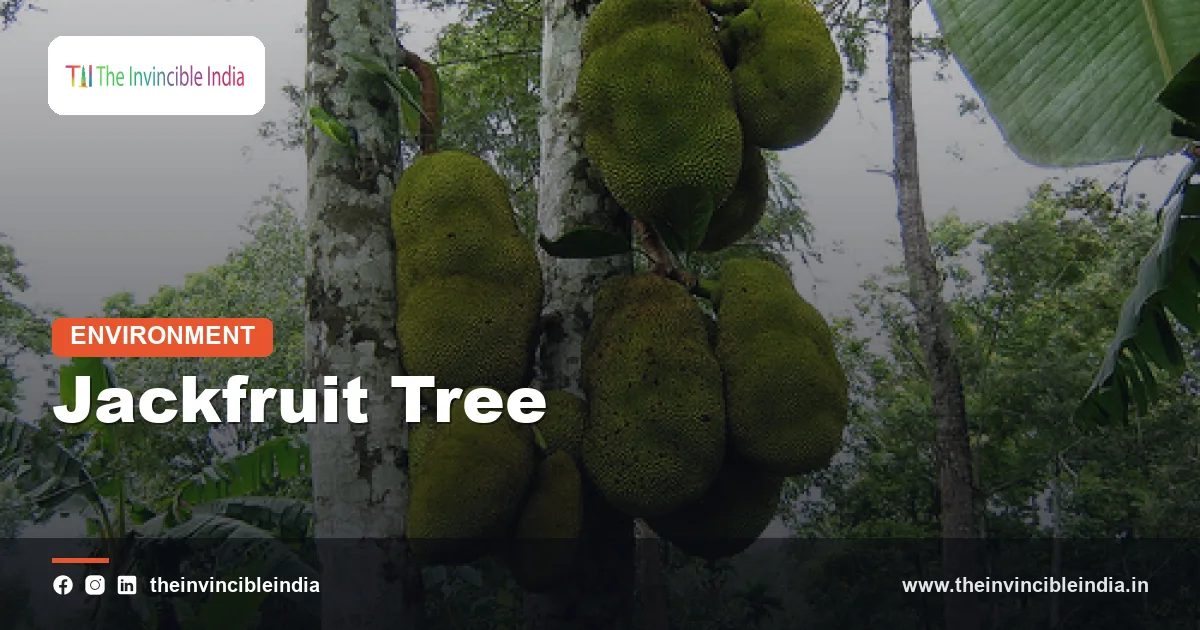
The jackfruit tree (Artocarpus heterophyllus) is an evergreen tree of the mulberry family that bears the largest tree-borne fruit in the world, a green, spiky fruit that can weigh several tens of kilograms and grows directly from the trunk and main branches. The jackfruit tree is believed to be native to the Western Ghats of India, and it is a long-standing food, timber and shade tree in Kerala, Tamil Nadu, Karnataka, the north-east and many other parts of the country.
Today the jackfruit tree is also known to a global audience because raw jackfruit has become a popular plant-based substitute for meat. This guide explains what the jackfruit tree is, where it grows, how its fruit, seeds and wood are used, how it is cultivated, and why Kerala and Tamil Nadu are especially associated with it.
Quick Facts: Jackfruit Tree
| Common name | Jackfruit tree; chakka (Malayalam), kathal (Hindi), palaa (Tamil), panasa (Telugu and Sanskrit), halasu (Kannada), panas (Marathi) |
|---|---|
| Scientific name | Artocarpus heterophyllus |
| Family | Moraceae (mulberry and fig family) |
| Origin | Believed to be native to the Western Ghats of India |
| Tree height | Commonly up to about 20 metres in mature trees |
| Fruit | Largest tree-borne fruit in the world; a compound fruit that can weigh several tens of kilograms |
| State fruit | Kerala (declared in 2018); also listed as the state fruit of Tamil Nadu |
| Main uses | Ripe fruit, raw vegetable, seeds, timber, fodder |
| Flowering habit | Separate male and female flowers on the same tree; fruits borne on trunk and branches |
Key Takeaways
- The jackfruit tree (Artocarpus heterophyllus) bears the largest tree-borne fruit in the world, and the fruit can weigh several tens of kilograms.
- The jackfruit tree is believed to have originated in the Western Ghats of India and has been cultivated across South Asia for a very long time.
- The jackfruit is eaten both as a sweet ripe fruit and as a raw, starchy vegetable that has a texture similar to shredded meat when cooked.
- The jackfruit tree also supplies edible seeds, valued timber used for furniture and musical instruments, and leaves that are used as fodder.
- Kerala declared the jackfruit its state fruit in 2018, and the fruit is also closely associated with Tamil Nadu, where it forms one of the celebrated three fruits known as mukkani.
- The jackfruit tree grows best in warm, humid climates with well-drained soil, and grafted trees usually start bearing earlier than seedling trees.
What is the jackfruit tree?
The jackfruit tree is a large, evergreen, tropical tree, Artocarpus heterophyllus, that produces the giant, bumpy-skinned jackfruit. The tree belongs to the Moraceae family, which also includes the fig, mulberry and breadfruit. The species name heterophyllus means “different-leaved” and refers to the varied leaf shapes seen on young and mature plants.
A mature jackfruit tree has a dense, rounded crown of glossy, dark green leaves and a straight trunk. The tree is monoecious, meaning it carries separate male and female flowers on the same plant. The female flowers develop into the large fruit, which hangs from short stalks on the trunk and older branches, a habit called cauliflory.
The tree produces a sticky white latex when cut, which is why many cooks oil their hands and knives before cutting a jackfruit. The latex can also be used in traditional glue-making, and it is one of the reasons the fruit needs careful handling.
Why is the jackfruit the largest tree-borne fruit in the world?
The jackfruit is the largest tree-borne fruit in the world because it is a compound fruit formed from hundreds of individual flowers that fuse into one huge mass. A single jackfruit can reach about a metre in length and weigh several tens of kilograms, though most fruits seen in markets are smaller.
Inside the thick, spiky rind lies a core surrounded by yellow bulbs, which are the fleshy parts of the individual flowers. Each bulb encloses a seed. Between the bulbs lie fibrous strands and a rubbery sheath. The fruit has a strong, sweet and slightly pungent smell when ripe, which some find appealing and others find overpowering.
Other fruits can be heavier or larger in different senses, such as melons and pumpkins, but those grow on vines along the ground. The jackfruit is distinctive because it hangs from a tree, which makes its weight and size more striking.
Where is the jackfruit tree grown in India?
The jackfruit tree is grown widely across southern and eastern India, with Kerala, Tamil Nadu, Karnataka, Andhra Pradesh, Maharashtra, West Bengal, Assam and other parts of the north-east among the major areas. It is also planted in home gardens in coastal Odisha and the Konkan.
The Western Ghats are widely regarded as the centre of origin, and wild and semi-wild trees can still be found in the forests and plantations of this range. Many homes in Kerala keep at least one jackfruit tree in the compound. In Tamil Nadu, the town of Panruti in Cuddalore district is particularly known for its jackfruit.
Beyond India, the jackfruit tree is grown in Bangladesh, where it is the national fruit, as well as in Sri Lanka, Myanmar, Thailand, Indonesia, Malaysia, the Philippines, Brazil and parts of Africa. The tree has spread through human cultivation across the tropics.
How is the jackfruit eaten?
The jackfruit is eaten either ripe, as a sweet fruit, or raw and unripe, as a vegetable cooked in curries, cutlets and other savoury dishes. The two forms are very different in taste, and many Indian households use both.
Ripe jackfruit
Ripe jackfruit bulbs are sweet and aromatic and are eaten fresh or turned into desserts. In Kerala, a ripe jackfruit is used to make chakka varatti, a jam-like preparation cooked with jaggery and ghee, and chakka pradhaman, a payasam. Ripe jackfruit is also dried, made into halwa, or used as a filling for sweet parcels.
Raw jackfruit
Raw jackfruit is firm, mild and fibrous and is cooked in the way that other starchy vegetables are. Well-known dishes include kathal ki sabzi in North India, echor dalna in Bengal and chakka puzhukku in Kerala. Because the cooked flesh pulls apart into strands, raw jackfruit is used in vegetarian versions of biryani, kebabs and curries.
Is jackfruit a good meat substitute?
Raw jackfruit is a popular meat substitute because its flesh shreds into strands with a texture similar to pulled meat and absorbs spices well, but it is low in protein compared with meat and should not be treated as a protein equal. Its mild taste makes it a flexible base for sauces, marinades and spice mixes.
Jackfruit has become well known in global vegetarian and vegan cooking, where it is used in sandwiches, tacos and curries. In India, however, it has been used as a vegetable for generations, and it is often described as a food that people ate long before plant-based diets became fashionable.
The seeds add some protein and starch. They are boiled, roasted or cooked in curries and are enjoyed as snacks. Nutritionally, ripe jackfruit provides carbohydrates, some vitamin C and potassium, while raw jackfruit is a source of fibre. As with any single food, it works best as part of a varied diet.
What is jackfruit wood used for?
Jackfruit wood is used for furniture, doors, window frames, house construction, boats and musical instruments, because the timber is durable, takes polish well and resists termites better than many other woods. The heartwood is yellow when freshly cut and darkens to a rich reddish-brown with age.
Common uses of the jackfruit tree’s timber and other parts include:
- Musical instruments: the body of the veena and the shell of the mridangam have traditionally been made from jackfruit wood in South India.
- Furniture and carving: tables, cots, pillars and decorative panels.
- Construction: beams, doors and window frames in village houses.
- Dye: the heartwood has traditionally yielded a yellow-brown dye, used in some places to colour cloth.
- Fodder: the leaves are fed to goats, cattle and other livestock.
Because mature trees are valuable for timber as well as fruit, they are often protected on private land, and in some states there are rules on felling trees on farms.
Why is the jackfruit linked to Kerala and Tamil Nadu?
The jackfruit is linked to Kerala and Tamil Nadu because it is a deeply rooted food and cultural symbol in both states, and both are associated with it as a state fruit. Kerala officially declared the jackfruit its state fruit in 2018, partly to encourage better use of the fruit and reduce wastage.
In Tamil Nadu, the jackfruit is one of the three celebrated fruits of Tamil tradition, called mukkani, along with the mango and banana. The fruit appears in classical Tamil literature and remains part of local festivals and markets.
Kerala has made efforts to promote jackfruit products, including flour, chips, jams and ready-to-cook items, and jackfruit festivals are held in some districts. These initiatives aim to turn a fruit that often goes uncollected in home gardens into a source of food and income.
How is the jackfruit tree cultivated?
The jackfruit tree is cultivated by planting seedlings or grafted plants in warm, humid conditions with deep, well-drained soil, and it needs little care once established. The tree does not tolerate waterlogging, and standing water around the roots can kill it.
Key points for growing the jackfruit tree include:
- Propagation: from seed, which is easy but gives variable fruit, or by grafting and budding, which keeps desired traits.
- Time to bearing: grafted trees generally begin fruiting in a few years, while seedling trees may take longer.
- Spacing: wide, because the crown grows large and the roots spread.
- Fruit development: fruits typically mature several months after flowering, with the main season in summer in many regions.
- Pests and problems: shoot and fruit borers, fruit rot and stem diseases can reduce yield.
Many varieties are described by the type of flesh. In Kerala, for example, varikka types have firm, crisp bulbs, while koozha types have soft, sticky, very sweet bulbs. Both types have their loyal fans.
What are the types of jackfruit varieties in India?
The main types of jackfruit in India are the firm-fleshed and the soft-fleshed kinds, along with named local cultivars and improved selections developed by research institutions. The differences are mainly in the texture, sweetness and use of the fruit.
| Type | Texture and taste | Typical use |
|---|---|---|
| Firm-fleshed (varikka in Kerala) | Crisp, firm bulbs; mild sweetness | Fresh eating and cooking when ripe |
| Soft-fleshed (koozha in Kerala) | Soft, sticky, very sweet bulbs | Desserts and preserves |
| Raw (unripe) fruit | Mild, fibrous, starchy | Curries, cutlets, vegetarian meat alternatives |
| Seeds | Starchy, nutty after cooking | Curries, roasted snacks, flour |
Early-bearing and year-round varieties have also been identified in different regions, and some are grown for their particularly sweet or aromatic bulbs.
Why does so much jackfruit go to waste, and what is being done?
A large share of jackfruit goes unused because the fruit is big, perishable and hard to cut, so it is often left to fall or rot in home gardens and on roadside trees. This wastage has been identified as a missed opportunity, especially since the tree needs few inputs.
Efforts to use more of the harvest include value-added products such as flour, dried chips, pickles, ready-to-cook raw jackfruit and frozen bulbs. Farmers’ groups, research institutions and food companies have also promoted the fruit as a climate-friendly food, because the tree is hardy and grows without heavy fertiliser or irrigation.
Better cutting tools, collection systems, processing units and market links remain the main needs for turning the abundance of jackfruit into steady income.
Bottom Line
The jackfruit tree is a hardy, long-lived Indian native that gives the world’s largest tree-borne fruit, an adaptable vegetable, edible seeds and fine timber. With Kerala and Tamil Nadu celebrating it as a state fruit, the jackfruit tree is increasingly seen as a valuable food for the future.
Frequently Asked Questions
What is a jackfruit tree?
A jackfruit tree is a large evergreen tree, scientifically called Artocarpus heterophyllus, that bears the world’s largest tree-borne fruit. It belongs to the mulberry family and is believed to be native to the Western Ghats of India. The fruit grows directly on the trunk and main branches.
How big can a jackfruit get?
A jackfruit can grow about a metre long and weigh several tens of kilograms, which makes it the largest tree-borne fruit in the world. Most fruits sold in markets are smaller than this. The size depends on the variety, the tree and growing conditions.
Is jackfruit the state fruit of Kerala?
Yes, jackfruit was declared the state fruit of Kerala in 2018. The move was meant to promote the fruit and encourage its use in food products. The jackfruit is also listed as a state fruit of Tamil Nadu and is part of that state’s traditional mukkani.
Can jackfruit replace meat?
Raw jackfruit can replace meat in texture and in many recipes because it shreds into strands and absorbs spices, but it is low in protein compared with meat. It is best seen as a flavourful meat alternative rather than a nutritional equivalent. The seeds provide a little extra protein.
What is jackfruit wood used for?
Jackfruit wood is used for furniture, doors, beams, boats and musical instruments such as the veena and mridangam. The yellow heartwood is durable and darkens with age. It is a valued timber in South India, and mature trees are often kept on farms for both wood and fruit.
How long does a jackfruit tree take to bear fruit?
A jackfruit tree grown from a graft usually starts to bear fruit within a few years, while a tree grown from seed may take longer. The exact time depends on the variety, climate and care. Fruits take several months to mature after flowering.
{“@context”:”https://schema.org”,”@graph”:[{“@type”:”FAQPage”,”mainEntity”:[{“@type”:”Question”,”name”:”What is a jackfruit tree?”,”acceptedAnswer”:{“@type”:”Answer”,”text”:”A jackfruit tree is a large evergreen tree, scientifically called Artocarpus heterophyllus, that bears the world’s largest tree-borne fruit. It belongs to the mulberry family and is believed to be native to the Western Ghats of India. The fruit grows directly on the trunk and main branches.”}},{“@type”:”Question”,”name”:”How big can a jackfruit get?”,”acceptedAnswer”:{“@type”:”Answer”,”text”:”A jackfruit can grow about a metre long and weigh several tens of kilograms, which makes it the largest tree-borne fruit in the world. Most fruits sold in markets are smaller than this. The size depends on the variety, the tree and growing conditions.”}},{“@type”:”Question”,”name”:”Is jackfruit the state fruit of Kerala?”,”acceptedAnswer”:{“@type”:”Answer”,”text”:”Yes, jackfruit was declared the state fruit of Kerala in 2018. The move was meant to promote the fruit and encourage its use in food products. The jackfruit is also listed as a state fruit of Tamil Nadu and is part of that state’s traditional mukkani.”}},{“@type”:”Question”,”name”:”Can jackfruit replace meat?”,”acceptedAnswer”:{“@type”:”Answer”,”text”:”Raw jackfruit can replace meat in texture and in many recipes because it shreds into strands and absorbs spices, but it is low in protein compared with meat. It is best seen as a flavourful meat alternative rather than a nutritional equivalent. The seeds provide a little extra protein.”}},{“@type”:”Question”,”name”:”What is jackfruit wood used for?”,”acceptedAnswer”:{“@type”:”Answer”,”text”:”Jackfruit wood is used for furniture, doors, beams, boats and musical instruments such as the veena and mridangam. The yellow heartwood is durable and darkens with age. It is a valued timber in South India, and mature trees are often kept on farms for both wood and fruit.”}},{“@type”:”Question”,”name”:”How long does a jackfruit tree take to bear fruit?”,”acceptedAnswer”:{“@type”:”Answer”,”text”:”A jackfruit tree grown from a graft usually starts to bear fruit within a few years, while a tree grown from seed may take longer. The exact time depends on the variety, climate and care. Fruits take several months to mature after flowering.”}}]}]}


