

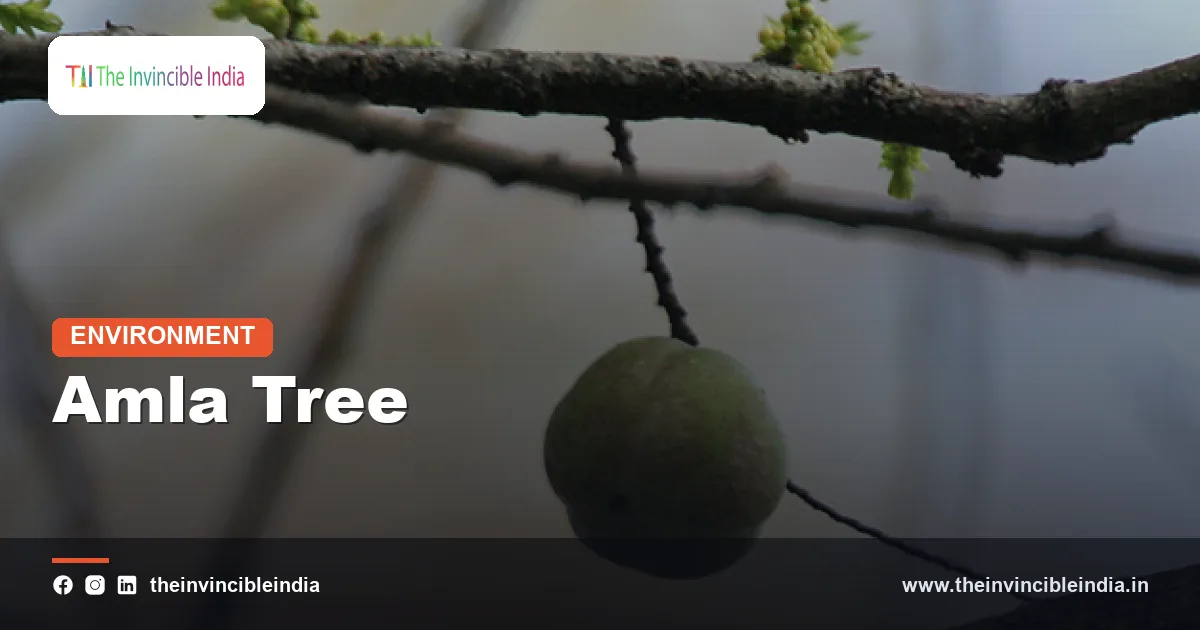
The amla tree (Phyllanthus emblica), also called the Indian gooseberry tree, is a small to medium deciduous tree native to the Indian subcontinent whose round, pale-green, intensely sour fruit is one of the richest natural sources of vitamin C and a cornerstone of Ayurveda, Indian cooking and Hindu ritual. Known as amla in Hindi, amalaki in Sanskrit and nelli in Tamil and Malayalam, the tree grows across most of India, from the Himalayan foothills to the peninsular plateau.
Amla fruit is the main ingredient of chyawanprash and one of the three fruits of triphala, and the tree itself is worshipped on festivals such as Amalaki Ekadashi. This explainer, last updated 23 October 2026, covers the botany, uses, cultural role and cultivation of the amla tree in India.
| Quick Fact | Detail |
|---|---|
| Scientific name | Phyllanthus emblica (earlier Emblica officinalis) |
| Plant family | Phyllanthaceae (formerly placed in Euphorbiaceae) |
| Common names | Amla, aonla, Indian gooseberry, amalaki, nelli, usiri, amlaki |
| Tree type | Small to medium deciduous tree, usually 8 to 18 metres tall |
| Native range | Tropical South and Southeast Asia, including India |
| Fruit season | Mainly October to February, depending on cultivar and region |
| Key products | Chyawanprash, triphala, pickles, murabba, candy, juice, hair oil |
| Sacred observances | Amalaki Ekadashi and Akshaya Navami (amla tree worship) |
| Major growing states | Uttar Pradesh, Gujarat, Rajasthan, Madhya Pradesh, Tamil Nadu, Andhra Pradesh |
Key Takeaways
- The amla tree, scientifically Phyllanthus emblica, is a deciduous tree native to the Indian subcontinent and is also called the Indian gooseberry tree.
- Amla fruit is widely regarded as one of the richest natural sources of vitamin C among common fruits, with levels that vary by cultivar and ripeness.
- Amalaki, the Sanskrit name for amla, is one of the three fruits of triphala and the principal ingredient of the Ayurvedic preparation chyawanprash.
- The amla tree is worshipped in Hindu tradition, notably on Amalaki Ekadashi in the month of Phalguna and on Akshaya Navami in the month of Kartika.
- Amla is a hardy, drought-tolerant fruit tree that tolerates poor and mildly saline or alkaline soils, which makes the amla tree popular for orchards in dry regions of India.
- Commercial amla orchards in India use named grafted or budded cultivars such as Banarasi, Chakaiya, Francis and NA-7 rather than plants grown from seed.
What is the amla tree?
The amla tree is a deciduous fruit tree of the family Phyllanthaceae, native to India and neighbouring parts of tropical Asia, that bears small, round, ribbed, pale-green to yellowish fruit. The botanical name Phyllanthus emblica was long written as Emblica officinalis, and older books and trade labels still use that older name.
Mature amla trees usually reach 8 to 18 metres, although cultivated orchard trees are kept shorter through pruning. The trunk is often crooked, with grey-brown bark that peels in thin flakes. The crown is open and spreading, and the thin branchlets carry tiny, closely arranged leaflets that give the foliage a feathery look similar to a tamarind tree. The small leaves sit on slender twigs, and the whole twig falls together in the dry season.
The fruit is a fleshy, nearly spherical drupe-like berry about 1.5 to 5 centimetres across, with six faint vertical lines running from the stalk to the tip. A hard, ribbed stone inside holds the seeds. Wild fruit is small and fibrous, while improved cultivars give larger and juicier fruit with less fibre.
What are the other names of the amla tree in India?
The amla tree carries a different local name in almost every Indian language, and the most common are amla or aonla in Hindi, amalaki in Sanskrit, nelli in Tamil and Malayalam, usiri in Telugu and amlaki in Bengali. The English names are Indian gooseberry and emblic myrobalan.
The Sanskrit name amalaki is the one found in classical Ayurvedic texts, where the fruit is also described by epithets that stress its rejuvenating reputation. The word amla itself means sour, which describes the dominant taste of the fruit. The name Indian gooseberry is a misnomer, because the amla tree is not related to the true European gooseberry, which belongs to the genus Ribes.
Where does the amla tree grow in India?
The amla tree grows wild in deciduous and mixed forests across much of peninsular and central India and in the Himalayan foothills up to roughly 1,300 metres, and it is cultivated in orchards in many states. Uttar Pradesh is traditionally regarded as the leading producer, with the Pratapgarh region around Prayagraj often called the amla belt of the country.
Other important growing states are Gujarat, Rajasthan, Madhya Pradesh, Maharashtra, Tamil Nadu and Andhra Pradesh. Beyond India, the species occurs naturally in Sri Lanka, Nepal, Bangladesh, Pakistan, Myanmar and parts of Southeast Asia and southern China. Because amla is robust, the tree is also planted on wastelands, field boundaries and degraded land under afforestation programmes.
Why is amla called a vitamin C powerhouse?
Amla is called a vitamin C powerhouse because raw amla fruit contains far more ascorbic acid, weight for weight, than most common fruits such as oranges. Reported values differ considerably between cultivars, growing conditions and ripeness, so any single figure should be treated as an approximate range rather than a fixed number.
Amla also contains tannins, gallic acid, ellagic acid, flavonoids and dietary fibre. Amla is often said to hold on to its vitamin C better than many other fruits during drying and cooking, which is one reason dried amla, murabba and chyawanprash are still valued as vitamin C sources, although the exact retained amount depends on processing.
Amla is a food and a traditional remedy, not a medicine. Scientific studies on amla extracts are ongoing, and anyone with a health condition, especially diabetes, a bleeding disorder or kidney problems, or anyone taking regular medicines, should speak to a doctor before using amla supplements regularly.
How is amla used in Ayurveda?
In Ayurveda, amalaki is classed as a rasayana, a rejuvenating substance traditionally used to support digestion, immunity, hair health and overall vitality. Ayurvedic practitioners describe the fruit as containing five of the six tastes, with sourness dominant and salty taste absent, and they consider it cooling in nature.
Triphala
Triphala, meaning three fruits, is a classic Ayurvedic combination of amalaki (Phyllanthus emblica), haritaki (Terminalia chebula) and bibhitaki (Terminalia bellirica) in powder or tablet form. Triphala is traditionally taken to support digestion and regular bowel movement and is also used as a mouthwash and eyewash base in traditional practice.
Chyawanprash
Chyawanprash is a thick, sweet, spiced jam in which fresh amla pulp is the main ingredient, cooked with ghee, honey or sugar and dozens of herbs and spices. Tradition links the formula to the sage Chyawana, and the preparation is described in classical texts such as the Charaka Samhita. Chyawanprash is commonly eaten in winter by Indian families, often a spoonful with warm milk.
Other traditional uses
Amla oil and amla powder are used in traditional hair care, and amla is a common ingredient in herbal shampoos and hair packs. Dried amla slices are chewed after meals in some regions as a digestive. Modern users also take amla juice and capsules, though such use is supported by traditional practice and limited clinical evidence rather than established medical approval.
How is amla eaten and cooked in Indian kitchens?
Amla is eaten in India raw with salt and chilli powder, pickled, candied, juiced and cooked into preserves, and the sour fruit is one of the most versatile seasonal ingredients of the winter months. The firm texture and strong astringency make raw amla an acquired taste, so most households process the fruit.
- Amla achar (pickle): whole or quartered fruit cooked in oil with mustard, fenugreek, fennel and chilli, popular across North and West India.
- Amla murabba: whole fruit pricked, boiled and soaked in sugar syrup, a traditional sweet preserve often eaten in the morning.
- Amla candy and supari: sweetened or salted dried segments, sold as a digestive and lozenge.
- Amla juice: pressed fruit juice, usually diluted with water, widely sold bottled.
- Amla chutney and thecha: grated fruit ground with green chilli, coriander, salt and sometimes coconut, a quick accompaniment.
- Amla in dals and curries: pieces added to tangy gravies, in the way tamarind or raw mango is used.
What is the religious significance of the amla tree?
The amla tree holds religious importance in Hinduism, where the tree is regarded as sacred to Lord Vishnu and is worshipped on Amalaki Ekadashi and Akshaya Navami. Several Puranic traditions describe amla as a tree that sprang from a divine origin and hold that Vishnu resides in the tree, so many devotees treat it as an auspicious plant for the courtyard or temple grounds.
Amalaki Ekadashi
Amalaki Ekadashi falls on the eleventh day (Ekadashi) of the bright fortnight of the month of Phalguna, which is usually in February or March. Devotees fast, worship an amla tree by offering water, lamps and incense, and sometimes circumambulate the trunk. The festival also falls just before Holi, and it is especially observed in North India, including the Braj region.
Akshaya Navami
Akshaya Navami, also called Amla Navami, is observed on the ninth day of the bright fortnight of Kartika, which usually falls in October or November. Families in many regions hold meals under an amla tree on this day, based on the belief that charity and worship carried out under it bring lasting merit. These customs differ between regions and communities.
What does the amla tree look like through the year?
The amla tree follows a clear seasonal cycle in which the tree sheds its leaves in the dry months, flowers in spring and ripens fruit in winter. Knowing the annual cycle helps growers time pruning, irrigation and harvest.
| Period | What happens in the amla tree |
|---|---|
| February to March | Leaves and small leaf-bearing twigs fall, and the tree is briefly bare in many regions |
| March to April | New twigs emerge, and tiny greenish-yellow flowers appear in clusters at the base of new twigs |
| April to June | Flowers are pollinated, small fruits set and many young fruits drop naturally |
| July to September | Fruits grow during the monsoon and fill with juice |
| October to February | Fruits mature and are hand-picked; early cultivars ripen first, late ones last |
The amla tree is monoecious, meaning that one tree carries separate male and female flowers. The flowers are small and inconspicuous, and insects such as bees carry out most of the pollination. Good fruit set depends on weather during flowering, and very hot, dry or rainy spells can reduce the crop.
How is the amla tree cultivated?
The amla tree is cultivated by budding or grafting a named cultivar onto a seedling rootstock, planting the grafted sapling in the monsoon and training the young tree for a strong framework, because seedlings are variable and slow to bear. Grafted trees usually begin to fruit within about three to five years and can remain productive for several decades.
Soil and climate
Amla tolerates a wide range of soils, including light, poor, mildly saline and alkaline soils, though deep, well-drained loam gives the best yield. The tree prefers a warm subtropical climate, endures hot, dry summers well, and young plants need protection from severe frost. Waterlogging should be avoided.
Common cultivars
- Banarasi: an old and widely grown variety from the Varanasi region, early-ripening, with medium-sized fruit.
- Chakaiya: a prolific bearer with fruit of good quality, widely grown in Uttar Pradesh.
- Francis (Hathijhool): a large-fruited cultivar with attractive fruit, but with a tendency towards alternate bearing.
- NA-7 (Narendra Aonla-7): a high-yielding selection developed in Uttar Pradesh and used heavily for processing.
- Krishna and Kanchan: improved selections released by agricultural research institutions.
Care and harvest
Orchard trees are normally spaced widely, fertilised with farmyard manure, irrigated lightly during dry spells and pruned to remove dead or crossing branches. Fruit is picked by hand, since shaking the tree bruises the fruit. Yield per tree rises with age, and well-managed orchards give regular crops, although alternate-year bearing is a well-known problem in some cultivars.
What other uses does the amla tree have?
Beyond food and medicine, the amla tree supplies wood, tannin, dye and ecological benefits. The wood is hard, close-grained and reddish, and it is used for small furniture, agricultural implements and, traditionally, as lining planks for wells because it resists decay when kept submerged.
- Dyes and tannin: fruit, bark and leaves are rich in tannins, historically used in tanning leather, preparing ink and fixing dyes, and in hair colouring blends.
- Fuel: the wood makes good firewood and charcoal.
- Fodder and green manure: twigs and leaves are lopped as fodder and compost material in some areas.
- Agroforestry: the light open canopy of the amla tree allows crops to grow beneath it, and the tree is planted on bunds and wastelands for livelihoods and soil protection.
- Wildlife: birds, monkeys and other animals feed on ripe fruit, and bees visit the flowers.
Why does the amla tree matter to India’s economy and livelihoods?
The amla tree matters economically because India is among the leading amla-producing countries and the fruit feeds a large processing industry of herbal medicines, juices, candies and cosmetics. Amla suits small and marginal farmers because the tree needs few inputs, tolerates drought and is not a conventional crop competing for the best irrigated land.
Value addition is the main income opportunity. Fresh amla is sold in winter at modest prices when the market is full, but processed products such as chyawanprash, murabba, powder and juice earn more and sell through the year. Many self-help groups, particularly women’s groups, make pickles and candy from locally grown amla.
Bottom Line
The amla tree combines botany, nutrition, tradition and livelihood in one species. Phyllanthus emblica gives India a hardy orchard tree, a vitamin C-rich fruit, a central Ayurvedic ingredient and a sacred tree honoured in annual rituals, and the amla tree remains one of the most useful native trees of the country.
Frequently Asked Questions
What is the amla tree called in English?
The amla tree is called the Indian gooseberry tree or emblic myrobalan in English. Its scientific name is Phyllanthus emblica, and older texts write it as Emblica officinalis. Despite the name, the amla tree is not related to the true gooseberry.
How long does an amla tree take to bear fruit?
A grafted or budded amla tree usually begins to bear fruit in about three to five years after planting. Trees grown from seed are slower and more variable and may take six to eight years or longer. Yield rises with age, and well-managed trees remain productive for decades.
Is amla a good source of vitamin C?
Yes, raw amla fruit is one of the richest natural sources of vitamin C among common fruits. The exact amount differs with cultivar, ripeness and processing, and heat and storage reduce it. A varied diet with fruit and vegetables remains the main source of vitamin C for most people.
When is Amalaki Ekadashi celebrated?
Amalaki Ekadashi is celebrated on the eleventh day of the bright fortnight of the month of Phalguna, usually in February or March. Devotees fast and worship an amla tree dedicated to Lord Vishnu. The exact Gregorian date shifts every year with the Hindu lunar calendar.
Which fruits make up triphala?
Triphala is made from three fruits: amalaki (Phyllanthus emblica), haritaki (Terminalia chebula) and bibhitaki (Terminalia bellirica). The name triphala means three fruits in Sanskrit. It is a traditional Ayurvedic combination used mainly to support digestion.
Can an amla tree be grown in a pot or home garden?
An amla tree can be grown in a large container or a home garden, provided the plant gets plenty of sunlight and well-drained soil. Choose a grafted sapling of a named variety, plant it at the start of the monsoon and prune it to keep it manageable. A container-grown amla tree will fruit later and yield less than an orchard tree planted in the ground.
{“@context”:”https://schema.org”,”@graph”:[{“@type”:”FAQPage”,”mainEntity”:[{“@type”:”Question”,”name”:”What is the amla tree called in English?”,”acceptedAnswer”:{“@type”:”Answer”,”text”:”The amla tree is called the Indian gooseberry tree or emblic myrobalan in English. Its scientific name is Phyllanthus emblica, and older texts write it as Emblica officinalis. Despite the name, the amla tree is not related to the true gooseberry.”}},{“@type”:”Question”,”name”:”How long does an amla tree take to bear fruit?”,”acceptedAnswer”:{“@type”:”Answer”,”text”:”A grafted or budded amla tree usually begins to bear fruit in about three to five years after planting. Trees grown from seed are slower and more variable and may take six to eight years or longer. Yield rises with age, and well-managed trees remain productive for decades.”}},{“@type”:”Question”,”name”:”Is amla a good source of vitamin C?”,”acceptedAnswer”:{“@type”:”Answer”,”text”:”Yes, raw amla fruit is one of the richest natural sources of vitamin C among common fruits. The exact amount differs with cultivar, ripeness and processing, and heat and storage reduce it. A varied diet with fruit and vegetables remains the main source of vitamin C for most people.”}},{“@type”:”Question”,”name”:”When is Amalaki Ekadashi celebrated?”,”acceptedAnswer”:{“@type”:”Answer”,”text”:”Amalaki Ekadashi is celebrated on the eleventh day of the bright fortnight of the month of Phalguna, usually in February or March. Devotees fast and worship an amla tree dedicated to Lord Vishnu. The exact Gregorian date shifts every year with the Hindu lunar calendar.”}},{“@type”:”Question”,”name”:”Which fruits make up triphala?”,”acceptedAnswer”:{“@type”:”Answer”,”text”:”Triphala is made from three fruits: amalaki (Phyllanthus emblica), haritaki (Terminalia chebula) and bibhitaki (Terminalia bellirica). The name triphala means three fruits in Sanskrit. It is a traditional Ayurvedic combination used mainly to support digestion.”}},{“@type”:”Question”,”name”:”Can an amla tree be grown in a pot or home garden?”,”acceptedAnswer”:{“@type”:”Answer”,”text”:”An amla tree can be grown in a large container or a home garden, provided the plant gets plenty of sunlight and well-drained soil. Choose a grafted sapling of a named variety, plant it at the start of the monsoon and prune it to keep it manageable. A container-grown amla tree will fruit later and yield less than an orchard tree planted in the ground.”}}]}]}


