

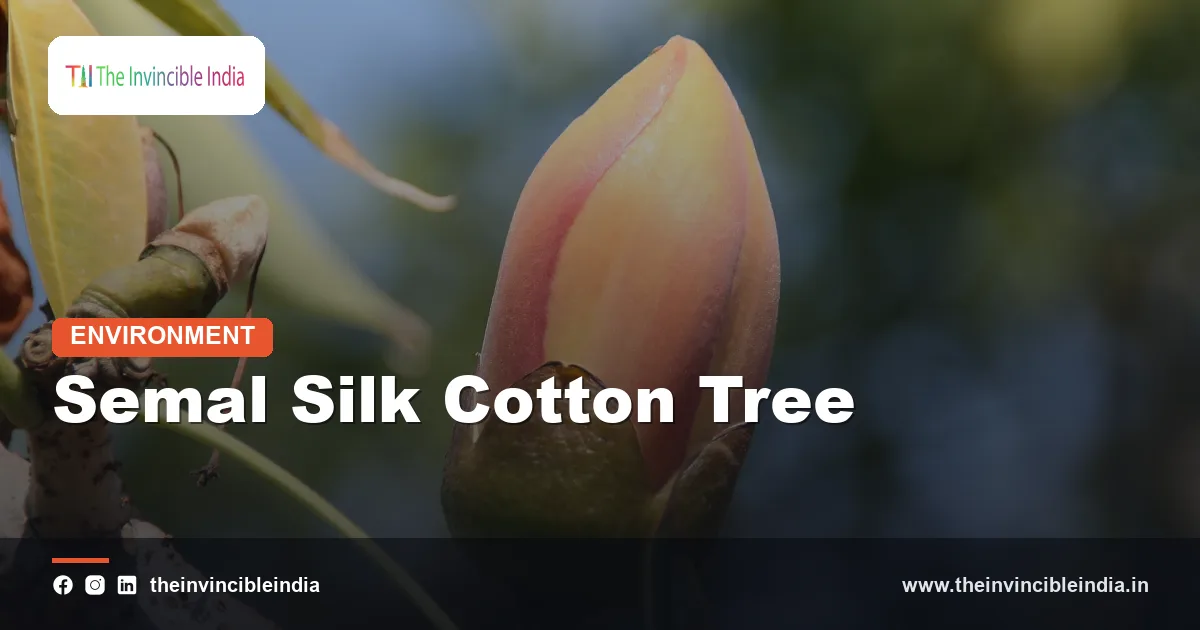
The semal tree (Bombax ceiba), also known as the red silk cotton tree, is a tall, thorny, buttressed deciduous tree of India that bursts into scarlet flowers while completely leafless in late winter and later splits open its pods to release fluffy, silk-like kapok fibre. Called semal or simbal in Hindi and shalmali in Sanskrit, the semal tree is one of the most conspicuous trees of the Indian spring and a major food source for birds, bees and other wildlife.
The semal tree grows across the deciduous forests, river valleys and village edges of India, and people have used its cotton, light timber, buds and gum for generations. This explainer, last updated 23 October 2026, covers the botany, flowers, cotton, wildlife value, uses and cultural role of the semal tree.
| Quick Fact | Detail |
|---|---|
| Scientific name | Bombax ceiba (earlier Bombax malabaricum, also Salmalia malabarica) |
| Plant family | Malvaceae (formerly Bombacaceae) |
| Common names | Semal, simbal, red silk cotton tree, shalmali (Sanskrit), kate savar (Marathi), buruga (Telugu), ilavu (Malayalam) |
| Tree type | Tall, deciduous, buttressed tree with a prickly trunk, often 25 to 40 metres in height |
| Flowering season | About January to March, while leafless |
| Fruiting and cotton | Woody capsules ripen and split about April to May, releasing cotton-like kapok |
| Main products | Kapok fibre, light timber, edible buds and flowers, gum, traditional root and bark remedies |
| Native range | South and Southeast Asia and northern Australia; found across most of India below about 1,500 metres |
| Wildlife value | Nectar for birds, bees, squirrels and insects; nesting and perching tree for birds |
Key Takeaways
- The semal tree, scientifically Bombax ceiba, is a tall deciduous tree of South and Southeast Asia that produces large red flowers on bare branches in late winter.
- Semal trees can grow 25 to 40 metres tall, and young trunks and branches carry conical prickles that protect the tree from climbing animals.
- The cotton-like fibre inside semal pods is kapok, which is light, buoyant and water-resistant but too short and slippery to be spun into ordinary thread.
- Semal flowers hold abundant nectar and are visited by mynas, crows, bulbuls, parakeets, sunbirds, squirrels and bees, so the semal tree is a major seasonal food source for wildlife.
- Semal timber is very light and soft, and it is used for matchsticks, plywood, packing cases, toys and lightweight boats rather than for heavy construction.
- The semal tree is not the same as the true kapok tree Ceiba pentandra, although both belong to the same mallow family and yield similar fibre.
What is the semal tree?
The semal tree is a large, fast-growing deciduous tree of the mallow family (Malvaceae) that is recognised by its straight, spiny trunk, tiers of horizontal branches and bright red flowers. The botanical name is Bombax ceiba, and older references use Bombax malabaricum for the same tree.
A mature semal tree has a tall, straight trunk that is buttressed at the base, meaning that broad, plank-like ridges spread out around the foot of the tree for support. The branches radiate in whorls at fairly regular levels, producing a layered, pagoda-like crown. The bark is grey and, on young trees, studded with sharp, cone-shaped prickles that become blunter and fall off with age. The leaves are compound, with five to seven long, pointed leaflets that spread like the fingers of a hand, and the tree sheds them every year.
Because the tree is tall, rapid in growth and easily recognised, semal is a favourite landmark tree along roads, riverbanks and fields. Individual semal trees may live for a hundred years or more.
Why is the semal tree called the red silk cotton tree?
The semal tree is called the red silk cotton tree because its flowers are red and its seed pods are filled with soft, silky, cotton-like fibre. The word silk refers to the sheen and softness of the fibre, and the word red separates the tree from the white-flowered silk cotton tree (kapok tree), Ceiba pentandra.
The name can cause confusion, since three or more different trees in India are loosely called silk cotton trees. The true cotton plant (Gossypium) is a different, shrubby crop altogether. The semal tree is the species that provides the red silk cotton of the Indian countryside.
Where does the semal tree grow in India?
The semal tree grows throughout most of India in tropical and subtropical deciduous forests, in open woodland, along rivers and streams and on the edges of villages, mostly below about 1,500 metres. It is common in the sub-Himalayan tract, the Gangetic plains, central India, the Western Ghats and the Eastern Ghats.
The species also occurs in Nepal, Bangladesh, Sri Lanka, Myanmar, Southeast Asia, southern China and northern Australia. Semal does best in warm climates with a clear dry season and prefers deep, well-drained soil, but it can grow in a range of soils. The tree needs full sun and is sensitive to hard frost when young. Several Indian national parks and tiger reserves, such as those in the Terai and central India, have large semal trees visible in the dry season.
When does the semal tree flower and what do the flowers look like?
The semal tree flowers between about January and March, when the branches are leafless and carry hundreds of large, fleshy, cup-shaped red flowers. Each flower is roughly 10 to 15 centimetres across, with five thick, waxy petals and a ring of numerous stamens in the centre.
The sight is striking: a bare, spiny tree covered with scarlet blossoms against a blue winter sky. The thick petals hold a good amount of nectar, and the tree is largely pollinated by birds, which are drawn by the colour and sweet fluid. Orange and yellow forms are occasionally seen. When the flowers fall, they carpet the ground under the tree, and the fallen petals are collected by villagers for use as vegetable and in traditional preparations.
The flowers are short-lived, though the tree produces new blossoms over several weeks. New leaves appear only after most of the flowers have dropped.
How does the semal tree produce cotton?
The semal tree produces cotton inside woody, elongated seed capsules that ripen and split open in April and May, releasing white to pale grey, silky fibre that carries small dark seeds. Each capsule is about 10 to 15 centimetres long and green when young, and it turns brown and dry as it matures.
When a capsule bursts, the fibre expands into a cloud of fluff that floats on the wind and carries the seeds far from the parent tree. This is the semal tree’s way of spreading its seed. In the hot weeks of late spring, the air near mature semal trees may be filled with drifting tufts, and the fluff piles up on the ground and in drains.
What is kapok?
Kapok is the name given to the soft, lightweight, hollow-celled fibre obtained from the fruits of semal and related trees. The fibre is buoyant, water-repellent and a good insulator, but it is brittle and too short and smooth to be spun into yarn the way cotton can. For this reason, semal cotton is used as a filling and not as a fabric.
What are the uses of semal cotton and wood?
Semal cotton is used mainly as a stuffing for pillows, cushions, mattresses and quilts and as insulation, while semal wood is a light, soft timber used for matchsticks, plywood, packing cases, toys and similar products. The fibre was historically also used in life jackets and buoyancy aids because kapok is very buoyant, although synthetic foam has replaced it in most modern safety equipment.
| Part of the tree | Common use | Notes |
|---|---|---|
| Kapok (cotton) | Stuffing for pillows, mattresses, quilts; insulation | Light and buoyant but flammable and not spinnable |
| Wood | Matchsticks, plywood, packing boxes, toys, lightweight boats, well curbs | Very light, soft and perishable unless treated |
| Flower buds and petals | Cooked as vegetable in some regions | Seasonal local food |
| Gum (mochras) | Traditional medicine, especially in Ayurveda and Unani | Collected from the bark |
| Roots (young) | Traditional tonic known as semal musli | Folk use only |
| Seeds | Oil and animal feed in some places | Secondary product |
Semal wood is not durable in damp conditions and is attacked by insects and fungi, so it is a utility timber, not a premium one. Its lightness and straight grain make it popular for the match industry, and the wood is also used for making packing material and plywood core.
How does the semal tree help birds, bees and other wildlife?
The semal tree helps wildlife by offering large quantities of nectar and pollen at a time of year when few other trees are in flower, and a long list of birds, mammals and insects feed at its blossoms. Common visitors include rose-ringed parakeets, Indian mynas, bulbuls, crows, sunbirds, drongos, squirrels, langurs, macaques and honeybees.
Because the flowers are large, upright and sturdy, birds can perch directly on the branches and sip from the flower cups. Birds that feed on nectar carry pollen on their heads and beaks from tree to tree, and in turn pollinate the flowers. Raptors, vultures and other large birds use the tall semal trees for roosting and nesting, since the tree stands above the forest canopy, and the prickly trunk offers some protection from climbing predators. Wildlife photographers and birdwatchers often visit flowering semal trees in January to March for this reason.
What is the cultural and religious significance of the semal tree?
The semal tree has a long place in Indian culture, where it is known as shalmali in Sanskrit literature and features in folklore, poetry and festival customs. In classical texts the tree is described as thorny and tall, and in Sanskrit poetry its brilliant flowers are a symbol of the arrival of spring.
In some regions, a branch of the semal tree is planted at the site of the Holika bonfire in the lead-up to Holi, and the branch is later burned as part of the ritual. Practices differ across regions, and some communities use a castor branch or another plant in place of semal. The Puranic literature also mentions the Shalmali as the name of one of the dvipas (continents) in traditional cosmology, which reflects how widely the tree appears in tradition. The tree also appears in Indian folk songs and rural sayings, often with the implication of a beautiful but unfruitful show, since the flowers are vivid but the fibre is not spun for cloth.
What are the traditional medicinal uses of the semal tree?
In traditional Ayurvedic and folk medicine, different parts of the semal tree, including the gum, bark, root and flowers, are used for digestive complaints, skin conditions and as a general tonic. The gum, called mochras or semal gum, is considered an astringent in Ayurveda, and the young root is the source of the traditional tonic called semal musli.
These applications are based on traditional use, and scientific evidence for them is limited. The information here is not medical advice, and a doctor should be consulted before using any herbal preparation for a health problem.
How is the semal tree grown and cared for?
The semal tree is grown mainly from seed or from stem cuttings and thrives in full sun and well-drained soil with little care once established. Seeds taken from freshly dried capsules usually germinate quickly, and young trees grow fast, often adding a metre or more per year in good conditions.
Semal is planted in avenues, large gardens, farm boundaries and plantations, and it is also grown as a source of match-industry timber in some states. The tree is fairly drought tolerant but does not tolerate waterlogging. Its size, thorns, heavy flower fall and flying cotton make it unsuitable for small homes and narrow streets, and mature trees may drop large branches in storms. Planting at a safe distance from buildings and power lines is advised.
How is the semal tree different from the kapok tree?
The semal tree (Bombax ceiba) differs from the true kapok tree (Ceiba pentandra) mainly in its red flowers, smaller pods and prickly trunk, while the kapok tree has paler, whitish to pinkish flowers and larger, smoother pods. Both trees belong to the mallow family and both give silky fibre, which is why the common names often overlap.
- Flowers: semal has large red or orange flowers, while kapok tree flowers are cream to pale pink.
- Origin: semal is native to South and Southeast Asia, while Ceiba pentandra is native to tropical America and West Africa and is grown widely in Southeast Asia for commercial kapok.
- Trunk: semal trunks are heavily prickly when young, while kapok tree trunks are usually smoother with fewer spines.
- Fibre use: both yield kapok, but most commercial kapok comes from Ceiba pentandra.
Bottom Line
The semal tree is among the most striking trees of the Indian landscape. Bombax ceiba offers a spectacular winter bloom, an important nectar source for birds, a light and useful timber and soft kapok, and the semal tree remains part of rural life and folklore across the country.
Frequently Asked Questions
What is the scientific name of the semal tree?
The scientific name of the semal tree is Bombax ceiba. Older books call it Bombax malabaricum or Salmalia malabarica. The tree belongs to the mallow family, Malvaceae.
When does the semal tree bloom?
The semal tree blooms from about January to March, when the branches are bare of leaves. The large red flowers appear in great numbers and attract birds and bees. New leaves appear after flowering is mostly over.
Can semal cotton be used to make cloth?
No, semal cotton cannot be spun into cloth in the usual way, because the fibres are short, smooth and brittle. The fibre is used instead as a stuffing for pillows, cushions and mattresses and as insulation. It is buoyant and water-resistant but burns easily.
Is the semal tree the same as the kapok tree?
No, the semal tree is a different species from the kapok tree, although both are related and both give silky kapok fibre. The semal tree is Bombax ceiba with red flowers, while the kapok tree is Ceiba pentandra with pale flowers. Semal is native to Asia, while Ceiba pentandra is native to tropical America and Africa.
Why does the semal tree have thorns?
The semal tree has conical prickles on its trunk and branches mainly to deter climbing animals and browsers, especially when the tree is young. The prickles become blunt and may fall off as the trunk thickens with age. Mature trunks are often partly smooth.
Which birds feed on semal flowers?
Many birds feed on semal flowers, including rose-ringed parakeets, Indian mynas, bulbuls, crows, sunbirds, drongos and babblers. They sip the nectar from the large flower cups. Squirrels, langurs and bees also visit the blossoms.
{“@context”:”https://schema.org”,”@graph”:[{“@type”:”FAQPage”,”mainEntity”:[{“@type”:”Question”,”name”:”What is the scientific name of the semal tree?”,”acceptedAnswer”:{“@type”:”Answer”,”text”:”The scientific name of the semal tree is Bombax ceiba. Older books call it Bombax malabaricum or Salmalia malabarica. The tree belongs to the mallow family, Malvaceae.”}},{“@type”:”Question”,”name”:”When does the semal tree bloom?”,”acceptedAnswer”:{“@type”:”Answer”,”text”:”The semal tree blooms from about January to March, when the branches are bare of leaves. The large red flowers appear in great numbers and attract birds and bees. New leaves appear after flowering is mostly over.”}},{“@type”:”Question”,”name”:”Can semal cotton be used to make cloth?”,”acceptedAnswer”:{“@type”:”Answer”,”text”:”No, semal cotton cannot be spun into cloth in the usual way, because the fibres are short, smooth and brittle. The fibre is used instead as a stuffing for pillows, cushions and mattresses and as insulation. It is buoyant and water-resistant but burns easily.”}},{“@type”:”Question”,”name”:”Is the semal tree the same as the kapok tree?”,”acceptedAnswer”:{“@type”:”Answer”,”text”:”No, the semal tree is a different species from the kapok tree, although both are related and both give silky kapok fibre. The semal tree is Bombax ceiba with red flowers, while the kapok tree is Ceiba pentandra with pale flowers. Semal is native to Asia, while Ceiba pentandra is native to tropical America and Africa.”}},{“@type”:”Question”,”name”:”Why does the semal tree have thorns?”,”acceptedAnswer”:{“@type”:”Answer”,”text”:”The semal tree has conical prickles on its trunk and branches mainly to deter climbing animals and browsers, especially when the tree is young. The prickles become blunt and may fall off as the trunk thickens with age. Mature trunks are often partly smooth.”}},{“@type”:”Question”,”name”:”Which birds feed on semal flowers?”,”acceptedAnswer”:{“@type”:”Answer”,”text”:”Many birds feed on semal flowers, including rose-ringed parakeets, Indian mynas, bulbuls, crows, sunbirds, drongos and babblers. They sip the nectar from the large flower cups. Squirrels, langurs and bees also visit the blossoms.”}}]}]}


