

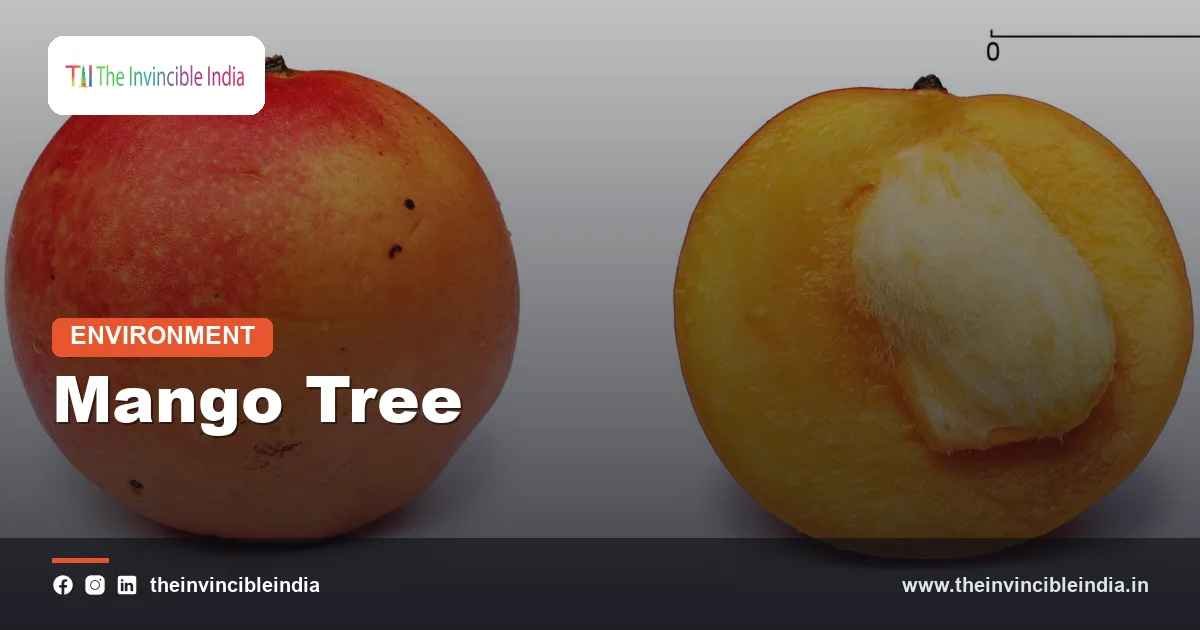
The mango tree (Mangifera indica) is a large, evergreen fruit tree native to South Asia, grown across India for its fruit, shade, timber and sacred leaves, and the fruit it bears is celebrated as the “king of fruits”. The mango tree sits at the centre of Indian orchards, kitchens, festivals and folklore, and India is the world’s largest mango-producing country.
From the grafted orchards of Maharashtra and Uttar Pradesh to the single backyard tree that shades an entire village courtyard, the mango tree is one of the most recognisable plants in the subcontinent. It is the national fruit of India, and its leaves, blossom and wood all have a place in Hindu ritual. This explainer covers what the mango tree is, how it grows, its best-known Indian varieties, its cultural role and how it is cultivated.
| Attribute | Detail |
|---|---|
| Scientific name | Mangifera indica |
| Plant family | Anacardiaceae (the cashew or sumac family) |
| Native range | South and Southeast Asia, including the Indian subcontinent and Myanmar |
| Hindi and Sanskrit names | Aam (Hindi); Amra (Sanskrit) |
| Official status in India | National fruit of India |
| Typical height | Commonly 10 to 30 metres; old seedling trees can grow larger |
| Lifespan | Often well over a century for seedling trees |
| Main fruiting season | Roughly March to July, depending on region and variety |
| Leading producing states | Uttar Pradesh, Andhra Pradesh, Karnataka, Bihar, Gujarat and Maharashtra, among others |
Key Takeaways
- The mango tree (Mangifera indica) is native to the Indian subcontinent and has been cultivated here for thousands of years.
- India is the world’s largest producer of mangoes, and the mango is the national fruit of India.
- Famous Indian mango varieties include Alphonso (Hapus), Dasheri, Langra, Chausa, Kesar, Banganapalli, Totapuri and Himsagar.
- Fresh mango leaves are strung into festive toran garlands and placed in the kalash during Hindu ceremonies, weddings and housewarmings.
- Commercial mango orchards in India propagate trees by grafting, because seed-grown trees often do not match the parent’s fruit quality.
- Mango trees flower in winter and early spring, and fruit set depends strongly on weather, with unseasonal rain or fog at flowering reducing the crop.
What Is the Mango Tree?
The mango tree is a dense, broad-crowned evergreen tree of the family Anacardiaceae, scientifically named Mangifera indica, and it produces a fleshy stone fruit known as the mango. The tree is closely related to the cashew and pistachio, and the genus Mangifera contains several dozen species, of which Mangifera indica is by far the most widely cultivated.
A mature mango tree has a thick, rounded canopy of long, leathery, lance-shaped leaves. New leaves emerge in a flush of copper-red or purplish colour before turning dark glossy green, which is why a mango tree in spring looks half-green and half-bronze. The bark is dark grey-brown and rough, and it exudes a resinous sap that can irritate skin in sensitive people.
The tree grows well in tropical and subtropical climates with a distinct dry spell before flowering. It is deep-rooted and hardy once established, which is one reason it survives in village compounds with little care. The word “mango” in English is traced to the Tamil “mankay” or “mangai”, which reached European languages through Portuguese traders on the Indian coast.
Where Did the Mango Tree Originate?
The mango tree originated in the region spanning north-eastern India, Bangladesh and Myanmar, and was domesticated in the Indian subcontinent, where cultivation is commonly dated back some four thousand years. Wild relatives still grow in the forests of north-eastern India and Southeast Asia, which supports the view that the species first evolved in this belt.
Ancient Indian literature mentions the tree repeatedly. Sanskrit texts refer to it as Amra, and classical poets such as Kalidasa describe mango blossom as a marker of spring and love. Buddhist tradition records that Amrapali, the celebrated courtesan of Vaishali, donated her mango grove to the Buddha and his monks. Jain tradition associates the goddess Ambika with a mango tree.
From India the mango spread with traders and travellers. It reached East Africa, the Middle East and later Brazil, the Caribbean and Florida, where cultivated selections from India were used in early orchards. Today the mango is grown in more than a hundred countries, but India remains its cultural home.
What Are the Famous Mango Varieties of India?
The famous mango varieties of India include Alphonso, Dasheri, Langra, Chausa, Kesar, Banganapalli, Totapuri and Himsagar, each tied to a particular region, flavour and season. India is often said to grow well over a thousand named varieties, though only a few dozen are grown commercially at scale.
| Variety | Home region | Notable character |
|---|---|---|
| Alphonso (Hapus) | Ratnagiri and Sindhudurg in Maharashtra, with related belts in Karnataka and Gujarat | Saffron-orange flesh, rich aroma, low fibre; among the most prized and most exported Indian mangoes |
| Dasheri | Malihabad and Lucknow region, Uttar Pradesh | Sweet, fragrant, elongated fruit; named after Dasheri village near Lucknow |
| Langra | Varanasi, Uttar Pradesh, and the wider Gangetic plain | Stays green when ripe; distinctive sweet-tart flavour |
| Chausa | Hardoi and western Uttar Pradesh; also Bihar | Late-season variety with very sweet flesh and a golden skin |
| Kesar | Junagadh and Girnar region, Gujarat | Saffron-coloured pulp, strong fragrance, widely used for pulp and juice |
| Banganapalli (Benishan) | Andhra Pradesh and Telangana | Large, fibre-free, golden fruit that is popular in the south |
| Totapuri | Karnataka, Andhra Pradesh and Tamil Nadu | Parrot-beak shape; firm, tangy; used for juice, pulp and pickles |
| Himsagar | West Bengal | Smooth, creamy, sweet flesh; an early-season eastern favourite |
Several of these have Geographical Indication (GI) recognition for their place of origin, which protects the regional name. Plant breeders have also developed hybrids such as Amrapali, a cross between Dasheri and Neelam, and Mallika, a cross between Neelam and Dasheri, bred to flower more reliably every year.
Why Is the Mango Called the King of Fruits?
The mango is called the “king of fruits” because of its flavour, aroma, nutritional value and the affection it commands across South Asia, and the title is a cultural description rather than an official one. The phrase has been used for centuries, and in India it reflects the fruit’s place as the symbol of summer.
Several factors support the reputation. Ripe mango pulp is a good source of vitamin C and carries carotenoids that give the flesh its yellow-orange colour. The fruit is eaten fresh, cut into cubes, sucked from the stone, blended into lassi and milkshakes, or processed into pulp, leather and canned slices.
The fruit also has a long association with royalty. Mughal rulers were famed mango patrons. The emperor Akbar is traditionally said to have planted a grove of about a hundred thousand trees at Darbhanga in Bihar, known as Lakhi Bagh. The poet Mirza Ghalib was well known for his love of the fruit. These stories explain why the mango is tied so strongly to refined taste in Indian memory.
How Is the Mango Tree Used in Indian Culture and Festivals?
The mango tree is used in Indian culture as a symbol of auspiciousness, fertility and prosperity, with its leaves, blossom and wood all featuring in Hindu rituals and celebrations. Few trees appear in as many ceremonies as the mango.
Leaves in Ritual and Decoration
- Toran: Strings of fresh mango leaves are hung across doorways during festivals such as Ugadi, Gudi Padwa, Diwali, Pongal and weddings, to welcome guests and invite good fortune.
- Kalash: A pot of water topped with five or seven mango leaves and a coconut is a standard element of puja and housewarming (griha pravesh) ceremonies.
- Havan: Dry mango wood is traditionally used as sacred fuel in fire rituals.
Blossom and Festivals
Mango blossom is tied to the spring festival of Vasant Panchami, when the goddess Saraswati is worshipped. In classical Sanskrit poetry, mango flowers are counted among the five flowery arrows of Kamadeva, the god of love. In south India, raw mango and neem flowers are blended into the Ugadi pachadi, a dish that represents the mixed flavours of life.
Mango in Marriage and Folk Songs
In many regions, a mango tree is symbolically “married” in village customs, and mango leaves line the wedding mandap. Folk songs in Hindi, Bengali, Tamil and Marathi dwell on the fruit, the tree and swings hung from its branches during the monsoon.
How Does the Mango Tree Grow and Fruit?
The mango tree grows through a yearly cycle of leaf flush, flowering in winter and early spring, fruit set and a long ripening period that ends in early summer. In most of north and central India, flowering begins from about January to March, and fruit is ready for harvest between April and July.
A flowering mango tree carries large, branched clusters called panicles, each holding hundreds or even thousands of tiny cream-to-pink flowers. Only a tiny fraction of these set fruit. Pollination is done by flies, bees, thrips and other insects rather than by the wind, and mango flowers have a faint smell that attracts flies.
Fruit takes roughly three to five months to mature after fruit set. Some varieties ripen early, such as Himsagar and Alphonso, while others like Chausa and Langra come later in the season. Many mango trees show alternate bearing, also called biennial bearing, where a heavy crop one year is followed by a light crop the next. Pruning, nutrient management and plant growth regulators are used to reduce this swing.
How Is the Mango Tree Cultivated in India?
The mango tree is cultivated in India mainly through grafted saplings planted in well-drained soil, with standard orchards spacing trees about 8 to 10 metres apart, though high-density orchards use much closer spacing. Grafting, using methods such as veneer grafting, stone grafting and inarching, ensures that the new tree carries the same fruit qualities as the chosen parent.
Mango seeds, by contrast, can yield trees with unpredictable fruit. Some Indian types are polyembryonic, meaning one seed produces several seedlings, and these are often used as rootstocks. Others are monoembryonic and produce a single hybrid seedling that can differ from its parent.
Soil, Water and Care
Mango trees prefer deep, well-drained loamy soil, though they tolerate a wide range. Young trees need regular watering for the first few years, while mature trees need irrigation chiefly at fruit development. Excess water just before flowering can encourage leaf growth at the expense of flowers.
Common Pests and Diseases
- Mango hoppers: Sap-sucking insects that attack flower panicles and cause flower drop.
- Powdery mildew: A fungal disease that coats flower clusters in whitish powder.
- Anthracnose: A fungus causing dark spots on leaves, flowers and fruit.
- Fruit flies and stone weevils: Pests that damage developing fruit or seed.
- Mango malformation: A disorder that distorts flower clusters and reduces fruiting.
Orchard managers rely on pruning, sanitation, timely spraying and, increasingly, integrated pest management to protect the crop.
Which Indian States Grow the Most Mangoes?
Uttar Pradesh is the leading mango-growing state of India by quantity, followed by states such as Andhra Pradesh, Karnataka, Bihar, Gujarat and Maharashtra. Production figures change from year to year with weather, so rankings are best read as approximate.
The geography of Indian mango growing has a clear pattern. Uttar Pradesh and Bihar supply Dasheri, Langra and Chausa. Maharashtra and the Konkan coast are known for Alphonso. Gujarat’s Saurashtra region is known for Kesar. Andhra Pradesh, Telangana and Karnataka produce Banganapalli, Totapuri and Neelam. West Bengal contributes Himsagar and Malda types.
India also exports fresh mangoes and processed products such as pulp and pickles. Exports go to destinations including the Gulf countries, the United Kingdom and the United States, with Alphonso and Kesar among the best-known export varieties. Exporting fresh fruit requires meeting plant-health standards of the importing country.
How Is Mango Used in Indian Food and Medicine?
Mango is used in Indian food at every stage of ripeness, from sour green fruit to sweet ripe pulp, and it appears in pickles, chutneys, drinks, desserts and spice powders. Unripe mango and ripe mango are almost two different ingredients in the Indian kitchen.
- Raw mango: Used in aam panna (a cooling summer drink), kuchha aam chutney, dals and the many regional varieties of achar (pickle).
- Amchur: Dried raw mango powder, a souring spice used in chaat masala and north Indian curries.
- Ripe mango: Eaten fresh, or turned into aamras, mango lassi, kulfi, shrikhand and aam papad (sun-dried mango leather).
In traditional Ayurvedic and folk practice, various parts of the mango tree, including leaves, bark and kernel, have been used for household remedies. These traditional uses are not a substitute for medical advice. Nutritionally, ripe mango is a source of vitamins A and C and dietary fibre, though it is also high in natural sugars and is best eaten in moderation by people managing blood sugar.
What Is the Mango Tree’s Role in the Environment and Economy?
The mango tree supports both ecology and livelihoods in India, giving shade and habitat while providing income for millions of orchard owners, labourers, traders and processors. As a large evergreen, it offers year-round cover for birds, squirrels and insects.
Mango groves, called amrai or aam ke bagh in many languages, were traditionally planted as community assets and boundary markers. Flowers provide nectar for pollinators, and fruit feeds bats, parrots and monkeys. Mango wood is used for furniture, packing crates, doors and fuel, and it has become popular for handicrafts and kitchenware because it comes from trees past their fruiting years.
The industry also faces challenges. Climate variability affects flowering, and unseasonal rain, heat spikes or fog can cut yields sharply. Illegal artificial ripening using calcium carbide is banned in India under food safety rules, and regulators promote controlled ripening using ethylene as a safer alternative. Rising pest pressure and the ageing of old orchards also push growers to adopt better management and rejuvenation practices.
Bottom Line
The mango tree is far more than an orchard crop in India. It is a native species with a thousands-year history, a source of hundreds of regional varieties, a ritual tree whose leaves bless doorways and a livelihood for millions. Understanding its varieties, seasons and cultivation explains why the mango remains the most beloved fruit tree of the subcontinent.
Frequently Asked Questions
What is the scientific name of the mango tree?
The scientific name of the mango tree is Mangifera indica. It belongs to the family Anacardiaceae, which also includes the cashew and pistachio. The species name “indica” reflects its origin in the Indian subcontinent.
Why are mango leaves used in Hindu ceremonies?
Mango leaves are used in Hindu ceremonies because they are regarded as auspicious symbols of prosperity, fertility and new beginnings. Fresh leaves are strung into toran garlands at doorways and placed on the kalash during puja, weddings and housewarmings. Their evergreen freshness is taken to represent life and good fortune.
Which mango variety is considered the best in India?
No single mango variety is officially the best, because preference depends on region and taste. Alphonso from Maharashtra is widely regarded as the most prized and aromatic, while Dasheri, Langra, Chausa and Kesar are equally loved in their home regions. Each variety has its own season, flavour and texture.
How many years does a mango tree take to fruit?
A grafted mango tree usually begins to fruit within about three to five years, whereas a seed-grown tree can take five to eight years or more. Fruiting improves as the tree matures and can continue for many decades. Good care, pruning and suitable weather all influence the first harvest.
Is India the largest producer of mangoes?
Yes, India is the largest producer of mangoes in the world, accounting for a large share of global output. Uttar Pradesh leads among Indian states, with other major contributors including Andhra Pradesh, Karnataka, Bihar, Gujarat and Maharashtra. Most of the crop is eaten within India, and only a fraction is exported.
Can you grow a mango tree from a seed?
Yes, a mango tree can be grown from a seed, but the resulting tree may produce fruit different from the parent and often takes longer to bear. Growers who want a specific variety such as Alphonso or Dasheri use grafted saplings instead. Fresh seeds germinate best when planted soon after the fruit is eaten.
{“@context”:”https://schema.org”,”@graph”:[{“@type”:”FAQPage”,”mainEntity”:[{“@type”:”Question”,”name”:”What is the scientific name of the mango tree?”,”acceptedAnswer”:{“@type”:”Answer”,”text”:”The scientific name of the mango tree is Mangifera indica. It belongs to the family Anacardiaceae, which also includes the cashew and pistachio. The species name “indica” reflects its origin in the Indian subcontinent.”}},{“@type”:”Question”,”name”:”Why are mango leaves used in Hindu ceremonies?”,”acceptedAnswer”:{“@type”:”Answer”,”text”:”Mango leaves are used in Hindu ceremonies because they are regarded as auspicious symbols of prosperity, fertility and new beginnings. Fresh leaves are strung into toran garlands at doorways and placed on the kalash during puja, weddings and housewarmings. Their evergreen freshness is taken to represent life and good fortune.”}},{“@type”:”Question”,”name”:”Which mango variety is considered the best in India?”,”acceptedAnswer”:{“@type”:”Answer”,”text”:”No single mango variety is officially the best, because preference depends on region and taste. Alphonso from Maharashtra is widely regarded as the most prized and aromatic, while Dasheri, Langra, Chausa and Kesar are equally loved in their home regions. Each variety has its own season, flavour and texture.”}},{“@type”:”Question”,”name”:”How many years does a mango tree take to fruit?”,”acceptedAnswer”:{“@type”:”Answer”,”text”:”A grafted mango tree usually begins to fruit within about three to five years, whereas a seed-grown tree can take five to eight years or more. Fruiting improves as the tree matures and can continue for many decades. Good care, pruning and suitable weather all influence the first harvest.”}},{“@type”:”Question”,”name”:”Is India the largest producer of mangoes?”,”acceptedAnswer”:{“@type”:”Answer”,”text”:”Yes, India is the largest producer of mangoes in the world, accounting for a large share of global output. Uttar Pradesh leads among Indian states, with other major contributors including Andhra Pradesh, Karnataka, Bihar, Gujarat and Maharashtra. Most of the crop is eaten within India, and only a fraction is exported.”}},{“@type”:”Question”,”name”:”Can you grow a mango tree from a seed?”,”acceptedAnswer”:{“@type”:”Answer”,”text”:”Yes, a mango tree can be grown from a seed, but the resulting tree may produce fruit different from the parent and often takes longer to bear. Growers who want a specific variety such as Alphonso or Dasheri use grafted saplings instead. Fresh seeds germinate best when planted soon after the fruit is eaten.”}}]}]}


