

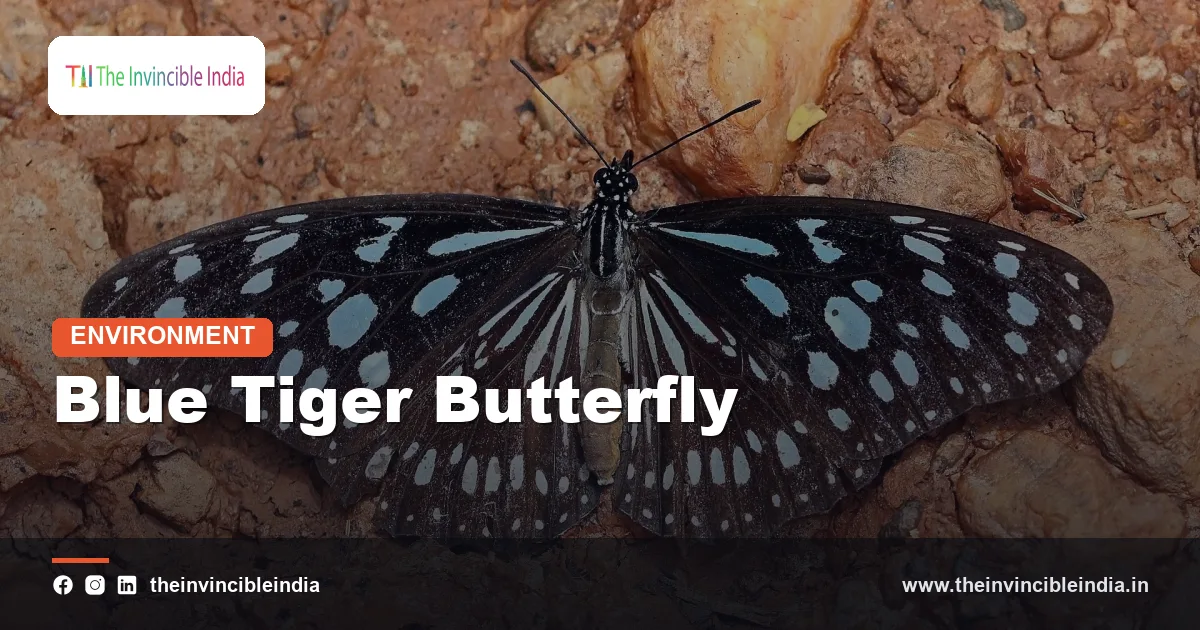
The blue tiger butterfly (Tirumala limniace) is a medium-large, dark brown to black butterfly marked with pale blue, translucent streaks, found across peninsular India and tropical Asia, and famous for the large seasonal migrations it makes together with other “tiger” butterflies. The blue tiger butterfly belongs to the milkweed butterfly group (subfamily Danainae), and it protects itself with bitter, toxic chemicals taken from its caterpillar food plants.
Few insect sights in India match a blue tiger migration, when thousands of butterflies glide in loose streams across the countryside, often with the arrival of the monsoon. This explainer covers how to identify the species, why it is toxic, where and when it migrates, what it eats, and how it fits into the wider group of mimics and look-alikes.
| Attribute | Detail |
|---|---|
| Scientific name | Tirumala limniace |
| Family and subfamily | Nymphalidae, subfamily Danainae (milkweed or tiger butterflies) |
| Wingspan | Roughly 85 to 100 millimetres |
| Colour pattern | Dark brown or black wings with long, pale blue to bluish-white streaks and spots |
| Range | Much of India, Sri Lanka and tropical and subtropical Asia |
| Behaviour | Slow, gliding flight; seasonal mass migration; communal roosting |
| Caterpillar food plants | Milkweed-family climbers such as Tylophora, Ceropegia, Cynanchum and Marsdenia |
| Defence | Toxic cardenolides from host plants; warning colours |
| Conservation status | Widespread and common; not considered threatened |
Key Takeaways
- The blue tiger butterfly (Tirumala limniace) is a black-and-pale-blue milkweed butterfly widespread across peninsular India.
- Blue tiger butterflies take part in seasonal mass migrations in south India, moving towards the Western Ghats around the monsoon and returning afterwards.
- Blue tiger caterpillars feed on milkweed-family climbers, from which they absorb bitter, toxic cardenolides.
- The blue tiger’s toxins stay in the adult butterfly, and its bold striped pattern acts as a warning signal to predators.
- Harmless butterflies such as the common mime imitate the blue tiger and the related tigers and crows to gain protection.
- Male blue tigers collect alkaloids from certain plants, such as heliotrope, to make pheromones used in courtship.
What Is the Blue Tiger Butterfly?
The blue tiger butterfly is a medium-large butterfly of the family Nymphalidae, scientifically named Tirumala limniace, and it is one of the “tigers”, a group of striped milkweed butterflies in the subfamily Danainae. The group also contains the plain tiger, the dark blue tiger, the glassy tiger and the crows.
The English name comes from the tiger-like stripes on the wings. The species has an elongated forewing and a more rounded hindwing, and it flies with a lazy, gliding wingbeat that sets it apart from faster-flying butterflies. The slow flight is itself a sign of confidence, because the toxic butterfly can afford to be less evasive than its edible relatives.
The butterfly is common in open forest, scrub, farmland and gardens in much of India. It is especially visible in the post-monsoon months, when it feeds on flowers along roadsides and in forest clearings.
How Do You Identify a Blue Tiger Butterfly?
You can identify a blue tiger butterfly by its dark brown-black wings crossed by long, pale blue, semi-transparent streaks, with rows of pale spots along the wing edges. The streaks tend to appear bluish-white from a distance and brighter bluish when the sun shines through the wings.
Key Field Marks
- Forewing: Long, broad pale-blue stripes between the dark veins, as well as pale spots near the tip.
- Hindwing: Pale blue streaks radiating from the base, bordered by a black margin dotted with white spots.
- Body: Black with white spots on the head and thorax.
- Flight: Slow gliding and sailing, with occasional flapping.
Blue Tiger vs Dark Blue Tiger
| Feature | Blue tiger (Tirumala limniace) | Dark blue tiger (Tirumala septentrionis) |
|---|---|---|
| Streak colour | Paler, whitish-blue and broader | Deeper blue and narrower |
| Overall look | Lighter, with longer streaks | Darker, with shorter streaks and a more contrasted pattern |
| Wing spots | Rows of white marginal spots | Similar spots but typically more prominent against a darker background |
| Typical habitat | Open country, scrub and forest edges, also gardens | Often in moister woodland and hill forest |
The two species are close relatives and are often seen together, so careful observation of streak colour and width is needed to separate them.
Why Is the Blue Tiger Butterfly Poisonous?
The blue tiger butterfly is poisonous because its caterpillars eat milkweed-family plants containing cardenolides, bitter heart-acting chemicals that the insect stores in its body for life. A predator that eats a blue tiger usually spits it out or becomes sick and learns to avoid it.
The caterpillar sequesters these compounds from the leaves, and they remain in the pupa and adult. The butterfly’s bold colours and contrasting stripes act as aposematism, or warning colouration, advertising that it is unpalatable. This is why the butterfly flies slowly and often rests in the open without being taken by birds or lizards.
Adult males add another chemical layer. They visit withered or damaged plants of certain groups, such as heliotropes and some Crotalaria, to sip pyrrolizidine alkaloids. These substances serve as raw material for a courtship pheromone, and they also add to the male’s chemical protection. Watching a male visit a dry heliotrope plant is a common sight during the dry season.
The toxic strategy is shared by many Danainae. The plain tiger (Danaus chrysippus), the striped tiger (Danaus genutia) and the crows (Euploea species) are also distasteful, and together they form a loose community of look-alikes that predators learn to avoid.
Where and When Do Blue Tiger Butterflies Migrate?
Blue tiger butterflies migrate in south India mainly between the plains and the Western Ghats, moving towards the hills around the pre-monsoon and monsoon months and returning towards the plains after the rains. The movement is part of a larger tiger-and-crow migration seen across the peninsula.
Researchers and butterfly watchers in Karnataka, Kerala, Tamil Nadu and neighbouring states have documented the pattern. During April to June, tigers and crows stream west and north-west in large numbers, often following valleys and ridges, and reach the forested slopes of the Western Ghats where the monsoon is strong. After the rains, from about October to December, many butterflies fly back eastwards and southwards into the plains.
Why Do They Migrate?
The most accepted explanation is that the migration allows the butterflies to escape dry, hot conditions in the plains, where their host plants wither, and to reach cooler, humid areas where fresh host plants and nectar flowers are available. Because the butterflies are toxic, they can travel in large conspicuous groups without being heavily preyed upon.
What Does a Migration Look Like?
A migration looks like a steady, thin stream of butterflies flying low in one direction over a wide front, sometimes continuing for days. Individual butterflies glide, flap and glide again, and may pause to drink nectar or mud. Compared with the famous monarch migration of North America, the Indian tiger migration is shorter and less well mapped, and many details remain under study.
Do Blue Tiger Butterflies Roost Together?
Yes, blue tiger butterflies roost together in groups, especially during the dry months when they gather in cool, shaded and humid spots. These roosts can contain dozens to many thousands of butterflies, often mixed with other tigers and crows.
Roosts typically form on trees and shrubs in forest hollows, riverbanks or sheltered valleys, and the insects hang from twigs and leaves with their wings closed, showing the dull undersides. The sight of a tree covered in butterflies is striking and has been recorded in several parts of the Western Ghats and the Eastern Ghats.
Scientists think communal roosting offers several benefits. It helps the butterflies retain moisture and keep a stable temperature. It may also increase the strength of the warning signal that predators see. Roosting sites are often used year after year, so protecting these patches of forest and riverside vegetation is important for the species.
What Plants Does the Blue Tiger Caterpillar Eat?
The blue tiger caterpillar eats leaves of milkweed-family plants, scientifically the Apocynaceae subfamily Asclepiadoideae, including climbers such as Tylophora, Ceropegia, Cynanchum and Marsdenia species. These plants contain milky sap and cardenolides, which protect them from most herbivores but not from specialised milkweed butterflies.
The female lays tiny, pale eggs singly on the underside of young leaves. The caterpillar that emerges is banded in colour, with contrasting stripes of black, white and yellow, and it bears soft, fleshy filaments that curve outwards from its body. These bold markings also advertise toxicity.
Different tiger butterflies prefer different food plants. The plain tiger often uses the crown flower or calotrope (Calotropis), which is common along roadsides, while the blue tiger usually favours twining climbers of forest edges and scrub. Because many host climbers are thin and easily overlooked, gardeners rarely see the caterpillars unless they plant suitable species deliberately.
What Is the Blue Tiger’s Life Cycle?
The blue tiger butterfly goes through four stages of complete metamorphosis, egg, caterpillar, chrysalis and adult, and one generation commonly takes several weeks in warm weather. Breeding is continuous in warm, moist conditions, with peaks during and after the monsoon.
- Egg: A tiny cream or pale-yellow egg is glued to the underside of a leaf of the host climber.
- Caterpillar: The larva feeds, moults several times, and grows into a striped caterpillar with fleshy filaments.
- Chrysalis: The caterpillar hangs head-down from a stalk and forms a smooth, green or pale chrysalis decorated with shiny, metallic-looking spots.
- Adult: The butterfly emerges, pumps fluid into its wings to expand them, and may live for several weeks, longer in migrating or roosting populations.
The adult feeds on nectar from a variety of flowers, including Lantana, Eupatorium, Tridax and wild herbs, and it also takes minerals from damp ground. Overwintering and migrating adults may live considerably longer than adults in the breeding season.
Which Butterflies Mimic the Blue Tiger?
Several harmless butterflies mimic the blue tiger, the best known being the common mime (Papilio clytia), a swallowtail whose dissimilis form looks like blue tigers and related toxic danaines. Mimicry of this type is called Batesian mimicry, in which an edible species copies the warning pattern of a distasteful one.
The common mime is a swallowtail, a member of the same family as the common mormon, yet its dissimilis form is strikingly similar to the tiger butterflies, with black wings and pale bluish-white streaks. Its flight is slow and gliding like the model’s, which adds to the deception. Another form of the common mime, called clytia, copies the common crow.
The blue tiger is also part of a Müllerian mimicry network. In Müllerian mimicry, several toxic species share similar warning patterns so that predators need to learn only one signal. The blue tiger, dark blue tiger, glassy tiger and other tigers look alike for this reason, and each species benefits from the shared reputation.
How Can You Spot and Protect Blue Tiger Butterflies?
You can spot blue tiger butterflies by visiting flowering shrubs, forest edges and damp stream banks in the post-monsoon season, and you can protect them by conserving host climbers and avoiding pesticides. The best time to see migrations is typically before and just after the monsoon, in southern states.
- Plant nectar flowers: Lantana, Tridax, ageratum and Eupatorium are favoured by tigers.
- Keep wild climbers: Do not clear milkweed-family vines from hedges and forest edges.
- Avoid pesticides: Sprays kill caterpillars and adults.
- Record sightings: Upload photos and counts to citizen science platforms such as India Biodiversity Portal, eButterfly or iNaturalist to help track migration timing.
- Do not collect: Observation and photography have no impact on populations, while collection can be restricted under Indian wildlife law.
The blue tiger is common and is not considered threatened. Even so, loss of forest edges, roadside weeds and riverside vegetation can reduce the host plants and roosting sites on which migrations depend.
Bottom Line
The blue tiger butterfly is a toxic, striking and well-travelled insect, wearing its warning in blue and black. Its caterpillars turn milkweed poison into defence, its adults migrate in streams across the peninsula, and its pattern is copied by harmless mimics. Protecting wild climbers and unsprayed gardens helps keep this migration alive.
Frequently Asked Questions
What is the scientific name of the blue tiger butterfly?
The scientific name of the blue tiger butterfly is Tirumala limniace. It belongs to the family Nymphalidae and the milkweed butterfly subfamily Danainae. It is closely related to the dark blue tiger, Tirumala septentrionis.
Is the blue tiger butterfly poisonous?
Yes, the blue tiger butterfly is poisonous to many predators because it stores bitter cardenolides taken from its milkweed host plants. The toxins make it unpalatable or sickening to birds and lizards. Its striped blue and black pattern warns predators to leave it alone.
Do blue tiger butterflies migrate in India?
Yes, blue tiger butterflies migrate in India, mainly in peninsular regions, where they move in large numbers towards the Western Ghats around the pre-monsoon and monsoon period. After the rains, many return towards the plains. The movement is shared with other tiger and crow butterflies.
What do blue tiger caterpillars eat?
Blue tiger caterpillars eat the leaves of milkweed-family climbers such as Tylophora, Ceropegia, Cynanchum and Marsdenia. These plants contain toxic compounds that the caterpillars absorb for their own defence. The caterpillars rarely feed on common garden plants.
How is the blue tiger different from the plain tiger?
The blue tiger is dark with pale blue streaks, while the plain tiger (Danaus chrysippus) is mostly orange-brown with black and white wing tips. The blue tiger usually feeds on forest-edge climbers, whereas the plain tiger often uses Calotropis. Both are toxic and both belong to the same subfamily.
Where can you see blue tiger butterflies in India?
You can see blue tiger butterflies in many parts of India, especially in south India, in forest edges, scrub, farmland and gardens. They are most visible after the monsoon, around flowering shrubs and damp ground. Migration streams are best seen in Karnataka, Kerala and Tamil Nadu before and after the rains.
{“@context”:”https://schema.org”,”@graph”:[{“@type”:”FAQPage”,”mainEntity”:[{“@type”:”Question”,”name”:”What is the scientific name of the blue tiger butterfly?”,”acceptedAnswer”:{“@type”:”Answer”,”text”:”The scientific name of the blue tiger butterfly is Tirumala limniace. It belongs to the family Nymphalidae and the milkweed butterfly subfamily Danainae. It is closely related to the dark blue tiger, Tirumala septentrionis.”}},{“@type”:”Question”,”name”:”Is the blue tiger butterfly poisonous?”,”acceptedAnswer”:{“@type”:”Answer”,”text”:”Yes, the blue tiger butterfly is poisonous to many predators because it stores bitter cardenolides taken from its milkweed host plants. The toxins make it unpalatable or sickening to birds and lizards. Its striped blue and black pattern warns predators to leave it alone.”}},{“@type”:”Question”,”name”:”Do blue tiger butterflies migrate in India?”,”acceptedAnswer”:{“@type”:”Answer”,”text”:”Yes, blue tiger butterflies migrate in India, mainly in peninsular regions, where they move in large numbers towards the Western Ghats around the pre-monsoon and monsoon period. After the rains, many return towards the plains. The movement is shared with other tiger and crow butterflies.”}},{“@type”:”Question”,”name”:”What do blue tiger caterpillars eat?”,”acceptedAnswer”:{“@type”:”Answer”,”text”:”Blue tiger caterpillars eat the leaves of milkweed-family climbers such as Tylophora, Ceropegia, Cynanchum and Marsdenia. These plants contain toxic compounds that the caterpillars absorb for their own defence. The caterpillars rarely feed on common garden plants.”}},{“@type”:”Question”,”name”:”How is the blue tiger different from the plain tiger?”,”acceptedAnswer”:{“@type”:”Answer”,”text”:”The blue tiger is dark with pale blue streaks, while the plain tiger (Danaus chrysippus) is mostly orange-brown with black and white wing tips. The blue tiger usually feeds on forest-edge climbers, whereas the plain tiger often uses Calotropis. Both are toxic and both belong to the same subfamily.”}},{“@type”:”Question”,”name”:”Where can you see blue tiger butterflies in India?”,”acceptedAnswer”:{“@type”:”Answer”,”text”:”You can see blue tiger butterflies in many parts of India, especially in south India, in forest edges, scrub, farmland and gardens. They are most visible after the monsoon, around flowering shrubs and damp ground. Migration streams are best seen in Karnataka, Kerala and Tamil Nadu before and after the rains.”}}]}]}


