

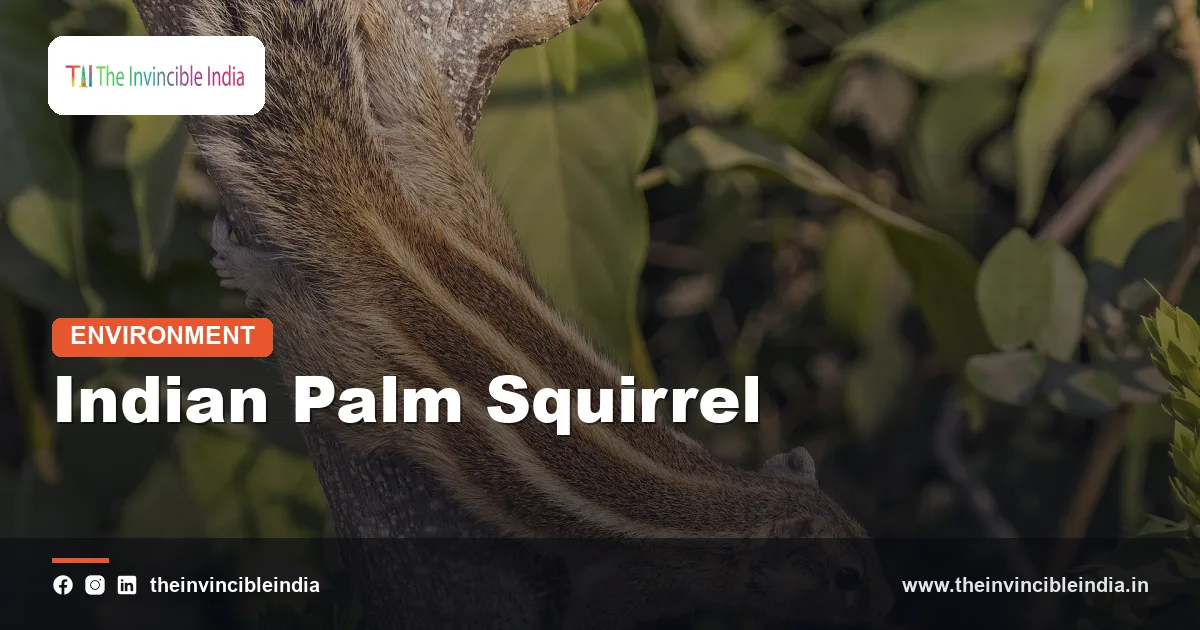
The Indian palm squirrel (Funambulus palmarum), also called the three-striped palm squirrel, is a small, agile rodent of the family Sciuridae that lives in homes, gardens, orchards and woodlands across peninsular India and Sri Lanka, and is recognised by the three pale stripes running down its back. The Indian palm squirrel is one of the most familiar wild mammals in the country, and it is the centre of a well-loved legend in which Lord Rama’s fingers left stripes on its fur.
This explainer covers how to identify the Indian palm squirrel, the difference between the three-striped and five-striped palm squirrels, where it lives, what it eats, how it communicates, the Ramayana story, and its role in dispersing seeds. Information was last reviewed on 23 October 2026.
| Quick Fact | Detail |
|---|---|
| Common names | Indian palm squirrel, three-striped palm squirrel; gilahri (Hindi), khar (Marathi), anil (Tamil and Malayalam), alilu (Kannada), udutha (Telugu) |
| Scientific name | Funambulus palmarum (Linnaeus, 1766) |
| Family | Sciuridae (squirrels), subfamily Sciurinae, genus Funambulus |
| Body size | Head and body about 12 to 18 cm, with a tail of similar length; weight roughly 100 to 150 g |
| Distinctive feature | Three pale stripes on the back, running from shoulders to rump |
| Range | Peninsular India (south of the Gangetic plain) and Sri Lanka; widely introduced in places |
| Activity | Diurnal (active by day), arboreal and ground-foraging |
| Diet | Fruit, seeds, nuts, flowers, buds, sap, insects and occasionally eggs |
| Conservation status | Assessed globally as Least Concern; common near human settlement |
Key Takeaways
- The Indian palm squirrel (Funambulus palmarum) is a small striped rodent of peninsular India and Sri Lanka, recognised by three pale stripes down its back.
- The northern palm squirrel (Funambulus pennantii) is a close relative with five stripes and replaces the three-striped species across much of northern India.
- The Indian palm squirrel eats fruits, seeds, nuts, flowers and insects, and it disperses seeds when it buries or drops food away from the parent tree.
- A Ramayana folk legend says Lord Rama stroked a helpful squirrel, and the marks of his fingers became the three stripes of the Indian palm squirrel.
- The Indian palm squirrel gives a sharp, chattering alarm call and flicks its tail to warn others when crows, cats, snakes or raptors approach.
- The Indian palm squirrel is common and adaptable, and it is classified as Least Concern by the global conservation assessment.
What Is the Indian Palm Squirrel?
The Indian palm squirrel is a small tree squirrel with greyish-olive fur and three creamy stripes along its back, and it belongs to the genus Funambulus, the palm squirrels of South Asia. Carl Linnaeus described it in 1766 as Sciurus palmarum, and the species is now placed in Funambulus, a name derived from the Latin word for a rope-walker.
The name “palm squirrel” reflects the animal’s habit of living in coconut and palmyra palms, where it feeds on flowers and fruits and builds nests among the fronds. It is also called the three-striped palm squirrel to distinguish it from the five-striped species and from the jungle palm squirrel of the Western Ghats.
The Indian palm squirrel is an unusually well-known animal because it shares human space. It runs along walls, wires and roofs, visits kitchens and verandas, and often becomes tame enough to take food from the hand.
How Do You Identify an Indian Palm Squirrel?
An Indian palm squirrel is identified by its olive-grey to brownish upper body, three pale stripes along the back, a long bushy tail ringed with black and buff, and a pale underside. Its ears are small and rounded, its eyes are dark and prominent, and its movements are quick and jerky.
Distinguishing features
- Stripes: three pale lines on the back, with the two outer stripes usually less clear than the central stripe, which may extend to the head.
- Tail: nearly as long as the body, with a fringe of fur that gives a fluffy outline.
- Underparts: creamy white or pale buff.
- Size: noticeably smaller than the Indian giant squirrel (Ratufa indica), which is much larger and has a rich maroon-and-cream coat.
Males and females look similar. Juveniles are smaller and often look paler, and they gain the full tail fluff over their first months.
What Is the Difference Between Three-Striped and Five-Striped Palm Squirrels?
The main difference is that the Indian palm squirrel (Funambulus palmarum) has three stripes, while the northern palm squirrel (Funambulus pennantii) has five stripes and a slightly paler, more yellowish body. The northern palm squirrel occupies drier regions of north-western and northern India, including Rajasthan, Gujarat, Punjab, Haryana, Delhi and Uttar Pradesh.
The ranges of the two species meet and overlap in parts of central and western India, and taxonomists continue to study their boundaries. A third relative, the jungle palm squirrel (Funambulus tristriatus), also has three stripes but lives in the wetter forests of the Western Ghats and has darker fur.
| Feature | Indian palm squirrel | Northern palm squirrel | Jungle palm squirrel |
|---|---|---|---|
| Scientific name | Funambulus palmarum | Funambulus pennantii | Funambulus tristriatus |
| Stripes | Three | Five | Three |
| Typical range | Peninsular India and Sri Lanka | Northern and north-western India, plus parts of Pakistan and Nepal | Western Ghats forests |
| Habitat | Gardens, towns, orchards, plantations | Dry plains, towns, farmland | Evergreen and moist deciduous forest |
| Notes | Most familiar squirrel in southern towns | Most familiar squirrel in northern cities | Shy, more forest-bound |
Where Does the Indian Palm Squirrel Live?
The Indian palm squirrel lives in peninsular India and Sri Lanka, in forests, plantations, gardens, parks and urban neighbourhoods, from the plains up to moderate hill elevations. It prefers areas with trees, especially coconut palms, mango, neem, tamarind, banyan and other fruit trees.
The species is adaptable, and its range has expanded in places where people planted trees and provided food. It has also been introduced to a few locations outside its natural range, where it can compete with local fauna.
Its home range is usually small, and individuals tend to remain near familiar trees and buildings. In cities, it uses power lines, balconies, walls and rooftops as travel routes, often keeping a safe distance from dogs and cats by staying high.
Nests and shelters
The Indian palm squirrel builds spherical nests, called dreys, from grass, fibres, leaves and sometimes rags or paper, placed in the crown of a palm, in a fork of a tree, or in a gap in a building. It also uses natural tree holes and sheltered crevices.
What Does the Indian Palm Squirrel Eat?
The Indian palm squirrel eats a mixed diet of fruits, seeds, nuts, flowers, buds and tender shoots, and it adds insects, tree sap and, occasionally, bird eggs or nestlings. It is an omnivore with a strong preference for plant food.
- Fruits: mango, guava, banana, jamun, papaya and many wild figs.
- Seeds and nuts: groundnut, coconut, cashew, tamarind seeds and cereal grains.
- Flowers and sap: coconut flowers, coral tree flowers and sweet sap from bark wounds.
- Animal food: termites, caterpillars and other insects in small quantities.
The Indian palm squirrel holds food with its forepaws, sits upright to eat, and gnaws constantly to keep its ever-growing incisors worn down. Like all rodents, its front teeth never stop growing, so chewing on hard objects is a daily necessity.
In orchards and gardens, the Indian palm squirrel is sometimes treated as a pest because it nibbles fruit, but it is generally a minor problem and many farmers tolerate it.
How Does the Indian Palm Squirrel Communicate?
The Indian palm squirrel communicates mainly through sharp, chirping calls, tail movements and posture, with its alarm call being a rapid “chip-chip-chip” chatter repeated while the tail flicks. The alarm call warns other squirrels and nearby birds about predators such as crows, kites, cats, mongooses and snakes.
The tail is a key signalling tool. A tail jerking from side to side or upward often signals alertness or excitement, while a fluffed tail may show agitation. Squirrels also use the tail for balance on thin branches and wires, and in hot weather it provides a little shade.
Other palm squirrel sounds include softer chittering between mates and quiet calls from mothers to young. During the breeding season, males chase females in energetic loops around tree trunks, a common sight in parks and gardens.
What Is the Ramayana Legend of the Indian Palm Squirrel?
The legend says that when Lord Rama’s army built a bridge to Lanka, a small squirrel helped by rolling in the sand and shaking it into the gaps between stones, and Rama gently stroked its back, leaving three stripes with his fingers. In popular belief, these stripes are why the Indian palm squirrel carries three lines down its back today.
The story is a folk tradition found in many regional retellings of the Ramayana rather than a feature of every version, and details vary between languages and regions. It is often told to children to show that even a small effort to serve a noble cause deserves respect.
Because of this tale, the squirrel is regarded with affection in many Hindu households, and it appears in temple art, storybooks and school lessons. The tale is a good example of how a natural feature, the stripes, becomes part of a shared cultural memory.
How Does the Indian Palm Squirrel Breed and Live?
The Indian palm squirrel breeds several times a year in favourable conditions, and females typically give birth to litters of two or three young after a gestation of roughly six weeks. The young are born blind and hairless, and they depend on the mother for several weeks before they venture out.
In the wild, breeding is linked to food supply and weather, and it can occur in more than one season. Mothers raise their young in the drey or a tree hole, and juveniles become independent within a few months.
Lifespan in the wild is usually several years, shortened by predation, traffic, electrocution on power lines and disease. In captivity or protected settings, individuals can live longer.
What Role Does the Indian Palm Squirrel Play in Ecosystems?
The Indian palm squirrel acts as a seed disperser, a minor pollinator of some flowering trees and a prey species, linking plants and predators in the food web. When it carries fruit away to eat, buries seeds or drops partly eaten fruit, it moves seeds away from the parent tree, giving some of them a chance to germinate.
It also feeds birds of prey, snakes and carnivorous mammals, and it supports populations of predators in towns and forests. At the same time, it reduces insects by eating them. Ecologists regard the palm squirrel as a useful small mammal for studying how animals live alongside people.
Roles such as pollination are less well documented than seed dispersal, so researchers describe them with caution. Local studies in orchards and plantations continue to refine how much the animal helps or harms crops.
Is the Indian Palm Squirrel Safe to Feed or Handle?
The Indian palm squirrel is a wild animal, and while it can be fed small amounts of fruit or nuts, it should not be handled, because it can bite and may carry parasites or diseases. Feeding should be modest and natural, such as a piece of fruit or a few unsalted nuts, rather than processed foods.
- Avoid giving sugary, salty or fried food, which can harm the squirrel’s health.
- Do not keep a wild squirrel as a pet; it is wild, and handling young animals can stress them.
- If you find a fallen baby squirrel, keep it warm and contact a local wildlife rescue group.
- Keep a bowl of fresh water available in hot weather.
Bottom Line
The Indian palm squirrel is a small, striped, adaptable rodent of peninsular India that eats fruit and seeds, scatters seeds across gardens and orchards, and carries a cherished place in the Ramayana folk tradition. Its stripes, chatter and daily presence make it one of the easiest wild mammals to observe and appreciate.
Frequently Asked Questions
What is the Indian palm squirrel?
The Indian palm squirrel (Funambulus palmarum) is a small striped rodent of the family Sciuridae that lives in peninsular India and Sri Lanka. It has three pale stripes down its back and a long bushy tail. It is common in homes, gardens, orchards and woodlands.
Why does the Indian palm squirrel have three stripes?
According to a Ramayana folk legend, the squirrel has three stripes because Lord Rama stroked its back with his fingers after it helped build the bridge to Lanka. In biological terms, the stripes are a natural camouflage pattern that breaks up the outline of the animal against tree bark and branches. The story is a folk tradition and varies between retellings.
What is the difference between the Indian palm squirrel and the northern palm squirrel?
The Indian palm squirrel (Funambulus palmarum) has three stripes, while the northern palm squirrel (Funambulus pennantii) has five. The northern species lives mainly in north and north-western India, and the three-striped species lives in the peninsula and Sri Lanka. Their ranges meet and overlap in some central and western regions.
What does the Indian palm squirrel eat?
The Indian palm squirrel eats fruits, seeds, nuts, flowers, buds and sap, along with insects and occasionally eggs. Mango, guava, coconut and groundnut are common foods. Its constant gnawing keeps its continuously growing front teeth worn down.
Why does the Indian palm squirrel chatter and flick its tail?
The Indian palm squirrel chatters and flicks its tail mainly to give an alarm when it sees a predator such as a crow, cat, snake or bird of prey. The rapid chirping warns other squirrels and often nearby birds. Tail movements also show excitement and help with balance.
Is the Indian palm squirrel endangered?
The Indian palm squirrel is not endangered and is classified as Least Concern in the global assessment. It is common near human settlements and adapts well to gardens and towns. Local threats include traffic, predation, electrocution on power lines and habitat loss.
{“@context”:”https://schema.org”,”@graph”:[{“@type”:”FAQPage”,”mainEntity”:[{“@type”:”Question”,”name”:”What is the Indian palm squirrel?”,”acceptedAnswer”:{“@type”:”Answer”,”text”:”The Indian palm squirrel (Funambulus palmarum) is a small striped rodent of the family Sciuridae that lives in peninsular India and Sri Lanka. It has three pale stripes down its back and a long bushy tail. It is common in homes, gardens, orchards and woodlands.”}},{“@type”:”Question”,”name”:”Why does the Indian palm squirrel have three stripes?”,”acceptedAnswer”:{“@type”:”Answer”,”text”:”According to a Ramayana folk legend, the squirrel has three stripes because Lord Rama stroked its back with his fingers after it helped build the bridge to Lanka. In biological terms, the stripes are a natural camouflage pattern that breaks up the outline of the animal against tree bark and branches. The story is a folk tradition and varies between retellings.”}},{“@type”:”Question”,”name”:”What is the difference between the Indian palm squirrel and the northern palm squirrel?”,”acceptedAnswer”:{“@type”:”Answer”,”text”:”The Indian palm squirrel (Funambulus palmarum) has three stripes, while the northern palm squirrel (Funambulus pennantii) has five. The northern species lives mainly in north and north-western India, and the three-striped species lives in the peninsula and Sri Lanka. Their ranges meet and overlap in some central and western regions.”}},{“@type”:”Question”,”name”:”What does the Indian palm squirrel eat?”,”acceptedAnswer”:{“@type”:”Answer”,”text”:”The Indian palm squirrel eats fruits, seeds, nuts, flowers, buds and sap, along with insects and occasionally eggs. Mango, guava, coconut and groundnut are common foods. Its constant gnawing keeps its continuously growing front teeth worn down.”}},{“@type”:”Question”,”name”:”Why does the Indian palm squirrel chatter and flick its tail?”,”acceptedAnswer”:{“@type”:”Answer”,”text”:”The Indian palm squirrel chatters and flicks its tail mainly to give an alarm when it sees a predator such as a crow, cat, snake or bird of prey. The rapid chirping warns other squirrels and often nearby birds. Tail movements also show excitement and help with balance.”}},{“@type”:”Question”,”name”:”Is the Indian palm squirrel endangered?”,”acceptedAnswer”:{“@type”:”Answer”,”text”:”The Indian palm squirrel is not endangered and is classified as Least Concern in the global assessment. It is common near human settlements and adapts well to gardens and towns. Local threats include traffic, predation, electrocution on power lines and habitat loss.”}}]}]}


