

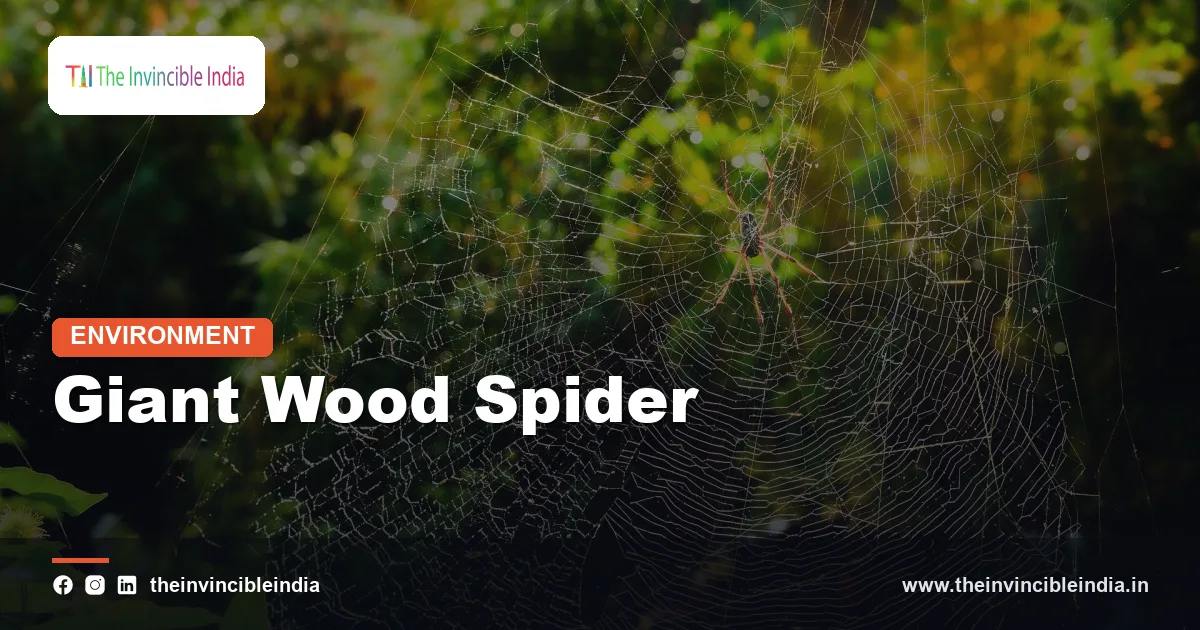
The giant wood spider is a very large golden orb-weaving spider, usually identified as Nephila pilipes, that spins huge, strong, golden-yellow webs between trees, shrubs and garden structures across India and much of Asia. The female is a big, striking spider with a body several centimetres long, while the male is a tiny fraction of her size, and both are harmless to people.
The giant wood spider looks alarming but is not dangerous: its venom is aimed at small insects, and it seldom bites humans even when disturbed. Its web is among the strongest natural structures made by any animal, and the spider is a valuable controller of flies, mosquitoes and other flying insects in forests, plantations and gardens.
| Quick Fact | Detail |
|---|---|
| Common names | Giant wood spider, northern golden orb-weaver, giant golden orb-weaver |
| Scientific name | Nephila pilipes (genus Nephila, sometimes grouped with Trichonephila in newer classifications) |
| Group | Orb-weaving spiders, Order Araneae |
| Female body length | Roughly 3 to 5 cm, with a leg span that can exceed 10 cm |
| Male body length | Only about 5 to 8 mm, many times smaller than the female |
| Web | Golden-tinted orb web, often about a metre across, supported by long anchor lines |
| Habitat | Forest edges, plantations, gardens, hedges and orchards across tropical and subtropical Asia |
| Danger to humans | Not dangerous; bites are rare and cause only mild, short-lived local pain |
Key Takeaways
- The giant wood spider (Nephila pilipes) is a large golden orb-weaver whose female can have a body length of several centimetres, while the male is only a few millimetres long.
- The giant wood spider builds a golden-tinted web, often about a metre across, which it keeps for weeks and repairs repeatedly.
- Silk of the giant wood spider is extremely tough, absorbing a great deal of energy before it breaks, which is why scientists and engineers study it.
- The giant wood spider is not dangerous to humans; its bite is rare and usually no worse than a mild pinch or sting.
- A giant wood spider feeds on flies, mosquitoes, wasps, moths and other flying insects, which makes it a natural pest controller in gardens and plantations.
- Female giant wood spiders are most visible in India from the late monsoon through winter, when they have grown to their full size.
What is the giant wood spider?
The giant wood spider is an orb-weaving spider of the genus Nephila whose large females hang head-down in the centre of a big golden web. The species most often given this name in India and Southeast Asia is Nephila pilipes, which was described by the Danish zoologist Johan Christian Fabricius in 1793. Many field guides also call it the northern golden orb-weaver.
The genus Nephila is placed among the orb-weavers and has long been famous for its size and its silk. In recent years some taxonomists have moved a few species into a related genus, Trichonephila, so you may see both names in literature. The common name “wood” refers to the habitats where the spider is usually found: wooded country, tree lines and forest clearings.
Because it is large, conspicuous and common near homes in some regions, the giant wood spider is one of the spiders that Indians are most likely to notice, particularly after the monsoon when webs seem to appear overnight along paths and between trees.
How big is a giant wood spider?
A female giant wood spider has a body about 3 to 5 cm long and a leg span that can exceed 10 cm, making her one of the largest web-building spiders in India. Her long, banded legs carry tufts of dark hair, her cephalothorax is covered in fine silvery hair, and her elongated abdomen is often yellow or olive with pale spots.
The male giant wood spider measures only about 5 to 8 mm and is so small that people frequently mistake him for a stray speck or an unrelated tiny spider. He is brownish and slender, and he lives on the female’s web, often sitting at its edge or on the guy lines.
Why the size difference?
The extreme difference in size between the two sexes is called sexual size dimorphism, and the giant wood spider is among the most extreme examples known. Biologists think that large females are favoured because a bigger body can carry and lay many more eggs, while small males can mature quickly, move lightly on the silk and search for mates with little energy cost.
In a typical web, one large female may share space with one or several tiny males who wait for a chance to mate, sometimes while she is moulting or feeding. Males that approach too boldly are sometimes caught and eaten, though in many Nephila species this cannibalism is less common than popular accounts suggest.
Why does the giant wood spider build a golden web?
The giant wood spider builds a golden web because its silk contains yellow pigments called carotenoids, and the colour appears to help in catching prey and in reducing the visibility of the web to birds. Researchers suggest that the yellow tint reflects light in a way that attracts insects in bright sunshine, while in shaded forest the same colour blends into the background and makes the web less obvious.
The web itself is made of three parts. At the centre is the orb, a round sticky spiral net often about a metre across. Surrounding it are strong frame and anchor lines that stretch several metres to branches or poles. On one or both sides of the orb there is often a loose, irregular barrier web made of threads, which may help to protect the spider from predators such as wasps and birds.
Unlike many small orb-weavers that rebuild their web every day, the giant wood spider keeps the same web for a long time and mends it by replacing damaged sections. This long-lived design explains why the web is so heavily built.
Why do webs appear after the rains?
Young spiders spread out in the early months and grow quickly during the wet season when insects are abundant. By the late monsoon and the cooler months that follow, females reach full size and their large webs become visible along forest trails, orchards and garden boundaries.
How strong is giant wood spider silk?
Giant wood spider silk is exceptionally strong and tough, because the main dragline thread can stretch and absorb a large amount of energy before it breaks. Weight for weight, spider dragline silk is often compared with high-grade steel in tensile strength, and it is much more elastic, which is why it can stop a flying insect without snapping.
Orb-weaving spiders such as the giant wood spider can produce several different types of silk from separate glands, up to seven in total in many orb-weavers. These range from the strong dragline and frame threads to sticky capture threads, wrapping silk for prey and soft silk for egg sacs.
| Silk type | Main use for the spider |
|---|---|
| Dragline (major ampullate) | Frame and radial threads of the web; safety line |
| Capture spiral (flagelliform with sticky glue) | Stretchy, sticky thread that traps insects |
| Wrapping silk (aciniform) | Wraps captured prey and lines egg sacs |
| Egg-case silk (tubuliform) | Tough protective covering for eggs |
| Attachment silk (piriform) | Cement-like discs that anchor lines to surfaces |
Human uses of Nephila silk
People in parts of New Guinea and the Pacific have traditionally used the webs of large Nephila spiders as fishing nets, by bending a flexible stick into a loop and collecting the webs on it. In 2009, a golden cape woven from the silk of more than a million wild golden orb spiders, collected over several years in Madagascar, was displayed at the Victoria and Albert Museum in London. Scientists studying the genes and proteins behind spider silk hope to make similar materials in the laboratory for medical sutures, lightweight armour and biodegradable fibres.
Is the giant wood spider poisonous or dangerous to humans?
The giant wood spider is not dangerous to humans: it is venomous in the sense that all spiders use venom to subdue prey, but its venom is mild for people and bites are very rare. A spider that is crushed against skin or seized by hand may bite, and the usual result is brief local pain, slight redness and sometimes mild swelling, similar to a minor sting.
The giant wood spider is shy and tends to freeze or to bounce its web when disturbed, and it will retreat rather than attack. There are no well-documented cases of serious harm to healthy people from Nephila species. People with allergies to insect stings should treat any spider bite with caution and see a doctor if swelling, breathing difficulty or other unusual symptoms appear.
The word “poisonous” is often misused for spiders. A poisonous animal causes harm when eaten or touched, whereas a venomous animal injects toxins by biting or stinging. The giant wood spider is venomous but its venom is directed at insects, not at people.
Common sense around webs
- Do not grab the spider or crush the web with bare hands.
- Walk around a web at head height, or move it away on a long stick if it blocks a path.
- Wash a bite with soap and water and apply a cold compress.
- Seek medical advice if you notice an allergic reaction.
What does the giant wood spider eat?
The giant wood spider eats flying and crawling insects that are caught in its web, including flies, mosquitoes, beetles, bees, wasps, butterflies, moths and grasshoppers. When an insect hits the web, the spider rushes to it, bites it to inject venom, and wraps it in silk before eating it or storing it for later.
Very large webs of the giant wood spider can occasionally catch small vertebrates such as tiny birds or bats, but this is rare and accidental, and such animals are not a regular food source. Every catch is a small contribution to the balance of insect populations in the habitat.
Small tenants in the web
The webs of large Nephila spiders often host smaller spiders, such as dewdrop spiders of the genus Argyrodes, that live at the edges and steal tiny insects or leftovers. These kleptoparasites are usually tolerated because they take little. The web is therefore a miniature ecosystem as well as a trap.
Why is the male giant wood spider so tiny?
The male giant wood spider is tiny because natural selection favours rapid maturation and agile movement in males, while it favours large body size in females. A small male takes less time to grow, which allows him to find a mate before he is killed by a predator or dies of starvation, and he weighs so little that he can cross the female’s web without alerting her.
Male Nephila spiders live mostly on or near a female’s web. After mating, males of some Nephila species leave part of their copulatory organ in the female, which acts as a plug and may reduce the chance that she will mate again with a rival. This behaviour is a documented part of the mating strategy of several Nephila species, and it shows how competition between males can shape their anatomy.
The result is a pair of animals so unlike each other that the first scientists to see them together did not always realise they were the same species.
How does the giant wood spider reproduce and live through the year?
The giant wood spider reproduces by laying hundreds of eggs in a small, brownish-gold silk sac that the female fastens to a nearby leaf, bark or branch, and the young hatch and disperse on silk threads. Females usually live for about a year, growing through several moults, mating when mature and dying after the egg season, while males live for a shorter time.
Spiderlings are tiny and orange or brown. After hatching they stay together briefly, then spread by “ballooning”, in which a spiderling lets out a thread that catches the wind and carries it to a new site. Some small spiders die as prey for ants, wasps and birds, but a few survive to build their first webs in suitable gaps in the vegetation.
Predators of adult giant wood spiders include birds, spider-hunting wasps and some lizards. The golden web and the spider’s habit of staying still at the centre are part of her defence.
Where is the giant wood spider found in India?
The giant wood spider is found across the warm, humid parts of India, including the Western Ghats, the forests of the northeast, the Andaman and Nicobar Islands, coastal plantations and hill gardens. Beyond India, Nephila pilipes ranges across South and Southeast Asia, China, Japan, New Guinea and northern Australia.
The spider is most common in open woodland, forest edges, plantations such as coffee, rubber and arecanut, and gardens that border trees. It needs open flyways between supports, which explains why webs often span a path, a gap between two trees or the space between a building and a nearby shrub.
| Large Indian web-builder | What to look for |
|---|---|
| Giant wood spider (Nephila pilipes) | Very large female, golden web, long banded legs with tufts |
| Garden orb-weaver (Argiope species) | Zigzag white stabilimentum in the web; yellow-black striped body |
| Spiny-backed orb-weaver (Gasteracantha species) | Hard, flat, spiked abdomen; small webs |
| Neoscona orb-weavers | Smaller grey-brown spiders that rebuild nightly webs |
Why is the giant wood spider beneficial?
The giant wood spider is beneficial because it removes large numbers of flying insects, including mosquitoes, flies and agricultural pests, without any chemical cost. In plantations and orchards, webs of golden orb-weavers help to hold down crop-damaging insects, and in forests they are part of a food web that supports birds, lizards and wasps.
The spider is also valuable to science. Its silk is studied in materials research, its extreme size dimorphism is a classic case for evolutionary biologists, and its habitat associations make it a handy indicator of how healthy a patch of woodland is.
If a web is in an inconvenient place, it is best left alone or moved gently with a stick to a nearby shrub, and the spider will usually rebuild there. Chemical sprays near webs are unnecessary and would kill many beneficial insects.
Bottom Line
The giant wood spider is a large but gentle web-builder whose golden silk, extreme size contrast between the sexes and diet of flying insects make it one of the most interesting spiders in India. It poses no real danger to people and should be admired from a distance and left to do its useful work.
Frequently Asked Questions
Is the giant wood spider dangerous to humans?
No, the giant wood spider is not dangerous to humans. It is venomous only in the sense that all spiders use venom on prey, and its bite is rare and usually causes only mild, brief pain and redness. People with severe insect-sting allergies should still avoid handling it.
How big does a giant wood spider get?
A female giant wood spider can have a body about 3 to 5 cm long and a leg span above 10 cm. The male is much smaller, only about 5 to 8 mm. This large difference between the sexes is called sexual size dimorphism.
Why is the web of the giant wood spider golden?
The web is golden because the silk contains yellow carotenoid pigments. Researchers think the colour helps attract insects in bright light and helps the web blend into shaded forest. The web is also very strong and is often a metre across.
How strong is giant wood spider silk?
Giant wood spider silk is extremely tough and elastic. Weight for weight, spider dragline silk is often compared with high-grade steel in strength, and it stretches much more, so it can stop a flying insect without breaking. Scientists study it for future materials.
What does the giant wood spider eat?
The giant wood spider eats insects caught in its web, such as flies, mosquitoes, beetles, bees, wasps, moths and grasshoppers. It bites the prey and wraps it in silk before feeding. This makes it a natural controller of flying insect pests.
When can I see giant wood spiders in India?
Giant wood spiders are easiest to see in India from the late monsoon through the winter months. By then females have grown large and their golden webs stand out along trails, gardens and forest edges. They are found in places such as the Western Ghats, the northeast and warm plantations.
{“@context”:”https://schema.org”,”@graph”:[{“@type”:”FAQPage”,”mainEntity”:[{“@type”:”Question”,”name”:”Is the giant wood spider dangerous to humans?”,”acceptedAnswer”:{“@type”:”Answer”,”text”:”No, the giant wood spider is not dangerous to humans. It is venomous only in the sense that all spiders use venom on prey, and its bite is rare and usually causes only mild, brief pain and redness. People with severe insect-sting allergies should still avoid handling it.”}},{“@type”:”Question”,”name”:”How big does a giant wood spider get?”,”acceptedAnswer”:{“@type”:”Answer”,”text”:”A female giant wood spider can have a body about 3 to 5 cm long and a leg span above 10 cm. The male is much smaller, only about 5 to 8 mm. This large difference between the sexes is called sexual size dimorphism.”}},{“@type”:”Question”,”name”:”Why is the web of the giant wood spider golden?”,”acceptedAnswer”:{“@type”:”Answer”,”text”:”The web is golden because the silk contains yellow carotenoid pigments. Researchers think the colour helps attract insects in bright light and helps the web blend into shaded forest. The web is also very strong and is often a metre across.”}},{“@type”:”Question”,”name”:”How strong is giant wood spider silk?”,”acceptedAnswer”:{“@type”:”Answer”,”text”:”Giant wood spider silk is extremely tough and elastic. Weight for weight, spider dragline silk is often compared with high-grade steel in strength, and it stretches much more, so it can stop a flying insect without breaking. Scientists study it for future materials.”}},{“@type”:”Question”,”name”:”What does the giant wood spider eat?”,”acceptedAnswer”:{“@type”:”Answer”,”text”:”The giant wood spider eats insects caught in its web, such as flies, mosquitoes, beetles, bees, wasps, moths and grasshoppers. It bites the prey and wraps it in silk before feeding. This makes it a natural controller of flying insect pests.”}},{“@type”:”Question”,”name”:”When can I see giant wood spiders in India?”,”acceptedAnswer”:{“@type”:”Answer”,”text”:”Giant wood spiders are easiest to see in India from the late monsoon through the winter months. By then females have grown large and their golden webs stand out along trails, gardens and forest edges. They are found in places such as the Western Ghats, the northeast and warm plantations.”}}]}]}


