

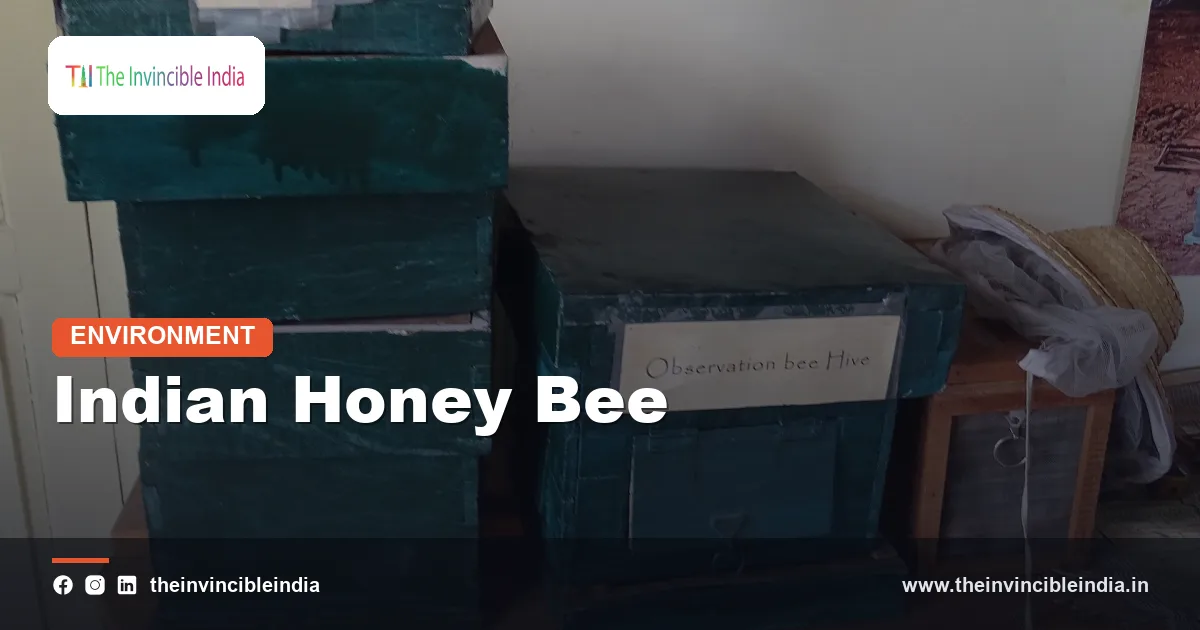
The Indian honey bee (Apis cerana indica) is the native, cavity-nesting honey bee of the Indian subcontinent, a smaller and gentler relative of the giant rock bee that builds several parallel wax combs inside hollows and is widely kept in wooden hive boxes for honey and crop pollination. It is a subspecies of the Asiatic honey bee, Apis cerana, and has lived alongside Indian farmers and forest communities for a very long time.
The Indian honey bee is beneficial and generally docile: it pollinates crops, wild flowers and orchards, and it produces honey and beeswax. It is the honey bee that most Indian beekeepers, especially in the south, the hills and the northeast, can manage in a box hive, unlike the aggressive giant rock bee, which cannot be kept in boxes.
| Quick Fact | Detail |
|---|---|
| Common names | Indian honey bee, Indian hive bee, Asiatic honey bee (species level) |
| Scientific name | Apis cerana indica Fabricius, 1798 |
| Family | Apidae, the bee family that also includes bumble bees and stingless bees |
| Nesting habit | Dark cavities such as tree hollows, wall niches and hive boxes, with several parallel combs |
| Colony size | From a few thousand to about 20,000 bees, much smaller than the colonies of the giant rock bee |
| Worker size | Roughly 10 mm long, smaller than the rock bee and the European honey bee |
| Temperament | Generally gentle, though it stings when the nest is disturbed |
| Regulatory support | National Bee Board and National Beekeeping and Honey Mission under the Ministry of Agriculture and Farmers Welfare |
Key Takeaways
- The Indian honey bee (Apis cerana indica) is a native Asian honey bee that nests in hollows and builds multiple parallel combs.
- The Indian honey bee is smaller and calmer than the giant rock bee (Apis dorsata) and can be kept in movable-frame hive boxes by beekeepers.
- An Indian honey bee colony includes one queen, thousands of female workers and a small number of male drones, and it communicates through a waggle dance.
- The Indian honey bee yields less honey per hive than the introduced European honey bee, but it is better adapted to local flowers, climate and diseases.
- Indian honey bees pollinate mustard, sunflower, fruit trees, coconut, cardamom and many wild plants, making them important for food security.
- Pesticide misuse, loss of flowering habitat, viral disease and climate stress are the main threats to the Indian honey bee.
What is the Indian honey bee?
The Indian honey bee is the subspecies Apis cerana indica of the Asiatic honey bee, a social insect that lives in organised colonies and stores honey in wax combs. The scientific name was assigned by the Danish zoologist Johan Christian Fabricius in 1798. The wider species Apis cerana ranges from Afghanistan and India across Southeast Asia to China, Japan and Korea, with local forms adapted to each region.
In India, the Indian honey bee is also known as the Indian hive bee, since it is the species most suited to hive keeping. Colonies live in cavities, and the workers are brown and golden-banded, with a slimmer shape than the introduced European honey bee, Apis mellifera. The bee has been used for honey and wax in Indian villages for centuries, and with the arrival of the movable-frame hive in the twentieth century it became the basis of organised beekeeping in the south and the hills.
How is the Indian honey bee different from the giant rock bee and other honey bees?
The Indian honey bee differs from the giant rock bee by nesting inside dark cavities in several combs, being smaller, and being far more manageable, while the rock bee builds a single huge open comb on cliffs and branches and is fierce when disturbed. India has four main kinds of honey bee, each with a distinct lifestyle, and the stingless bees add a fifth group.
| Bee | Scientific name | Nest | Temperament and use |
|---|---|---|---|
| Indian honey bee | Apis cerana indica | Several combs in a cavity | Gentle; kept in hive boxes |
| Giant rock bee | Apis dorsata | One large open comb on cliffs, trees or buildings | Defensive; honey is hunted, not farmed |
| Little bee | Apis florea | Single small comb in open shrubs | Gentle but not suitable for boxes |
| European honey bee | Apis mellifera | Several combs in a cavity | Introduced; high honey yield; widely kept in the north |
| Stingless bees | Tetragonula species | Small cavity nests with resin tubes | Tiny; low honey yield, valued for medicinal honey |
The European honey bee was introduced to India in the twentieth century, with an important introduction in Himachal Pradesh in 1962, and it now supports commercial honey production in many northern states.
How does an Indian honey bee colony work?
An Indian honey bee colony is a single family consisting of one queen, thousands of worker bees and a few hundred drones during the breeding season, and the colony functions as a single organism with a division of labour. The queen lays all the eggs, the workers do every other job, and the drones exist only to mate with queens from other colonies.
Queen, workers and drones
- Queen: a single large female who may lay several hundred to over a thousand eggs a day at peak season, and who releases pheromones that hold the colony together.
- Workers: sterile females who clean the cells, feed larvae, build comb, guard the entrance, and later forage for nectar, pollen, water and resin. A summer worker lives only a few weeks.
- Drones: males that develop from unfertilised eggs and have no stinger.
Talking by dance
Indian honey bees share information through the waggle dance. A forager that finds a rich patch of flowers returns to the hive and dances on the comb, and the direction and duration of the waggle run tell other bees the direction and distance of the flowers. The Austrian scientist Karl von Frisch won a Nobel Prize in 1973 for his work on honey bee communication, and Apis cerana shows the same type of dance as other honey bees.
Where does the Indian honey bee nest?
The Indian honey bee nests in dark, enclosed cavities such as hollows in tree trunks, gaps in walls, abandoned pots and wooden boxes, and it builds several parallel combs from top to bottom. The bees seal gaps with propolis, a resin-based glue that they collect from plants, leaving a small entrance.
The combs are spaced a fixed distance apart, which is what makes the species suitable for movable-frame hives. Brood is raised in the centre of the combs, while honey and pollen are stored towards the edges and the top. Compared with the European honey bee, the colony is smaller, it uses smaller cells, and it is more likely to abscond, that is, to abandon the hive and move elsewhere if food runs short, if the nest is disturbed or if pests invade.
Is the Indian honey bee gentle and safe?
The Indian honey bee is relatively gentle and safe compared with the giant rock bee, but it will sting in defence of its nest, and its sting can be serious for people allergic to bee venom. Unprovoked attacks are uncommon, and a managed colony can be handled with a veil, gloves and a smoker.
When a hive is badly disturbed, guard bees release an alarm pheromone that calls other bees to join the defence. A bee that stings a mammal loses its stinger and dies, which is why bees generally sting only as a last resort. Wasps, hornets and rock bees are the insects most often involved in dangerous stinging incidents in India, not the hive bee.
In the wild, Indian honey bees may also use a shimmering wave of body movement, produced by many bees on the surface of the nest, to scare off predatory wasps, and they sometimes cover the entrance with sticky resin to keep out hornets.
How is the Indian honey bee kept in beekeeping?
The Indian honey bee is kept in hive boxes with movable wooden frames, so that the beekeeper can inspect the brood, remove honey combs without destroying the colony, and increase the number of colonies by dividing strong ones. Indian-designed boxes, such as the Newton hive and hives built to Indian Standard specifications for Apis cerana, are sized to the smaller combs of this species.
Typical beekeeping year
- Flowering season: colonies grow quickly, and the beekeeper adds supers, which are extra boxes, for honey storage.
- Honey harvest: sealed combs are taken out, and the honey is extracted by spinning or pressing, while leaving enough stores for the bees.
- Dearth period: in months with few flowers, such as the peak of summer or heavy monsoon, beekeepers may feed sugar syrup or move the hives.
- Migration: some beekeepers truck hives to follow flowering crops such as mustard, sunflower, litchi and rubber.
The Government of India supports beekeeping through the National Bee Board, which was set up under the Ministry of Agriculture and Farmers Welfare, and through the National Beekeeping and Honey Mission launched in 2020. The effort, often called the “Sweet Revolution”, provides training, equipment, quality testing and market support, and it aims to raise farmers’ incomes along with crop yields.
How much honey does the Indian honey bee produce?
The Indian honey bee produces a few kilograms of honey per hive per year in many regions, and up to around ten kilograms in good seasons and rich flowering areas. This is usually less than the yield of the European honey bee, whose larger colonies can store much more, but the Indian honey bee requires less intervention and copes better with the local climate.
Honey yield varies with the flowers available in the area. Honey from mustard, eucalyptus, litchi, sunflower, jamun, neem and multi-floral forest nectar has different colours, tastes and textures. Besides honey, the bee provides beeswax, which is used in candles, cosmetics and traditional crafts, as well as propolis and pollen.
Quality matters as much as quantity. Honey should be harvested when most cells are capped, because capped honey has a low moisture level and keeps well. Pure honey is simply what the bees make, and it must not be adulterated with sugar syrups.
Why does the Indian honey bee matter for pollination?
The Indian honey bee matters for pollination because the workers visit thousands of flowers a day, carrying pollen from bloom to bloom, which raises the fruit and seed set of many crops. The bee is active in cooler and cloudier weather than some other bees, and begins foraging early in the day, which helps with crops that bloom in winter and in hill areas.
Crops that benefit from honey bee pollination include mustard and other oilseeds, sunflower, apple, cherry, almond, litchi, mango, citrus, coconut, cardamom, coffee and many vegetables such as cucumber, pumpkin and onion seed crops. Properly placed hives near these crops can raise yield and improve fruit quality, often by a margin that exceeds the value of the honey.
The bees also pollinate wild plants, which sustains forests and the animals that depend on them. Because a hive bee forages within a few kilometres of its nest, the benefits are felt mostly in nearby fields and forests.
What threatens the Indian honey bee?
The main threats to the Indian honey bee are pesticide poisoning, loss of flowering plants, disease, predators and competition from introduced bees. Insecticides, particularly the neonicotinoid group, can kill foragers or damage their navigation and memory, and sprays applied while crops are in flower are especially harmful.
- Viral disease: outbreaks of Thai sacbrood virus from the late 1970s devastated Apis cerana colonies in parts of India and neighbouring countries, and the virus remains a concern for beekeepers.
- Habitat loss: monoculture, deforestation and the clearing of hedgerows and roadside trees reduce nectar and pollen across the year.
- Pests and predators: wax moths, wasps, hornets, ants and mites attack weak colonies, and absconding is a common response.
- Climate stress: erratic rainfall and heat can shift flowering times so that nectar flows no longer match the colony’s needs.
- Competition and disease spillover: large numbers of imported European honey bees may compete for flowers and may pass on pathogens.
The Indian honey bee has an advantage over the European honey bee in resisting some parasites. The Varroa mite, for example, is a major problem for Apis mellifera worldwide, but the Asian hive bee has evolved behaviours such as grooming and removing infested brood that keep the mites in check.
How can people help Indian honey bees?
People can help Indian honey bees by planting flowers that bloom across the seasons, avoiding spraying pesticides on flowering plants, leaving water available and not destroying colonies. Bee-friendly plants include mustard, sunflower, neem, jamun, tulsi, drumstick, coriander left to flower, marigold and native trees such as Indian beech (karanj) and rain tree.
- Spray pesticides only in the evening, when bees are not foraging, or choose biological controls.
- If a swarm settles on your property, do not burn or spray it; call a local beekeeper, forest department or agriculture extension centre to relocate it.
- Buy honey from trustworthy local beekeepers and cooperatives to support sustainable beekeeping.
- Keep a shallow dish of water with pebbles in a garden so that bees can drink safely.
Bottom Line
The Indian honey bee is a gentle, native pollinator and honey producer that is central to small-scale beekeeping and to the pollination of India’s crops and wild flowers. Protecting its habitat and limiting pesticide use is a practical way to protect both biodiversity and food production.
Frequently Asked Questions
What is the Indian honey bee?
The Indian honey bee is Apis cerana indica, the native hive bee of the Indian subcontinent. It nests in cavities, builds several parallel combs and is kept in boxes by beekeepers. It is smaller and calmer than the giant rock bee.
Is the Indian honey bee aggressive?
No, the Indian honey bee is generally gentle compared with the giant rock bee. It stings only to defend its nest, and managed colonies can be handled with a veil and a smoker. People allergic to bee venom should still keep away from hives.
How is the Indian honey bee different from the giant rock bee?
The Indian honey bee nests in cavities with several combs, while the giant rock bee (Apis dorsata) builds one huge open comb on cliffs and trees. The Indian honey bee is smaller and can be kept in hive boxes. The rock bee is much more defensive and cannot be farmed in boxes.
How much honey does an Indian honey bee hive produce?
An Indian honey bee hive usually produces a few kilograms of honey a year, and up to roughly ten kilograms in good flowering seasons. This is often less than the yield of the European honey bee. Actual yield depends on the area, the flowers and the care taken by the beekeeper.
Why are Indian honey bees important for farming?
Indian honey bees are important for farming because they pollinate crops such as mustard, sunflower, fruit trees, coconut and cardamom. Pollination raises the fruit and seed set of these crops. The benefit to farmers is often worth more than the honey itself.
What is harming Indian honey bees?
Pesticides, loss of flowering habitat, viral disease such as Thai sacbrood virus, predators and climate change are harming Indian honey bees. Spraying crops while they are in bloom is especially damaging. Planting bee-friendly flowers and reducing pesticide use help the bees recover.
{“@context”:”https://schema.org”,”@graph”:[{“@type”:”FAQPage”,”mainEntity”:[{“@type”:”Question”,”name”:”What is the Indian honey bee?”,”acceptedAnswer”:{“@type”:”Answer”,”text”:”The Indian honey bee is Apis cerana indica, the native hive bee of the Indian subcontinent. It nests in cavities, builds several parallel combs and is kept in boxes by beekeepers. It is smaller and calmer than the giant rock bee.”}},{“@type”:”Question”,”name”:”Is the Indian honey bee aggressive?”,”acceptedAnswer”:{“@type”:”Answer”,”text”:”No, the Indian honey bee is generally gentle compared with the giant rock bee. It stings only to defend its nest, and managed colonies can be handled with a veil and a smoker. People allergic to bee venom should still keep away from hives.”}},{“@type”:”Question”,”name”:”How is the Indian honey bee different from the giant rock bee?”,”acceptedAnswer”:{“@type”:”Answer”,”text”:”The Indian honey bee nests in cavities with several combs, while the giant rock bee (Apis dorsata) builds one huge open comb on cliffs and trees. The Indian honey bee is smaller and can be kept in hive boxes. The rock bee is much more defensive and cannot be farmed in boxes.”}},{“@type”:”Question”,”name”:”How much honey does an Indian honey bee hive produce?”,”acceptedAnswer”:{“@type”:”Answer”,”text”:”An Indian honey bee hive usually produces a few kilograms of honey a year, and up to roughly ten kilograms in good flowering seasons. This is often less than the yield of the European honey bee. Actual yield depends on the area, the flowers and the care taken by the beekeeper.”}},{“@type”:”Question”,”name”:”Why are Indian honey bees important for farming?”,”acceptedAnswer”:{“@type”:”Answer”,”text”:”Indian honey bees are important for farming because they pollinate crops such as mustard, sunflower, fruit trees, coconut and cardamom. Pollination raises the fruit and seed set of these crops. The benefit to farmers is often worth more than the honey itself.”}},{“@type”:”Question”,”name”:”What is harming Indian honey bees?”,”acceptedAnswer”:{“@type”:”Answer”,”text”:”Pesticides, loss of flowering habitat, viral disease such as Thai sacbrood virus, predators and climate change are harming Indian honey bees. Spraying crops while they are in bloom is especially damaging. Planting bee-friendly flowers and reducing pesticide use help the bees recover.”}}]}]}


