

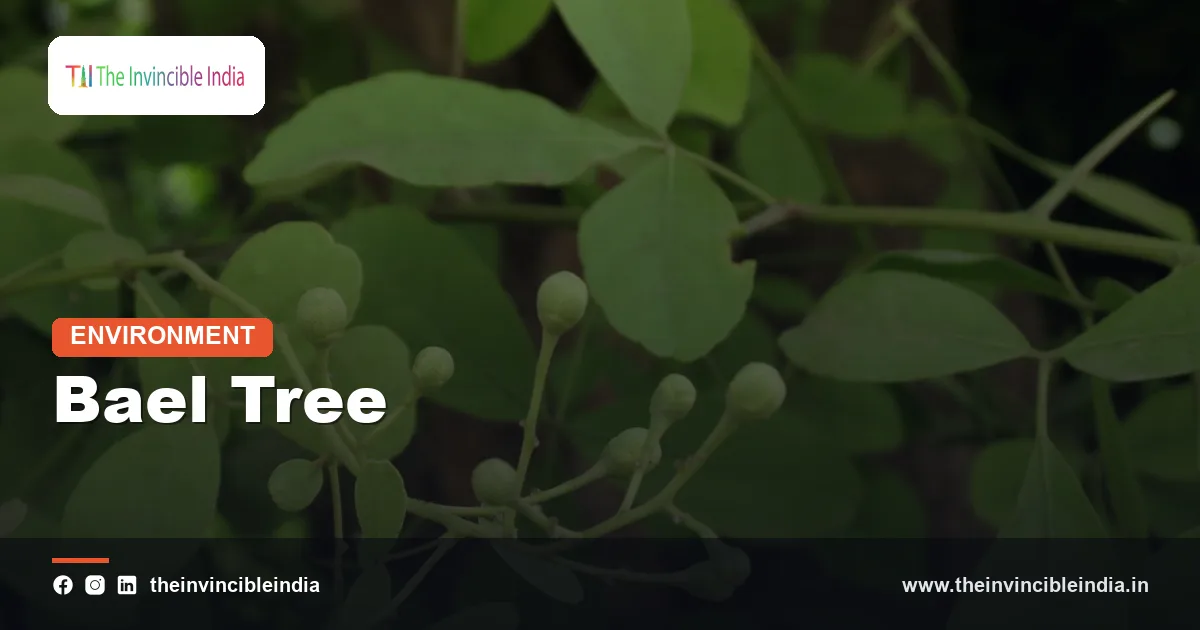
The bael tree (Aegle marmelos) is a thorny, medium-sized, leaf-shedding tree native to India, sacred to Lord Shiva in Hindu worship and valued for its hard-shelled, aromatic fruit and its distinctive three-leaflet leaves. The bael tree grows wild in the dry forests of peninsular India and across the sub-Himalayan belt, and it is also planted in temple precincts, village edges and home gardens throughout the country.
In everyday life the bael tree is best known for two things: the trifoliate leaves, called bilva patra or bel patra, which are offered at Shiva shrines, and the fruit pulp, which is mixed with water, jaggery or sugar to make a cooling summer sharbat. This explainer covers what the tree is, how it grows, why it is sacred, how its fruit is used, and what is and is not established about its traditional medicinal reputation.
| Attribute | Detail |
|---|---|
| Common name | Bael tree (also spelled bel); bilva in Sanskrit |
| Scientific name | Aegle marmelos |
| Plant family | Rutaceae (the citrus family) |
| Native range | India and neighbouring parts of South and Southeast Asia |
| Growth habit | Spiny, slow-growing, deciduous tree, commonly 8 to 15 metres tall |
| Leaves | Alternate and trifoliate, with three leaflets joined at one point |
| Fruit | Round to oval berry with a hard, woody shell and sticky, fragrant pulp |
| Religious significance | Leaves offered to Shiva; the tree is regarded as sacred in Hinduism |
| Best-known food use | Bael sharbat, a cooling summer drink made from the fruit pulp |
Key Takeaways
- The bael tree, scientifically Aegle marmelos, belongs to the same plant family (Rutaceae) as citrus fruits and the curry leaf tree.
- Bael leaves are trifoliate, meaning each leaf carries three leaflets, and this form is the reason they are linked with Shiva’s trident in popular belief.
- The bael fruit has a woody shell that must be cracked open, and its sticky pulp is the basis of bael sharbat, murabba and dried bael slices.
- The bael tree is drought-hardy, sheds its leaves in the dry season and survives in poor, rocky and dry-forest soils where many other trees struggle.
- Bael is mentioned in traditional Ayurvedic practice, but claims about it treating disease are not backed by strong clinical evidence, so it should be treated as a food and traditional remedy rather than a medicine.
- The common name “wood apple” is used loosely in English and can refer either to bael or to a different tree, Limonia acidissima, so the scientific name is the safest way to identify the species.
What is the bael tree and where does it grow in India?
The bael tree is a tough, spiny tree of the citrus family that occurs naturally in the dry deciduous forests of India and is cultivated across the subcontinent. It is found wild on the Deccan plateau, in central India, in the Shivalik foothills and in many parts of the Gangetic plain, and it extends into Nepal, Sri Lanka, Myanmar and other parts of Southeast Asia, where it has long been planted.
The tree prefers a dry-to-seasonally-dry climate with a distinct hot season. It tolerates poor, stony and even slightly saline or alkaline soils, which is why it is often seen on wasteland, along field boundaries and around old temples. It does not need much care once established, although young saplings grow slowly and need protection from grazing animals and from frost in their first years.
Botanically, Aegle marmelos is the only species in its genus that is widely known, and it stands apart from most citrus relatives because its leaves are compound and its fruit has a hard rind rather than a soft peel. Local names vary by language: bel in Hindi, bilva in Sanskrit, bilwa or bel in Bengali and Odia, vilvam in Tamil, maredu in Telugu and bilpatre in Kannada. Because these names differ across regions, botanists rely on the Latin name when they need to be exact.
What does a bael tree look like?
A bael tree looks like a rounded, open-crowned tree with a short trunk, drooping branches, sharp straight spines and glossy compound leaves. Mature trees are usually between 8 and 15 metres tall, with a pale, slightly flaky bark and a crown that becomes thin when the tree sheds its leaves.
Leaves and flowers
Each bael leaf is trifoliate: three leaflets are attached to one stalk, with the middle leaflet usually longer than the two side leaflets. When crushed, the leaves release a strong, resinous, citrus-like smell. New leaves appear in the hot weather, often with a reddish or pinkish tinge, and the old leaves fall in the dry season, so the tree can look bare for a short period.
The flowers of the bael tree are small, greenish-white and sweetly scented. They appear in clusters at the tips of branches around the start of the hot season, typically in spring, and they are pollinated by insects.
Fruit and seeds
The bael fruit is a large berry, often the size of a cricket ball or bigger, with a smooth, hard shell that turns from green to yellowish-grey as it ripens. Inside, the shell encloses a sticky, orange-brown, aromatic pulp and numerous flat seeds covered in a clear, slimy coating. The fruit takes many months to mature, so it ripens well after the flowers have gone, and it is usually harvested in the hot months when the shell begins to change colour.
Why is the bael tree sacred to Shiva?
The bael tree is sacred to Shiva because its trifoliate leaves are traditionally offered in his worship, and Hindu belief associates the three leaflets with the three eyes or the trident (trishula) of the deity. Offering bilva patra to a Shivalinga is a common devotional practice throughout India, particularly on Mondays, during the month of Shravan and on Maha Shivaratri.
Devotees typically offer clean, undamaged leaves with the glossy side facing down, often together with water, milk or other items used in the ritual bathing of the linga. Tradition holds that the tree should be treated with respect, and in many places there are customs against cutting a bael tree casually. As a result, bael trees often survive in and around temple compounds, village shrines and courtyards even where other trees have been cleared.
The tree also has a place in the wider religious landscape. In Sanskrit literature and devotional texts, the bilva is described as a sacred tree, and its wood and leaves feature in several rituals. Because belief and botany are different things, this article treats the religious significance as a matter of tradition and cultural practice, and it does not present any spiritual claim as scientific fact.
How is bael fruit used as a summer drink?
Bael fruit is used as a summer drink by scooping out the pulp, soaking it in water, straining it and sweetening it with sugar, jaggery or sometimes rock salt to make bael sharbat. The drink has a thick, slightly sticky body and a distinctive smoky-sweet, floral taste, and it is widely sold in hot weather by street vendors across north and central India.
The reason bael sharbat is called “cooling” is cultural and traditional: in Ayurveda and in everyday folk understanding, the fruit is regarded as a food that suits the heat of summer. Modern nutrition science does not use the idea of “cooling” foods, so the term is best read as a traditional description rather than a measurable property. What can be said plainly is that the sharbat is a hydrating, flavourful drink, and that it is usually taken as a refreshment rather than as a treatment.
A simple preparation outline
- Crack the hard shell by striking it firmly on a hard edge, then scoop out the pulp with a spoon.
- Soak the pulp in water for a short time so that it softens.
- Mash and press it through a sieve to remove seeds and fibre.
- Add sugar or jaggery to taste, plus water and, if desired, a pinch of black salt or a little lime juice.
- Serve chilled or at room temperature, and drink it fresh.
Ripe fruit gives a sweeter, more fragrant drink, while less ripe fruit tends to be more astringent. Preparing the drink needs some effort because of the tough shell and the seed slime, which is why ready-made bael pulp and powders are now common in shops.
What other foods and products are made from bael?
Besides sharbat, the bael fruit is made into murabba (a preserve), candy, jam, squash, dried slices and a powdered pulp that can be reconstituted with water. Dried bael slices keep well, which allows the fruit to be used outside its short season and carried over long distances.
Several parts of the tree have had practical uses beyond food:
- Fruit shell: the empty, hard shell has been used as a small container, and in some places it is carved or decorated as a craft item.
- Pulp and gum: the sticky pulp contains a gum-like substance, and traditional builders have used it as a binder or additive in lime plaster and similar mixtures.
- Wood: bael wood is hard and fine-grained and has been used for small tools, handles and carving.
- Leaves: beyond worship, the young leaves are used in some regional dishes and traditional preparations, though this is not a mainstream food use.
These uses vary from region to region, and most are small-scale or traditional rather than industrial. Bael products are generally found in Indian markets in summer, when the fruit is in season, and in dried or processed form during the rest of the year.
What are the traditional uses of bael, and what does science say?
Bael has a long traditional use in Ayurveda and folk medicine, especially for digestive complaints, but scientific evidence for these uses is limited, and the tree should not be treated as a proven medicine. Traditional texts describe the fruit as useful for the stomach and bowels, and the bilva (bael) root is one of the ingredients in the traditional Ayurvedic formulation group known as Dashamoola, the “ten roots”.
Researchers have studied extracts from bael leaves, fruit and bark in laboratories and in some small trials, looking at properties such as antioxidant activity and effects on blood sugar. These studies are mostly preliminary, they often use concentrated extracts rather than the food as normally eaten, and they do not show that bael prevents or cures any disease. Anyone with a medical condition should not replace professional treatment with home remedies.
A few practical cautions are worth noting:
- People who take medicines for diabetes should check with a doctor before using bael preparations in large or regular amounts, because bael is traditionally linked to effects on blood sugar.
- Pregnant and breastfeeding women, and people with chronic illness, should seek medical advice before using herbal products.
- Eating the fruit or drinking sharbat in normal food quantities is a different matter from taking concentrated extracts or supplements.
How do you grow a bael tree?
You grow a bael tree by planting fresh seeds or a grafted sapling in a sunny spot with well-drained soil and then leaving it largely alone, because the tree is slow-growing and drought-hardy once established. Seeds germinate best when sown fresh, and seedling trees can take many years to bear fruit, while grafted or budded plants generally fruit earlier and are preferred by growers who want a reliable crop.
The conditions that suit the bael tree are straightforward:
- Sunlight: full sun for most of the day.
- Soil: well-drained soil; the tree tolerates stony, sandy and mildly alkaline ground, but waterlogging should be avoided.
- Water: regular watering for young plants, and very little once the tree has settled in.
- Space: a large open area, since the crown spreads and the spines make crowded planting awkward.
- Safety: because of the sharp spines, it is sensible to plant bael away from paths where children play.
Because the tree is deciduous, it is normal for it to lose its leaves in the dry season, and a bare bael tree is not necessarily a sick one. Fresh growth returns with the warmer weather.
Why does the bael tree matter for the environment?
The bael tree matters for the environment because it grows in dry, degraded land where many trees fail, and it offers shade, flowers for insects and fruit for animals. In dry-forest ecosystems it forms part of a mixed canopy, and its flowers and fruit support insects, birds and mammals that feed on them.
The bael tree is also a host for butterflies of the citrus family. Caterpillars of the common lime butterfly, Papilio demoleus, are among the insects that feed on its young leaves, as they do on citrus and curry leaf plants. For a gardener this means that a bael sapling may sometimes be chewed by caterpillars, which is natural, and an established tree is usually not harmed by it.
Planting bael in wasteland, along boundaries and in community spaces is also a low-maintenance way to add native tree cover. Since the tree is long-lived and culturally protected in many places, it can survive for generations in the same spot.
How does bael compare with other citrus-family plants?
Bael differs from familiar citrus-family plants by having a hard woody fruit shell and trifoliate leaves, while sharing the family’s aromatic oils. The table below sets bael beside two other Rutaceae plants that Indians know well.
| Feature | Bael tree | Lemon or lime tree | Curry leaf tree |
|---|---|---|---|
| Scientific name | Aegle marmelos | Citrus species | Murraya koenigii |
| Size | Medium tree, 8 to 15 metres | Small tree or shrub | Small tree or large shrub |
| Leaf form | Three leaflets per leaf | Single leaflet with a winged stalk | Many leaflets on one stalk |
| Fruit | Large, hard-shelled berry | Soft-skinned, juicy fruit | Small black berry |
| Main use | Sacred leaves, sharbat, preserves | Juice, pickles, flavouring | Leaves for tempering |
| Spines | Present, sharp and straight | Present in many forms | Absent |
How is bael different from “wood apple”?
Bael is different from the fruit that is more precisely called wood apple, because the two names are often confused in English even though they refer to different trees. Bael is Aegle marmelos, while the wood apple, also called elephant apple or kaith in Hindi, is Limonia acidissima, a separate tree of the same family with a hard-shelled fruit that has a tart, tangy pulp.
Some English-language sources call bael “wood apple” or “stone apple”, which adds to the confusion. The two fruits do look somewhat alike from outside because both have hard, woody shells, but the pulp, taste and use differ. Bael pulp is sweet-aromatic and is the basis of the well-known sharbat, whereas kaith pulp is sour and is more often used in chutneys and jams.
When buying, reading a recipe or searching for information, using the local name (bel) or the Latin name (Aegle marmelos) removes the ambiguity.
What should you keep in mind when using bael?
When using bael, remember that the tree is both a culturally significant plant and a food, so it should be handled with care and used in sensible amounts. Respecting temple and village customs about the tree is part of living with it, and cutting a bael tree may be restricted or frowned upon in many communities.
In the kitchen, wash the shell before cracking it, strain out the seeds and use fresh pulp promptly because the sticky pulp spoils quickly in warm weather. For leaves offered in worship, collect them gently rather than stripping branches, so that the tree can keep growing. Anyone interested in bael for health reasons should talk to a qualified doctor or a registered Ayurvedic practitioner rather than rely on general claims found online.
Bottom Line
The bael tree is a hardy native tree of India whose three-leaflet leaves are offered to Shiva and whose hard-shelled fruit makes the familiar summer sharbat. It is easy to grow once established, useful as food, rich in tradition and best understood with the caution that its medicinal reputation is traditional rather than proven. Last updated: 23 October 2026.
Frequently Asked Questions
What is the scientific name of the bael tree?
The scientific name of the bael tree is Aegle marmelos. It belongs to the Rutaceae family, the same plant family as citrus fruits and the curry leaf tree, and it is native to India.
Why are bael leaves offered to Shiva?
Bael leaves are offered to Shiva because Hindu tradition regards the tree as sacred to him and links the three leaflets with his trident or three eyes. Devotees commonly offer them at Shiva shrines on Mondays, in the month of Shravan and on Maha Shivaratri.
How is bael sharbat made?
Bael sharbat is made by scooping the pulp out of the hard-shelled fruit, soaking it in water, straining out the seeds and fibre, and sweetening it with sugar or jaggery. It is served chilled or at room temperature and is best drunk fresh because the pulp spoils quickly in warm weather.
Is bael the same as wood apple?
Bael is not the same as the fruit more precisely called wood apple, although English names for the two are often mixed up. Bael is Aegle marmelos with sweet, aromatic pulp, while the wood apple or kaith is Limonia acidissima with a tart pulp, so the Latin name is the most reliable guide.
Is bael good for health?
Bael is a traditional food and Ayurvedic remedy, especially for digestive complaints, but strong clinical evidence for treating disease is lacking. Eating the fruit or drinking sharbat in ordinary amounts is common, but people with diabetes, pregnant women and those on medication should ask a doctor before using bael preparations regularly.
Can you grow a bael tree at home?
You can grow a bael tree at home if you have a sunny, open space with well-drained soil, because the tree is hardy and needs little care once established. It grows slowly and has sharp spines, so choose a spot away from play areas, and expect grafted plants to fruit sooner than seedlings.
{“@context”:”https://schema.org”,”@graph”:[{“@type”:”FAQPage”,”mainEntity”:[{“@type”:”Question”,”name”:”What is the scientific name of the bael tree?”,”acceptedAnswer”:{“@type”:”Answer”,”text”:”The scientific name of the bael tree is Aegle marmelos. It belongs to the Rutaceae family, the same plant family as citrus fruits and the curry leaf tree, and it is native to India.”}},{“@type”:”Question”,”name”:”Why are bael leaves offered to Shiva?”,”acceptedAnswer”:{“@type”:”Answer”,”text”:”Bael leaves are offered to Shiva because Hindu tradition regards the tree as sacred to him and links the three leaflets with his trident or three eyes. Devotees commonly offer them at Shiva shrines on Mondays, in the month of Shravan and on Maha Shivaratri.”}},{“@type”:”Question”,”name”:”How is bael sharbat made?”,”acceptedAnswer”:{“@type”:”Answer”,”text”:”Bael sharbat is made by scooping the pulp out of the hard-shelled fruit, soaking it in water, straining out the seeds and fibre, and sweetening it with sugar or jaggery. It is served chilled or at room temperature and is best drunk fresh because the pulp spoils quickly in warm weather.”}},{“@type”:”Question”,”name”:”Is bael the same as wood apple?”,”acceptedAnswer”:{“@type”:”Answer”,”text”:”Bael is not the same as the fruit more precisely called wood apple, although English names for the two are often mixed up. Bael is Aegle marmelos with sweet, aromatic pulp, while the wood apple or kaith is Limonia acidissima with a tart pulp, so the Latin name is the most reliable guide.”}},{“@type”:”Question”,”name”:”Is bael good for health?”,”acceptedAnswer”:{“@type”:”Answer”,”text”:”Bael is a traditional food and Ayurvedic remedy, especially for digestive complaints, but strong clinical evidence for treating disease is lacking. Eating the fruit or drinking sharbat in ordinary amounts is common, but people with diabetes, pregnant women and those on medication should ask a doctor before using bael preparations regularly.”}},{“@type”:”Question”,”name”:”Can you grow a bael tree at home?”,”acceptedAnswer”:{“@type”:”Answer”,”text”:”You can grow a bael tree at home if you have a sunny, open space with well-drained soil, because the tree is hardy and needs little care once established. It grows slowly and has sharp spines, so choose a spot away from play areas, and expect grafted plants to fruit sooner than seedlings.”}}]}]}


