

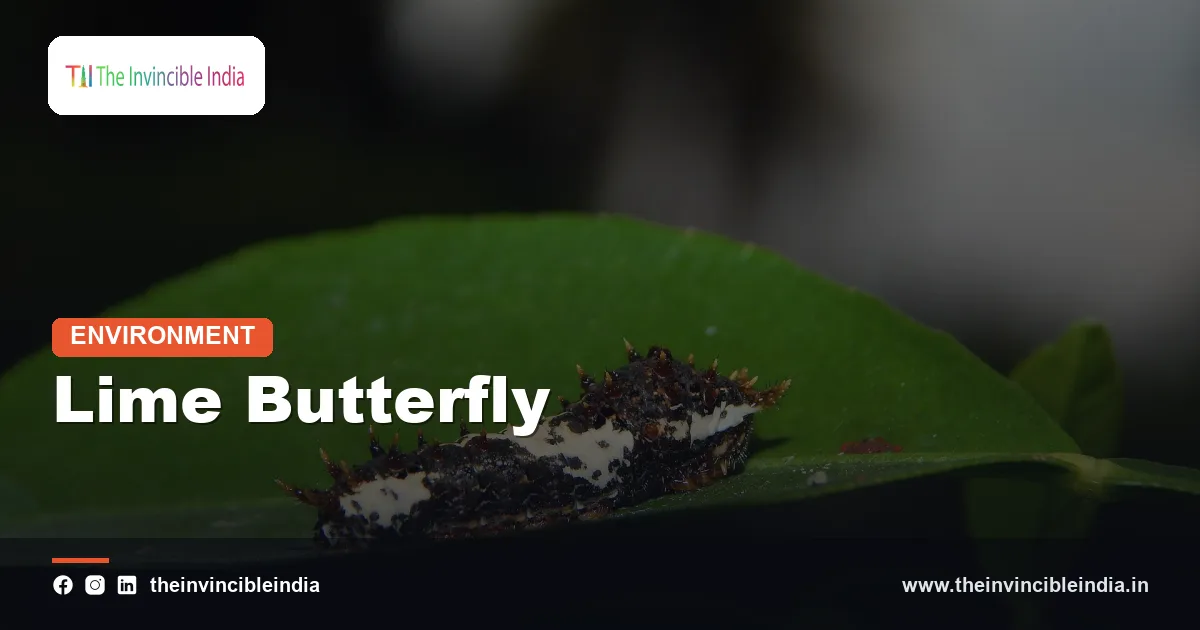
The lime butterfly (Papilio demoleus) is a common black-and-cream swallowtail butterfly of India whose green caterpillars feed on the leaves of citrus plants, making it one of the most familiar butterflies in Indian gardens, farms and towns. The lime butterfly, also called the lemon butterfly or chequered swallowtail, is a strong, fast flier that is easy to spot in open, sunny places.
The lime butterfly is best known for the life of its caterpillar, which looks like a bird dropping when young and turns bright green when older, and which can shoot out a forked, smelly organ called an osmeterium when disturbed. This explainer covers how to identify the lime butterfly, what it eats, how its caterpillar defends itself, how it relates to citrus growers, and how to share a garden with it.
| Attribute | Detail |
|---|---|
| Common name | Lime butterfly; also lemon butterfly and chequered swallowtail |
| Scientific name | Papilio demoleus |
| Family | Papilionidae (swallowtails) |
| Distribution | Widespread across India and much of Asia, extending to Australasia |
| Approximate wingspan | Around 8 to 10 centimetres |
| Adult colouring | Black wings marked with cream or pale yellow spots and bands; a blue band and red-orange eyespot on the hindwing |
| Caterpillar host plants | Citrus and other members of the family Rutaceae; also some legumes |
| Caterpillar defence | Bird-dropping camouflage when young; an osmeterium when threatened |
| Flight | Fast, strong and often low over plants |
Key Takeaways
- The lime butterfly, scientifically Papilio demoleus, is a swallowtail in the family Papilionidae and one of the most widespread butterflies in India.
- The lime butterfly has black wings with cream or pale yellow markings, a blue band and a red-orange eyespot on each hindwing.
- Lime butterfly caterpillars feed mainly on citrus leaves, as well as on curry leaf, bael and other members of the citrus family (Rutaceae).
- Young lime butterfly caterpillars are brown, black and white and resemble bird droppings, while older caterpillars are green with fine markings.
- A disturbed lime butterfly caterpillar can extend a forked, orange-red osmeterium that releases a pungent smell, which is an effective defence against small predators.
- The lime butterfly can damage young citrus seedlings in nurseries, but it is rarely a serious threat to mature trees, and hand removal is a sensible control method.
What is the lime butterfly?
The lime butterfly is a medium-to-large swallowtail butterfly, Papilio demoleus, that is named for its caterpillars’ habit of feeding on lime and other citrus plants. It is found across most of India, from the plains and cities to the hills, and also across a wide range of Asia, including parts of the Middle East and South and Southeast Asia, reaching Australasia.
The lime butterfly belongs to the family Papilionidae, the swallowtails, which includes the common mormon, the common rose and the southern birdwing. Many swallowtails have a tail-like extension on the hindwing, but the lime butterfly has only a very small one or none at all, so it can look less obviously “swallowtailed” than its relatives.
The butterfly is common because its host plants are so common. Citrus trees are grown in orchards and home gardens throughout the country, and curry leaf plants are found in most kitchen gardens, so the lime butterfly has plenty of places to lay its eggs.
How can you identify a lime butterfly?
You can identify a lime butterfly by its black wings with irregular cream or pale yellow spots and bands, a blue band along the hindwing, and a round red-orange patch near the hindwing’s hind edge. The wings are broad and strong, the wingspan is typically around 8 to 10 centimetres, and the overall look is a bold chequered pattern.
Upperside and underside
The upperside of the lime butterfly is black with lines of cream spots running across the forewing and a broader band of cream across the hindwing. Between the cream areas lie blue scales, especially in a band across the hindwing, and near the hindwing’s rear is a round red-orange eyespot with a dark centre. The underside shows a similar pattern, usually paler and with more orange.
Males and females
Male and female lime butterflies look very similar, and distinguishing them in the field is difficult. Seasonal and regional variation in the intensity of the markings also occurs, so you may notice that individual butterflies look slightly different in the dry and wet seasons.
Look-alikes
Other black-and-pale swallowtails can be confused with the lime butterfly, notably the common mormon (Papilio polytes) and the common rose. The lime butterfly is the one with the complete chequered cream-and-black pattern, whereas the common mormon has distinctive white hindwing patches in some females, and the common rose has crimson body parts and a different shape.
What do lime butterfly caterpillars eat?
Lime butterfly caterpillars eat the young leaves of plants in the citrus family, Rutaceae, especially lime, lemon, orange, pomelo and other citrus species. They also feed on curry leaf (Murraya koenigii), bael (Aegle marmelos) and ornamental Murraya shrubs, and in some regions they feed on certain legumes.
The caterpillars choose tender new growth, which is soft and rich in nutrients. A female lime butterfly flutters around a plant and lays tiny round eggs one at a time on the young leaves, so each caterpillar starts on its own. The leaves of citrus-family plants contain aromatic oils, and the female uses smell and taste through her feet and antennae to identify suitable host plants.
- Citrus (lime, lemon, orange): the best-known host, especially new shoots.
- Curry leaf: a common host in kitchen gardens and pots.
- Bael: used by caterpillars in the wild and in plantings.
- Other Rutaceae: such as ornamental Murraya shrubs and some wild relatives.
- Some legumes: recorded in certain regions, though citrus-family plants are the main hosts in India.
How does the lime butterfly caterpillar defend itself?
The lime butterfly caterpillar defends itself with camouflage while young and with a smelly, forked organ called an osmeterium when threatened. In the first few stages, the caterpillar is brown and black with a white patch and looks like a bird dropping, which is something most predators ignore.
Bird-dropping camouflage
This mimicry is an example of crypsis, in which an animal avoids predators by looking like something unappealing. The young caterpillar rests on the upper surface of a leaf, holding a posture that looks like a splash of droppings. Because it is so small and so convincing, it often escapes the attention of birds, lizards and other predators.
The green final stage
As the caterpillar grows through several moults, it changes. The later stages are green with fine markings and a darker band across the body, which blends in with the leaves it feeds on. At this size, it is too large to pass as a dropping, so the colour change shifts the strategy from looking like waste to looking like part of the plant.
The osmeterium
When a caterpillar is touched or disturbed, it raises its head and everts a forked, orange-red organ from behind its head. This organ, the osmeterium, releases a strong, sharp smell that deters small predators such as ants and wasps. It retracts when the threat passes. The osmeterium is a defining feature of swallowtail caterpillars and is harmless to people, though the smell is unpleasant, and it is not a sign that the caterpillar is dangerous.
What is the life cycle of the lime butterfly?
The life cycle of the lime butterfly has four stages: egg, caterpillar, pupa and adult, and in warm weather the entire cycle can be completed in roughly a month. The butterfly can have several generations in a year, which is one reason it is so common.
| Stage | Appearance and behaviour |
|---|---|
| Egg | Small, round, pale yellow egg laid singly on tender leaves |
| Young caterpillar | Brown, black and white; looks like a bird dropping |
| Mature caterpillar | Green with fine markings; can extend an orange-red osmeterium |
| Pupa | Green or brown chrysalis fixed to a twig or stem by a silk girdle |
| Adult | Black-and-cream butterfly that feeds on nectar and lays eggs on citrus-family plants |
The pupa is usually attached upright to a twig or stem by a silk pad at the tail and a silk girdle around the body, and it often matches the colour of its surroundings, being green on leaves and brown on dry stems. After a period that depends on temperature, the adult butterfly emerges, rests while its wings expand and dry, and then flies away. In cooler weather, the pupal stage may be much longer.
How does the lime butterfly fly and feed?
The lime butterfly flies fast and strongly, usually in the daytime, and it feeds on nectar from flowers while often keeping its wings open or fluttering. It is quick to notice movement, so approaching it closely can take patience.
The adult feeds on nectar from many kinds of flowers, including lantana, zinnia, marigold, ixora, flowering herbs and weedy plants such as Tridax and Bidens. Adults can also be seen mud-puddling at damp ground, where males in particular take up salts and minerals.
The lime butterfly is a butterfly of open, sunny places. It is common in gardens, roadsides, fields, orchards, wasteland and scrub, and it tolerates dry conditions better than some forest butterflies. This makes it one of the butterflies you can expect to see in a typical Indian town, even in the hot season.
Is the lime butterfly a pest of citrus?
The lime butterfly is a minor pest of citrus, mainly harmful to young plants and nursery seedlings rather than to mature trees. Its caterpillars can strip the tender new leaves of small plants, slowing growth, while mature trees usually tolerate some leaf loss without significant harm to the crop.
The damage is greatest where there are many new flushes of leaf, such as in nurseries, newly planted orchards and potted citrus or curry leaf plants. In these places, a handful of caterpillars can eat most of the foliage in a short time. Commercial growers of citrus seedlings therefore pay attention to the caterpillar.
Sensible ways to manage caterpillars
- Hand-picking: remove caterpillars by hand and relocate them to a wild host plant.
- Netting: cover nursery seedlings with fine netting so that females cannot lay eggs.
- Regular checks: inspect new shoots, because young caterpillars look like droppings and are easy to overlook.
- Natural enemies: birds, ants, spiders and parasitic wasps already control many caterpillars, and avoiding broad-spectrum insecticides protects them.
- Growers’ guidance: commercial growers should follow advice from their agricultural extension service or a Krishi Vigyan Kendra about any treatment.
For home gardeners, a few caterpillars are usually an acceptable cost for the pleasure of seeing butterflies. A common compromise is to grow an extra curry leaf, lemon or bael plant as a “butterfly plant” so that caterpillars have a place to feed.
Where is the lime butterfly found, and is it spreading?
The lime butterfly is found across most of India and a large part of Asia, and it has also spread to the Caribbean, where it is considered an invasive species. It occurs naturally from the Arabian region through South and Southeast Asia to Australia and New Guinea, and in India it is seen virtually everywhere except in the highest mountains.
In the early 2000s, the lime butterfly was found in the Dominican Republic, and it later spread to other Caribbean islands and nearby regions. In the Americas, it has become a concern for citrus growers because the butterfly arrived in a region where it had not been part of the local fauna. This example shows how a butterfly that is a minor, well-balanced insect in its native range can become a larger problem when it arrives somewhere new, away from its usual natural enemies.
In India, the species is native and is kept in check by predators and parasites. The lime butterfly can expand its numbers in areas where citrus is grown and in towns with many gardens, but it is not regarded as a conservation concern.
How does the lime butterfly compare with other common swallowtails?
The lime butterfly differs from other common Indian swallowtails mainly in its chequered pattern and in its caterpillar’s host plants. The comparison below places it beside two relatives that share citrus hosts.
| Feature | Lime butterfly | Common mormon | Common rose |
|---|---|---|---|
| Scientific name | Papilio demoleus | Papilio polytes | Pachliopta aristolochiae |
| Main colours | Black with cream spots; blue band and red-orange eyespot | Black with white patches in some females; tailed hindwing | Black with a red body and pink or white patches |
| Caterpillar hosts | Citrus and other Rutaceae | Citrus and other Rutaceae | Aristolochia (birthwort) plants |
| Flight | Fast and strong | Fast and strong | Slower and gliding |
| Tail on hindwing | Very short or absent | Present | Present |
The common rose is aposematic like the common jezebel, relying on toxins from its food plant. The lime butterfly, by contrast, depends on camouflage as a caterpillar and on speed as an adult.
How can you attract lime butterflies to a garden?
You can attract lime butterflies to a garden by growing citrus-family host plants for the caterpillars and nectar-rich flowers for the adults, in a sunny, pesticide-free space. A lemon, lime, curry leaf or bael plant gives females somewhere to lay eggs, and lantana, zinnia, marigold or ixora provide nectar.
- Plant at least one citrus-family host plant, and leave some new shoots for the caterpillars.
- Add sunny nectar flowers with a long blooming season.
- Avoid spraying insecticides, which can kill eggs, caterpillars and pollinators.
- Provide a shallow dish of damp sand or a wet patch for puddling.
- Learn to recognise the “bird dropping” stage so that you do not remove caterpillars by mistake.
Seeing the entire life cycle on one plant, from egg to caterpillar to chrysalis to butterfly, is a rewarding experience for children and adults alike.
Bottom Line
The lime butterfly is a bold, fast-flying black-and-cream swallowtail whose caterpillar changes from a bird-dropping mimic to a green leaf-eater with a smelly defensive organ. It is a minor nursery pest, a widespread native and an easy butterfly to watch in Indian gardens. Last updated: 23 October 2026.
Frequently Asked Questions
What is the scientific name of the lime butterfly?
The scientific name of the lime butterfly is Papilio demoleus. It belongs to the swallowtail family Papilionidae and is also known as the lemon butterfly or chequered swallowtail.
What does a lime butterfly caterpillar look like?
A young lime butterfly caterpillar is brown, black and white and looks like a bird dropping, while an older caterpillar is green with fine markings. The change in appearance helps the caterpillar stay hidden at each stage of its growth.
What is the osmeterium of a lime butterfly caterpillar?
The osmeterium is a forked, orange-red organ that a lime butterfly caterpillar extends from behind its head when it is disturbed. It releases a strong, pungent smell that deters small predators and is harmless to people.
Is the lime butterfly a pest?
The lime butterfly is a minor pest because its caterpillars eat the tender leaves of citrus seedlings and other young plants. Mature trees usually tolerate the damage, and hand-picking caterpillars or covering nursery plants with netting is generally enough to control them.
What plants do lime butterflies lay eggs on?
Lime butterflies lay eggs on citrus plants such as lime, lemon and orange, and on other members of the citrus family such as curry leaf and bael. The female chooses tender new leaves, and she lays the eggs one at a time.
How can you tell a lime butterfly from a common mormon?
You can tell a lime butterfly from a common mormon by its chequered pattern of cream spots on black wings, along with the blue band and red-orange eyespot on the hindwing, and by its very short or absent tail. The common mormon has a more clearly tailed hindwing, and some females show white hindwing patches.
{“@context”:”https://schema.org”,”@graph”:[{“@type”:”FAQPage”,”mainEntity”:[{“@type”:”Question”,”name”:”What is the scientific name of the lime butterfly?”,”acceptedAnswer”:{“@type”:”Answer”,”text”:”The scientific name of the lime butterfly is Papilio demoleus. It belongs to the swallowtail family Papilionidae and is also known as the lemon butterfly or chequered swallowtail.”}},{“@type”:”Question”,”name”:”What does a lime butterfly caterpillar look like?”,”acceptedAnswer”:{“@type”:”Answer”,”text”:”A young lime butterfly caterpillar is brown, black and white and looks like a bird dropping, while an older caterpillar is green with fine markings. The change in appearance helps the caterpillar stay hidden at each stage of its growth.”}},{“@type”:”Question”,”name”:”What is the osmeterium of a lime butterfly caterpillar?”,”acceptedAnswer”:{“@type”:”Answer”,”text”:”The osmeterium is a forked, orange-red organ that a lime butterfly caterpillar extends from behind its head when it is disturbed. It releases a strong, pungent smell that deters small predators and is harmless to people.”}},{“@type”:”Question”,”name”:”Is the lime butterfly a pest?”,”acceptedAnswer”:{“@type”:”Answer”,”text”:”The lime butterfly is a minor pest because its caterpillars eat the tender leaves of citrus seedlings and other young plants. Mature trees usually tolerate the damage, and hand-picking caterpillars or covering nursery plants with netting is generally enough to control them.”}},{“@type”:”Question”,”name”:”What plants do lime butterflies lay eggs on?”,”acceptedAnswer”:{“@type”:”Answer”,”text”:”Lime butterflies lay eggs on citrus plants such as lime, lemon and orange, and on other members of the citrus family such as curry leaf and bael. The female chooses tender new leaves, and she lays the eggs one at a time.”}},{“@type”:”Question”,”name”:”How can you tell a lime butterfly from a common mormon?”,”acceptedAnswer”:{“@type”:”Answer”,”text”:”You can tell a lime butterfly from a common mormon by its chequered pattern of cream spots on black wings, along with the blue band and red-orange eyespot on the hindwing, and by its very short or absent tail. The common mormon has a more clearly tailed hindwing, and some females show white hindwing patches.”}}]}]}


