

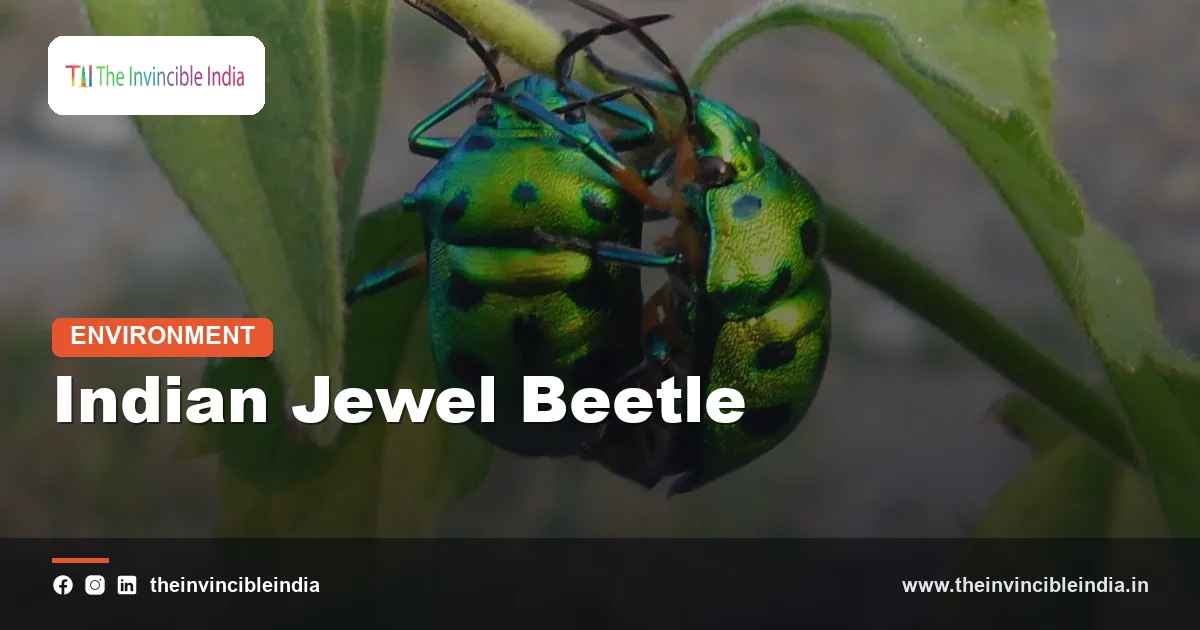
A jewel beetle is a metallic, iridescent beetle of the family Buprestidae, whose wing-cases shine in green, blue, copper and gold and whose larvae bore into wood, and several such species live in India. Indian jewel beetles were historically prized because their brilliant, non-fading wing-cases were stitched into “beetlewing” embroidery on textiles, a craft associated with royal and ceremonial dress in South Asia.
The phrase Indian jewel beetle is a popular label for the metallic buprestid species found across the country, such as members of the genera Sternocera and Chrysochroa, and not the name of a single species. Jewel beetles are harmless to people, and the adults are admired for their colour while the larvae play a role in recycling dead and dying wood. This explainer covers their appearance, structural colour, life cycle, the beetlewing craft and their ecology.
Quick Facts
| Attribute | Detail |
|---|---|
| Group | Jewel beetles, also called metallic wood-boring beetles, family Buprestidae (order Coleoptera) |
| Number of species | Over 15,000 described worldwide; hundreds recorded in India |
| Size range | From a few millimetres to several centimetres, with the larger Indian forms around 3 to 4 cm |
| Colour origin | Mainly structural colour, produced by thin layers in the wing-case that reflect and interfere with light |
| Larval habit | Wood-boring, legless grubs known as flat-headed borers |
| Adult diet | Leaves, pollen, nectar or tree sap, depending on the species |
| Cultural use | Wing-cases used in beetlewing embroidery on textiles, especially in the nineteenth century |
| Danger to humans | None; not venomous and not a disease carrier |
| Ecological role | Breaks down dead and stressed wood; food for birds, wasps and other animals |
Key Takeaways
- A jewel beetle is a beetle of the family Buprestidae, which includes more than 15,000 described species of metallic, iridescent insects.
- The shimmering colour of a jewel beetle comes mostly from structural colour, in which microscopic layers in the wing-case reflect light, so the shine does not fade like a pigment.
- Jewel beetle larvae are legless wood-borers called flat-headed borers, and most feed in dead, dying or stressed wood.
- Indian craftsmen and royal courts used jewel beetle wing-cases in beetlewing embroidery, stitching them with gold and silver thread onto fabric.
- Jewel beetles are not harmful to humans, and the vast majority of species are not pests of crops or forests.
- Jewel beetles are valuable to forests because their larvae help decompose wood and because the adults serve as prey for birds, wasps and other predators.
What does a jewel beetle look like?
A jewel beetle has a hard, streamlined, torpedo-shaped body covered by glossy, metallic wing-cases that shimmer in shades of green, blue, bronze, copper or gold. Many species are patterned with spots, stripes or bands in contrasting colours, which gives the group its jewel-like reputation.
The wing-cases are called elytra, and they are the hardened front wings that protect the thin flying wings folded underneath. The head is small and often tucked into the front part of the thorax, the antennae are short and saw-toothed, and the legs are strong and short. Beetles of the family Buprestidae range from a few millimetres to several centimetres, and some tropical species exceed eight centimetres. In India, large forms are commonly around three to four centimetres long.
Common features
- A hard, often rough or ridged body surface, giving a solid, armoured feel.
- Wing-cases with a polished metallic sheen that changes with the angle of light.
- Short, serrated antennae.
- A body that tapers towards the rear, giving the characteristic bullet or torpedo shape.
Why are jewel beetles so shiny?
Jewel beetles are so shiny because their wing-cases contain stacked microscopic layers that reflect light and produce structural colour, a physical effect different from the chemical colour found in pigments. These layers alternate between materials that bend light differently, so some wavelengths reinforce each other while others cancel out.
The effect is called thin-film interference, and it is the same principle that makes soap bubbles and oil films shimmer. As the angle of view or the angle of the light changes, the thickness that light travels through also changes, and so the colour appears to shift. This iridescence is why a jewel beetle can look green from one angle and blue or coppery from another.
Why the colour lasts
Structural colour is built into the physical structure of the wing-case, so it does not fade in the way a dye or pigment can. Museum textiles decorated with beetle wings more than a century old still glitter, and this durability is a major reason that craftsmen prized the material. The colour may also help the beetle by blending into sunlit leaves or by confusing predators, although scientists continue to study its exact functions.
Researchers are interested in jewel beetle structures for designing anti-counterfeit labels, paints and displays that need colour without dyes, an area of study called biomimicry.
Where are jewel beetles found in India?
Jewel beetles are found in forests, scrublands, orchards and gardens across India, with the greatest variety in warm, wooded regions such as the Western Ghats, the north-east and the peninsular forests. They need trees or shrubs to feed and breed, so they are rare in treeless habitats.
Adult jewel beetles are sun-loving insects. They are most active on hot, bright days, when they fly rapidly, rest on tree trunks and leaves, and take off quickly if disturbed. In India, many large species are noticed in the warm season and after the first rains, when adults emerge from their wooden tunnels. Some species are associated with the trees of dry regions, such as jujube (ber) and acacias, while others live on evergreen and moist deciduous forest trees.
Some Indian jewel beetle groups
| Group (genus) | Appearance | Notes |
|---|---|---|
| Sternocera | Large, robust beetles with metallic green or bronze bodies and often patterned wing-cases | Their wing-cases have been widely used in historical beetlewing work |
| Chrysochroa | Elongated beetles with bright metallic green, blue or purple wing-cases and stripes | Related species were used in craft traditions across Asia |
| Belionota | Medium to large beetles with shiny, often green or bronze bodies | Found in forests and orchards |
| Agrilus | Small, slender, narrow-bodied beetles | One of the largest beetle genera; some species attack stressed trees |
What is the life cycle of a jewel beetle?
A jewel beetle goes through complete metamorphosis in four stages: egg, larva, pupa and adult. The female lays eggs in cracks in bark or in dead or dying wood, the larva tunnels inside the wood for months or years, and the adult emerges after a pupal stage spent in a chamber near the surface.
Egg
Females select suitable host plants with great care, laying eggs singly or in small clusters in crevices of bark, on fresh wounds, or at the base of plants. The choice of host differs by species, and some prefer only a narrow group of trees.
Larva
The larva is a pale, soft, legless grub with a flattened, widened section just behind its head, which gives rise to the name flat-headed borer. It chews winding tunnels beneath the bark or deeper into the wood, packing the tunnel behind it with fine sawdust-like material called frass. The larval stage can last from several months to a few years, depending on the species and on how nutritious the wood is.
Pupa and adult
When fully grown, the larva forms a chamber and changes into a pupa, which then becomes an adult. The adult chews an exit hole, which is often oval or D-shaped in cross-section, a useful clue for identifying jewel beetle damage. After emerging, the adult feeds, mates and lays eggs.
What do adult jewel beetles eat?
Adult jewel beetles eat plant material, mostly leaves, pollen, nectar and sometimes tree sap, depending on the species. They use their small mouthparts to nibble leaf edges or to feed on flowers, and many adults live for only a few weeks.
The adults are often wary. They can fly quickly, and when handled some species tuck in their legs and play dead, a defence known as thanatosis. Their hard bodies and metallic colouring make them unpalatable or difficult prey for some predators, although birds, lizards and robber flies still eat them.
A few jewel beetles show extraordinary adaptations. Some species of the genus Melanophila, found in other parts of the world, have special sensors that detect the infrared radiation from forest fires, and they fly towards burnt trees to lay eggs in wood that has lost its natural defences. Such examples show how varied the family is.
What is beetlewing embroidery?
Beetlewing embroidery is a textile art in which the shimmering wing-cases of jewel beetles are sewn onto fabric, often together with gold or silver thread, to create glittering patterns. The wing-cases act like natural sequins, reflecting changing colour as the fabric moves.
This craft was practised in several parts of Asia, including South Asia, Myanmar, Thailand and Japan. A famous early example from Japan is the seventh-century Tamamushi Shrine, which was once decorated with the wings of the jewel beetle Chrysochroa fulgidissima. In India, beetlewing work was used on garments, shawls, accessories and furnishings, often in combination with zardozi, the metal-thread embroidery of the subcontinent.
How the work was done
- Wing-cases were collected, usually from dead beetles, and cleaned.
- They were cut or pierced, often in tiny geometric shapes such as diamonds, drops or petals.
- Each piece was stitched onto cloth with fine thread, often along with gold and silver wire, to form borders, flowers and leaves.
- Large numbers of wing-cases were used to cover surfaces and create a shimmering effect.
Beetlewing embroidery spread beyond Asia. Wing-cases were exported to Europe in the nineteenth century, where they decorated Victorian dresses and accessories, including a famous stage costume made for the actress Ellen Terry in 1888. Museums in India and abroad hold examples that still glitter after more than a century.
How were jewel beetle wing-cases used in Indian textiles?
Jewel beetle wing-cases were used in Indian textiles to add colour and shimmer to garments and furnishings worn or displayed on special occasions. They were stitched into floral patterns, borders and small motifs, and were valued because they could imitate the sparkle of gems at a lower cost.
| Use | How the wing-cases appeared |
|---|---|
| Ceremonial and court garments | Formed borders, vines and flower motifs along hems and sleeves |
| Shawls and wraps | Added green and gold highlights to embroidered edges |
| Accessories such as bags, slippers and caps | Created small glittering panels |
| Decorative furnishings and trims | Accented hangings and covers with a metallic sheen |
Today the craft is rare. Synthetic sequins and glass beads have replaced beetle wings in most workshops, and heritage specialists treat old beetlewing textiles as delicate objects that must be shielded from strong light and rough handling. Some contemporary designers and museums are interested in the craft as heritage, and any modern use depends on ethical sourcing, since only naturally dead beetles or legally obtained material should be used.
Are jewel beetles pests?
Most jewel beetles are not pests, and only a small number of species damage trees, mostly those that are already stressed, dying or recently felled. The majority of species develop in dead or decaying wood and play a useful role in forest recycling.
A few jewel beetles attack living plants. Some species of Agrilus and other genera mine the cambium of trees, particularly those weakened by drought, disease or injury, and a few borers can damage fruit trees, timber species or ornamental plants. The emerald ash borer, Agrilus planipennis, which has killed millions of ash trees in North America, is a well-known invasive example from outside India.
How can tree damage be reduced?
- Keep trees healthy with proper watering and avoid injuring bark.
- Remove and burn or destroy dead and dying branches in orchards and plantations.
- Look for D-shaped exit holes, sawdust-like frass and thinning crowns.
- Consult the local agricultural or forest authority before using chemicals.
Are jewel beetles harmful to humans?
Jewel beetles are not harmful to humans. They have no venom, do not sting, are not known to transmit diseases and do not infest homes the way some wood-boring insects do. A large beetle may pinch if handled roughly, but the effect is mild.
The hard, dry wing-cases of dead beetles are non-toxic. Anyone handling antique beetlewing textiles should still take care, since old fabrics can be fragile and may contain dust or historical preservatives. Insect collectors and craftspeople should also follow local rules, as collecting insects in protected areas such as national parks and sanctuaries typically requires permission from forest authorities.
What is the ecological role of jewel beetles?
Jewel beetles help forests by breaking down dead and stressed wood, recycling nutrients and feeding other animals. When larvae tunnel through logs, they open the wood to fungi, bacteria and other decomposers, which speeds up decay and returns nutrients to the soil.
The beetles are also a link in the food chain. Eggs, larvae and adults are eaten by woodpeckers, other birds, parasitic wasps, lizards and spiders. In turn, parasitic wasps that specialise in wood-borers help keep beetle numbers balanced. Some adults visit flowers for nectar and pollen and may contribute small amounts to pollination.
Because many jewel beetle species depend on particular trees, they can also be indicators of forest health. A rich diversity of buprestids often points to old trees, deadwood and varied vegetation, all of which are valuable for wider biodiversity.
Why is it called a jewel beetle?
The jewel beetle gets its name from its glittering, gem-like colouring, which resembles polished emeralds, sapphires and gold. The scientific family name, Buprestidae, comes from an ancient Greek word that referred to a beetle supposed to make cattle swell if eaten.
The same metallic beauty explains the beetle’s cultural significance, from ancient Japanese shrines to Indian court dress to Victorian fashion. Few insects have been so closely connected with human craft and ornament.
Bottom Line
The Indian jewel beetle is a harmless, dazzling insect whose structural colour inspired centuries of beetlewing embroidery and whose larvae quietly recycle wood in forests. Protecting old trees, leaving some deadwood in place and appreciating the beetles without collecting them keeps this living jewel in India’s landscapes.
Frequently Asked Questions
What is a jewel beetle?
A jewel beetle is a metallic, iridescent beetle of the family Buprestidae, with more than 15,000 species worldwide. Its wing-cases shine in green, blue, copper or gold, and its larvae bore into wood. Many species occur in India, and they are harmless to people.
Why are jewel beetles so colourful?
Jewel beetles are colourful mainly because of structural colour, produced by microscopic layers in the wing-case that reflect and interfere with light. This gives a metallic, iridescent sheen that changes with the viewing angle. Because it is physical and not chemical, the colour does not fade easily.
What is beetlewing embroidery?
Beetlewing embroidery is a textile craft in which wing-cases of jewel beetles are stitched onto fabric, often with gold or silver thread. The wings work like natural sequins and glitter with shifting colour. The craft was used in India and in other parts of Asia on garments, shawls and accessories.
Are jewel beetles harmful to humans or crops?
Jewel beetles are not harmful to humans, and most species are not pests. A few species attack stressed or weakened trees, and some borers can damage orchards or timber trees. Good tree care and removal of dead wood reduce the risk.
What do jewel beetle larvae do?
Jewel beetle larvae are legless, flat-headed grubs that tunnel through wood or under the bark, feeding on it for months or years. Most feed in dead, dying or stressed trees, so they help decompose wood. The adult later emerges through a characteristic D-shaped or oval exit hole.
Where can you see jewel beetles in India?
You can see jewel beetles in forests, scrublands, orchards and gardens, especially on sunny days when they rest on tree trunks and leaves. They are more diverse in wooded areas such as the Western Ghats and the north-east. Observing and photographing them is better than collecting, particularly inside protected areas.
{“@context”:”https://schema.org”,”@graph”:[{“@type”:”FAQPage”,”mainEntity”:[{“@type”:”Question”,”name”:”What is a jewel beetle?”,”acceptedAnswer”:{“@type”:”Answer”,”text”:”A jewel beetle is a metallic, iridescent beetle of the family Buprestidae, with more than 15,000 species worldwide. Its wing-cases shine in green, blue, copper or gold, and its larvae bore into wood. Many species occur in India, and they are harmless to people.”}},{“@type”:”Question”,”name”:”Why are jewel beetles so colourful?”,”acceptedAnswer”:{“@type”:”Answer”,”text”:”Jewel beetles are colourful mainly because of structural colour, produced by microscopic layers in the wing-case that reflect and interfere with light. This gives a metallic, iridescent sheen that changes with the viewing angle. Because it is physical and not chemical, the colour does not fade easily.”}},{“@type”:”Question”,”name”:”What is beetlewing embroidery?”,”acceptedAnswer”:{“@type”:”Answer”,”text”:”Beetlewing embroidery is a textile craft in which wing-cases of jewel beetles are stitched onto fabric, often with gold or silver thread. The wings work like natural sequins and glitter with shifting colour. The craft was used in India and in other parts of Asia on garments, shawls and accessories.”}},{“@type”:”Question”,”name”:”Are jewel beetles harmful to humans or crops?”,”acceptedAnswer”:{“@type”:”Answer”,”text”:”Jewel beetles are not harmful to humans, and most species are not pests. A few species attack stressed or weakened trees, and some borers can damage orchards or timber trees. Good tree care and removal of dead wood reduce the risk.”}},{“@type”:”Question”,”name”:”What do jewel beetle larvae do?”,”acceptedAnswer”:{“@type”:”Answer”,”text”:”Jewel beetle larvae are legless, flat-headed grubs that tunnel through wood or under the bark, feeding on it for months or years. Most feed in dead, dying or stressed trees, so they help decompose wood. The adult later emerges through a characteristic D-shaped or oval exit hole.”}},{“@type”:”Question”,”name”:”Where can you see jewel beetles in India?”,”acceptedAnswer”:{“@type”:”Answer”,”text”:”You can see jewel beetles in forests, scrublands, orchards and gardens, especially on sunny days when they rest on tree trunks and leaves. They are more diverse in wooded areas such as the Western Ghats and the north-east. Observing and photographing them is better than collecting, particularly inside protected areas.”}}]}]}


