

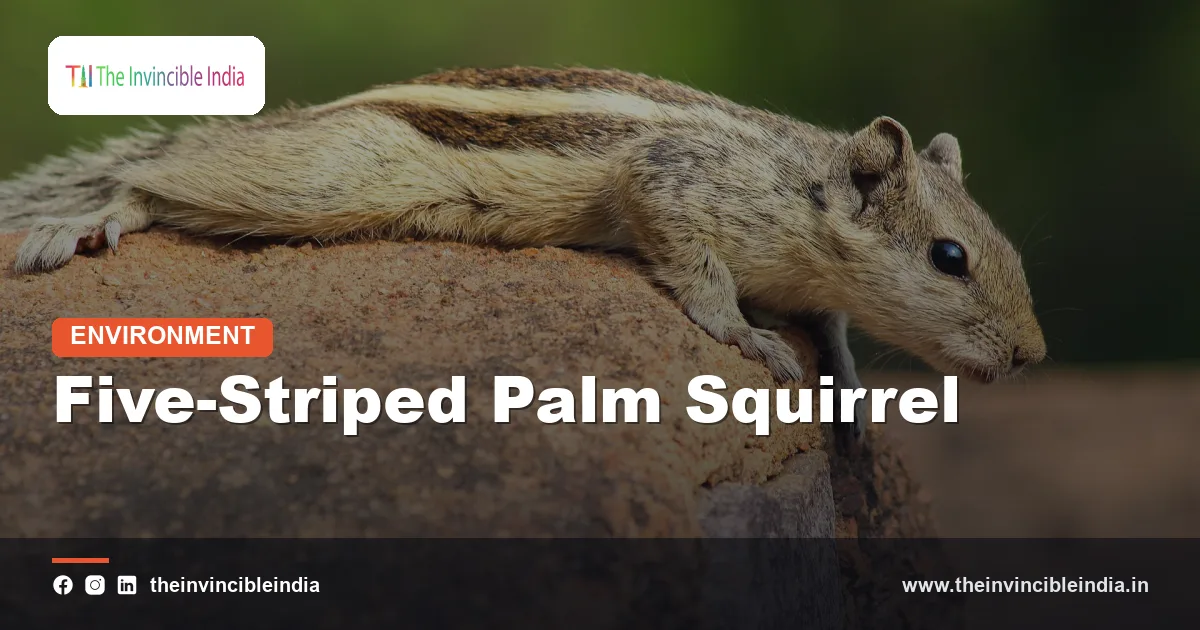
The five-striped palm squirrel (Funambulus pennantii), also called Northern palm squirrel or Pennant’s palm squirrel, is a small, quick, diurnal tree squirrel of northern and north-western India, recognised by the five pale stripes that run along its greyish-brown back. It is among the most familiar wild mammals in the Indian plains, scampering along walls, power lines, rooftops and garden trees and calling with sharp chirps.
The five-striped palm squirrel is a close relative of the three-striped palm squirrel of southern India, and the two are often confused. This explainer covers how to identify the five-striped palm squirrel, where it lives, what it eats, how it breeds, why it thrives around people, and how to share space with it.
| Attribute | Detail |
|---|---|
| Common names | Five-striped palm squirrel, northern palm squirrel, Pennant’s palm squirrel |
| Scientific name | Funambulus pennantii |
| Family and genus | Sciuridae (squirrels), genus Funambulus (Indian palm squirrels) |
| Distinctive feature | Five pale stripes on the back, with the middle stripe along the spine |
| Typical size | Body about 12 to 15 cm with a tail of similar length; weight roughly 100 to 150 g |
| Range | Northern and north-western India, and neighbouring Pakistan, Nepal and Bangladesh; introduced to parts of Australia |
| Habitat | Gardens, farmland, orchards, scrub, roadside trees, villages and cities |
| Activity pattern | Diurnal (active by day) |
| Conservation status (IUCN) | Least Concern |
Key Takeaways
- The five-striped palm squirrel (Funambulus pennantii) is a small tree squirrel with five pale stripes on its back, found mainly in northern and north-western India.
- The five-striped palm squirrel differs from the three-striped palm squirrel (Funambulus palmarum) of southern and peninsular India in its extra stripes and its northern range.
- The five-striped palm squirrel is diurnal and omnivorous, eating seeds, fruits, flowers, nuts, insects and sometimes eggs.
- The five-striped palm squirrel thrives around people, nesting in tree hollows, building cracks, roof spaces and wire-and-leaf nests.
- Females of the five-striped palm squirrel can breed more than once a year and typically raise a few young per litter.
- The IUCN lists the five-striped palm squirrel as Least Concern, but individuals face risks from traffic, dogs, cats, electric wires and predators.
What is the five-striped palm squirrel?
The five-striped palm squirrel is a species of tree squirrel in the genus Funambulus, a group of small squirrels found in South Asia that are known as palm squirrels. It was named Funambulus pennantii after the British naturalist Thomas Pennant, and the genus name comes from Latin words associated with tightrope walking, a fitting description of its agility.
The family Sciuridae includes tree squirrels, ground squirrels, chipmunks, marmots and flying squirrels. Palm squirrels are among the smallest members of the family in India and are well adapted to human-modified landscapes. They belong to the order Rodentia, the largest order of mammals.
The squirrel’s common names reflect its stripes and its link to palm trees, though it is far from confined to palms. It is as likely to be seen on a mango tree, a boundary wall or a telephone wire as on a coconut palm.
How can you identify the five-striped palm squirrel?
The five-striped palm squirrel is identified by five cream or pale buff stripes along a grey-brown back, a bushy tail with dark and pale banding and a lighter underside. The stripes run the full length of the back, with the central stripe running along the spine and a dark band between each pair of pale stripes.
Other identifying features include:
- Size: small and slim, with a body length of roughly 12 to 15 cm and a tail of about the same length.
- Tail: bushy, with a mix of black and pale tips; it is flicked rapidly when the squirrel is excited or alarmed.
- Face: a rounded head with large, dark eyes and small ears without tufts.
- Underparts: a pale grey or whitish belly.
- Voice: a loud, repeated chirp or chatter, with different calls for alarm and territory.
The stripes and body colour vary slightly between regions, and the outer pair of stripes can be faint. Young squirrels look similar to adults but are smaller and have softer fur. Seen from a distance, the species may look like a small brown blur with a flicking tail.
How is the five-striped palm squirrel different from the three-striped palm squirrel?
The five-striped palm squirrel differs from the three-striped palm squirrel mainly in the number of pale stripes on the back, the position of the middle stripe and the geographic range. The three-striped palm squirrel (Funambulus palmarum) has three pale stripes and is the common palm squirrel of southern India and Sri Lanka, while the five-striped palm squirrel is typical of the north.
| Feature | Five-striped palm squirrel | Three-striped palm squirrel |
|---|---|---|
| Scientific name | Funambulus pennantii | Funambulus palmarum |
| Pale back stripes | Five | Three |
| Typical range | Northern, north-western and parts of central India | Southern and peninsular India, Sri Lanka |
| Typical habitat | Gardens, farmland, towns and cities of the plains | Palms, gardens, forest edges and towns of the south |
| Colour | Greyish-brown back, pale underparts | Olive-brown back, pale underparts |
The two species meet or overlap in parts of central India, and where ranges overlap, identification depends on counting the stripes and noting the location. Other Funambulus species, such as the Nilgiri striped squirrel and the Jungle palm squirrel, live in forests of the south. Taxonomic details have been revised over time, so older books may use different names.
Indian folklore links the squirrel’s stripes to a story from the Ramayana, in which Rama stroked a squirrel that had helped build the bridge to Lanka, leaving his fingers’ marks on its back. This is a traditional story and is usually told about the three-striped palm squirrel, but it is often applied to palm squirrels in general.
Where does the five-striped palm squirrel live?
The five-striped palm squirrel lives mainly in northern and north-western India, including the Indo-Gangetic plain, as well as in neighbouring Pakistan, Nepal and Bangladesh. It is one of the most common mammals in cities such as Delhi, Lucknow and Jaipur, and in rural areas across the plains.
Its habitat includes:
- dry deciduous forest edges and scrub;
- farmland with scattered trees, field bunds and orchards;
- city parks, avenues, gardens and campuses;
- temples, monuments, old buildings and rooftops.
The species has been introduced outside its natural range. A population has long been established in the city of Perth in Western Australia, descended from animals that escaped captivity, where it is regarded as an introduced species and a potential pest. In its home range it is native and ecologically valuable.
Exact population numbers are not known, but the squirrel is regarded as abundant and widespread, and its numbers seem stable or increasing in many towns.
What does the five-striped palm squirrel eat?
The five-striped palm squirrel is an omnivore that eats seeds, nuts, fruits, flowers, buds, tender shoots and insects, and it occasionally takes bird eggs and nestlings. Most of its diet is plant matter, and it forages mainly during the day on the ground and in trees.
Common foods include:
- fruits such as mango, guava, jamun, ber and figs;
- seeds and nuts, including those of babul, neem and other trees;
- cultivated crops such as groundnut, maize, wheat and sunflower;
- flower nectar and petals;
- insects, termites and occasionally small vertebrates or eggs.
Squirrels hold food in their forepaws and sit upright to eat. They often gnaw bark to reach sap, and they may store small amounts of food, although palm squirrels are less given to caching than temperate squirrels. In cities they accept food from people, including bread, biscuits and peanuts, though feeding such food regularly is not ideal for their health.
The squirrel plays a small role in seed dispersal, since seeds carried or dropped away from the parent tree may germinate. It can also damage crops and fruit in orchards, which is why farmers sometimes regard it as a pest.
How does the five-striped palm squirrel breed?
The five-striped palm squirrel breeds more than once a year in suitable conditions, with a gestation of roughly five to six weeks and litters of typically two to four young. Breeding seasons vary by region and food supply, and in many places there are two main peaks, often in late winter to spring and again around the monsoon.
Key points of its reproduction include:
- Nesting: females build a spherical nest of grass, leaves, fibre and rags in a tree fork, a tree hollow, a building crevice or even inside a fan casing.
- Young: they are born blind, hairless and helpless, and they open their eyes after about two to three weeks.
- Parental care: the mother alone usually raises the young, nursing them and moving them between nests if disturbed.
- Weaning: young begin leaving the nest and eating solid food at roughly six to eight weeks.
The courtship period involves chases in which a male pursues a female through trees and along walls, making chirping sounds. Lifespan in the wild is usually a few years, though individuals in captivity may live longer. Predation and accidents shorten many lives.
Why is the five-striped palm squirrel so bold around people?
The five-striped palm squirrel is bold around people because it has adapted to human-modified places where food, nest sites and shelter are plentiful and where danger from large predators is lower than in forest. Species that benefit from living near people are called synanthropic or human-commensal.
Several factors explain its confidence:
- It finds easy food in gardens, markets, temples and waste.
- Buildings, walls and wires provide safe highways and nesting sites.
- Repeated exposure to harmless people reduces fear; squirrels learn which humans and places are safe.
- It stays alert, however, and bolts to a tree or wall when dogs, cats or hawks appear.
The squirrel’s behaviour is a blend of curiosity and caution. It will sit and watch a person at a short distance, flick its tail, and bolt if approached. It should not be handled, since a frightened squirrel can bite and scratch, and like any wild mammal it can carry parasites or disease, though serious problems are uncommon.
What are the main behaviours and calls of the five-striped palm squirrel?
The main behaviours of the five-striped palm squirrel are rapid climbing, tail-flicking, sharp chirping and sunbathing, and its calls serve to warn other squirrels of danger and to defend territory. Its movements are quick and often jerky, interrupted by pauses when it freezes or looks around.
- Alarm calls: a rapid series of loud chirps, often accompanied by flicking tail movements, given when a cat, snake, dog or bird of prey appears.
- Tail signals: the tail is flicked, fluffed and curled as a visual signal.
- Grooming: squirrels spend time cleaning their fur and tails with their paws and mouths.
- Sunbathing: they flatten themselves on warm surfaces in the morning, especially in cooler months.
- Territorial chases: males and females chase each other on trunks and walls.
Alarm calls can alert other animals too, including birds and langurs, which benefits the whole local community. Watching squirrels is therefore a good way to notice the presence of a hidden predator.
What threatens the five-striped palm squirrel?
The five-striped palm squirrel is threatened mainly by predators, vehicle collisions, electrocution on overhead wires and loss of tree cover, though the species as a whole is not at risk. Its high reproductive rate and adaptability keep populations healthy in most places.
- Natural predators: domestic and feral cats, dogs, snakes, owls, hawks, kites and mongooses.
- Roads and wires: squirrels are frequently killed by vehicles, and some are electrocuted when they cross uninsulated cables.
- Tree felling: removal of old trees reduces nest sites and fruit.
- Poisoning and trapping: pest control and rodenticides may harm squirrels in orchards and storage areas.
- Weather: extreme heat or cold can cause deaths among young animals.
The IUCN lists the five-striped palm squirrel as Least Concern. Residents can help by keeping fruit trees, providing shallow water in summer, keeping cats indoors and avoiding rodenticides in gardens.
How can people live alongside the five-striped palm squirrel?
People can live alongside the five-striped palm squirrel by keeping food waste secured, providing water, preserving trees and avoiding direct handling. Most squirrel conflicts involve nuisance damage, such as nesting in roofs or eating fruit, and can be reduced with simple measures.
- Seal gaps in roofs and walls before breeding season to prevent nests inside buildings.
- Cover grain stores and keep food waste in closed bins.
- Place a shallow bowl of water in a shady spot during hot months.
- Use netting to protect valuable fruit rather than poison.
- Keep pet cats indoors, especially at dawn and dusk, to protect squirrels and birds.
- If you find a very young squirrel on the ground, wait to see if the mother retrieves it, and contact a local wildlife rescuer if it does not.
Feeding is common in India, but regular feeding of processed human food should be avoided. Small quantities of nuts, seeds or chopped fruit are better than sweets, fried snacks or bread.
Bottom Line
The five-striped palm squirrel is a small, successful, adaptable squirrel of the Indian plains and cities, easy to identify by its five pale back stripes. It is an everyday wild neighbour that shows how some wildlife can thrive alongside people, provided trees, water and safe places remain. 23 October 2026
Frequently Asked Questions
What is a five-striped palm squirrel?
The five-striped palm squirrel (Funambulus pennantii) is a small tree squirrel with five pale stripes along its back, common in northern and north-western India. It lives in gardens, farms and cities. It is active by day and eats seeds, fruits, flowers and insects.
How do you tell a five-striped palm squirrel from a three-striped one?
You tell the two apart mainly by counting the pale stripes on the back: five for the five-striped palm squirrel and three for the three-striped palm squirrel. Their ranges also differ, since the five-striped species lives mainly in the north and the three-striped species in the south. Where ranges overlap, careful counting of stripes matters.
What does the five-striped palm squirrel eat?
The five-striped palm squirrel eats seeds, nuts, fruits, flowers, buds and insects, and sometimes eggs. Most of its diet is plant-based. It also feeds on crops such as groundnut and maize, and on fruit in orchards and gardens.
How many babies does a five-striped palm squirrel have?
A five-striped palm squirrel typically has about two to four young per litter, after a gestation of roughly five to six weeks. Females can breed more than once a year. The young are born blind and hairless and are raised in a nest by the mother.
Is the five-striped palm squirrel dangerous to humans?
The five-striped palm squirrel is not dangerous to humans in general, but a frightened animal can bite or scratch if handled. Like any wild mammal it should be left alone. Anyone bitten should wash the wound thoroughly and seek medical advice.
Is the five-striped palm squirrel endangered?
The five-striped palm squirrel is not endangered, and the IUCN lists it as Least Concern because it is widespread and adaptable. Individuals still face threats from cats, dogs, vehicles and electric wires. Preserving trees and avoiding poisons helps local populations.
{“@context”:”https://schema.org”,”@graph”:[{“@type”:”FAQPage”,”mainEntity”:[{“@type”:”Question”,”name”:”What is a five-striped palm squirrel?”,”acceptedAnswer”:{“@type”:”Answer”,”text”:”The five-striped palm squirrel (Funambulus pennantii) is a small tree squirrel with five pale stripes along its back, common in northern and north-western India. It lives in gardens, farms and cities. It is active by day and eats seeds, fruits, flowers and insects.”}},{“@type”:”Question”,”name”:”How do you tell a five-striped palm squirrel from a three-striped one?”,”acceptedAnswer”:{“@type”:”Answer”,”text”:”You tell the two apart mainly by counting the pale stripes on the back: five for the five-striped palm squirrel and three for the three-striped palm squirrel. Their ranges also differ, since the five-striped species lives mainly in the north and the three-striped species in the south. Where ranges overlap, careful counting of stripes matters.”}},{“@type”:”Question”,”name”:”What does the five-striped palm squirrel eat?”,”acceptedAnswer”:{“@type”:”Answer”,”text”:”The five-striped palm squirrel eats seeds, nuts, fruits, flowers, buds and insects, and sometimes eggs. Most of its diet is plant-based. It also feeds on crops such as groundnut and maize, and on fruit in orchards and gardens.”}},{“@type”:”Question”,”name”:”How many babies does a five-striped palm squirrel have?”,”acceptedAnswer”:{“@type”:”Answer”,”text”:”A five-striped palm squirrel typically has about two to four young per litter, after a gestation of roughly five to six weeks. Females can breed more than once a year. The young are born blind and hairless and are raised in a nest by the mother.”}},{“@type”:”Question”,”name”:”Is the five-striped palm squirrel dangerous to humans?”,”acceptedAnswer”:{“@type”:”Answer”,”text”:”The five-striped palm squirrel is not dangerous to humans in general, but a frightened animal can bite or scratch if handled. Like any wild mammal it should be left alone. Anyone bitten should wash the wound thoroughly and seek medical advice.”}},{“@type”:”Question”,”name”:”Is the five-striped palm squirrel endangered?”,”acceptedAnswer”:{“@type”:”Answer”,”text”:”The five-striped palm squirrel is not endangered, and the IUCN lists it as Least Concern because it is widespread and adaptable. Individuals still face threats from cats, dogs, vehicles and electric wires. Preserving trees and avoiding poisons helps local populations.”}}]}]}


