

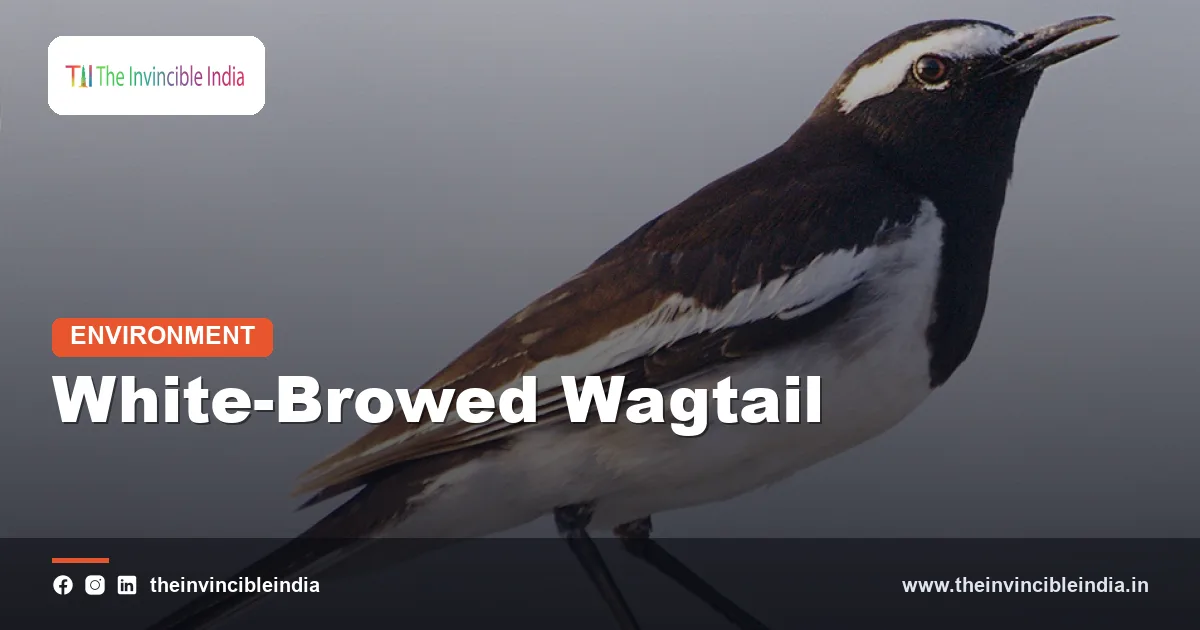
The white-browed wagtail (Motacilla maderaspatensis), also called the large pied wagtail, is the largest wagtail found in India: a long-tailed, black-and-white songbird that walks along riverbanks, canals, lawns and wet pavements while constantly wagging its tail. It is a bird of the Indian subcontinent, resident in many regions, and one of the easiest wetland-edge birds for an ordinary person to recognise.
The white-browed wagtail is easy to spot because of a bold white eyebrow stripe, a black head and breast, and a white wing patch. This explainer covers how to identify the bird, where it lives, what it eats, why it wags its tail, how it breeds and sings, and how it differs from other Indian wagtails.
| Attribute | Detail |
|---|---|
| Common name | White-browed wagtail, also called large pied wagtail |
| Scientific name | Motacilla maderaspatensis |
| Family | Motacillidae (wagtails and pipits) |
| Size | Roughly 21 cm long, the largest of the wagtails found in India |
| Range | Mainly the Indian subcontinent, with India holding most of its population |
| Habitat | Rivers, streams, canals, ponds, paddy margins, gardens and town lawns |
| Diet | Insects and other small invertebrates picked from the ground and water edge |
| Conservation status | Listed as Least Concern by the IUCN |
| Signature behaviour | Constant up-and-down tail wagging while walking |
Key Takeaways
- The white-browed wagtail is the largest wagtail in India, measuring roughly 21 cm from bill to tail tip.
- The white-browed wagtail is identified by a broad white eyebrow stripe, black upperparts, a black breast and a bold white wing patch.
- The white-browed wagtail is largely restricted to the Indian subcontinent and is resident in many parts of India rather than a long-distance migrant.
- The white-browed wagtail feeds mostly on insects and other small invertebrates, which it picks from mud, stones and short grass near water.
- The white-browed wagtail often nests in crevices of bridges, walls, rocks and buildings close to water, and it sings loudly from perches.
- The IUCN lists the white-browed wagtail as Least Concern, and the bird adapts well to towns where it finds water and open ground.
What is the white-browed wagtail?
The white-browed wagtail is a medium-sized songbird in the family Motacillidae, which also includes the other wagtails and the pipits. Its scientific name is Motacilla maderaspatensis, and the species name points to Madras, an old name for Chennai, where early specimens were studied.
The English name “large pied wagtail” is also widely used, and the two names refer to the same bird. “Pied” simply means patched in two colours, in this case black and white. The word “wagtail” refers to the habit shared by the whole group of bobbing the long tail up and down.
The white-browed wagtail is a passerine, which means a perching songbird. Despite the “large” in one of its names, the bird is still slender and light, weighing only a few dozen grams. It is large only when compared with other wagtails such as the grey wagtail or the white wagtail that visit India.
How can you identify a white-browed wagtail?
A white-browed wagtail can be identified by its black-and-white plumage and the clear white band above each eye, which gives the bird its name. The crown, back, wings, throat and upper breast are black or very dark, while the belly and flanks are clean white.
The most useful field marks are listed below.
- White eyebrow: A broad white stripe runs from the bill over the eye, set against a dark head.
- Black upperparts and breast: The back, shoulders and chest look black in adult males and slightly greyer or browner in females.
- White wing patch: A large white panel on the folded wing is conspicuous when the bird walks or flies.
- Long tail: The tail is black with white outer feathers that flash when the bird flutters up.
- White underparts: The belly and under-tail are white, which separates the bird from darker lookalikes.
Young birds are duller, with browner upperparts and a less sharply defined breast. Males and females look broadly similar, so observers usually tell the sexes apart only by the slightly browner back of the female.
Where is the white-browed wagtail found in India?
The white-browed wagtail is found across much of India, from the foothills of the Himalaya through the plains and the peninsula, and it extends into neighbouring countries of the subcontinent. It is generally a resident bird, though some local movements follow water availability and season.
The species prefers open ground near water. Typical places include the banks of rivers and streams, irrigation canals, the edges of lakes and village ponds, rocky stretches of hill streams, temple tanks and wet lawns. In forested hill country it is often seen on rocks along streams, while in the plains it is a familiar visitor to paddy-field bunds and city parks.
The bird is particularly adaptable. It has learned to use sprinkler-watered lawns, rooftops after rain, canal embankments and even the wet edges of roads, which helps it persist in towns and cities. Exact numbers are not known with precision, but the species is described as widespread and fairly common across its range.
What does the white-browed wagtail eat?
The white-browed wagtail eats mainly insects and other small invertebrates that it finds on the ground, on mud flats and among stones at the water’s edge. Its slim, pointed bill is well suited to picking up tiny prey.
Typical food items include flies, beetles, small bugs, ant-like insects, tiny crustaceans and the larvae of aquatic insects. Occasionally the bird takes a few small seeds or other scraps, but animal prey forms the bulk of the diet.
The feeding method is easy to observe. The bird walks briskly or runs in short bursts, stops, and snaps at a small insect. It may also make a short upward flutter to catch a flying insect or flush hidden prey from vegetation. Because it eats large numbers of insects, including some that bother people and crops, it is sometimes counted among the useful birds of gardens and farmland.
Why does the white-browed wagtail wag its tail?
The white-browed wagtail wags its tail constantly, and scientists have proposed several explanations without settling on a single one. The most commonly discussed ideas are that the movement helps flush hidden insects, signals alertness to predators, and helps the bird keep balance on uneven ground.
One idea is that the motion startles small insects from cover, making them visible and easier to catch. Another suggests that the wag tells potential predators that the bird has already noticed them, which may discourage an attack. A third points to the physics of walking: a long tail acts as a counterweight on wet stones and sloping banks.
It is best to treat these as hypotheses rather than established facts. What is certain is that the behaviour is shared across the wagtail family and is part of how the group got its name, and that the white-browed wagtail does it more or less all the time while walking and standing.
How does the white-browed wagtail breed?
The white-browed wagtail builds a cup-shaped nest in a sheltered crevice or ledge, usually close to water, and the female typically lays a small clutch of a few eggs. The timing of breeding varies with region and rainfall, and it often falls in the warmer months around the pre-monsoon and monsoon period.
Nest sites are varied. The birds use holes in stone walls, gaps under bridges, gaps in embankments, spaces among rocks and on the beams or ledges of old buildings. The nest itself is made from grass, roots, fibres and sometimes bits of cloth or string, lined with softer material such as hair or feathers.
Both parents are involved in feeding the young once the eggs hatch. Pairs hold territories and defend them energetically. Wagtails of several species are known to attack their own reflection in windows, car mirrors and glass, mistaking the image for a rival, so a pair living near a building may repeatedly peck at the glass during the breeding season.
What does the white-browed wagtail sound like?
The white-browed wagtail has a loud, musical, whistling song that is more melodious than the calls of most other wagtails, and it often sings from a rooftop, wire, tree top or rock at dawn. Its call note is a sharp, short chirp that carries well across open water.
The song is made of clear, varied whistled phrases and is heard most often in the breeding season. Males sing to advertise a territory and to attract a mate. In urban areas the bird is often detected by sound first, because the early-morning song stands out against the hum of a waking town.
The bird also makes a harsh alarm call when a predator such as a cat or a bird of prey is near. Other small birds nearby tend to respond to such calls, so wagtails can indirectly act as lookouts for a wetland edge.
How is the white-browed wagtail different from other Indian wagtails?
The white-browed wagtail differs from other Indian wagtails mainly in its larger size, its black upperparts and breast, and its broad white eyebrow. Most other wagtails are smaller, greyer or yellower, and many of them are winter visitors rather than residents.
| Wagtail | Key features | Status in India |
|---|---|---|
| White-browed wagtail | Largest; black above and on breast; broad white eyebrow; large white wing patch | Mostly resident |
| White wagtail | Grey back; white face with a black neck patch and crown | Mainly a winter visitor in many areas |
| Grey wagtail | Grey back, yellow underparts and a very long tail | Mostly a winter visitor to the plains, breeding in the hills |
| Citrine wagtail | Bright yellow head and underparts with a grey or black back | Winter visitor |
| Yellow wagtail | Olive back and yellow underparts, with variable head patterns | Winter visitor and passage migrant |
The simplest way to separate the white-browed wagtail from the white wagtail is the back and the face. The white-browed wagtail has a black back and a black face with a white eyebrow, while the white wagtail has a grey back and a mostly white face.
Is the white-browed wagtail endangered?
The white-browed wagtail is not endangered; the IUCN lists it as Least Concern because it is widespread and adapts well to human-modified habitats. The bird does not appear to be declining at a rate that would raise conservation alarms.
That does not mean it faces no pressure. Polluted rivers, drained ponds, concrete-lined canals and the loss of insect life through heavy pesticide use can reduce feeding grounds in some places. Disturbance at nesting sites, such as the renovation of old bridges and buildings, can also destroy nests.
Because the bird feeds at the water’s edge, it can act as a rough indicator of how healthy a small wetland is. A pair that holds a territory along a stream year after year usually means that the stream still supports insects and has some clean, open bank.
How can you watch the white-browed wagtail?
The best way to watch a white-browed wagtail is to visit a quiet riverbank, canal, pond or garden lawn in the early morning and look for a black-and-white bird walking at the water’s edge. The bird is not shy in towns and can often be approached closely without alarm.
A few practical tips help beginners.
- Visit during the first two hours after sunrise, when the birds sing and feed actively.
- Look on bare, wet ground, flat rocks, bridge pillars and short-cropped lawns.
- Watch for the tail wag and the white eyebrow to confirm identification.
- Stay still and keep a distance from nests, especially during breeding months.
- Note the date and place in a nature-observation app or notebook, which helps community science projects.
Binoculars are useful but not essential, because the bird is often close and its pattern is so bold. Photographers can get good frames by waiting where a bird regularly walks, since wagtails follow predictable routes along the same stretch of bank.
Bottom Line
The white-browed wagtail is India’s largest wagtail and one of its most approachable wetland-edge birds, easily recognised by its black-and-white plumage, white eyebrow and constantly wagging tail. It is a resident, insect-eating songbird that remains common because it adapts to rivers, canals and town lawns alike.
Frequently Asked Questions
What is the white-browed wagtail also called?
The white-browed wagtail is also called the large pied wagtail. Both names refer to Motacilla maderaspatensis, a black-and-white songbird of the Indian subcontinent. The word “pied” describes its two-tone plumage.
Is the white-browed wagtail the largest wagtail in India?
Yes, the white-browed wagtail is the largest wagtail found in India. It measures roughly 21 cm in length, which is bigger than the grey, white, yellow and citrine wagtails that visit the country. Even so, it remains a slim, light bird.
Does the white-browed wagtail migrate?
The white-browed wagtail is mostly a resident bird and does not make long-distance migrations. Some birds make local movements in response to water availability and season. This sets it apart from several other Indian wagtails, which are mainly winter visitors.
What does the white-browed wagtail eat?
The white-browed wagtail eats mainly insects and other small invertebrates. It picks them from mud, stones, lawns and shallow water, and occasionally flutters up to catch a flying insect. Animal prey makes up most of its diet.
Why does the white-browed wagtail attack windows or mirrors?
The white-browed wagtail sometimes attacks reflections because it mistakes its own image for a rival bird. This happens mostly in the breeding season when pairs defend territories. The behaviour is harmless and usually stops once the breeding period ends.
Is the white-browed wagtail protected in India?
The white-browed wagtail is a wild bird that is covered by India’s general wildlife protection laws, and catching or harming wild birds is illegal. The IUCN lists the species as Least Concern because it is widespread and common. Protecting wetlands, streams and old nesting sites helps keep its numbers stable.
{“@context”:”https://schema.org”,”@graph”:[{“@type”:”FAQPage”,”mainEntity”:[{“@type”:”Question”,”name”:”What is the white-browed wagtail also called?”,”acceptedAnswer”:{“@type”:”Answer”,”text”:”The white-browed wagtail is also called the large pied wagtail. Both names refer to Motacilla maderaspatensis, a black-and-white songbird of the Indian subcontinent. The word “pied” describes its two-tone plumage.”}},{“@type”:”Question”,”name”:”Is the white-browed wagtail the largest wagtail in India?”,”acceptedAnswer”:{“@type”:”Answer”,”text”:”Yes, the white-browed wagtail is the largest wagtail found in India. It measures roughly 21 cm in length, which is bigger than the grey, white, yellow and citrine wagtails that visit the country. Even so, it remains a slim, light bird.”}},{“@type”:”Question”,”name”:”Does the white-browed wagtail migrate?”,”acceptedAnswer”:{“@type”:”Answer”,”text”:”The white-browed wagtail is mostly a resident bird and does not make long-distance migrations. Some birds make local movements in response to water availability and season. This sets it apart from several other Indian wagtails, which are mainly winter visitors.”}},{“@type”:”Question”,”name”:”What does the white-browed wagtail eat?”,”acceptedAnswer”:{“@type”:”Answer”,”text”:”The white-browed wagtail eats mainly insects and other small invertebrates. It picks them from mud, stones, lawns and shallow water, and occasionally flutters up to catch a flying insect. Animal prey makes up most of its diet.”}},{“@type”:”Question”,”name”:”Why does the white-browed wagtail attack windows or mirrors?”,”acceptedAnswer”:{“@type”:”Answer”,”text”:”The white-browed wagtail sometimes attacks reflections because it mistakes its own image for a rival bird. This happens mostly in the breeding season when pairs defend territories. The behaviour is harmless and usually stops once the breeding period ends.”}},{“@type”:”Question”,”name”:”Is the white-browed wagtail protected in India?”,”acceptedAnswer”:{“@type”:”Answer”,”text”:”The white-browed wagtail is a wild bird that is covered by India’s general wildlife protection laws, and catching or harming wild birds is illegal. The IUCN lists the species as Least Concern because it is widespread and common. Protecting wetlands, streams and old nesting sites helps keep its numbers stable.”}}]}]}


