

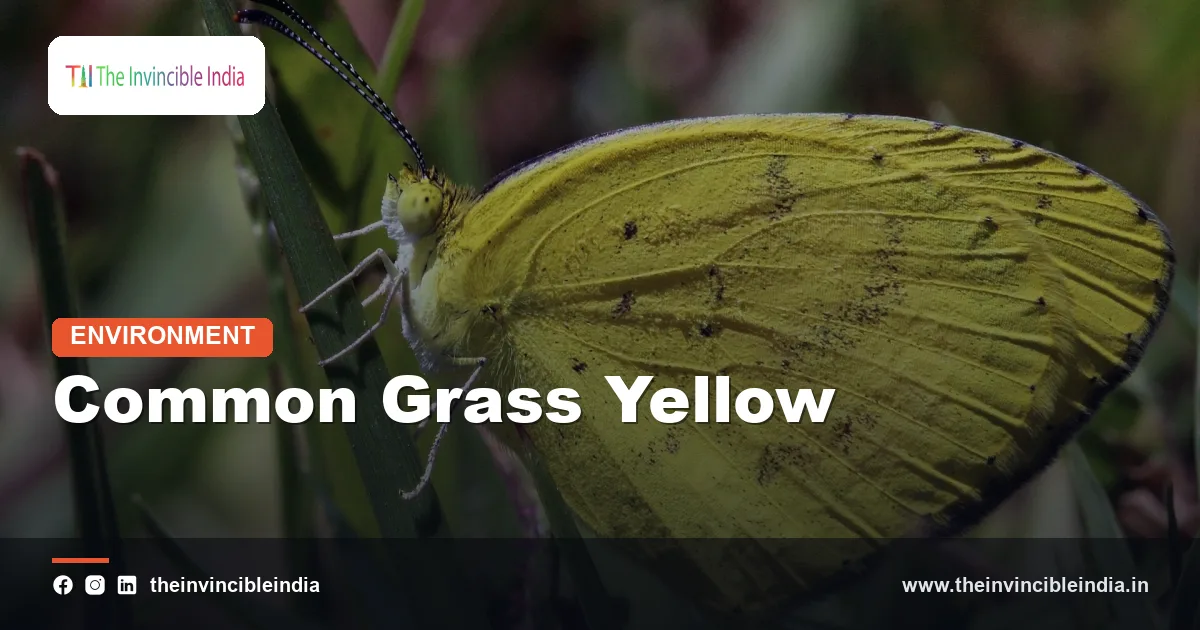
The common grass yellow (Eurema hecabe) is a small, bright-yellow butterfly of the family Pieridae that flutters low over grass, gardens and open ground across India and much of the Old World tropics, and whose males gather in dense groups at damp soil. Few Indian butterflies are more familiar: the common grass yellow appears in lawns, roadside verges, farmland and forest clearings almost all year round, and is often one of the first butterflies a beginner learns to recognise.
This explainer covers how to identify the common grass yellow, how it differs from other grass yellows, why its colour changes with the season, what its caterpillars eat, and why groups of males crowd onto wet ground.
| Attribute | Detail |
|---|---|
| Scientific name | Eurema hecabe (a species complex) |
| Family | Pieridae (whites and yellows), subfamily Coliadinae |
| Typical wingspan | Roughly 3.5 to 5 cm |
| Colour | Bright yellow above with a black border on the forewing; pale underside with brownish markings |
| Seasonal forms | Wet-season and dry-season forms that differ in border width and underside markings |
| Caterpillar food plants | Members of the pea family (Fabaceae), such as Senna, Cassia and Albizia |
| Habitat | Gardens, grassland, scrub, farmland and forest edges |
| Range | Africa through South and South-East Asia to Australia; found across India |
| Conservation concern | Common and widespread; not regarded as threatened |
Key Takeaways
- The common grass yellow (Eurema hecabe) is a small yellow butterfly in the family Pieridae with a wingspan of roughly 3.5 to 5 centimetres.
- Common grass yellow caterpillars feed on plants of the pea family (Fabaceae), including Senna, Cassia and Albizia species.
- The common grass yellow has seasonal forms: the dry-season form typically shows heavier brown markings on the underside, while the wet-season form is brighter and more neatly bordered.
- Male common grass yellows gather in groups at damp soil, a behaviour called mud-puddling, to take up salts and minerals.
- Eurema hecabe is now treated by many scientists as a species complex, so several look-alike grass yellows share the name in field guides.
- The common grass yellow is abundant across India and thrives in lawns and gardens where wild legumes are allowed to grow.
What is the common grass yellow butterfly?
The common grass yellow is a small butterfly in the whites-and-yellows family Pieridae, scientifically known as Eurema hecabe, recognised by its sulphur-yellow wings edged with black on the forewing. The Pieridae are a large family in which the wings are usually white, yellow or orange, and the common grass yellow belongs to the yellow-dominated subfamily Coliadinae.
The word “grass” in the name refers to the low, grass-skimming flight and the preference for grassy habitats, not to the caterpillar food plant, which is usually a legume. The common grass yellow is ranked among the commonest butterflies in India, often seen in the hundreds during and after the monsoon.
Adults feed on nectar from small flowers such as tridax, lantana and various weeds, and they are modest pollinators in gardens and farmland. Their weak, fluttering flight rarely covers long distances, but populations can spread widely over successive generations, and the butterfly colonises new gardens and wastelands quickly.
The butterfly is tiny compared with swallowtails and tigers, yet it is conspicuous because of the bright colour. A flock of grass yellows rising from a damp path looks like scattered yellow petals, which is one of the pleasures of a monsoon walk in India.
How can you identify a common grass yellow?
A common grass yellow can be identified by its small size, bright yellow upper wings, a black border on the forewing and a pale, brown-marked underside. The border is usually broader in females and in the wet season, and the hindwing is mostly clear yellow, with a thin dark edge.
The underside, which is what an observer sees when the butterfly settles with closed wings, is a paler yellow with a few small brown or reddish markings near the wing edges. These markings are the main reason this butterfly can look different from season to season.
Quick field checks
- Size: small, about the span of a two-rupee coin.
- Upperside: bright yellow with a black band along the front and outer edge of the forewing.
- Underside: pale yellow with small brown spots, especially in the dry season.
- Flight: low, weak and fluttering, rarely rising above the height of a person.
- Posture: settles with wings closed, so the upper surface is seen only in flight.
How is the common grass yellow different from other grass yellows?
The common grass yellow differs from other grass yellows mainly in the size and shape of its forewing border and in the pattern of spots on the underside. Several species of the genus Eurema fly together in India, and beginners often lump them all as “grass yellows”.
| Species | Scientific name | Distinguishing feature |
|---|---|---|
| Common grass yellow | Eurema hecabe | Broad forewing border; underside with variable brown markings |
| Small grass yellow | Eurema brigitta | Smaller; border toothed on its inner edge; fewer underside marks |
| Spotless grass yellow | Eurema laeta | Underside plain, lacking dark spots; narrow border |
| Three-spot grass yellow | Eurema blanda | Three small dark spots on the forewing underside |
| One-spot grass yellow | Eurema andersonii | A single dark spot on the underside of the forewing |
The reason for the confusion is that grass yellows are similar in size, colour and habit, and they frequently fly together over the same patch of grass or share the same puddle. Careful observers therefore note three things: the width and shape of the black border on the forewing, the presence or absence of dark spots on the underside, and the overall size relative to nearby butterflies. A photograph of the closed wings from the side is often the most useful record for later identification.
Because the common grass yellow is a species complex, even experts sometimes rely on genetic studies and breeding experiments to separate its members. For a general naturalist, treating all similar medium-sized yellow butterflies with a broad black border as common grass yellows is a reasonable field approach.
Why does the common grass yellow change colour with the season?
The common grass yellow changes appearance with the season because of seasonal polyphenism, a process in which the same species produces different forms depending on temperature, day length and humidity during the caterpillar and pupal stages. In India the two forms are called the wet-season form and the dry-season form.
The dry-season form generally has more brown or reddish mottling on the underside and a reduced black border on the upperside. These markings help the butterfly blend into dry leaves and grass when green vegetation is scarce. The wet-season form tends to be brighter, with cleaner underside and a more clearly defined border.
This kind of switching is found in several Indian butterflies, including the pansies and bush browns. It is a good example of how an animal’s body pattern can respond to the environment without any change in its genes.
- Wet season: warm, humid, plenty of green growth, brighter butterflies.
- Dry season: cooler or drier, sparser vegetation, more camouflaged underside.
- Intermediate forms occur in the transition months, so not every butterfly fits neatly into one category.
What do common grass yellow caterpillars eat?
Common grass yellow caterpillars eat the leaves of plants in the pea family (Fabaceae), and recorded hosts include Senna and Cassia species, Albizia trees and various other legumes. Some of these are garden shrubs, others are roadside weeds, and the butterfly adapts easily to whichever is available.
The caterpillar is slender, green, and nearly the same colour as the leaflets it eats, with a faint paler stripe along each side. This colour provides camouflage from birds, wasps and spiders. The caterpillar rests along the midrib of a leaflet, which breaks its outline.
The pupa is also green, attached to a stem or leaf by a silk pad and a silk girdle. Pupation takes only several days in warm weather, and a new adult emerges.
Common host plants
- Senna tora and Senna occidentalis, widespread weedy cassias of wasteland and roadsides.
- Cassia fistula, the golden shower tree, in some regions.
- Albizia species and other leguminous trees and shrubs.
- Other small legumes of grassland and field edges.
What is the life cycle of the common grass yellow?
The common grass yellow completes a four-stage life cycle of egg, caterpillar, pupa and adult, which in warm weather can take roughly three to five weeks. Because many generations can occur in a year, the butterfly can be seen in nearly every month in tropical regions of India.
The female lays tiny, spindle-shaped eggs, usually singly on young leaflets. The egg is pale at first and darkens as the caterpillar develops. The newly hatched caterpillar eats its eggshell and then begins to feed on the leaflet.
The caterpillar moults several times. After its last moult it attaches itself and becomes a pupa. Adult butterflies live for a few weeks, during which they feed on nectar from small flowers and mate.
- Egg: tiny, upright and spindle-shaped, laid on tender leaves.
- Caterpillar: green, smooth-looking and slender, with several growth stages.
- Pupa: green, attached by a silk girdle.
- Adult: bright yellow, with a lifespan of weeks.
Why do common grass yellows gather in groups on wet ground?
Common grass yellows gather in groups on wet ground because the males take in dissolved salts and minerals from damp soil, a behaviour known as mud-puddling. Such gatherings are most common in the warm hours of the day, along streams, puddles, damp sand and animal dung.
The minerals, especially sodium, are scarce in the nectar that adult butterflies drink, so the males supplement their diet. Sodium and other nutrients can be passed to the female during mating, which may help the eggs. Mud-puddling groups often include several species at once, with grass yellows, other pierids and swallowtails sharing a damp patch.
Mud-puddling is mostly a male activity across many butterfly families. In the common grass yellow, such groups can look like a patch of yellow petals on the ground, and they are a regular sight along rural roads, riverbanks and forest tracks in India during the warmer months.
When puddling, butterflies are less wary, so this is a good time to observe and photograph them. Quiet, slow movement works better than rushing, since sudden shadows will scatter the group.
How does the common grass yellow avoid predators?
The common grass yellow avoids predators mainly through camouflage, small size and a weak, unpredictable flight that makes it a difficult target. The butterfly does not have the toxins of a crow or tiger, so it relies on blending in with grass, leaf litter and dry vegetation rather than advertising itself.
When resting, the common grass yellow folds its wings upright over its back, which hides the bright upperside and shows only the pale, mottled underside. A resting butterfly with its wings closed is much harder to spot than one in flight. In the dry season the extra brown markings on the underside make the butterfly look even more like a withered leaf.
The caterpillar and pupa also use colour for protection. Both are green, matching the leaflets of the host plant. Despite these defences, grass yellows are eaten by birds, spiders, praying mantises, lizards and wasps, and they survive as a species because females lay many eggs and several generations appear each year.
- Resting posture: wings folded upright to hide the bright upperside.
- Underside pattern: pale and mottled, resembling dry grass or leaf litter.
- Immature stages: green caterpillars and pupae that match the host plant.
- High reproductive rate: many broods a year offset heavy predation.
Where is the common grass yellow found in India?
The common grass yellow is found throughout India, from the coasts and plains to lower hill slopes, and in gardens, grassland, farmland, forest edges and wasteland. It is one of the species most likely to be seen in a city park.
Globally, the species complex extends from Africa through South Asia and South-East Asia to China, Japan and Australia. The Indian populations are part of this broad range, and the butterfly adapts well to modified habitats, especially where leguminous weeds and shrubs flourish.
Numbers are highest after the monsoon, when new growth supports many caterpillars. In very dry regions the butterfly is still present but less abundant, and individuals persist near water and irrigated land.
Is the common grass yellow threatened, and how can you help it?
The common grass yellow is not considered threatened in India because it is abundant and uses many common host plants. Local populations can fall where habitats are paved over, sprayed or mown continuously, but the species recovers quickly because it breeds fast.
Gardeners can help this butterfly and many others by following simple habitat practices.
- Allow wild legumes such as Senna tora to grow in a corner of the garden.
- Avoid insecticide spraying during the monsoon breeding period.
- Provide a shallow dish of damp sand for puddling.
- Plant small nectar flowers such as lantana, tridax and zinnia.
- Photograph and log sightings on a citizen-science platform.
Collecting butterflies inside protected areas is prohibited under India’s wildlife law, so photography and observation are the better ways to enjoy them.
Bottom Line
The common grass yellow is a small, abundant and attractive butterfly, easy to see and a useful gateway to butterfly watching in India. Its seasonal forms, legume-eating caterpillars and puddling groups give it far more interest than its modest size suggests.
Frequently Asked Questions
What is the common grass yellow?
The common grass yellow is a small yellow butterfly, Eurema hecabe, in the family Pieridae. It has bright yellow wings with a black border on the forewing. The butterfly is found across India and much of the tropical Old World.
What do common grass yellow caterpillars eat?
Common grass yellow caterpillars eat the leaves of plants in the pea family, such as Senna, Cassia and Albizia. They are green and slender, which makes them hard to see on the leaflets. Many of the host plants are common weeds.
Why do grass yellows gather on wet soil?
Grass yellows gather on wet soil because males take in salts and minerals from the moisture, a behaviour called mud-puddling. These nutrients are scarce in nectar. The groups can include dozens of butterflies at a single damp patch.
How do I tell the common grass yellow from other grass yellows?
The common grass yellow has a broad black forewing border and variable brown markings underneath, while related species differ in size, border shape and the number of underside spots. The spotless grass yellow has a plain underside, and the three-spot grass yellow has three dark dots. Because the species is a complex, exact identification can be difficult.
Does the common grass yellow change colour with the season?
The common grass yellow does change with the season, producing wet-season and dry-season forms. The dry-season form typically has heavier brown markings beneath, which help it blend with dry leaves. The change is triggered by temperature and humidity during development.
Is the common grass yellow harmful?
The common grass yellow is harmless to people, crops and gardens. Its caterpillars eat only a few leaflets of legume plants and rarely cause serious damage. The adults are pollinators of small flowers.
{“@context”:”https://schema.org”,”@graph”:[{“@type”:”FAQPage”,”mainEntity”:[{“@type”:”Question”,”name”:”What is the common grass yellow?”,”acceptedAnswer”:{“@type”:”Answer”,”text”:”The common grass yellow is a small yellow butterfly, Eurema hecabe, in the family Pieridae. It has bright yellow wings with a black border on the forewing. The butterfly is found across India and much of the tropical Old World.”}},{“@type”:”Question”,”name”:”What do common grass yellow caterpillars eat?”,”acceptedAnswer”:{“@type”:”Answer”,”text”:”Common grass yellow caterpillars eat the leaves of plants in the pea family, such as Senna, Cassia and Albizia. They are green and slender, which makes them hard to see on the leaflets. Many of the host plants are common weeds.”}},{“@type”:”Question”,”name”:”Why do grass yellows gather on wet soil?”,”acceptedAnswer”:{“@type”:”Answer”,”text”:”Grass yellows gather on wet soil because males take in salts and minerals from the moisture, a behaviour called mud-puddling. These nutrients are scarce in nectar. The groups can include dozens of butterflies at a single damp patch.”}},{“@type”:”Question”,”name”:”How do I tell the common grass yellow from other grass yellows?”,”acceptedAnswer”:{“@type”:”Answer”,”text”:”The common grass yellow has a broad black forewing border and variable brown markings underneath, while related species differ in size, border shape and the number of underside spots. The spotless grass yellow has a plain underside, and the three-spot grass yellow has three dark dots. Because the species is a complex, exact identification can be difficult.”}},{“@type”:”Question”,”name”:”Does the common grass yellow change colour with the season?”,”acceptedAnswer”:{“@type”:”Answer”,”text”:”The common grass yellow does change with the season, producing wet-season and dry-season forms. The dry-season form typically has heavier brown markings beneath, which help it blend with dry leaves. The change is triggered by temperature and humidity during development.”}},{“@type”:”Question”,”name”:”Is the common grass yellow harmful?”,”acceptedAnswer”:{“@type”:”Answer”,”text”:”The common grass yellow is harmless to people, crops and gardens. Its caterpillars eat only a few leaflets of legume plants and rarely cause serious damage. The adults are pollinators of small flowers.”}}]}]}


