

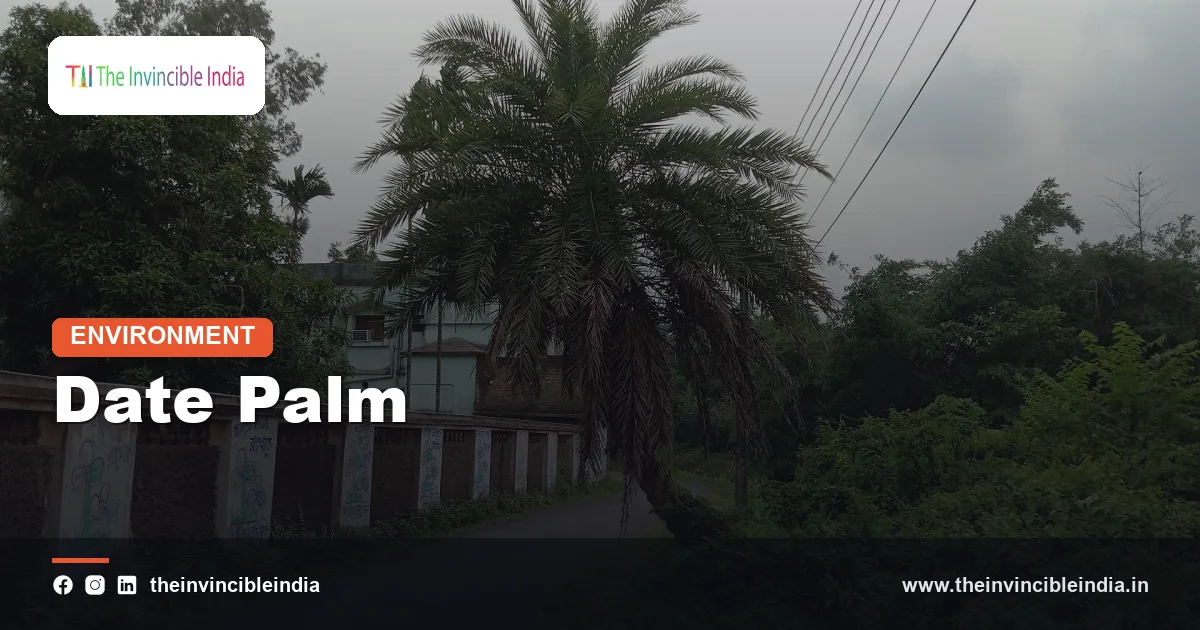
The date palm (Phoenix dactylifera) is a tall desert palm grown for its sweet fruit, the date, and in India it is cultivated commercially mainly in Kutch in Gujarat and in the arid districts of Rajasthan, while a related wild species is tapped in West Bengal and other states for the sap that becomes winter jaggery (nolen gur). The date palm needs long, hot, dry summers and a steady supply of water at the roots, which is why it suits the arid north-west of the country.
India produces some dates but imports far more than it grows, so date farming is a growing but still modest sector. This explainer covers what the date palm is, where and how it is grown in India, the difference between the fruit-bearing date palm and the sap-yielding wild date palm, and the health and safety points that matter, including the caution about raw sap.
Quick Facts
| Attribute | Detail |
|---|---|
| Scientific name | Phoenix dactylifera |
| Family | Arecaceae (palm family) |
| Common names | Khajoor or khajur (Hindi, Gujarati, Marathi), khejur (Bengali), perichai (Tamil) |
| Native region | Arid Middle East and North Africa; one of the oldest cultivated fruit trees |
| Main Indian growing areas | Kutch (Gujarat); Jaisalmer, Barmer, Bikaner and Jodhpur regions (Rajasthan); small areas elsewhere |
| Sexes | Dioecious: only female palms bear fruit; pollination is usually done by hand |
| Typical height | About 15 to 25 metres |
| Years to first crop | Roughly 3 to 5 years from an offshoot or tissue-culture plant |
| Related Indian species | Wild or silver date palm (Phoenix sylvestris), tapped for sap and nolen gur |
Key Takeaways
- The date palm (Phoenix dactylifera) is a dioecious palm, so only female trees bear dates and growers keep a few male trees, or buy pollen, for pollination.
- Commercial date cultivation in India is concentrated in Kutch in Gujarat and in the desert districts of Rajasthan, with Barhi, Khadrawy and Medjool among the varieties grown.
- Date palms grown from offshoots or tissue culture generally begin fruiting in about three to five years, far earlier than palms raised from seed.
- Nolen gur, the winter date-palm jaggery of Bengal, comes mainly from the wild date palm (Phoenix sylvestris), not from the commercial date-fruit palm.
- Raw date palm sap can carry Nipah virus when fruit bats contaminate collection pots, so health authorities advise against drinking unprotected raw sap.
- India imports more dates than it grows, buying mostly from Gulf countries and Iran, so domestic date farming is a small but growing sector.
What is the date palm?
The date palm is a tall, single- or multi-stemmed palm, Phoenix dactylifera, cultivated for its sweet, energy-rich fruit, the date. It has a rough trunk covered in the stubs of old leaf bases, topped by a crown of long, stiff, feather-shaped (pinnate) leaves, and it is one of the oldest cultivated fruit trees in the world, with a history in the arid zones of the Middle East and North Africa stretching back thousands of years.
A well-known saying about the tree is that it likes “its feet in water and its head in the fire”, meaning it needs abundant water at the roots but a long spell of hot, dry, rainless weather above ground. The palm tolerates salinity better than most fruit trees, which is the reason it can grow in saline, dry soils where other orchards fail.
Dates are central to the diet and culture of the Middle East and are traditionally used by Muslims around the world to break the fast during Ramadan. In India they are widely eaten fresh, dried, stuffed into sweets and used in festival gifting.
Where is the date palm grown in India?
The date palm is grown commercially in India mainly in Kutch in Gujarat and in the arid districts of western Rajasthan, with trial plantings in Punjab and Haryana. These regions offer the very hot, dry summers that ripening needs, while irrigation from wells and canals provides the water the roots demand.
- Kutch, Gujarat: the leading date-growing area, with orchards around Bhuj, Mundra, Mandvi and nearby talukas, and a date palm research station in the region under the state agricultural university system.
- Rajasthan: orchards in Jaisalmer, Barmer, Bikaner and Jodhpur districts, where the Medjool and Barhi varieties have been promoted, supported in part by Indo-Israeli agricultural cooperation.
- Punjab and Haryana: smaller pockets, especially in the dry south-west of Punjab, where growers are experimenting with the crop.
Rain at fruit ripening can ruin a crop, so the palm is not suited to the humid or monsoon-heavy parts of India. In wetter regions, it is the wild date palm that grows naturally, but it produces small, astringent fruit that is not a commercial dessert date.
How is the date palm grown and pollinated?
The date palm is grown from offshoots or tissue-culture plants and pollinated by hand, because the tree is dioecious, with male and female flowers on separate trees. Growers plant mostly female palms and a small number of males, and in spring they dust the female flower clusters with pollen collected from the male flowers.
Why is hand pollination used?
Hand pollination is used because it gives a far higher and more even fruit set than leaving pollination to the wind. A worker climbs the palm, places a few strands of male flowers within each female cluster and ties it, and then thins the bunches later to improve fruit size. Fruiting palms also need regular pruning of old fronds and thorn-like leaf spines, which makes the work skilled and labour-intensive.
Why are offshoots and tissue culture preferred to seeds?
Offshoots and tissue-culture plants are preferred because they are genetically identical copies of the parent. A palm grown from seed gives variable fruit, roughly half the seedlings are male, and the tree takes longer to bear. Offshoots (suckers) that grow around the base of a mother palm are separated and rooted, while tissue-culture plantlets, produced in a laboratory, now supply large numbers of disease-free plants of varieties such as Medjool and Barhi.
A date palm planted as an offshoot or tissue-culture plantlet generally begins to fruit in about three to five years, reaches full yield in around eight to ten years, and can remain productive for several decades. Fully grown palms need about 8 to 10 metres between them in the orchard.
What are the main varieties of date grown in India?
The main varieties of date grown in India include Barhi, Khadrawy, Medjool, Halawy, Zahidi and Khalas, selected for their ability to ripen well in dry Indian conditions. Varieties are classified by the stage and texture at which they are eaten, whether soft, semi-dry or dry.
| Variety | Typical fruit type | Remarks |
|---|---|---|
| Barhi | Can be eaten at the yellow, crunchy stage as well as when soft | Popular for its sweet taste and suitability for fresh sale |
| Medjool | Large, soft, caramel-like fruit | Premium variety introduced through tissue culture, grown in Kutch and Rajasthan |
| Khadrawy | Soft, dark fruit | Widely grown in Gujarat and Rajasthan |
| Halawy | Soft, sweet fruit | Early-ripening and fairly well adapted to dry zones |
| Zahidi | Semi-dry fruit | Tolerant of some humidity; also grown for drying |
Dates pass through four recognised stages as they ripen: kimri (green and hard), khalal (full-sized, crisp and yellow or red), rutab (soft and partly browned) and tamar (fully ripe, dry and long-keeping). Different varieties are harvested and sold at different stages, which is why some dates are sold fresh and others dried.
What is the difference between the date palm and the wild date palm?
The difference is that the date palm (Phoenix dactylifera) is the cultivated fruit-bearing species, while the wild or silver date palm (Phoenix sylvestris) is a native Indian relative grown mainly for its sap. The two belong to the same genus and look alike, but the wild species is shorter, has a greyish crown and bears small, mostly astringent fruit.
- Phoenix dactylifera: grown in orchards, hand-pollinated, harvested for dates, concentrated in Kutch and western Rajasthan.
- Phoenix sylvestris: found wild across much of the plains of India, especially in Bengal, Odisha, Bihar and Jharkhand, tapped for sap in winter; known in Telugu as eetha and in Hindi as khajur or sendhi.
The distinction matters for understanding “date palm jaggery”. The jaggery that makes Bengal famous in winter is mostly produced from the wild species, which is why the phrase date palm in an Indian context can mean either tree.
What is nolen gur and how is date palm sap tapped?
Nolen gur is the fragrant date palm jaggery of West Bengal, made in winter by boiling the sap collected from tapped date palms until it thickens. Specialised tappers, locally known as gachhis, shave the bark from the top of the trunk, cut a groove, and insert a bamboo spout so that sap drips overnight into an earthen pot.
What does the tapping season look like?
The tapping season runs through the cold months, roughly from November to February, because the sap flows best when nights are cool and days are mild. The pots are emptied early in the morning, and the sap is boiled in large iron pans the same day to make liquid jaggery (jhola gur) and solid blocks (patali gur). A tree is tapped for a few days and then rested before the next cut, since overtapping weakens it.
Nolen gur is the key ingredient in classic Bengali winter sweets, including nolen gurer sandesh, nolen gurer rasgulla, payesh and pithe. The jaggery from the winter harvest is prized for its smoky, caramel aroma, and because the real product is seasonal, it is often adulterated outside winter.
Is raw date palm sap safe to drink?
No, raw date palm sap is not considered safe to drink when it is collected in open pots, because it can carry Nipah virus if fruit bats have contaminated it. Fruit bats visit the pots at night to lick the sweet sap and may leave saliva or urine in it, and in Bangladesh and parts of eastern India this route has been linked to Nipah virus infections in people.
Health authorities advise that sap should be boiled, or collected in pots protected by bamboo skirts or nets that keep bats out, and that fresh sap should be avoided in areas with a history of Nipah outbreaks. Boiled sap and finished jaggery, which is cooked at high temperature, are not regarded as the same risk. Anyone planning to drink fresh sap in rural Bengal should check local health guidance first.
Are dates healthy, and what are they used for?
Dates are a nutritious, energy-dense fruit that supplies natural sugars, dietary fibre, potassium and small amounts of other minerals, but they are high in sugar and calories, so portions matter. A few dates can serve as a quick energy source, and their fibre content supports digestion.
- Whole fruit: eaten fresh, dried or soaked, and widely exchanged during Ramadan, Eid and Diwali.
- Date paste and syrup: used as a natural sweetener in baking and in some Indian sweets.
- Date seeds: sometimes roasted and ground as a coffee substitute or used as animal feed.
- Leaves: woven into mats, baskets, brooms and roof thatch.
- Trunk: used for posts and rough timber.
People with diabetes should eat dates in controlled portions and take advice from their doctor or dietitian, since the sugar is concentrated even though the fibre slows its absorption somewhat.
Why does India still import so many dates?
India imports many dates because domestic production is small compared with demand, and the major date-producing countries of the Gulf and Iran supply large quantities at competitive prices. Imports peak before festivals and Ramadan, and the dates sold in Indian markets are often of Gulf or Iranian origin.
Date farming in India has the potential to expand in saline, dry lands that suit few other crops, but it requires heavy initial investment in plants and a wait of several years before the first meaningful harvest. Tissue-culture plants, drip irrigation, protected cultivation of bunches against rain, and training for climbers and pollinators are the main focus areas for expansion in Kutch and Rajasthan.
Bottom Line
The date palm is a small but promising crop for India’s driest regions, with Kutch and Rajasthan leading, while the wild date palm of the east gives the seasonal pleasure of nolen gur. The fruit palm and the sap palm are different species, and raw sap needs care because of Nipah virus risk.
Frequently Asked Questions
Where are dates grown in India?
Dates are grown commercially in India mainly in Kutch in Gujarat and in the arid districts of Rajasthan, such as Jaisalmer, Barmer and Bikaner. Smaller trials exist in Punjab and Haryana. The crop needs very hot, dry summers and irrigation, so it does not suit wet regions.
Why do date palms need hand pollination?
Date palms need hand pollination because male and female flowers grow on separate trees and natural pollination is unreliable in orchards. Growers apply pollen from male flowers to female clusters in spring, which improves fruit set. This is a skilled task done by climbers.
How long does a date palm take to bear fruit?
A date palm planted as an offshoot or tissue-culture plant usually begins to bear fruit in about three to five years. Palms grown from seed take longer and give variable fruit. Full yield generally arrives after eight to ten years.
What is nolen gur made from?
Nolen gur is made from the sap of date palms, mainly the wild date palm Phoenix sylvestris, collected in winter in West Bengal and nearby areas. The sap is boiled down to make liquid or solid jaggery. It is a seasonal ingredient in Bengali sweets such as nolen gurer sandesh and payesh.
Can you drink raw date palm sap?
Raw date palm sap is not advised because fruit bats can contaminate open collection pots and pass on Nipah virus. Sap should be boiled, or collected in pots protected from bats. Boiled sap and finished jaggery are cooked and treated differently.
Is the date palm native to India?
No, the cultivated date palm (Phoenix dactylifera) is not native to India; it originated in the arid Middle East and North Africa and was introduced for cultivation. India does have a native relative, the wild date palm (Phoenix sylvestris), which grows naturally across the plains and is tapped for sap.
{“@context”:”https://schema.org”,”@graph”:[{“@type”:”FAQPage”,”mainEntity”:[{“@type”:”Question”,”name”:”Where are dates grown in India?”,”acceptedAnswer”:{“@type”:”Answer”,”text”:”Dates are grown commercially in India mainly in Kutch in Gujarat and in the arid districts of Rajasthan, such as Jaisalmer, Barmer and Bikaner. Smaller trials exist in Punjab and Haryana. The crop needs very hot, dry summers and irrigation, so it does not suit wet regions.”}},{“@type”:”Question”,”name”:”Why do date palms need hand pollination?”,”acceptedAnswer”:{“@type”:”Answer”,”text”:”Date palms need hand pollination because male and female flowers grow on separate trees and natural pollination is unreliable in orchards. Growers apply pollen from male flowers to female clusters in spring, which improves fruit set. This is a skilled task done by climbers.”}},{“@type”:”Question”,”name”:”How long does a date palm take to bear fruit?”,”acceptedAnswer”:{“@type”:”Answer”,”text”:”A date palm planted as an offshoot or tissue-culture plant usually begins to bear fruit in about three to five years. Palms grown from seed take longer and give variable fruit. Full yield generally arrives after eight to ten years.”}},{“@type”:”Question”,”name”:”What is nolen gur made from?”,”acceptedAnswer”:{“@type”:”Answer”,”text”:”Nolen gur is made from the sap of date palms, mainly the wild date palm Phoenix sylvestris, collected in winter in West Bengal and nearby areas. The sap is boiled down to make liquid or solid jaggery. It is a seasonal ingredient in Bengali sweets such as nolen gurer sandesh and payesh.”}},{“@type”:”Question”,”name”:”Can you drink raw date palm sap?”,”acceptedAnswer”:{“@type”:”Answer”,”text”:”Raw date palm sap is not advised because fruit bats can contaminate open collection pots and pass on Nipah virus. Sap should be boiled, or collected in pots protected from bats. Boiled sap and finished jaggery are cooked and treated differently.”}},{“@type”:”Question”,”name”:”Is the date palm native to India?”,”acceptedAnswer”:{“@type”:”Answer”,”text”:”No, the cultivated date palm (Phoenix dactylifera) is not native to India; it originated in the arid Middle East and North Africa and was introduced for cultivation. India does have a native relative, the wild date palm (Phoenix sylvestris), which grows naturally across the plains and is tapped for sap.”}}]}]}


