

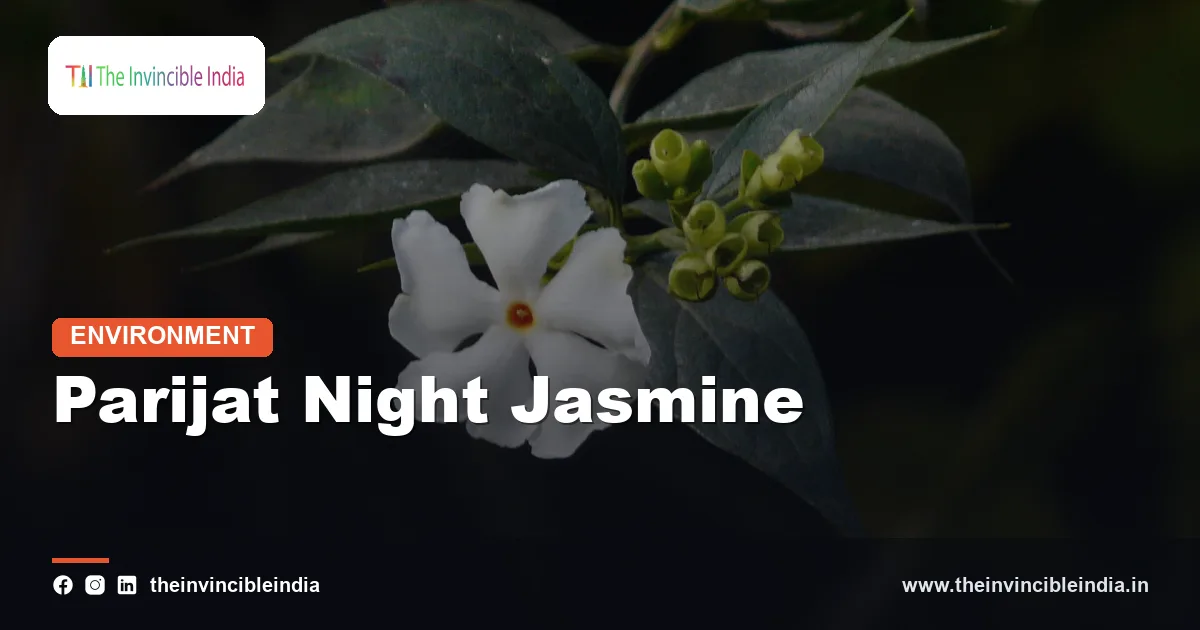
The parijat (Nyctanthes arbor-tristis), also called the night-flowering jasmine, is a small tree of the Indian subcontinent whose fragrant white flowers with orange-red centres open at dusk and fall to the ground by dawn. Known as harsingar in Hindi, shiuli in Bengali and parijatham in Tamil and Telugu, the parijat is not a true jasmine, although its sweet scent and starry flowers explain the common name.
The parijat tree carries a heavy load of mythology, ritual and folk medicine in India, and it is the state flower of West Bengal. This explainer, last updated 23 October 2026, covers the botany, mythology, traditional uses, cultural role and cultivation of the parijat.
| Quick Fact | Detail |
|---|---|
| Scientific name | Nyctanthes arbor-tristis |
| Plant family | Oleaceae (the olive family), not the true jasmine genus Jasminum |
| Common names | Parijat, harsingar, shiuli, sephali, night-flowering jasmine, coral jasmine, tree of sadness |
| Plant type | Large shrub or small tree, usually 3 to 10 metres tall |
| Native range | South Asia, including the sub-Himalayan tracts and lower hills of India |
| Flowering season | Mainly the monsoon end and autumn, roughly August to November |
| Flower feature | White petals with an orange-red tube; opens at night and drops by morning |
| State flower | West Bengal (as shiuli) |
| Main uses | Worship and garlands, orange dye, folk medicine, garden ornamental |
Key Takeaways
- The parijat (Nyctanthes arbor-tristis) is a tree in the olive family, Oleaceae, and is not a true jasmine of the genus Jasminum.
- Parijat flowers open after sunset, release their strongest fragrance at night and fall to the ground by early morning.
- The orange-red tube of the parijat flower yields a natural yellow-orange dye that was once used to colour silk and cotton cloth.
- Hindu tradition allows parijat flowers to be offered in worship after they have fallen, which is unusual because most flowers must be plucked fresh.
- Shiuli, the Bengali name for the parijat, is the state flower of West Bengal and is closely associated with the autumn festival season and Durga Puja.
- Parijat leaves, flowers and bark feature in traditional Indian medicine, but modern clinical evidence for specific health claims remains limited.
What is the parijat?
The parijat is a woody, bushy plant that botanists classify as Nyctanthes arbor-tristis, the only commonly known species in its genus in India. The plant grows as a large shrub that can mature into a small tree, with a rounded crown, grey-green bark and four-angled young stems that feel slightly rough to the touch.
The leaves of the parijat are opposite, simple and oval to lance-shaped, with a rough, sandpaper-like surface covered in short, stiff hairs. This roughness helps in field identification, because the leaves of true jasmines are usually smoother. The tree is largely evergreen in humid places and may shed part of its foliage in drier regions.
The scientific name carries a small story. Nyctanthes means “night flower” in Greek-derived botanical Latin, and arbor-tristis means “sad tree” or “tree of sorrow”. The second part of the name refers to the way the plant seems to lose its flowers each morning, as if the tree were mourning the daylight.
Why is the parijat called the night-flowering jasmine?
The parijat is called the night-flowering jasmine because its flowers open in the evening, perfume the night air and drop before or soon after sunrise. The jasmine comparison comes from the scent and the pinwheel shape of the corolla, even though the plant belongs to a different genus within the same broad olive family.
Many English-language names are in use. Coral jasmine refers to the coral-orange colour of the central tube. Tree of sadness is a translation of the Latin epithet. In Indian languages the parijat has dozens of regional names, which shows how widely the plant is grown and valued.
- Hindi and Urdu: harsingar, parijat, singhar
- Bengali and Assamese: shiuli, xewali, sephali
- Marathi and Gujarati: parijatak, pagadmalli
- Tamil: pavazhamalli, parijatham
- Malayalam: pavizhamalli, parijatham
- Telugu and Kannada: parijatamu, parijata, gangaraghi
- Sanskrit: parijata, shephalika, sephalika
What does the parijat flower look like?
The parijat flower is small and delicate, with five to eight white petals that fuse at the base into a narrow orange-red tube. Flowers grow in small clusters at the tips of branches, and each flower is only about one to two centimetres across. The petals twist slightly, giving the flower a pinwheel look.
The contrast between the white petals and the bright orange tube is the most recognisable feature of the plant. A single healthy tree can drop thousands of flowers in one night, leaving a white-and-orange carpet under the canopy by morning.
Fragrance and pollination
The fragrance of the parijat is sweet and fairly strong, and it peaks after dark. Night-active insects, particularly moths, are the likely pollinators because the long, narrow tube suits long-tongued visitors. In practice, parijat plants in India set seed more reliably in some regions than in others, and many garden plants are propagated from cuttings.
Fruit and seed
The fruit of the parijat is a flat, rounded, two-lobed capsule that turns brown as it matures and splits to release two flat seeds. The seeds are used in some regions to raise new plants, and they germinate best after a short period of warm, moist conditions.
Where does the parijat grow in India?
The parijat grows across much of India, from the sub-Himalayan foothills and Gangetic plains to the Deccan plateau and the Western Ghats foothills. It is native to the Indian subcontinent and has been taken to many other tropical countries as an ornamental and temple plant.
The tree thrives in warm, humid and sub-humid climates and tolerates a wide variety of soils, from sandy loam to heavier clay. It prefers full sun to light shade and is relatively undemanding once established. Plants are damaged by prolonged frost, so in cold northern areas they are grown in sheltered spots.
| Region | Local name | Typical association |
|---|---|---|
| West Bengal and Assam | Shiuli, xewali | Autumn, Durga Puja season, poetry and songs |
| Uttar Pradesh and Bihar | Harsingar | Courtyard tree, temple offering, folk remedies |
| Maharashtra and Gujarat | Parijatak, pagadmalli | Home gardens and worship flowers |
| Tamil Nadu, Kerala, Karnataka | Pavazhamalli, parijatham | Temple gardens and fragrant hedges |
| Andhra Pradesh and Telangana | Parijatamu | Temple trees and ritual use |
What is the mythology of the parijat?
In Hindu mythology the parijat is a celestial tree that emerged during the churning of the ocean of milk, the Samudra Manthan, and was claimed by Indra, the king of the gods, for his heavenly garden. The tree is also called the kalpavriksha or wish-fulfilling tree in some retellings, and its scent was said to refresh anyone who stood near it.
A popular episode, told in the Puranas and in regional literature, says that Krishna brought a parijat to earth after his consort Satyabhama asked for it. The story explains an odd feature of the plant: according to the tale, the tree was planted in Satyabhama’s courtyard, but its flowers fell in Rukmini’s courtyard, which is why the parijat drops its blossoms away from where it stands.
Another folk tale explains the name tree of sadness. It tells of a princess named Parijataka who fell in love with the sun, was abandoned and died of grief, and from her ashes grew a tree that cannot bear the sight of the sun. That is why, according to the story, its flowers open at night and fall at dawn.
The Kintoor tree
The village of Kintoor in Barabanki district of Uttar Pradesh is locally believed to be associated with the parijat of the Mahabharata, linked to Kunti and the Pandavas. A very large, old tree there is venerated as the parijat, and it draws pilgrims. Botanists identify that particular tree as a baobab (Adansonia digitata), which is a different species altogether, and it shows how the name parijat is applied in popular tradition.
How is the parijat used in worship and culture?
The parijat is used in Hindu worship as an offering to deities, and tradition permits flowers that have already fallen to the ground to be gathered and offered. This is distinct from most flowers, which are meant to be picked fresh from the plant. The rule is often cited as a reason why the parijat is a favourite in temple and household gardens.
In Bengal, the shiuli is deeply tied to the arrival of autumn. The flowers appear around the time of Mahalaya and Durga Puja, and the scent of shiuli on a cool early morning is one of the markers of the festive season in poems, songs and prose. Children and women gather the fallen flowers in baskets at dawn to make garlands and offerings.
- Garlands and temple offerings, especially to Vishnu, Krishna and the goddess Durga
- Decoration for autumn festivals in eastern India
- Inspiration in Bengali literature and music, where shiuli stands for early autumn mornings
- Planting in courtyards and near temples as a fragrant, easy-care tree
What are the traditional uses of the parijat?
The parijat has been used in traditional Indian medicine, particularly Ayurveda, where the leaves, flowers, bark and seeds are described as remedies for fever, joint pain and digestive complaints. These are traditional uses, and they should not be read as proven medical treatments.
The most commonly cited traditional use is a decoction or juice of the leaves, taken for fever and for pain in the lower back and legs described in folk medicine as sciatica. The leaf juice has also been used in some households as a bitter tonic and as a treatment for worms in children. Flowers have been used in teas and in hair oils, and the dried seeds have been ground for scalp care in folk practice.
Laboratory studies on parijat extracts have explored antioxidant, anti-inflammatory and antimicrobial activity. Such studies are early-stage, often carried out on cells or animals, and they do not establish safe doses or proven benefits for people. Anyone considering a herbal preparation should consult a qualified practitioner, especially during pregnancy or while taking other medicines.
The natural dye
The orange tube of the parijat flower contains a pigment called nyctanthin, which gives a yellow-orange dye. In earlier centuries the dye was used to colour silk and cotton, and in some places it was used to tint the robes of Buddhist monks. The colour fades in sunlight, so it is no longer common commercially, but small craft workers still use it for natural dyeing.
How do you grow a parijat tree?
A parijat tree is grown most easily from stem cuttings or nursery saplings, planted in a sunny spot with well-drained soil and moderate water. The plant is hardy, and once the roots establish it tolerates dry spells, poor soil and a wide range of temperatures.
- Sunlight: Full sun to light shade; more sun usually means more flowers.
- Soil: Well-drained loam or sandy loam with some organic matter.
- Water: Regular watering in the first year, then only during long dry spells.
- Pruning: Light pruning after flowering keeps the shape compact and encourages new flowering shoots.
- Propagation: Semi-hardwood cuttings, air layering or fresh seed.
- Pests: Few serious pests; occasional leaf-eating caterpillars and scale insects may appear.
Because the flowers fall every morning, the parijat is best planted where the fallen blossoms can be gathered easily, such as near a path or courtyard, and away from a pond or well that could be fouled by the dropped flowers.
How is the parijat different from true jasmine?
The parijat differs from true jasmine mainly in its genus, its night-only flowering, its rough leaves and its orange flower tube. Both plants are in the olive family, Oleaceae, and both are valued for fragrance, but they are separate genera.
| Feature | Parijat (Nyctanthes arbor-tristis) | True jasmine (Jasminum species) |
|---|---|---|
| Genus | Nyctanthes | Jasminum |
| Growth form | Large shrub or small tree | Shrubs, scramblers or climbers |
| Leaves | Rough, hairy, sandpaper-like | Usually smoother, often compound |
| Flower colour | White petals with orange-red tube | White or yellow, sometimes pink in bud |
| Opening time | Evening; falls by dawn | Varies; many open at night but remain longer |
| Fruit | Flat, two-lobed capsule | Small berry |
| Ritual rule | Fallen flowers accepted for offering | Flowers usually plucked fresh |
Why does the parijat matter today?
The parijat matters today because it links natural history, culture, craft and gardening in a single easy-to-grow plant. It is a traditional temple tree, a seasonal marker in eastern India, a source of natural dye and a useful low-maintenance ornamental for gardens in warm climates.
Its night-flowering habit also makes it a valuable plant for moths and other nocturnal insects, which is a reminder that urban and village gardens can support wildlife as well as people. Planting native or long-naturalised trees such as the parijat is one practical way to keep local pollinator networks active.
Bottom Line
The parijat is a hardy, fragrant, night-flowering tree of the olive family that India has valued for centuries in mythology, worship, craft and folk medicine. It is easy to grow, loved for the shiuli season in Bengal, and best understood as a plant of tradition whose health claims remain traditional rather than proven.
Frequently Asked Questions
Is the parijat the same as night-flowering jasmine?
Yes, parijat and night-flowering jasmine are two names for Nyctanthes arbor-tristis. The plant is not a true jasmine, because it belongs to a different genus within the olive family. It is called a jasmine because of its scent and the star-shaped white flowers that open at night.
What is the English name of harsingar?
Harsingar is called night-flowering jasmine, coral jasmine or tree of sadness in English. All these names refer to Nyctanthes arbor-tristis, which is also known as parijat in Hindi and Sanskrit and as shiuli in Bengali. The coral name refers to the orange-red tube at the centre of each flower.
Why do parijat flowers fall in the morning?
Parijat flowers fall in the morning because each flower is short-lived and opens only for a single night. The blossoms are adapted to be pollinated by night-active insects, and once the night is over the flower drops. A tree can shed thousands of blossoms each dawn throughout its flowering season.
Can parijat flowers be offered to God after falling?
Yes, Hindu tradition accepts fallen parijat flowers as offerings, unlike most flowers which are expected to be picked fresh. Devotees gather the blossoms from the ground in the morning and use them for garlands and puja. This custom is one reason the parijat is common near temples and homes.
Is parijat a medicinal plant?
The parijat is used in traditional Indian medicine, especially its leaves, for fever and joint pain, but these uses are traditional rather than clinically proven. Laboratory studies show some antioxidant and anti-inflammatory activity in extracts. A qualified practitioner should be consulted before using any herbal preparation, particularly in pregnancy or alongside other medicines.
When does the parijat bloom in India?
The parijat blooms mainly from August to November, around the end of the monsoon and through autumn. In West Bengal the shiuli season coincides with Mahalaya and Durga Puja. Flowering can extend a little earlier or later depending on the local climate and the age of the tree.
{“@context”:”https://schema.org”,”@graph”:[{“@type”:”FAQPage”,”mainEntity”:[{“@type”:”Question”,”name”:”Is the parijat the same as night-flowering jasmine?”,”acceptedAnswer”:{“@type”:”Answer”,”text”:”Yes, parijat and night-flowering jasmine are two names for Nyctanthes arbor-tristis. The plant is not a true jasmine, because it belongs to a different genus within the olive family. It is called a jasmine because of its scent and the star-shaped white flowers that open at night.”}},{“@type”:”Question”,”name”:”What is the English name of harsingar?”,”acceptedAnswer”:{“@type”:”Answer”,”text”:”Harsingar is called night-flowering jasmine, coral jasmine or tree of sadness in English. All these names refer to Nyctanthes arbor-tristis, which is also known as parijat in Hindi and Sanskrit and as shiuli in Bengali. The coral name refers to the orange-red tube at the centre of each flower.”}},{“@type”:”Question”,”name”:”Why do parijat flowers fall in the morning?”,”acceptedAnswer”:{“@type”:”Answer”,”text”:”Parijat flowers fall in the morning because each flower is short-lived and opens only for a single night. The blossoms are adapted to be pollinated by night-active insects, and once the night is over the flower drops. A tree can shed thousands of blossoms each dawn throughout its flowering season.”}},{“@type”:”Question”,”name”:”Can parijat flowers be offered to God after falling?”,”acceptedAnswer”:{“@type”:”Answer”,”text”:”Yes, Hindu tradition accepts fallen parijat flowers as offerings, unlike most flowers which are expected to be picked fresh. Devotees gather the blossoms from the ground in the morning and use them for garlands and puja. This custom is one reason the parijat is common near temples and homes.”}},{“@type”:”Question”,”name”:”Is parijat a medicinal plant?”,”acceptedAnswer”:{“@type”:”Answer”,”text”:”The parijat is used in traditional Indian medicine, especially its leaves, for fever and joint pain, but these uses are traditional rather than clinically proven. Laboratory studies show some antioxidant and anti-inflammatory activity in extracts. A qualified practitioner should be consulted before using any herbal preparation, particularly in pregnancy or alongside other medicines.”}},{“@type”:”Question”,”name”:”When does the parijat bloom in India?”,”acceptedAnswer”:{“@type”:”Answer”,”text”:”The parijat blooms mainly from August to November, around the end of the monsoon and through autumn. In West Bengal the shiuli season coincides with Mahalaya and Durga Puja. Flowering can extend a little earlier or later depending on the local climate and the age of the tree.”}}]}]}


