

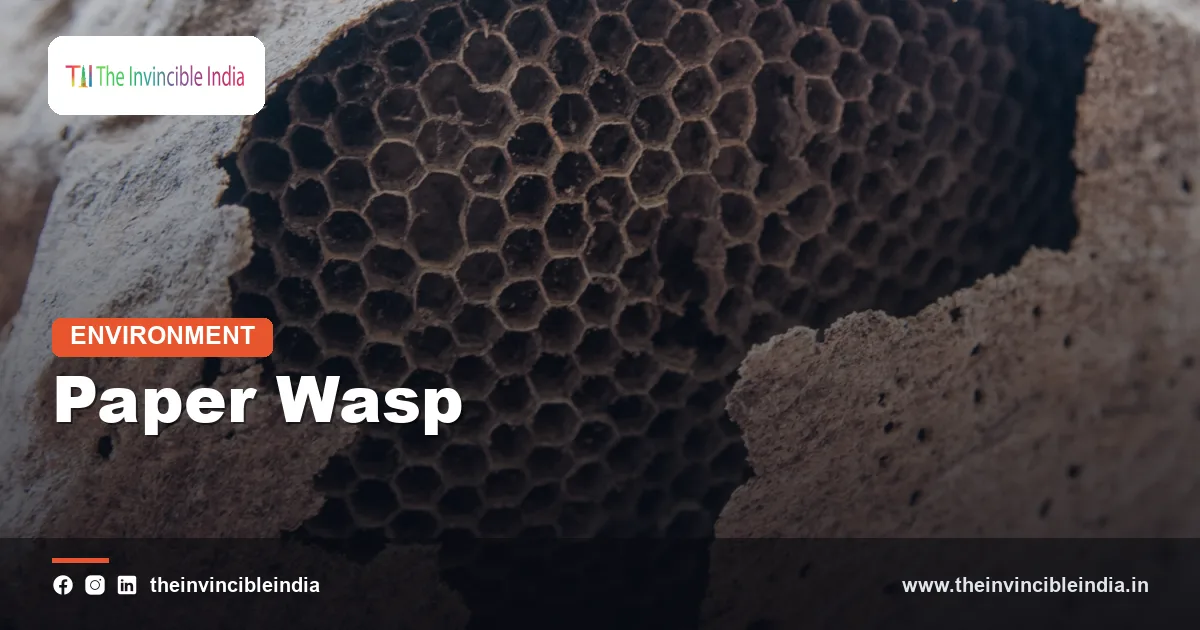
A paper wasp is a slender social wasp that builds an open, umbrella-shaped nest of paper-like material, with exposed hexagonal cells, usually hung from a single stalk under eaves, branches and ledges. Paper wasps are common across India, where they live in colonies, hunt caterpillars and other insects, and sting only when their nest or body is threatened.
The group is biologically fascinating, since several Indian species have been studied closely for how colonies choose queens and share work. This explainer describes what paper wasps are, how they build nests, how colonies are organised, what they eat, how to tell them from other stinging insects and how to stay safe around them. It was last reviewed on 23 October 2026.
| Quick Fact | Detail |
|---|---|
| Classification | Family Vespidae, subfamily Polistinae; order Hymenoptera |
| Common genera in India | Polistes and Ropalidia; Ropalidia marginata is often called the Indian paper wasp |
| Nest material | Plant fibre or weathered wood chewed with saliva into a paper-like pulp |
| Nest design | Open comb of hexagonal cells with no outer envelope, hung from a short stalk |
| Social structure | Colonies with one or more egg-laying queens and non-breeding female workers |
| Diet of adults | Nectar, plant sugars and sometimes ripe fruit or honeydew |
| Diet of larvae | Chewed caterpillars and other insects brought by workers |
| Who can sting | Females only; the stinger is smooth, so a wasp can sting more than once |
| Typical body length | About 1.5 to 2.5 centimetres, depending on species |
Key Takeaways
- A paper wasp builds an open comb nest from chewed plant fibre, and the hexagonal cells are visible from below.
- Paper wasps in India belong to the subfamily Polistinae of the wasp family Vespidae, with genera such as Polistes and Ropalidia.
- Paper wasp colonies are social, with a queen or several egg-layers and female workers who build, forage and defend the nest.
- Paper wasps hunt caterpillars and other insects to feed their larvae, so they act as natural pest controllers in gardens and farms.
- A paper wasp can sting repeatedly, but it usually does so only when its nest is disturbed, so staying calm and moving away slowly is the best response.
- People with known allergies to wasp stings should treat any sting with serious swelling or breathing difficulty as a medical emergency.
What is a paper wasp?
A paper wasp is a social wasp in the subfamily Polistinae that makes its nest from a paper-like substance created by chewing plant fibres. It belongs to the family Vespidae, the same family that includes hornets, yellowjackets and potter wasps, and to the insect order Hymenoptera, which also contains bees and ants.
Paper wasps are usually brown, reddish or yellow-banded, with narrow waists and long, dangling legs in flight. When they rest, they fold their wings lengthwise along the body, a feature typical of vespid wasps. Their bodies are slimmer than those of honeybees and have little hair.
In India two genera are especially familiar. Polistes includes the widespread Polistes hebraeus and related species. Ropalidia includes the Indian paper wasp, Ropalidia marginata, a species that makes brown nests under ledges, roofs and branches and has been the focus of long-term research by Indian scientists at the Indian Institute of Science, Bengaluru.
How does a paper wasp build its nest?
A paper wasp builds its nest by scraping fibres from dry wood, plant stems or bark, chewing them with saliva into a pulp and shaping the pulp into thin layers of paper. The nest begins with a short stalk, called a petiole, fixed to a roof, branch or wall. The wasp then adds hexagonal cells in a single horizontal comb that hangs down from the stalk.
Unlike the covered nests of hornets, a paper wasp nest has no outer envelope. The open cells are visible, and the whole structure often looks like a small upside-down umbrella or shower head. Colour varies with the material collected, from grey to tan to brown.
The wasps also manage nest temperature and moisture. Workers fan their wings over the nest on hot days and bring water to cool it through evaporation. Some species smear a chemical on the stalk that discourages ants from climbing up to raid the brood.
New cells are added as the colony grows, and each cell is used to raise one larva at a time. Cells may be reused for several rounds of eggs.
How is a paper wasp colony organised?
A paper wasp colony is organised around egg-laying females and non-breeding female workers, with males appearing mostly at certain times of the year. In many species a single dominant queen lays most of the eggs, while workers build, feed the young and defend the nest.
Paper wasps are described as primitively eusocial, meaning that workers are not physically different from queens. Any female could in principle become a queen, so dominance, age and condition decide who leads. Researchers studying the Indian paper wasp Ropalidia marginata have shown that new queens can take over a colony when the old queen dies, and that the replacement is often decided through behaviour and not through fighting.
These studies helped explain why individuals may help raise relatives instead of breeding themselves. Colonies in warm tropical regions such as peninsular India can be active through most of the year, whereas colonies in cooler climates often die back in winter.
What do paper wasps eat?
Paper wasps eat nectar and other plant sugars as adults, while their larvae are fed with chewed insects, especially caterpillars. Workers leave the nest to hunt soft-bodied prey, such as moth larvae, chew the catch into a paste and bring it back for the grubs.
The larvae in turn produce a sugary secretion that adult wasps drink, creating a two-way exchange of food. Adult wasps may also visit flowers, sip on ripe fruit or lick honeydew.
Because caterpillars are major crop and garden pests, paper wasps are recognised as beneficial. Studies in various parts of the world have found that Polistes wasps can reduce caterpillar numbers in vegetable and tobacco crops. In India they are useful in orchards and kitchen gardens, though their value has to be balanced against the stinging risk near human activity.
Are paper wasps dangerous?
Paper wasps are not aggressive by nature, but they can deliver a painful sting if their nest is disturbed or if they are squeezed, and they should be treated with respect. Only females sting, because the stinger is a modified egg-laying organ. Males are stingless.
The stinger of a paper wasp is smooth, not barbed, so it does not stay in the skin as a honeybee’s does. This allows the wasp to sting several times in a row.
A typical sting causes sharp pain, redness and swelling that fade within a day or two. Danger arises mainly in two situations.
- Allergy: a small number of people are allergic to wasp venom and can develop anaphylaxis, a rapid whole-body reaction that needs urgent medical care.
- Multiple stings: disturbing a large nest can lead to many stings, which can be serious even for non-allergic people, especially children and older adults.
Nests near doorways, windows, balconies and play areas deserve attention because accidental disturbance is more likely there.
What should you do if a paper wasp stings you?
If a paper wasp stings you, move away from the nest calmly, wash the area and use a cold compress to reduce pain and swelling. Running and swatting at wasps can provoke more stings, so walking away steadily is better.
- Move at least several metres away from the nest and avoid flailing.
- Wash the sting site with soap and clean water.
- Apply a cold pack wrapped in cloth for ten to fifteen minutes.
- Take an oral antihistamine or a simple painkiller if advised by a doctor or pharmacist.
- Avoid scratching and watch for signs of infection over the next few days.
Seek urgent medical help if there is swelling of the face, lips or throat, wheezing, dizziness, widespread hives or a fast heartbeat. Anyone with a known wasp allergy should follow their doctor’s advice about carrying prescribed emergency medicine. Home remedies should never replace emergency care in these cases.
How can you tell a paper wasp from other stinging insects?
You can tell a paper wasp from other stinging insects mainly by its nest and its slim, long-legged shape. The comparison below summarises the main differences.
| Feature | Paper wasp | Honeybee | Hornet | Potter or mud wasp |
|---|---|---|---|---|
| Nest | Open paper comb on a stalk | Wax combs, often in a hollow or on a rock face | Enclosed paper nest with outer cover | Small clay pot or mud tube |
| Body shape | Slim, narrow waist, dangling legs | Stout and hairy | Large and robust | Very narrow waist, solitary |
| Social life | Social colonies | Highly social | Social colonies | Mostly solitary |
| Diet of young | Chewed caterpillars | Pollen and honey | Chewed insects | Paralysed caterpillars or spiders |
| Sting | Smooth, repeatable | Barbed, usually single use | Smooth, repeatable | Smooth, rarely used on people |
The wasp family also differs from bees in diet. Bees feed their young on pollen and nectar, while wasps feed their young on animal prey.
What should be done about a paper wasp nest at home?
A paper wasp nest at home should be left alone if it is out of the way, and removed by a trained professional if it sits near doors, windows or places where people gather. Wasps usually defend only the area close to the nest, so small nests high in a corner may cause no trouble.
When removal is needed, some practical points apply.
- Do not poke, knock down or burn the nest, since this provokes a defensive attack.
- Avoid doing it yourself if anyone in the household is allergic.
- Use a pest-control professional or local civic helpline, who can treat nests safely, often at dusk or after dark when wasps are inside and calmer.
- Keep children and pets indoors during removal.
Preventing nests is easier than removing them. Check eaves, balconies, shutters and sheds in spring and early monsoon, when queens start new nests, and remove tiny starter nests early. Sealing gaps and keeping rarely used areas clean can reduce nesting sites.
Why are paper wasps important for the environment?
Paper wasps are important because they regulate populations of caterpillars and other insects and also visit flowers, giving them a modest role as pollinators. A colony can bring many insect prey items to its larvae over a season, which lowers pressure on crops and garden plants.
They are also part of the food web. Birds such as bee-eaters, some lizards and certain parasitic insects feed on adults, larvae or nests. A few parasitic moths and flies lay eggs in wasp nests.
Paper wasps have even contributed to science. Indian research on Ropalidia marginata has helped biologists understand how cooperation, queen succession and division of labour evolve, topics that are relevant to the study of all social insects. These insects therefore have both ecological and scientific value, beyond being nuisances.
When are paper wasps most active in India?
Paper wasps are most active in India during the warm and humid months, especially around the monsoon and the weeks that follow, when caterpillars and flowers are abundant. Activity is high in daylight and falls sharply after dark, when most wasps rest on the nest.
In the tropical south, colonies of some species can persist year-round, with the queen role passing from one female to another over time. In the cooler north, colonies often decline in winter and new queens start fresh nests in spring. Weather, food supply and disturbance all influence when a nest peaks in size.
People notice wasps most in late summer and early autumn, since colonies are then at their largest and workers forage widely. This is also the season when accidental contact with a nest is most likely, so extra care around sheds, hedges and balconies is sensible.
Bottom Line
The paper wasp is a useful but potentially painful neighbour. It builds neat paper combs, patrols for caterpillars and shows remarkable social behaviour. With sensible caution around nests and quick action for anyone with an allergy, people can live alongside paper wasps in most Indian homes and gardens.
Frequently Asked Questions
What is a paper wasp?
A paper wasp is a social wasp that builds an open nest of paper-like material made from chewed plant fibre. It belongs to the subfamily Polistinae within the family Vespidae. In India the best-known groups are Polistes and Ropalidia.
Do paper wasps sting?
Yes, female paper wasps can sting, but they usually do so only when their nest or body is threatened. The stinger is smooth, so a wasp can sting more than once. Males cannot sting.
Are paper wasps good or bad for gardens?
Paper wasps are generally good for gardens because they hunt caterpillars and other pests to feed their larvae. They also visit flowers for nectar. The main downside is the sting risk when a nest is close to human activity.
What does a paper wasp nest look like?
A paper wasp nest looks like a small, open comb of hexagonal cells hanging from a short stalk, often resembling an upturned umbrella. It has no outer cover, so the cells are visible from below. The colour is usually grey, tan or brown.
How can I remove a paper wasp nest safely?
The safest way to remove a paper wasp nest is to call a trained pest-control professional, especially if the nest is large or near a doorway. Avoid knocking, burning or spraying it yourself, since that triggers defensive stinging. Anyone allergic to wasp venom should stay well away.
What should I do if I am stung by a paper wasp?
If you are stung by a paper wasp, move away calmly, wash the area and apply a cold compress. Mild pain and swelling usually settle within a day or two. Seek emergency help at once if there is facial swelling, trouble breathing, dizziness or widespread hives.
{“@context”:”https://schema.org”,”@graph”:[{“@type”:”FAQPage”,”mainEntity”:[{“@type”:”Question”,”name”:”What is a paper wasp?”,”acceptedAnswer”:{“@type”:”Answer”,”text”:”A paper wasp is a social wasp that builds an open nest of paper-like material made from chewed plant fibre. It belongs to the subfamily Polistinae within the family Vespidae. In India the best-known groups are Polistes and Ropalidia.”}},{“@type”:”Question”,”name”:”Do paper wasps sting?”,”acceptedAnswer”:{“@type”:”Answer”,”text”:”Yes, female paper wasps can sting, but they usually do so only when their nest or body is threatened. The stinger is smooth, so a wasp can sting more than once. Males cannot sting.”}},{“@type”:”Question”,”name”:”Are paper wasps good or bad for gardens?”,”acceptedAnswer”:{“@type”:”Answer”,”text”:”Paper wasps are generally good for gardens because they hunt caterpillars and other pests to feed their larvae. They also visit flowers for nectar. The main downside is the sting risk when a nest is close to human activity.”}},{“@type”:”Question”,”name”:”What does a paper wasp nest look like?”,”acceptedAnswer”:{“@type”:”Answer”,”text”:”A paper wasp nest looks like a small, open comb of hexagonal cells hanging from a short stalk, often resembling an upturned umbrella. It has no outer cover, so the cells are visible from below. The colour is usually grey, tan or brown.”}},{“@type”:”Question”,”name”:”How can I remove a paper wasp nest safely?”,”acceptedAnswer”:{“@type”:”Answer”,”text”:”The safest way to remove a paper wasp nest is to call a trained pest-control professional, especially if the nest is large or near a doorway. Avoid knocking, burning or spraying it yourself, since that triggers defensive stinging. Anyone allergic to wasp venom should stay well away.”}},{“@type”:”Question”,”name”:”What should I do if I am stung by a paper wasp?”,”acceptedAnswer”:{“@type”:”Answer”,”text”:”If you are stung by a paper wasp, move away calmly, wash the area and apply a cold compress. Mild pain and swelling usually settle within a day or two. Seek emergency help at once if there is facial swelling, trouble breathing, dizziness or widespread hives.”}}]}]}


