

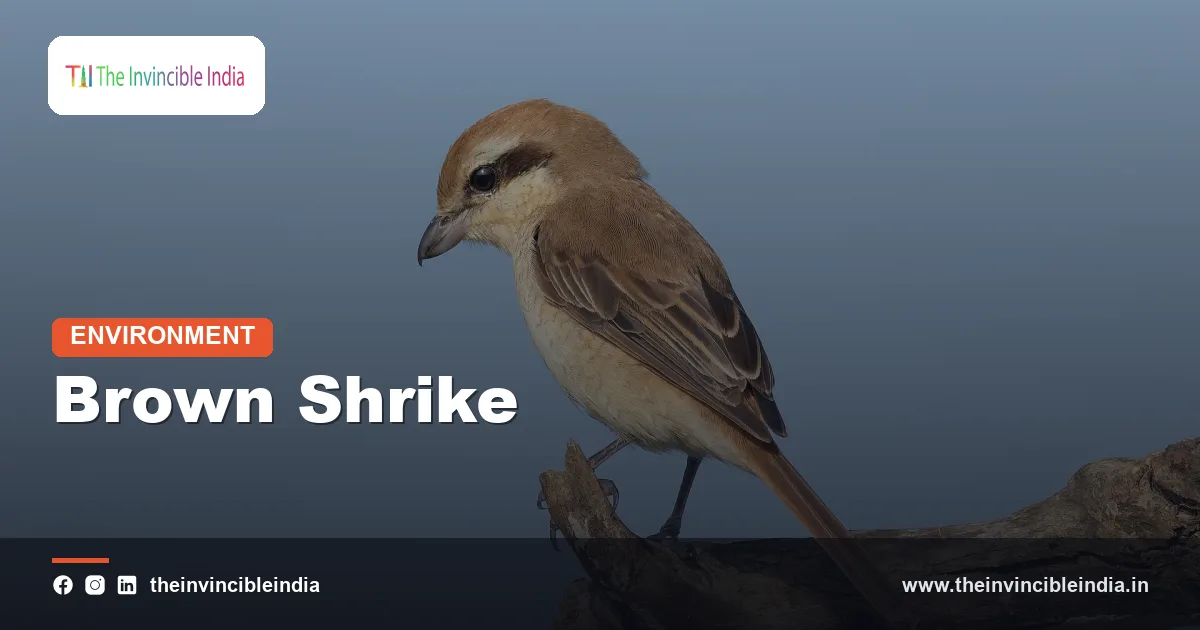
The brown shrike (Lanius cristatus) is a medium-small, black-masked songbird of the family Laniidae that breeds in north-eastern Asia and spends the winter across India and South-East Asia, where it hunts insects and small animals from low perches. It is one of the most familiar winter visitors to Indian gardens, scrub and farmland, arriving in autumn and leaving in spring.
With its rufous-brown upperparts, pale buff underparts, dark eye-mask and hooked bill, the brown shrike looks modest compared with some of its relatives, but it is a spirited, territorial predator that defends a winter patch with loud, harsh calls. This explainer covers its identification, migration, habitat, diet, behaviour, subspecies and conservation status.
Quick Facts
| Attribute | Details |
|---|---|
| Common name | Brown shrike (also called Philippine shrike or Japanese shrike for some subspecies) |
| Scientific name | Lanius cristatus |
| Family and order | Laniidae (shrikes); order Passeriformes |
| Size | About 18 to 20 cm in length, with a rounded, medium-long tail |
| Range and habitat in India | Winter visitor to much of India, especially the peninsula, east and north-east; scrub, gardens, farmland edges, light woodland and forest clearings |
| Diet | Mainly insects such as grasshoppers, beetles and crickets; also small lizards and other small animals |
| Breeding season | Does not breed in India; breeds in summer in Siberia, Mongolia, northern China, Korea and Japan |
| Conservation status | IUCN Least Concern; protected as a native wild bird under the Wild Life (Protection) Act, 1972 |
Key Takeaways
- The brown shrike (Lanius cristatus) is a winter visitor to India that breeds in north-eastern Asia and arrives in the subcontinent roughly from September to October.
- Brown shrikes defend individual winter territories in India, often returning to the same garden, orchard or scrub patch in successive years.
- A brown shrike is recognised by its dark eye-stripe, rufous-brown back and tail, buff underparts and a hooked, notched bill.
- Brown shrikes hunt by perching low and pouncing on insects and small lizards, and they may impale prey on thorns or twigs like other shrikes.
- The brown shrike is not known to breed in India, so the harsh calls and subsong heard in winter are used mainly for territory defence.
- The IUCN classes the brown shrike as Least Concern because its breeding range is huge and its winter range includes many human-modified habitats.
What is the brown shrike?
The brown shrike is a small predatory songbird of the genus Lanius that breeds across eastern Asia and migrates south for the winter, reaching India as a regular visitor. The scientific name Lanius cristatus is the one used in current checklists, and the species belongs to the shrike family, Laniidae.
Like other shrikes, the brown shrike has a strong bill with a hooked tip and a tooth-like notch that helps it kill prey with a bite to the neck. It lacks powerful talons and so depends on its bill and, at times, thorns for handling food. Despite its dull colours, it is a bold and noisy bird, which makes it easier to find than many shy winter migrants.
Several subspecies are described, and they differ slightly in colour and in breeding range. The birds seen in India include individuals from more than one of these populations, and some subspecies have previously been treated as separate species by different authorities.
How can you identify a brown shrike?
A brown shrike can be identified by its broad dark mask through the eye, rufous-brown upperparts and tail, buff-white underparts and a hooked bill, usually while perched upright on a low branch. A narrow pale eyebrow (supercilium) above the mask and a slightly rounded, often wagging tail complete the typical impression.
Key field marks
- A thick black or dark brown mask from the bill through the eye to the ear coverts.
- Brown or greyish-brown crown, merging into a more rufous back and rump.
- A rufous-brown tail, often tinged redder than the back.
- White or buff throat and underparts, with warm buff on the flanks.
- A strong, black, hooked bill with a notch near the tip.
Age and plumage differences
Adult males typically show a cleaner, stronger mask and crisper colours, while females and young birds are slightly duller and may show fine, faint barring on the flanks and breast. First-winter birds that arrive in India in autumn often have a scaly or barred look that smooths out as they moult during the winter. The brown shrike is sometimes confused with related species such as the Isabelline (red-tailed) shrike, which has a paler, sandier back, so careful observation of the mask and back colour helps.
Where does the brown shrike live in India?
The brown shrike lives as a winter visitor across much of India, mainly in scrub, gardens, orchards, farmland edges, forest clearings and light woodland from the peninsula to the north-east. It is among the commonest wintering shrikes in southern and eastern India and is also recorded in many other states during the cold months.
Habitats used in winter
- Gardens, parks and orchards in towns and villages.
- Thorn scrub and degraded forest edges.
- Hedgerows, field boundaries and fallow farmland.
- Clearings in dry and moist deciduous forests.
- Wetland margins with bushes and tall grass.
The brown shrike favours places with a mix of low perches and open ground. Because it can use suburban gardens and roadside shrubs, it is one of the easier wild shrikes for urban birdwatchers to see in India during winter.
When does the brown shrike migrate to India?
The brown shrike migrates to India in autumn, typically arriving between about September and October, and leaves again in spring, around March to April, to return to its breeding grounds. The exact dates vary with latitude and weather, and early or late birds are regularly reported.
Migration is made by night, and birds take a route across Asia from the breeding areas in Siberia, Mongolia, China, Korea and Japan to winter quarters in India, Sri Lanka, Bangladesh and South-East Asia. After arrival, each bird settles on a winter territory and generally remains there until it is time to leave.
Typical annual cycle
- Summer: breeding in north-eastern Asia.
- Autumn: southward passage, with arrival in India in September to October.
- Winter: territorial life in Indian scrub, gardens and farmland.
- Spring: departure in March to April, with some birds lingering into May.
Many shrikes, including the brown shrike, show strong site fidelity, meaning that individuals often return to the same wintering spot year after year. Birdwatchers sometimes notice the “same” bird back on the same perch each winter.
What does the brown shrike eat?
The brown shrike eats mainly insects such as grasshoppers, crickets, beetles, bugs and caterpillars, and it also takes small lizards and other small animals. In India, insects form the bulk of its diet during winter, because insects remain active in the warm climate.
- Grasshoppers, crickets and mantises caught on or near the ground.
- Beetles, flies, moths and their larvae.
- Dragonflies and other large flying insects, occasionally caught in short aerial chases.
- Small lizards, such as young geckos or skinks.
- Spiders and other small invertebrates.
Occasionally, brown shrikes may attack small vertebrates, but their small size limits the size of prey. Foraging in garden and farmland habitats puts the bird in contact with many insects that humans consider pests, so the species is often viewed as beneficial.
How does the brown shrike hunt?
The brown shrike hunts by perching low on a bush, fence or wire and watching the ground, then pouncing on the prey before returning to a perch to eat it. This perch-and-pounce technique is common to all shrikes, and the brown shrike is typically seen on low, open perches about one to three metres above the ground.
Hunting and feeding behaviour
- The bird scans the surroundings with its head tilted and tail wagging.
- On spotting an insect, it drops quickly, grabs it with the bill and takes it back to a perch.
- Large prey are killed with a quick bite to the neck.
- Surplus food may be impaled on thorns, spines or the tips of twigs.
The brown shrike often uses the same few perches repeatedly. Because it is territorial, other brown shrikes are chased away, so one patch of garden or scrub may support only a single bird in winter.
Why is the brown shrike territorial in winter?
The brown shrike is territorial in winter because defending a feeding patch secures a reliable supply of insects and small prey for the individual bird. Unlike many migrants, which wander and flock, brown shrikes establish a fixed winter territory and drive away other shrikes and sometimes other birds.
Territorial behaviour includes loud, harsh calls, tail flicks, bowing and chases. The bird may also sing a soft, rambling subsong in winter, which often includes imitations of other species. These songs and calls are not related to breeding in India, but to maintaining the territory and, in late winter, practising behaviour used on the breeding grounds.
The fidelity to a territory means that disturbing a bird’s feeding patch, for instance by removing hedges and shrubs, can force it to move on. On the other hand, a garden with scattered bushes, thorny shrubs and an abundance of insects can host the same bird for many winters.
What does the brown shrike sound like?
The brown shrike gives a harsh, rattling “chrrr” or “cheh-cheh” call and a rambling subsong made of whistles, chatters and mimicked notes of other birds. The harsh notes are used as an alarm and as a warning to rivals, while the subsong is softer and often delivered from a hidden perch.
Because the bird frequently calls from the top of a bush or a wire, the sound is often the first sign of its presence. In winter, when most songbirds are quiet, the brown shrike’s chatter can be an unexpectedly lively part of the soundscape of a garden or field. Before departure in spring, many birds become more vocal and may sing more elaborately.
What are the subspecies and similar species of the brown shrike?
The brown shrike has several recognised subspecies, and it is closely related to, and often confused with, other brown-and-buff shrikes such as the Isabelline (red-tailed) shrike. Subspecies differ in details such as back colour, crown shade and extent of the mask, and they breed in different parts of eastern Asia.
| Form or species | Breeding area | Distinguishing notes |
|---|---|---|
| Brown shrike (Lanius cristatus) | Siberia, Mongolia, north China, Korea, Japan | Rufous-brown back, dark mask, buff underparts |
| Philippine shrike form (lucionensis) | Parts of China, Korea and Japan | Greyer crown, often a more contrasting mask |
| Isabelline shrike (Lanius isabellinus) | Central Asia | Paler, sandy-brown back, reddish tail; a related winter visitor |
| Long-tailed shrike (Lanius schach) | Resident in India | Larger, long black tail, grey back with rufous rump |
Distinguishing these forms in the field can be difficult, particularly for juveniles and birds in non-breeding plumage. Experienced observers look at the colour of the crown and back, the tail and the extent of the mask to narrow down the identity.
Is the brown shrike threatened?
The brown shrike is not considered threatened and is classed as Least Concern by the IUCN, because its breeding range across eastern Asia is vast and the bird adapts to a variety of habitats in winter. In India it is protected as a native wild bird under the Wild Life (Protection) Act, 1972.
As a long-distance migrant, the species faces risks along its route and in both breeding and wintering areas. Potential pressures include:
- Loss of scrub, hedgerows and farmland edges to development and intensive agriculture.
- Pesticide use that reduces insect prey and may harm birds.
- Collisions with vehicles, glass and wires during migration and in winter.
- Capture of small birds for the pet trade or by hunters at some points on the migration route.
Retaining native shrubs, thorny hedges and open perches in gardens and farm margins helps brown shrikes and many other wintering birds.
Bottom Line
The brown shrike is a territorial, insect-hunting winter visitor to India, recognised by its dark mask, rufous-brown back and hooked bill. It arrives in autumn from breeding grounds in north-eastern Asia, returns to the same winter patch year after year and remains a Least Concern species.
Frequently Asked Questions
What is a brown shrike?
A brown shrike is a small, black-masked songbird of the family Laniidae that breeds in north-eastern Asia and winters in India and South-East Asia. Its scientific name is Lanius cristatus. It has rufous-brown upperparts, buff underparts and a hooked bill.
When does the brown shrike arrive in India?
The brown shrike usually arrives in India from about September to October and leaves around March to April. Dates vary with weather and latitude, and early or late individuals are common. Each bird typically settles on a fixed winter territory.
Does the brown shrike breed in India?
The brown shrike does not breed in India, as it is a winter visitor. It nests in summer in Siberia, Mongolia, northern China, Korea and Japan. The calls and subsong heard in India are used mostly to defend its winter territory.
What does the brown shrike eat?
The brown shrike eats mainly insects such as grasshoppers, crickets, beetles and caterpillars, and it also catches small lizards. It hunts from low perches and pounces on prey. Surplus food may be impaled on thorns or twigs.
How can I tell a brown shrike from an Isabelline shrike?
The brown shrike typically has a darker, rufous-brown back and a dark mask, while the Isabelline shrike has a paler, sandy-brown back and a reddish tail. Careful observation of the back colour, tail and mask helps in separating them. Juveniles and birds in worn plumage can be difficult to identify.
Is the brown shrike protected in India?
The brown shrike is protected in India as a native wild bird under the Wild Life (Protection) Act, 1972, which prohibits hunting and capture. The IUCN lists the species as Least Concern because its breeding range is very large. Habitat loss and pesticide use remain local concerns.
{“@context”:”https://schema.org”,”@graph”:[{“@type”:”FAQPage”,”mainEntity”:[{“@type”:”Question”,”name”:”What is a brown shrike?”,”acceptedAnswer”:{“@type”:”Answer”,”text”:”A brown shrike is a small, black-masked songbird of the family Laniidae that breeds in north-eastern Asia and winters in India and South-East Asia. Its scientific name is Lanius cristatus. It has rufous-brown upperparts, buff underparts and a hooked bill.”}},{“@type”:”Question”,”name”:”When does the brown shrike arrive in India?”,”acceptedAnswer”:{“@type”:”Answer”,”text”:”The brown shrike usually arrives in India from about September to October and leaves around March to April. Dates vary with weather and latitude, and early or late individuals are common. Each bird typically settles on a fixed winter territory.”}},{“@type”:”Question”,”name”:”Does the brown shrike breed in India?”,”acceptedAnswer”:{“@type”:”Answer”,”text”:”The brown shrike does not breed in India, as it is a winter visitor. It nests in summer in Siberia, Mongolia, northern China, Korea and Japan. The calls and subsong heard in India are used mostly to defend its winter territory.”}},{“@type”:”Question”,”name”:”What does the brown shrike eat?”,”acceptedAnswer”:{“@type”:”Answer”,”text”:”The brown shrike eats mainly insects such as grasshoppers, crickets, beetles and caterpillars, and it also catches small lizards. It hunts from low perches and pounces on prey. Surplus food may be impaled on thorns or twigs.”}},{“@type”:”Question”,”name”:”How can I tell a brown shrike from an Isabelline shrike?”,”acceptedAnswer”:{“@type”:”Answer”,”text”:”The brown shrike typically has a darker, rufous-brown back and a dark mask, while the Isabelline shrike has a paler, sandy-brown back and a reddish tail. Careful observation of the back colour, tail and mask helps in separating them. Juveniles and birds in worn plumage can be difficult to identify.”}},{“@type”:”Question”,”name”:”Is the brown shrike protected in India?”,”acceptedAnswer”:{“@type”:”Answer”,”text”:”The brown shrike is protected in India as a native wild bird under the Wild Life (Protection) Act, 1972, which prohibits hunting and capture. The IUCN lists the species as Least Concern because its breeding range is very large. Habitat loss and pesticide use remain local concerns.”}}]}]}


