

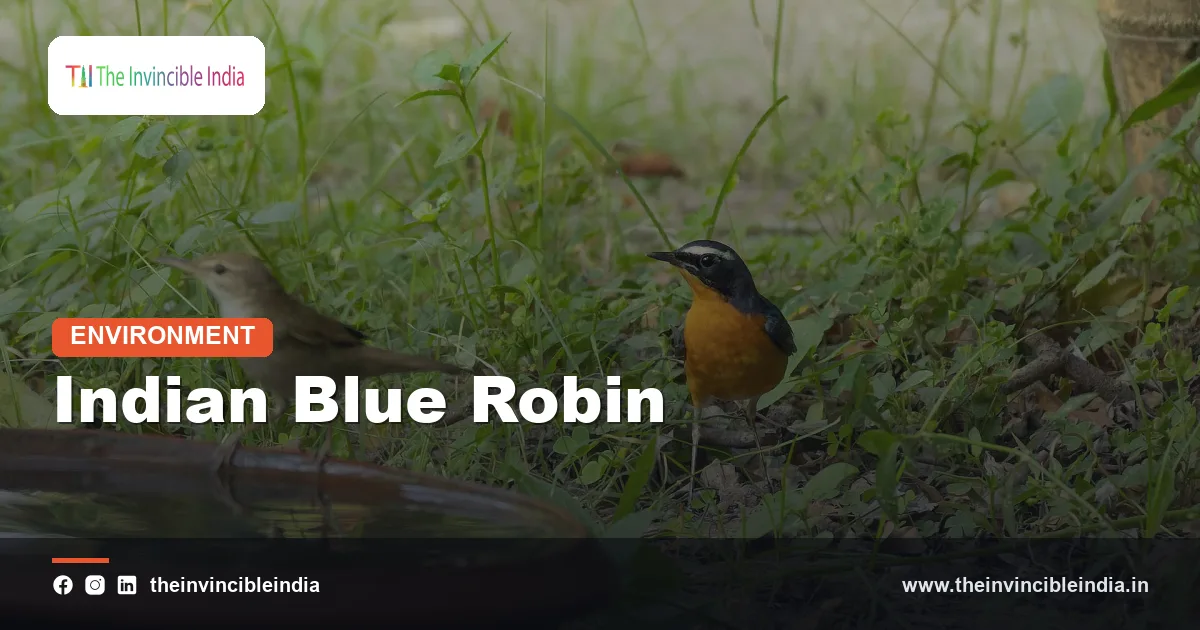
The Indian blue robin (Larvivora brunnea) is a shy, ground-loving songbird of the Old World flycatcher family, in which the male is deep blue above with a rich orange breast, and which breeds in the forests of the Himalaya before migrating to winter in the hills of peninsular India and Sri Lanka. Because the bird lives in dense undergrowth and moves quietly across the forest floor, it is far more often heard than seen.
The species is a good example of a seasonal migrant that travels within the Indian subcontinent, linking high mountain forests with distant southern hills. This article explains how to identify the Indian blue robin, where it breeds and winters, what it eats, how it sings and nests and why the forests it depends on matter.
Quick Facts
| Common name | Indian blue robin |
|---|---|
| Scientific name | Larvivora brunnea (earlier placed in the genus Luscinia) |
| Family | Muscicapidae (Old World flycatchers and chats) |
| Size | About 15 cm, a small, long-legged bird |
| Range in India | Breeds in the Himalaya; winters mainly in the Western Ghats and other southern hills |
| Habitat | Dense undergrowth in temperate forest when breeding; shady forest, shola and plantation understorey in winter |
| Diet | Insects, ants, beetles, spiders and other small invertebrates, taken from the ground |
| Breeding season | Roughly May to July in the Himalayan hills |
| Conservation status | Least Concern on the IUCN Red List; wild birds are protected under the Wildlife (Protection) Act, 1972 |
Key Takeaways
- The Indian blue robin is a small songbird in which the male has dark blue upperparts, a pale eyebrow stripe and bright orange underparts, while the female is olive-brown above and buff-orange below.
- The Indian blue robin is a long-distance seasonal migrant within the subcontinent, breeding in the Himalaya and wintering mainly in the Western Ghats and Sri Lanka.
- The Indian blue robin forages on the forest floor, hopping through leaf litter in search of ants, beetles, spiders and other small invertebrates.
- The Indian blue robin is secretive, preferring thick undergrowth, and is usually first noticed by its song or its tail-flicking movements.
- The Indian blue robin should not be confused with the Indian robin, which is a different, black-and-chestnut bird of open, dry country.
- The IUCN classifies the Indian blue robin as Least Concern, but the bird depends on intact forest understorey at both ends of its migration.
What is the Indian blue robin?
The Indian blue robin is a small migratory forest bird of the Himalaya and the southern Indian hills, belonging to the group of ground-dwelling robins within the Old World flycatcher family. It was long placed in the genus Luscinia with the nightingales and bluethroats, but modern studies of relationships place it in the genus Larvivora, which contains a number of Asian forest robins.
The name can cause confusion. The Indian robin (Copsychus fulicatus) is a quite different bird, a black or brown, chestnut-vented species of open scrub and village edges. The Indian blue robin, by contrast, is a forest species and is far less often seen by casual observers.
The species is known by names such as Indian blue chat in older bird books, and some regional names exist in Himalayan languages. In English-language field guides, however, “Indian blue robin” is the standard name and is used across the literature on Indian birds.
How can you identify an Indian blue robin?
An Indian blue robin is identified by its shape and colour: a compact, long-legged robin with blue upperparts and orange underparts in the male, and a plain brown bird with a buffy-orange breast in the female. The bird typically stands upright on the ground and flicks its tail.
The adult male
The adult male has dark slaty-blue upperparts, a bluish tail, a pale or whitish eyebrow stripe and rich orange-rufous underparts that range from the throat to the belly. The sides of the head are dark, which makes the pale eyebrow stand out. Its legs are pinkish and fairly long, giving it a lively, upright stance.
The female and young
The female is olive-brown above with a rufous tinge to the tail and buff-orange underparts, so she looks much more subdued than the male. She also shows a pale eye-ring, and young birds are spotted with buff, resembling the female in overall tone.
Features that help in the field
- The bird hops and runs along the forest floor rather than flying much.
- The tail is frequently flicked or cocked.
- The male shows two distinct colour zones, blue above and orange below.
- The bird often stays in low, shady cover and may freeze when observed.
Where does the Indian blue robin breed?
The Indian blue robin breeds in the Himalaya, in dense undergrowth of temperate and subalpine forests at mid-to-high elevations, from the west of the range through Uttarakhand, Himachal Pradesh, Sikkim and further east. It prefers thick thickets of shrubs, bamboo, rhododendron and mossy slopes with rich leaf litter.
The breeding habitat is cool, moist and shaded, and the bird tends to stay near the ground within a tangle of vegetation. Males become more visible during the breeding season because they climb to low perches to sing, but even then they keep close to cover.
The Himalayan range is wide, and the exact altitude depends on the locality, with birds breeding higher in some regions than in others. After the nesting season, the birds leave these hills and begin their long journey to the south.
Where does the Indian blue robin spend the winter?
The Indian blue robin spends the winter mainly in the Western Ghats and other hills of peninsular India, and also in the hill country of Sri Lanka. This makes it a notable example of a bird that migrates from the Himalaya to the far south of the subcontinent.
In winter the species uses shady forest, the understorey of coffee and cardamom plantations, shola forest patches and well-wooded valleys. It occupies low, dark places where leaf litter is deep and the soil is moist, because these places hold large numbers of invertebrates.
The journey between the breeding and wintering grounds is long, given the distance between the northern mountains and the southern hills. The birds travel at night and are rarely seen during migration, though occasional records from the plains show that some individuals stop over in gardens or wooded patches along the way.
| Season | Typical location | Typical habitat |
|---|---|---|
| Summer (breeding) | Himalayan hills | Dense forest undergrowth, thickets, mossy slopes |
| Autumn (passage) | Plains and central India (briefly) | Wooded patches, gardens, scrub |
| Winter | Western Ghats, southern hills, Sri Lanka | Shady forest floor, plantation understorey, shola |
| Spring (return) | Movement north to the Himalaya | Forest and scrub en route |
What does the Indian blue robin eat?
The Indian blue robin eats mainly small invertebrates, including ants, beetles, caterpillars, spiders and other insects picked from the forest floor. It also takes some seeds or berries occasionally, but animal prey makes up the bulk of the diet.
The bird feeds in a typical robin manner. It hops across the leaf litter, pauses and tilts its head to look, then snatches prey from the surface or flips aside dead leaves to uncover hidden insects. The long legs help the bird to move quickly on uneven ground.
Feeding is usually carried out in shade, either at dawn and dusk or during the day in thick cover. In wintering areas, the bird may share the forest floor with other ground-feeding birds such as thrushes and babblers, but it generally keeps to its own patch.
The diet makes the robin a valuable part of the forest food web. It helps to keep populations of small ground insects in check and in turn is eaten by snakes, small carnivores and birds of prey, so it forms a link between the leaf litter and larger predators.
How does the Indian blue robin sing?
The Indian blue robin sings a rich, rippling, melodious warble, usually from a low perch in dense cover, and the male uses this song to defend his territory and attract a mate. The song is among the most attractive of the Himalayan forest birds, though it is often heard at dawn and dusk when light is poor.
The call is a short, sharp note that is used as an alarm or contact call, and the bird may give it repeatedly when disturbed. Because the species is shy and hidden, bird watchers often depend on these sounds to know that it is nearby.
In the wintering grounds the robin is much quieter. A few birds may utter low calls or a subdued version of the song, but the loud, full singing of the breeding season is not normally heard in the southern hills.
How does the Indian blue robin nest?
The Indian blue robin nests on or close to the ground, building a cup or dome of moss, leaves and fine roots hidden in a bank, among roots or beneath a rock or thick plant. Such low, concealed sites make the nest very hard to find and give some protection from predators.
The female lays a small clutch of pale eggs and is mainly responsible for incubation, while the male defends the territory and sings nearby. After hatching, both parents bring insects to the young. The nestlings leave the nest while still weak flyers and spend some days hopping about in the undergrowth under the care of the parents.
Nesting takes place in the cooler Himalayan summer, roughly from May to July, and the exact timing depends on altitude. Bird watchers are advised not to search for nests, because disturbance can cause the parents to abandon the eggs or young.
Is the Indian blue robin threatened?
The Indian blue robin is not currently threatened, and the IUCN lists it as Least Concern because of its fairly wide range and no evidence of a rapid decline. In India, wild birds like this species are protected under the Wildlife (Protection) Act, 1972.
Even so, the robin is tied to forest understorey on both the breeding and wintering grounds, and this makes it vulnerable to certain pressures. Clearing of Himalayan forests, over-grazing of the understorey, conversion of shola and other hill forest to other land uses and removal of undergrowth in plantations can reduce suitable habitat.
Protected areas in the Himalaya and the Western Ghats, together with shade-grown plantations that retain native trees and understorey, help to support the species. Because the bird links two distant regions, conservation of both ends of its range is necessary for its long-term welfare.
- Maintaining dense, native undergrowth in hill forests helps breeding birds.
- Keeping shade trees and ground cover in plantations supports wintering birds.
- Limiting forest fragmentation allows safe movement between habitat patches.
- Recording sightings in community bird databases helps track the species over time.
Bottom Line
The Indian blue robin is a secretive, beautifully coloured forest songbird that connects the Himalaya with the southern hills each year. Its survival depends on shady, undisturbed understorey, and it serves as a reminder that migration in India can be a journey within the country as well as across continents.
Frequently Asked Questions
What does an Indian blue robin look like?
An Indian blue robin is a small, long-legged ground bird. The male has dark blue upperparts, a pale eyebrow stripe and orange underparts, while the female is olive-brown above with a buff-orange breast.
Is the Indian blue robin the same as the Indian robin?
No, the Indian blue robin is not the same as the Indian robin. The Indian robin is a black or brown bird with a chestnut rump found in open dry country, while the Indian blue robin is a blue-and-orange forest species.
Where does the Indian blue robin breed and winter?
The Indian blue robin breeds in the dense undergrowth of Himalayan forests and winters mainly in the Western Ghats and other southern hills, as well as in Sri Lanka. The long migration is made largely at night.
What does the Indian blue robin eat?
The Indian blue robin eats mainly small invertebrates such as ants, beetles, caterpillars and spiders, which it picks from the forest floor. It sometimes takes small seeds or berries as well.
How can I see an Indian blue robin?
An Indian blue robin is best seen in shady forest undergrowth in the Western Ghats in winter or in Himalayan forests in summer. Patience and a quiet approach are needed, because the bird is shy and hides in dense cover.
Is the Indian blue robin endangered?
No, the Indian blue robin is not endangered, and the IUCN lists it as Least Concern. It does, however, depend on intact forest understorey at both ends of its migration, so habitat loss can still affect local populations.
{“@context”:”https://schema.org”,”@graph”:[{“@type”:”FAQPage”,”mainEntity”:[{“@type”:”Question”,”name”:”What does an Indian blue robin look like?”,”acceptedAnswer”:{“@type”:”Answer”,”text”:”An Indian blue robin is a small, long-legged ground bird. The male has dark blue upperparts, a pale eyebrow stripe and orange underparts, while the female is olive-brown above with a buff-orange breast.”}},{“@type”:”Question”,”name”:”Is the Indian blue robin the same as the Indian robin?”,”acceptedAnswer”:{“@type”:”Answer”,”text”:”No, the Indian blue robin is not the same as the Indian robin. The Indian robin is a black or brown bird with a chestnut rump found in open dry country, while the Indian blue robin is a blue-and-orange forest species.”}},{“@type”:”Question”,”name”:”Where does the Indian blue robin breed and winter?”,”acceptedAnswer”:{“@type”:”Answer”,”text”:”The Indian blue robin breeds in the dense undergrowth of Himalayan forests and winters mainly in the Western Ghats and other southern hills, as well as in Sri Lanka. The long migration is made largely at night.”}},{“@type”:”Question”,”name”:”What does the Indian blue robin eat?”,”acceptedAnswer”:{“@type”:”Answer”,”text”:”The Indian blue robin eats mainly small invertebrates such as ants, beetles, caterpillars and spiders, which it picks from the forest floor. It sometimes takes small seeds or berries as well.”}},{“@type”:”Question”,”name”:”How can I see an Indian blue robin?”,”acceptedAnswer”:{“@type”:”Answer”,”text”:”An Indian blue robin is best seen in shady forest undergrowth in the Western Ghats in winter or in Himalayan forests in summer. Patience and a quiet approach are needed, because the bird is shy and hides in dense cover.”}},{“@type”:”Question”,”name”:”Is the Indian blue robin endangered?”,”acceptedAnswer”:{“@type”:”Answer”,”text”:”No, the Indian blue robin is not endangered, and the IUCN lists it as Least Concern. It does, however, depend on intact forest understorey at both ends of its migration, so habitat loss can still affect local populations.”}}]}]}


