

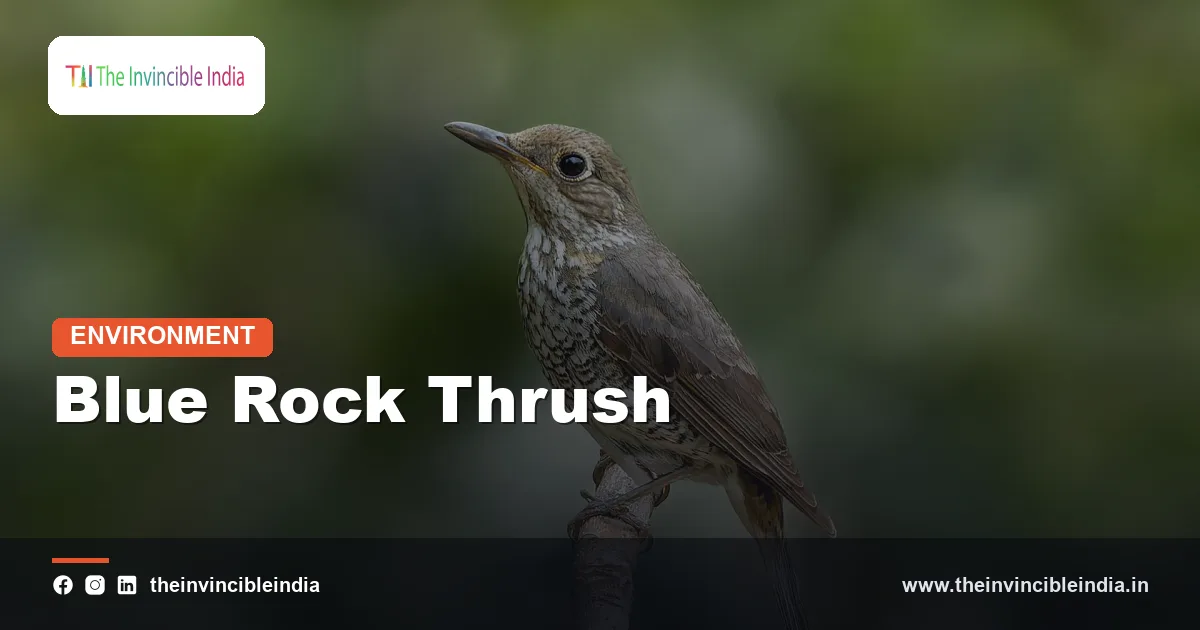
The blue rock thrush (Monticola solitarius) is a medium-sized songbird of rocky country, the male of which is a deep slate-blue bird that perches upright on cliffs, ruins, rooftops and sea-facing rocks across much of India in winter. Despite its name, the blue rock thrush is placed in the Old World flycatcher family (Muscicapidae) rather than among the true thrushes, although it behaves very much like a thrush when it hops across open ground.
In India the blue rock thrush is best known as a winter visitor that appears in temple towers, old forts, hill-station bungalows and quarry edges between autumn and spring, while some birds breed in the Himalaya. This article explains how to recognise the species, where it lives, what it eats, how it sings and nests, and why its habits make it a useful indicator of rocky habitats.
| Quick Fact | Detail |
|---|---|
| Scientific name | Monticola solitarius |
| Family | Muscicapidae (Old World flycatchers and chats) |
| Indian names | No single standard vernacular name; most Indian field guides use the English name “blue rock thrush” |
| Size | About 20 to 23 cm, roughly the length of a myna |
| Range in India | Breeds in the Himalaya; widespread winter visitor to the peninsula, hills and coasts |
| Habitat | Rocky hills, cliffs, ruins, old buildings, quarries and rocky shores |
| Diet | Insects, spiders, small lizards, snails and berries |
| Breeding season | Roughly April to July in its Himalayan breeding range |
| Conservation status | Least Concern (IUCN) |
Key Takeaways
- The blue rock thrush (Monticola solitarius) is a rock-dwelling songbird whose male looks slate-blue in good light and almost black in shade.
- The blue rock thrush is a winter visitor across most of peninsular India, arriving from about October and leaving by roughly March or April.
- Female and young blue rock thrushes are dull grey-brown with scaly, barred underparts, which makes them easy to overlook against rock.
- The blue rock thrush hunts by perching upright, watching the ground and dropping onto insects, spiders and small lizards.
- The blue rock thrush nests in rock crevices, cave ledges and cavities in old walls, and lays pale blue eggs with fine reddish speckles.
- The blue rock thrush is assessed as Least Concern by the IUCN and is the national bird of Malta.
What is the blue rock thrush?
The blue rock thrush is a thrush-like perching bird that lives on rocky slopes, cliffs and old stone structures, and is found from southern Europe and North Africa across Asia to Japan. It belongs to the genus Monticola, whose members are known as rock thrushes because they spend most of their lives on boulders, crags and rock faces rather than in dense woodland.
Several populations of the blue rock thrush are recognised. Birds that reach the Indian peninsula in winter are commonly assigned to the form usually called pandoo, while a longer-billed form breeds in the western Himalaya and Central Asia. Taxonomists still debate how many of these forms deserve species rank, but all are covered by the general name blue rock thrush in Indian field guides.
Indian bird-watchers often meet the blue rock thrush in places that suit its habits rather than in any particular forest type. A lone bird on a fort wall, a temple spire, a ruined bridge or the top of a tin roof in a hill town is usually this species.
What does a blue rock thrush look like?
A male blue rock thrush is a plump, long-billed bird with uniformly slate-blue plumage, darker wings and tail, and a slim black bill. In bright sunlight the blue is obvious, but in shade, at dusk or against dark rock the bird often appears to be plain black or charcoal, which is why many observers first mistake it for a dark bird of the starling or myna type.
Fresh winter plumage on the male carries narrow pale fringes on the feathers, giving a faintly scaled look. These fringes wear away by spring, and the colour becomes cleaner and deeper at the start of the breeding season.
The female blue rock thrush is very different. She is grey-brown above with a pale throat and buffy underparts finely barred with dark crescents, a pattern that blends well with lichen-covered stone. Young birds resemble the female, with additional pale spotting. Both sexes have dark legs and a short, slightly rounded tail that the bird flicks slowly, often with a small bow of the body.
Where is the blue rock thrush found in India?
The blue rock thrush is found across most of India as a winter visitor, with a breeding population in the Himalaya. In winter it is recorded in rocky hills of the Deccan, the Western and Eastern Ghats, the Aravallis, coastal headlands, old forts and hill-station towns, and it reaches the far south and Sri Lanka.
Records from the open Gangetic plain are patchy, because the species needs raised rock, walls or buildings from which to survey the ground. It is therefore commoner around ruins, quarries, bridges and tall institutional buildings than in uniformly flat farmland.
The blue rock thrush also breeds across a wide area outside India, from the Mediterranean through Central Asia and the Himalaya to eastern China and Japan. This broad distribution is one reason the species is classified as Least Concern.
Typical winter perches
- Fort walls, bastions and ruined temples
- Rock outcrops and boulder-strewn hillsides
- Rooftops, water tanks, antennas and parapets of tall buildings
- Quarries, road cuttings and rocky sea cliffs
- Bungalow gardens in hill stations such as those of the Western Ghats
What does the blue rock thrush eat?
The blue rock thrush eats mainly insects and other small animals, supplemented by berries and soft fruit. Typical prey includes beetles, grasshoppers, crickets, caterpillars, spiders, centipedes, snails and small lizards such as geckos and garden lizards, and occasionally a small frog.
The bird usually hunts from a perch. It sits upright and still, scans the ground below, then glides or hops down to seize prey and either eats it on the spot or carries it back to the same stone. Larger items, such as a lizard or a big grasshopper, are beaten against rock before being swallowed.
In winter the blue rock thrush also takes berries and small fruits, particularly when insects are scarce. This habit places it among the many Indian birds that help disperse seeds of wild shrubs, though its role is small compared with fruit specialists such as bulbuls or barbets.
How does the blue rock thrush sing and call?
The blue rock thrush sings a rich, fluty, thrush-like warble, delivered from a prominent rock or rooftop, usually at dawn and dusk. The song is loud, clear and unhurried, with phrases that rise and fall and are separated by short pauses.
Males sing most fully on their breeding grounds, but birds in India are sometimes heard singing quietly in late winter and just before departure. Besides the song, the species gives hard, tapping “chak” notes and a thin whistle when alarmed or when defending a favoured perch.
Because the species holds a small winter territory around its chosen perch, one bird will often be found using the same spot day after day. This faithfulness makes it easy to find once its favourite stone or parapet has been identified.
How does the blue rock thrush breed?
The blue rock thrush breeds in the Himalaya and beyond, nesting in rock crevices, cave ledges, cliff holes and cavities in old walls. The nest is a loose cup of grass, roots, moss and fine twigs, often placed on a ledge or in a hole shielded from rain and wind.
The female lays a clutch of roughly three to five pale blue eggs, usually with fine reddish speckles. The female does most of the incubation, and both parents feed the nestlings with insects and other small prey. The breeding season in the Indian Himalaya generally runs from about April to July, depending on altitude.
Because blue rock thrushes in the Indian plains are winter visitors, nests are rarely found there. Reports of the species in summer from lower areas are unusual and normally involve non-breeding or resident-hill populations.
Is the blue rock thrush a migratory bird?
The blue rock thrush is partly migratory, and in India it behaves largely as a winter visitor. Birds from the Himalaya and from regions further north move to lower hills, plains and the peninsula as winter approaches, arriving mostly from October and returning north by about March or April.
Some individuals appear to use the same wintering territory in successive years, which is typical for solitary perch-hunting birds. Altitudinal movement also occurs within the Himalaya, with birds descending from higher crags to lower valleys during harsh weather.
| Period | What the blue rock thrush does in India |
|---|---|
| September to October | First arrivals reach hills and plains, usually solitary |
| November to February | Birds hold small winter territories on rocks, ruins and buildings |
| March to April | Males sing more, plumage brightens, birds begin moving north |
| April to July | Himalayan birds nest in crevices and cliff holes |
How can the blue rock thrush be told apart from similar birds?
The blue rock thrush is told apart from similar birds by its large size, uniformly dark blue male, long slim bill and habit of sitting motionless on rock or masonry. Several other Indian species also have blue males, so the comparison below helps with identification.
| Species | Key difference from the blue rock thrush |
|---|---|
| Blue-capped rock thrush | Male has a bright blue cap, black face and chestnut underparts |
| Chestnut-bellied rock thrush | Male has blue upperparts but deep chestnut underparts |
| Blue whistling thrush | Larger, glossy dark blue with a yellow bill and a mountain-stream habitat |
| Malabar whistling thrush | Larger, black-billed, tied to Western Ghats streams |
| Asian pied starling and myna types | Shorter bills, noisier flocking behaviour and different calls |
The female blue rock thrush can be confused with other brown thrushes and with female redstarts, but the scaly underparts, longer bill and upright stance on a rock are good clues.
Why does the blue rock thrush matter?
The blue rock thrush matters because it is a visible insect predator of rocky and built-up landscapes and a useful indicator of intact rock habitats. By eating beetles, grasshoppers, caterpillars and spiders, the species contributes to natural control of the small invertebrates in the places where it winters.
The bird also has cultural value. The blue rock thrush is the national bird of Malta, where it is a well-known symbol, and its melodious song has long drawn attention from European and Asian naturalists. In India it is a popular target for garden and fort-visit bird-watchers because it is confiding and easy to observe.
The main pressures on the species in India are quarrying, loss of old stone structures, and disturbance at nesting sites in the Himalaya. At present the global population is considered large and stable enough for a Least Concern assessment.
Bottom Line
The blue rock thrush is a handsome, rock-loving songbird that brings a flash of slate-blue to Indian forts, hills and rooftops each winter. Learning its upright posture, long bill and fluty song makes it easy to identify, and its steady habits make it one of the most reliable winter visitors for beginner bird-watchers.
Frequently Asked Questions
Is the blue rock thrush found in India all year?
The blue rock thrush is mainly a winter visitor to India, although some birds breed and stay in the Himalaya. In the peninsula and plains it is generally seen from about October to March or April. Summer records from low-lying areas are unusual.
Why does the male blue rock thrush look black?
The male blue rock thrush looks black because its deep slate-blue plumage reflects little light in shade. In direct sun the blue becomes clearly visible. Fresh winter feathers also have pale fringes that give a scaly look, which fades by spring.
What does the blue rock thrush eat?
The blue rock thrush eats insects, spiders, snails and small lizards, and also takes berries and soft fruit. It usually hunts from a perch, dropping to the ground to seize prey. Larger prey is beaten against a rock before being swallowed.
Is the blue rock thrush a true thrush?
The blue rock thrush is not a true thrush in the strict sense, because modern classifications place it in the Old World flycatcher family, Muscicapidae. It was traditionally grouped with thrushes owing to its size, shape and song. Its common name reflects this older arrangement.
Where does the blue rock thrush nest?
The blue rock thrush nests in rock crevices, cliff holes, cave ledges and cavities in old walls. The nest is a loose cup of grass, roots and moss. The female lays roughly three to five pale blue, finely speckled eggs.
Is the blue rock thrush endangered?
The blue rock thrush is not endangered; the IUCN assesses it as Least Concern. Its range is very large, covering parts of Europe, Africa and Asia, and its population is considered stable. Local threats include quarrying and the loss of old stone structures used for nesting.
{“@context”:”https://schema.org”,”@graph”:[{“@type”:”FAQPage”,”mainEntity”:[{“@type”:”Question”,”name”:”Is the blue rock thrush found in India all year?”,”acceptedAnswer”:{“@type”:”Answer”,”text”:”The blue rock thrush is mainly a winter visitor to India, although some birds breed and stay in the Himalaya. In the peninsula and plains it is generally seen from about October to March or April. Summer records from low-lying areas are unusual.”}},{“@type”:”Question”,”name”:”Why does the male blue rock thrush look black?”,”acceptedAnswer”:{“@type”:”Answer”,”text”:”The male blue rock thrush looks black because its deep slate-blue plumage reflects little light in shade. In direct sun the blue becomes clearly visible. Fresh winter feathers also have pale fringes that give a scaly look, which fades by spring.”}},{“@type”:”Question”,”name”:”What does the blue rock thrush eat?”,”acceptedAnswer”:{“@type”:”Answer”,”text”:”The blue rock thrush eats insects, spiders, snails and small lizards, and also takes berries and soft fruit. It usually hunts from a perch, dropping to the ground to seize prey. Larger prey is beaten against a rock before being swallowed.”}},{“@type”:”Question”,”name”:”Is the blue rock thrush a true thrush?”,”acceptedAnswer”:{“@type”:”Answer”,”text”:”The blue rock thrush is not a true thrush in the strict sense, because modern classifications place it in the Old World flycatcher family, Muscicapidae. It was traditionally grouped with thrushes owing to its size, shape and song. Its common name reflects this older arrangement.”}},{“@type”:”Question”,”name”:”Where does the blue rock thrush nest?”,”acceptedAnswer”:{“@type”:”Answer”,”text”:”The blue rock thrush nests in rock crevices, cliff holes, cave ledges and cavities in old walls. The nest is a loose cup of grass, roots and moss. The female lays roughly three to five pale blue, finely speckled eggs.”}},{“@type”:”Question”,”name”:”Is the blue rock thrush endangered?”,”acceptedAnswer”:{“@type”:”Answer”,”text”:”The blue rock thrush is not endangered; the IUCN assesses it as Least Concern. Its range is very large, covering parts of Europe, Africa and Asia, and its population is considered stable. Local threats include quarrying and the loss of old stone structures used for nesting.”}}]}]}


