

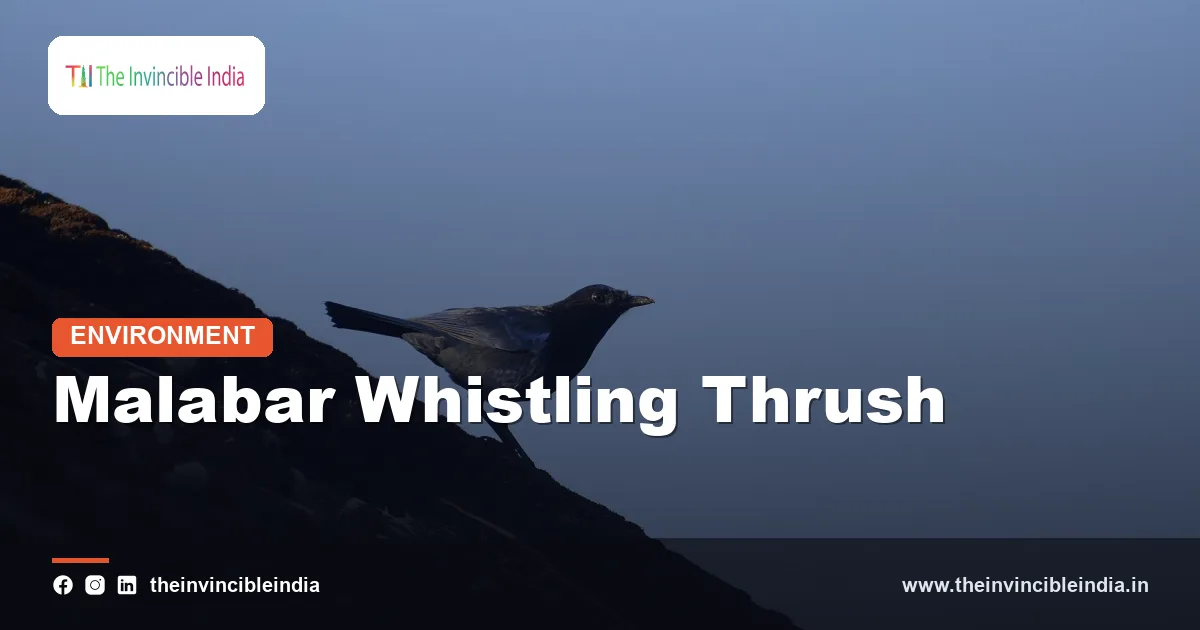
The Malabar whistling thrush (Myophonus horsfieldii) is a large, dark-blue songbird of hill streams in the Western Ghats and some other peninsular Indian hill ranges, famous for a human-like whistled song that has earned it the nickname “whistling schoolboy”. The Malabar whistling thrush is placed in the Old World flycatcher family (Muscicapidae) and is one of the best-known voices of India’s southern forests.
The bird is a near-endemic of peninsular India, found by rocky streams, waterfalls, shaded ravines and hill-station bungalows. This article explains how the Malabar whistling thrush looks, where it lives, what it eats, why it whistles, and how it builds its nest close to running water.
| Quick Fact | Detail |
|---|---|
| Scientific name | Myophonus horsfieldii |
| Family | Muscicapidae (Old World flycatchers and chats) |
| Common nickname | Whistling schoolboy |
| Size | About 25 cm, larger than a myna |
| Range in India | Western Ghats and some other hill ranges of peninsular India |
| Habitat | Rocky hill streams, waterfalls, shaded ravines, forest and estates near water |
| Diet | Crabs, snails, frogs, insects and some fruit |
| Breeding season | Roughly March to July, around the pre-monsoon and monsoon |
| Conservation status | Least Concern (IUCN) |
Key Takeaways
- The Malabar whistling thrush (Myophonus horsfieldii) is a dark-blue stream thrush of the Western Ghats and some other peninsular hill ranges.
- The Malabar whistling thrush is nicknamed the whistling schoolboy because its song sounds like a person whistling a simple tune.
- The Malabar whistling thrush has a black bill, glistening blue patches on the forehead and shoulders, and dark blue-black plumage that looks black in shade.
- The Malabar whistling thrush feeds on crabs, snails, frogs and insects, often cracking hard-shelled prey against rocks beside streams.
- The Malabar whistling thrush builds a cup nest of moss, roots and mud on rock ledges, in crevices, under bridges or near waterfalls.
- The Malabar whistling thrush is assessed as Least Concern by the IUCN, but it depends on clean, shaded, flowing streams.
What is the Malabar whistling thrush?
The Malabar whistling thrush is a large, glossy dark-blue songbird that lives beside rocky hill streams and is celebrated for its whistled song. The species belongs to the genus Myophonus, the whistling thrushes, a group of stream-dwelling birds found from the Himalaya and South-East Asia to the Indian peninsula.
The scientific name horsfieldii honours Thomas Horsfield, an American naturalist who worked in the East Indies and later in London. The common name Malabar refers to the coastal region of south-western India, although the bird is found more widely in the hills than that single word suggests.
The bird was traditionally grouped with the true thrushes, and some older books still place it in the family Turdidae. Present-day classifications generally move whistling thrushes into the Old World flycatcher family. Whatever the family, the Malabar whistling thrush behaves as a bold, large-bodied thrush that spends most of its time on the ground near water.
What does the Malabar whistling thrush look like?
The Malabar whistling thrush looks like a large, dark bird, deep violet-blue to blue-black in overall colour, with a short bright blue patch on the forehead and glistening blue shoulder patches. In dim forest light the bird often looks almost black, and the glossy blue appears only when sunlight strikes the feathers.
The bill is black, which separates the species from the blue whistling thrush of the Himalaya, which has a yellow bill. The legs are black and strong, and the tail is rather long, with a fan-like flick at the end of each bout of walking.
Males and females look very similar, although some females are slightly duller. Young birds are browner, with pale spotting on the body, and they gain the full blue gloss after their first moult. Because the bird is large and confident, it is usually easy to spot on a flat rock or a mossy boulder at the edge of a stream.
Where is the Malabar whistling thrush found?
The Malabar whistling thrush is found mainly in the Western Ghats, from the hills of Maharashtra and Goa southwards through Karnataka and Kerala to Tamil Nadu, and also in some other hill ranges of peninsular India. It occurs from foothill streams to forested plateaus at moderate and high elevations.
The species lives near water. Typical sites include fast rocky streams, shaded ravines, waterfalls, river banks and forested slopes. It also visits hill-station bungalows, tea and coffee estates and roadside culverts where small streams pass through. Its dependence on running water means that it is much commoner in the wetter, western side of the Ghats.
Typical places to look
- Rocky streams under forest cover, especially at dawn
- Waterfalls and the rocks around their base
- Estate bungalows, culverts and bridges over small streams
- Shaded ravines with moss-covered boulders
- Hill-station gardens with ponds or running water
What does the Malabar whistling thrush eat?
The Malabar whistling thrush eats freshwater crabs, snails, frogs, aquatic and terrestrial insects, earthworms and some fruit. The bird hops along stream edges and across wet boulders, probing under stones and leaves for hidden prey.
A well-known habit of the species is to carry a hard-shelled snail or small crab to a favourite rock and strike it repeatedly until the shell breaks open. Such rocks become anvils, and scatterings of broken shells below them often reveal where a bird feeds regularly.
The Malabar whistling thrush also eats berries and other small fruits, and it may take insects at lights and on lawns of hill-station gardens. By removing crabs, snails and large insects from streamside habitats, the species plays a small part in controlling these animals in forest streams.
Why is the Malabar whistling thrush called the whistling schoolboy?
The Malabar whistling thrush is called the whistling schoolboy because its song resembles a person whistling a short, wandering tune. The song is a series of clear, liquid whistles that rise and fall, sometimes broken by sudden pauses, so that many listeners mistake it for a human whistler hidden in the forest.
The bird sings mostly at dawn and dusk, and again after rain, from a rock, a branch or a rooftop near the stream. The song carries a long way through the quiet forest, and it is among the first sounds heard in the Ghats on a cool morning. Male birds sing the most during the breeding season, but singing is frequent at other times of year as well.
Besides the song, the Malabar whistling thrush gives a sharp, thin alarm note and a short harsh call when flushed. The bird is not a mimic in the way of mynas or drongos, but the sheer clarity of its notes gives the song an almost human quality.
How does the Malabar whistling thrush breed?
The Malabar whistling thrush breeds mainly between about March and July, building a bulky cup nest of moss, roots, mud and leaves close to running water. The nest is placed on a rock ledge, in a crevice of a cliff, under a bridge, in a niche behind a waterfall or sometimes in a building near a stream.
The female lays about three to four eggs, which are pale in colour with brownish markings. Both parents feed the nestlings with crabs, insects, snails and other food, and the fledglings remain near the stream for some time after leaving the nest.
The species is territorial and often returns to the same nest site in successive years, repairing or rebuilding the nest. This site loyalty makes the bird vulnerable to disturbance by construction work at bridges and culverts.
| Feature | Malabar whistling thrush | Blue whistling thrush |
|---|---|---|
| Bill colour | Black | Yellow |
| Typical range in India | Western Ghats and peninsular hills | Himalaya and its foothills |
| Typical habitat | Rocky forest streams | Mountain streams and gorges |
| Plumage | Dark blue-black with bright blue patches | Dark blue with pale spangling |
Is the Malabar whistling thrush endemic to India?
The Malabar whistling thrush is almost endemic to India, because its range is centred on the Western Ghats and other peninsular hill ranges. The Western Ghats are recognised as a global biodiversity hotspot, and the bird is one of a group of birds largely restricted to this region.
Closely related whistling thrushes live in the Himalaya and South-East Asia, and Sri Lanka has its own separate species, the Sri Lanka whistling thrush. The Malabar species is therefore an important component of the Western Ghats bird community, together with other peninsular specialists such as the Malabar grey hornbill and the Nilgiri flycatcher.
Such near-endemic status makes the species a useful flagship for conservation of forest streams in southern India.
How is the Malabar whistling thrush different from the blue whistling thrush?
The Malabar whistling thrush is different from the blue whistling thrush mainly in bill colour, range and detailed plumage. The Malabar species has a black bill and a bright blue forehead patch, whereas the blue whistling thrush has a yellow bill, is found in the Himalayan region and its foothills, and has fine pale spangling on the body.
The two species look similar from a distance, and in earlier decades the Malabar bird was treated as a subspecies of a wider group. Today the Malabar whistling thrush is usually treated as a separate species, and Indian bird-watchers rely on the black bill and geographic location to separate them.
Other dark birds near streams, such as the black bulbul and the white-bellied blue flycatcher, are smaller and have different shapes and calls.
Why does the Malabar whistling thrush matter?
The Malabar whistling thrush matters because it is a visible and vocal indicator of clean, shaded, flowing streams in the Western Ghats. The bird depends on crabs, snails and stream insects, which in turn need unpolluted water and intact bank vegetation.
The main threats are deforestation of stream catchments, siltation, water pollution, dam and road building, and disturbance at nesting sites under bridges and culverts. Because the species also lives near human settlements in hill areas, it is exposed to pesticide runoff and rubbish dumping along streams. The IUCN currently lists the species as Least Concern, but its habitat is under steady pressure.
The bird also has cultural and tourism value. Its song is a familiar sound in hill stations, and it is a favourite subject for photographers and visitors in places such as the Western Ghats national parks and tea and coffee estates.
Bottom Line
The Malabar whistling thrush is a large, glossy, near-endemic stream bird of peninsular India, remembered chiefly for a song that sounds like a schoolboy’s whistle. Protecting forest streams and quiet nesting sites under bridges and ledges is the most practical way of keeping the species common in the Western Ghats.
Frequently Asked Questions
Why is it called the whistling schoolboy?
The Malabar whistling thrush is called the whistling schoolboy because its song sounds like a person whistling a short, wandering tune. The clear, liquid notes rise and fall and are often heard at dawn and dusk. Many listeners think a human is whistling in the forest.
Where is the Malabar whistling thrush found?
The Malabar whistling thrush is found mainly in the Western Ghats and some other hill ranges of peninsular India. It lives near rocky streams, waterfalls, shaded ravines and estates with flowing water. It is rare in dry plains away from hills and streams.
What does the Malabar whistling thrush eat?
The Malabar whistling thrush eats freshwater crabs, snails, frogs, insects and earthworms, along with some fruit. It often cracks hard-shelled snails and crabs against favourite rocks. These anvils can be recognised by the scatter of broken shells around them.
How can the Malabar whistling thrush be told from the blue whistling thrush?
The Malabar whistling thrush can be told from the blue whistling thrush mainly by its black bill. The blue whistling thrush has a yellow bill and lives in the Himalayan region and its foothills. Range and detailed plumage also differ between the two.
Where does the Malabar whistling thrush nest?
The Malabar whistling thrush nests on rock ledges, in crevices, under bridges and in niches behind waterfalls, always near running water. The nest is a bulky cup of moss, roots, mud and leaves. The female usually lays about three to four eggs between roughly March and July.
Is the Malabar whistling thrush endangered?
The Malabar whistling thrush is not endangered; the IUCN assesses it as Least Concern. It remains fairly common in suitable forest streams of the Western Ghats. Habitat loss, stream pollution and disturbance at nest sites are its main long-term threats.
{“@context”:”https://schema.org”,”@graph”:[{“@type”:”FAQPage”,”mainEntity”:[{“@type”:”Question”,”name”:”Why is it called the whistling schoolboy?”,”acceptedAnswer”:{“@type”:”Answer”,”text”:”The Malabar whistling thrush is called the whistling schoolboy because its song sounds like a person whistling a short, wandering tune. The clear, liquid notes rise and fall and are often heard at dawn and dusk. Many listeners think a human is whistling in the forest.”}},{“@type”:”Question”,”name”:”Where is the Malabar whistling thrush found?”,”acceptedAnswer”:{“@type”:”Answer”,”text”:”The Malabar whistling thrush is found mainly in the Western Ghats and some other hill ranges of peninsular India. It lives near rocky streams, waterfalls, shaded ravines and estates with flowing water. It is rare in dry plains away from hills and streams.”}},{“@type”:”Question”,”name”:”What does the Malabar whistling thrush eat?”,”acceptedAnswer”:{“@type”:”Answer”,”text”:”The Malabar whistling thrush eats freshwater crabs, snails, frogs, insects and earthworms, along with some fruit. It often cracks hard-shelled snails and crabs against favourite rocks. These anvils can be recognised by the scatter of broken shells around them.”}},{“@type”:”Question”,”name”:”How can the Malabar whistling thrush be told from the blue whistling thrush?”,”acceptedAnswer”:{“@type”:”Answer”,”text”:”The Malabar whistling thrush can be told from the blue whistling thrush mainly by its black bill. The blue whistling thrush has a yellow bill and lives in the Himalayan region and its foothills. Range and detailed plumage also differ between the two.”}},{“@type”:”Question”,”name”:”Where does the Malabar whistling thrush nest?”,”acceptedAnswer”:{“@type”:”Answer”,”text”:”The Malabar whistling thrush nests on rock ledges, in crevices, under bridges and in niches behind waterfalls, always near running water. The nest is a bulky cup of moss, roots, mud and leaves. The female usually lays about three to four eggs between roughly March and July.”}},{“@type”:”Question”,”name”:”Is the Malabar whistling thrush endangered?”,”acceptedAnswer”:{“@type”:”Answer”,”text”:”The Malabar whistling thrush is not endangered; the IUCN assesses it as Least Concern. It remains fairly common in suitable forest streams of the Western Ghats. Habitat loss, stream pollution and disturbance at nest sites are its main long-term threats.”}}]}]}


