

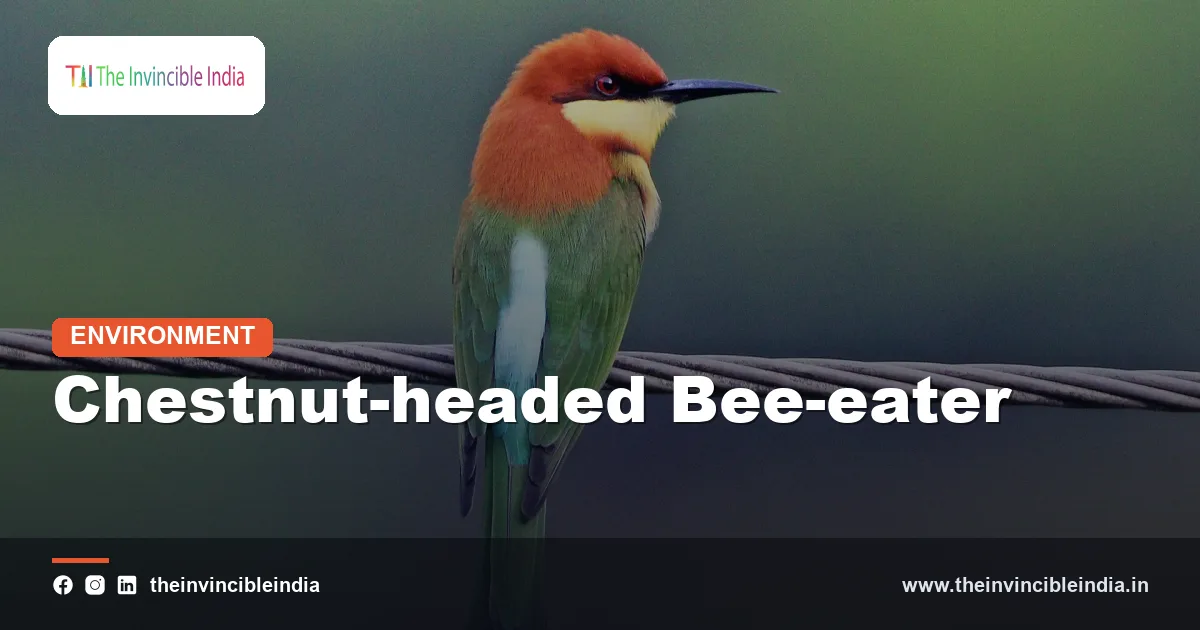
The chestnut-headed bee-eater is a slim, bright green bee-eater with a rich chestnut crown and nape and a yellow throat, found in forest clearings, river valleys and well-wooded hill country across India and South-East Asia. It catches bees, wasps, dragonflies and other flying insects from an open perch, and it nests in burrows dug into sandy banks.
The chestnut-headed bee-eater (Merops leschenaulti) is one of the most striking of the bee-eater family in India. It is more tied to wooded country than the common green bee-eater of open plains, and it is often seen in small, lively groups sallying out from branches over streams and forest tracks.
Quick Facts
| Attribute | Detail |
|---|---|
| Common name | Chestnut-headed bee-eater (formerly also called bay-headed bee-eater) |
| Scientific name | Merops leschenaulti |
| Family | Meropidae (bee-eaters), order Coraciiformes |
| Size | About 20 cm long, with a short, square tail and no long central streamers |
| Key features | Chestnut crown, nape and upper back, black eye-stripe, yellow throat with a chestnut band, green body, bluish rump |
| Range and habitat | Forested foothills, river valleys, forest clearings and well-wooded country in peninsular, eastern and north-eastern India, Sri Lanka and South-East Asia |
| Diet | Flying insects, especially bees, wasps, dragonflies and flying termites |
| Breeding | Burrows in sandy banks, usually in small colonies, with several white eggs; mostly spring to early summer |
| Conservation status | Least Concern on the IUCN Red List |
Key Takeaways
- The chestnut-headed bee-eater, Merops leschenaulti, is a forest-loving member of the bee-eater family Meropidae found in India and across South-East Asia.
- A chestnut cap and nape, a yellow throat and a green body make the chestnut-headed bee-eater easy to separate from India’s other bee-eaters.
- The chestnut-headed bee-eater hunts bees, wasps and dragonflies from a perch and removes the sting by striking the prey on a branch.
- The chestnut-headed bee-eater digs a nesting tunnel in a sandy bank or cutting, and several pairs often nest close together.
- Unlike the green bee-eater, the chestnut-headed bee-eater lacks long central tail feathers and prefers wooded, humid country.
- The IUCN lists the chestnut-headed bee-eater as Least Concern, though loss of forest and sand-bank nesting sites can affect local groups.
What is the chestnut-headed bee-eater?
The chestnut-headed bee-eater is a medium-small, brightly coloured bird that belongs to the bee-eaters, a family of insect hunters famous for taking stinging insects on the wing. It has a slim body, a long, slightly downcurved black bill, short legs and long pointed wings that make it a graceful flier.
The scientific name Merops comes from the Greek word for bee-eater, and the species name leschenaulti honours Jean-Baptiste Leschenault de la Tour, a French botanist who travelled in Asia in the early nineteenth century. The bird was formerly known in many field guides as the bay-headed bee-eater, a name still seen in older books.
Bee-eaters belong to the order Coraciiformes, the same group that contains kingfishers, rollers and hoopoes. Like kingfishers, they nest in tunnels, and like rollers they have brilliant plumage and a habit of sitting in the open to watch for prey.
How can you identify a chestnut-headed bee-eater?
The chestnut-headed bee-eater can be identified by its chestnut crown, nape and upper back, black stripe through the eye, yellow throat and green body. The rump and tail are bluish-green, the underparts are pale greenish-yellow and the eye is red in adults.
The tail is short and square, without the elongated central feathers of the common green bee-eater or blue-tailed bee-eater. Males and females look alike. Young birds are duller, with a greener head and less distinct throat band, and they only gain the full chestnut colour as they mature.
How does it differ from other Indian bee-eaters?
Several bee-eaters occur in India, and the chestnut-headed one is the only one with a chestnut head combined with a yellow throat and no long tail streamers. The table below compares the commonly seen species.
| Species | Head and throat | Tail | Usual habitat |
|---|---|---|---|
| Chestnut-headed bee-eater | Chestnut crown and nape; yellow throat with chestnut band | Short and square | Forest edges, streams, wooded hills |
| Green bee-eater | Golden-green head with rufous wash; thin black gorget | Long central streamers | Open plains, scrub, fields |
| Blue-tailed bee-eater | Chestnut throat, golden-yellow chin | Blue with long streamers | Wetlands, rivers, coasts |
| Blue-bearded bee-eater | Large and heavy; blue throat feathers | Long and rounded | Dense forest canopy |
| European bee-eater | Chestnut crown with yellow throat | Long central streamers | Passage migrant in open country |
Where does the chestnut-headed bee-eater live in India?
The chestnut-headed bee-eater lives in well-wooded hill and foothill country of India, including parts of the Western Ghats, the Eastern Ghats, the Himalayan foothills and north-eastern India. It also occurs in Sri Lanka and through South-East Asia to Indonesia.
Its typical home is forest edge, clearings, riverbanks, plantations and open glades inside evergreen and moist deciduous forest. It is less common in dry scrub and in treeless plains, where the green bee-eater takes over. The bird usually keeps to areas where tall trees offer perches and where water or damp ground supports a steady supply of insects.
In the hills it can occur at moderate elevations, and local movements are common. Birds may move down to warmer lowlands in cold weather or shift to places where insects are emerging, but the species is not known for long migrations.
Because it needs both trees to perch on and sandy or earthy banks to nest in, rivers and forest roads cutting through woodland are among the best places to find it.
What does the chestnut-headed bee-eater eat?
The chestnut-headed bee-eater eats flying insects, with a strong preference for bees, wasps and hornets, along with dragonflies, flies, termites, beetles and butterflies. It catches almost all of its food in the air after short flights from a perch.
Its hunting technique is simple and effective. The bird sits on an exposed twig or wire, watches for passing insects, then darts out, snaps the prey in its bill and returns to the same perch. Stinging prey are handled with care. The bird beats the insect against the branch, rubbing it to squeeze out the venom, before swallowing it.
This is a notable behaviour, because it allows bee-eaters to eat insects that are dangerous to most other birds. Studies of bee-eaters elsewhere show that they can remove the sting and much of the venom by rubbing and striking prey, though the exact method differs between species.
Do bee-eaters harm beekeepers?
Bee-eaters can take honeybees near hives, but their effect on managed colonies is usually small. They feed on many other insects as well, and many farmers accept them as natural pest controllers. Where beekeepers are worried, hives can be placed away from favoured bee-eater perches.
How does the chestnut-headed bee-eater breed?
The chestnut-headed bee-eater breeds by digging a tunnel in a sandy bank, road cutting or flat sandy ground, and laying several round white eggs in a chamber at the end. The tunnel is usually about a metre or more long and is excavated with the bill and feet by both parents.
Nesting generally takes place in the dry season and early summer, roughly from March to June in much of India, though the timing varies with region and rain. A clutch usually contains around four to six eggs, and both parents incubate and feed the nestlings with insects.
Several pairs may nest close together, so a bank can hold a small colony of tunnels. These nest holes are easy to recognise as neat, round openings in a vertical face. Because the birds return to the same banks in successive years, old sites are valuable.
- Nest site: tunnel in a sandy bank, cutting or flat ground.
- Clutch: several white, nearly round eggs.
- Parental care: shared by both parents, sometimes helped by other adults.
- Season: mainly spring to early summer, depending on the region.
Why do chestnut-headed bee-eaters live in flocks?
Chestnut-headed bee-eaters live in small flocks because group living helps them find insect swarms, spot predators and share good nesting banks. Outside the breeding season, flocks of a few birds to a few dozen can be seen perched in a row on a dead branch or telephone wire.
In the evening they often gather at communal roosts, packing tightly on a high branch or in dense foliage. During the day, the group scatters to hunt but stays in contact by calling. The call is a soft, rolling, liquid trill, often given in flight or when a bird returns to its perch.
The flocks are not rigid. Birds join and leave, and groups move between feeding areas as insect numbers change. In some places, the flocks are joined by other aerial feeders, including swifts, swallows and drongos, all of which benefit from the same insect swarms.
What role does the chestnut-headed bee-eater play in the ecosystem?
The chestnut-headed bee-eater plays the role of an aerial predator that keeps down populations of flying insects, including wasps, bees and dragonflies, and in turn becomes prey for hawks and falcons. It links insect life in forest clearings with the larger food web.
By taking large numbers of winged termites, flying ants and flies, the bird helps limit swarms near forest edges and farms. Its presence is also a mild indicator of habitat health, because it requires both stable nesting banks and an abundant insect supply.
Bee-eaters also create burrows that other animals may use after the breeding season is over, such as small lizards, mice, bees and sometimes other birds. The soil in these banks is slightly loosened by digging, which affects the local microhabitat.
Is the chestnut-headed bee-eater threatened?
No, the chestnut-headed bee-eater is not globally threatened and is listed as Least Concern by the IUCN because it is widespread and fairly common across its range. Local numbers, however, depend on forests, clean rivers and undisturbed banks.
What are the main pressures?
- Clearing of forest and conversion of woodland to farmland.
- Sand mining and bank stabilisation that destroy nesting banks.
- Heavy pesticide use that reduces insect prey.
- Disturbance by people and livestock at nest colonies.
What helps the species?
Protecting river banks and forest edges, regulating sand mining in the breeding months and limiting insecticide use all help the chestnut-headed bee-eater. In India, most native wild birds are covered by the Wildlife (Protection) Act, 1972, which discourages harming birds and their nests.
How can you watch the chestnut-headed bee-eater?
You can watch the chestnut-headed bee-eater by visiting forest edges, quiet river valleys and wooded hill roads in the early morning or late afternoon, when the birds are most active. Look for small flocks on bare branches and listen for soft trilling calls.
- Scan dead branches and wires near clearings, since the bird prefers open perches.
- Watch for quick sallies and a return to the same perch.
- Look for neat round holes in sandy banks during spring.
- Keep a distance from nest colonies, and avoid playing recordings of calls.
- Carry binoculars to appreciate the chestnut cap and the yellow throat.
Recording sightings on a citizen-science platform adds to the knowledge of how bee-eaters move through Indian forests.
Bottom Line
The chestnut-headed bee-eater is a colourful, sociable insect hunter of India’s wooded hills, easy to tell apart by its chestnut head, yellow throat and short square tail. It is common enough to be safe overall, but it depends on healthy forest edges and undisturbed sandy banks, so protecting those places keeps its colonies going.
Frequently Asked Questions
What is the chestnut-headed bee-eater?
The chestnut-headed bee-eater (Merops leschenaulti) is a green bee-eater with a chestnut crown and nape and a yellow throat that lives in wooded country in India and South-East Asia. It catches bees, wasps and other flying insects from a perch and nests in tunnels dug into sandy banks.
How is the chestnut-headed bee-eater different from the green bee-eater?
The chestnut-headed bee-eater has a chestnut head, a yellow throat and a short, square tail, while the green bee-eater has a golden-green head and long central tail streamers. The chestnut-headed species prefers wooded and humid country, whereas the green bee-eater is common in open plains and scrub.
What does the chestnut-headed bee-eater eat?
The chestnut-headed bee-eater eats flying insects, especially bees, wasps and dragonflies. It also takes flies, termites, beetles and butterflies. It catches prey in the air from a perch and strikes stinging insects against a branch to remove the sting before swallowing them.
Where does the chestnut-headed bee-eater nest?
The chestnut-headed bee-eater nests in tunnels dug into sandy banks, road cuttings or flat sandy ground. Both parents dig the burrow and lay several white eggs in a chamber at its end. Several pairs often nest close together, forming a small colony.
Is the chestnut-headed bee-eater found all over India?
No, the chestnut-headed bee-eater is found mainly in wooded hill and foothill regions, including the Western Ghats, Eastern Ghats, Himalayan foothills and the north-east. It is uncommon in dry treeless plains and deserts, where other bee-eaters replace it.
Is the chestnut-headed bee-eater endangered?
No, the chestnut-headed bee-eater is classed as Least Concern by the IUCN because it has a wide range and a large population. Local declines can happen when forests are cleared, nesting banks are mined for sand or insects are reduced by heavy pesticide use.
{“@context”:”https://schema.org”,”@graph”:[{“@type”:”FAQPage”,”mainEntity”:[{“@type”:”Question”,”name”:”What is the chestnut-headed bee-eater?”,”acceptedAnswer”:{“@type”:”Answer”,”text”:”The chestnut-headed bee-eater (Merops leschenaulti) is a green bee-eater with a chestnut crown and nape and a yellow throat that lives in wooded country in India and South-East Asia. It catches bees, wasps and other flying insects from a perch and nests in tunnels dug into sandy banks.”}},{“@type”:”Question”,”name”:”How is the chestnut-headed bee-eater different from the green bee-eater?”,”acceptedAnswer”:{“@type”:”Answer”,”text”:”The chestnut-headed bee-eater has a chestnut head, a yellow throat and a short, square tail, while the green bee-eater has a golden-green head and long central tail streamers. The chestnut-headed species prefers wooded and humid country, whereas the green bee-eater is common in open plains and scrub.”}},{“@type”:”Question”,”name”:”What does the chestnut-headed bee-eater eat?”,”acceptedAnswer”:{“@type”:”Answer”,”text”:”The chestnut-headed bee-eater eats flying insects, especially bees, wasps and dragonflies. It also takes flies, termites, beetles and butterflies. It catches prey in the air from a perch and strikes stinging insects against a branch to remove the sting before swallowing them.”}},{“@type”:”Question”,”name”:”Where does the chestnut-headed bee-eater nest?”,”acceptedAnswer”:{“@type”:”Answer”,”text”:”The chestnut-headed bee-eater nests in tunnels dug into sandy banks, road cuttings or flat sandy ground. Both parents dig the burrow and lay several white eggs in a chamber at its end. Several pairs often nest close together, forming a small colony.”}},{“@type”:”Question”,”name”:”Is the chestnut-headed bee-eater found all over India?”,”acceptedAnswer”:{“@type”:”Answer”,”text”:”No, the chestnut-headed bee-eater is found mainly in wooded hill and foothill regions, including the Western Ghats, Eastern Ghats, Himalayan foothills and the north-east. It is uncommon in dry treeless plains and deserts, where other bee-eaters replace it.”}},{“@type”:”Question”,”name”:”Is the chestnut-headed bee-eater endangered?”,”acceptedAnswer”:{“@type”:”Answer”,”text”:”No, the chestnut-headed bee-eater is classed as Least Concern by the IUCN because it has a wide range and a large population. Local declines can happen when forests are cleared, nesting banks are mined for sand or insects are reduced by heavy pesticide use.”}}]}]}


