

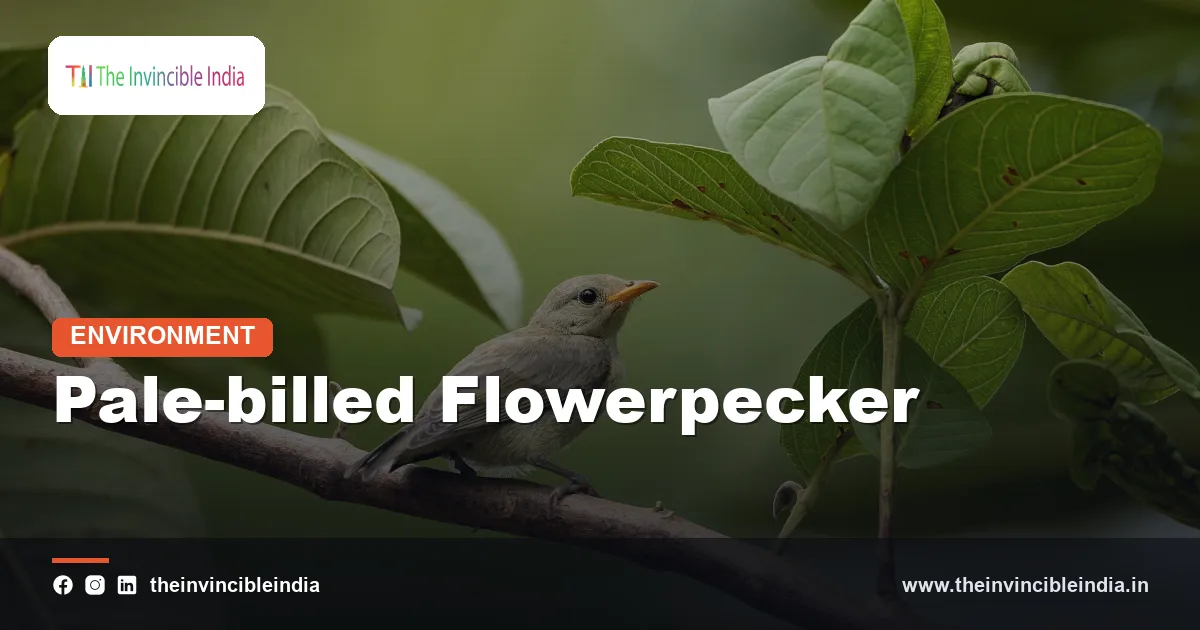
The pale-billed flowerpecker (Dicaeum erythrorynchos) is a tiny, plain-coloured bird of the flowerpecker family that lives in the gardens, groves and open forests of India and feeds mainly on mistletoe berries, nectar and small insects. Measuring only about 8 cm and weighing around 6 to 8 grams, it ranks among the smallest birds in the country, so small that it is often overlooked until its sharp metallic call gives it away. Older Indian field guides called it Tickell’s flowerpecker.
Although the pale-billed flowerpecker is drab, it plays an unusual role in Indian ecology because it spreads the seeds of parasitic mistletoes. Its short, pale, slightly curved bill is well suited to small berries and tiny flowers. This article explains how to recognise the bird, where it lives, what it eats, how it nests and why it matters.
Quick Facts
| Common name | Pale-billed flowerpecker (formerly Tickell’s flowerpecker) |
|---|---|
| Scientific name | Dicaeum erythrorynchos |
| Family | Dicaeidae (flowerpeckers) |
| Size | About 8 cm long, around 6 to 8 grams |
| Range | Widespread across India, also Nepal, Bangladesh and Sri Lanka |
| Habitat | Gardens, groves, farmland trees, open and deciduous forest |
| Diet | Mistletoe berries, flower nectar, small insects and spiders |
| Breeding | Hanging purse-shaped nest, usually two to three eggs; mostly spring and summer |
| Conservation status | Least Concern (IUCN) |
Key Takeaways
- The pale-billed flowerpecker is a tiny bird, about 8 cm long and a few grams in weight, that ranks among the smallest birds found in India.
- The pale-billed flowerpecker has plain olive-grey upperparts, buffy underparts and a pale pinkish bill that gives the species its name.
- Mistletoe berries are the signature food of the pale-billed flowerpecker, and the bird helps spread mistletoe seeds from tree to tree.
- The pale-billed flowerpecker builds a small hanging pouch nest from plant down and cobweb, and the female usually lays two to three eggs.
- The pale-billed flowerpecker is widespread across India and is listed as Least Concern.
- The best clue to the pale-billed flowerpecker is its loud, sharp metallic tick call, which carries much further than the bird looks.
What is the pale-billed flowerpecker?
The pale-billed flowerpecker is a member of the Dicaeidae, a family of small, short-tailed, fruit- and nectar-eating birds found from India through Southeast Asia to Australia. It was formerly known in India as Tickell’s flowerpecker, after the British army officer and ornithologist Samuel Tickell, and the older name still appears in books. The current English name refers to its pale, flesh-coloured bill.
Flowerpeckers are not related to woodpeckers, despite the “pecker” in their name, and they do not peck wood. The name came from the habit of poking into flowers and fruits. They are also unrelated to sunbirds, although both groups visit flowers. In India the flowerpeckers include the pale-billed, thick-billed, plain, scarlet-backed and fire-breasted species, each of which prefers a slightly different habitat.
The pale-billed flowerpecker is the commonest of these in the plains and low hills, and it is the one most likely to be seen in a city park or village grove. It is known in Hindi under the general name Phulchuhi, which means “flower mouse” and refers to its tiny size and restless, rodent-like movement through foliage.
How can you identify the pale-billed flowerpecker?
You can identify the pale-billed flowerpecker by its minute size, plain olive-grey back, pale buffy underparts, short tail and a short, pale bill that is slightly curved. It has no bright patches, bars or streaks, and that plainness is itself a clue because most other tiny garden birds show some colour.
Plumage and bill
The upperparts are dull olive-grey or greenish-grey, and the underparts are pale buff or whitish. The bill is pinkish or horn-coloured, with a darker tip, and it is short and slightly down-curved. The legs and feet are dark. Males and females look almost identical, which makes the species hard to sex in the field.
Young birds
Young birds are even duller, and they have a paler or yellowish gape at the base of the bill, which they use to beg for food. Within a few weeks they develop the adult tone.
Voice
The call is a loud, abrupt, metallic note, often written as “tchik” or “tick”, repeated from a high perch. The thin, rapid song is a series of high-pitched notes. Many birders find the bird by call first.
Where does the pale-billed flowerpecker live?
The pale-billed flowerpecker lives across most of India, from the plains to the lower slopes of the Himalaya, and it also occurs in Nepal, Bangladesh and Sri Lanka. It is largely a bird of lowlands and foothills, and it is absent from the driest deserts and the high mountains.
The bird occupies several kinds of habitat:
- Gardens and parks: mature trees with mistletoe clumps are a strong attraction.
- Village groves and farmland trees: mango, neem, banyan and other large trees host mistletoes.
- Open deciduous and scrub forest: the bird works through the canopy of lightly wooded country.
- Roadside avenues: old trees along roads often carry mistletoe and attract the bird.
The pale-billed flowerpecker is mostly a resident, with some local wandering as fruit and flowers become available. It often stays high in the canopy, so a view from below with binoculars is the usual way to see it.
What does the pale-billed flowerpecker eat?
The pale-billed flowerpecker eats mainly mistletoe berries, along with other small fruits, flower nectar and small insects and spiders. Berries of the Loranthaceae family, the group of parasitic mistletoes that grow on tree branches, form the most characteristic part of its diet.
The bird has a short, pointed tongue with a frayed tip that helps it take nectar and a short gut adapted to process soft fruit quickly. Mistletoe berries are small, sticky and rich in sugars, and the flowerpecker squeezes the fruit pulp in its bill and swallows it. The seed passes through the body in minutes and is often deposited on a branch, where it sticks.
The main foods include:
- Mistletoe berries (genus Dendrophthoe and related Indian mistletoes), the favourite food.
- Small figs and berries from garden and roadside trees.
- Nectar from small flowers, which it sips by probing with the tip of the bill.
- Tiny insects, spiders and larvae gleaned from leaves, which supply protein, especially for chicks.
How does the pale-billed flowerpecker spread mistletoe?
The pale-billed flowerpecker spreads mistletoe by swallowing the sticky berries and then depositing the seeds on tree branches, where they can germinate. Mistletoes are partial parasites that need to land on a host branch, and birds like the flowerpecker are their main delivery system.
The seed of a mistletoe is covered with a sticky layer called viscin. When the bird passes the seed, or wipes its bill on a twig to clean off the glue, the seed attaches to the bark. In time the seed sprouts and sends a root-like structure into the host branch to draw water and minerals. A mistletoe clump may then flower and fruit, attracting more flowerpeckers.
This relationship is mutual. The bird gets food, and the plant gets transport. Because mistletoes also supply nectar to sunbirds and berries to other birds, they support a small web of garden wildlife. Ecologists therefore describe mistletoes as a keystone resource in many dry-country habitats, even though gardeners sometimes dislike them because heavy infestations can weaken host trees.
How does the pale-billed flowerpecker breed?
The pale-billed flowerpecker breeds by building a tiny, purse-shaped hanging nest of plant down, fibres and cobweb, and the female lays two to three small white eggs. The nest is suspended from a branch, often high in a tree, and has a small entrance hole near the top on one side.
The soft wall of the nest is felted from cotton from silk-cotton and other plants, spider silk and bits of bark, which gives it a pale, neat appearance. The nest is so small that it can easily be mistaken for a ball of fluff or a cluster of dry leaves.
The breeding season varies from region to region, but in much of India it extends from spring into the early monsoon. The female does most of the incubation. Both parents feed the nestlings with insects, berries and nectar, and the young leave the nest after about two weeks. After breeding, family groups wander together in search of fruiting trees.
How does the pale-billed flowerpecker behave?
The pale-billed flowerpecker behaves as a restless, quick-moving canopy bird that flits from twig to twig, pausing only briefly before darting off again. It is usually seen alone, in pairs or in small family parties, and it rarely stays still for more than a few seconds.
Its flight is fast, direct and slightly undulating, and the bird often crosses open gaps between trees in a short, straight dash. When feeding, it clings to twigs and hangs at odd angles to reach berries, much like a tit. It will defend a favoured mistletoe clump from other fruit-eating birds, which is surprising for a creature so small.
The bird is most vocal in the breeding season, when males call repeatedly from the top of a tree. A flowerpecker perched at the very tip of a bare branch, uttering sharp notes, is usually a male advertising his territory. Outside the breeding season the species is quieter and may join mixed-species foraging flocks of small insect-eating birds that move through the canopy together.
How is the pale-billed flowerpecker different from similar small birds?
The pale-billed flowerpecker differs from sunbirds and other small garden birds mainly in its tiny size, short tail, plain colouring and short pale bill. The table below compares it with some birds that are sometimes confused with it.
| Bird | Size | Bill | Colour | Main food |
|---|---|---|---|---|
| Pale-billed flowerpecker | About 8 cm | Short, pale, slightly curved | Plain olive-grey above, buff below | Mistletoe berries, nectar, insects |
| Plain flowerpecker | About 8 cm | Short, darker | Plain olive above, greyish olive below | Berries and nectar |
| Purple sunbird (female) | About 10 cm | Long, curved, dark | Olive above, pale yellowish below | Nectar, insects |
| Common tailorbird | About 12 cm | Slender, pointed | Green above, rufous crown, long tail | Insects |
Among these, the flowerpecker is the smallest and the plainest. Its short tail gives it a compact, “tail-less” outline that is easy to learn.
Why does the pale-billed flowerpecker matter?
The pale-billed flowerpecker matters because it spreads mistletoe seeds and pollinates small flowers, linking trees, parasitic plants and other wildlife in gardens and woodlands. Its role is small in size but significant in function.
The bird is also a sensitive indicator of tree cover. It prefers areas that still have mature trees and fruiting plants, and its presence in a town suggests that older trees and some native vegetation remain. Because it eats insects in addition to fruit, it contributes modestly to controlling small garden pests.
Nature educators like the bird because it is a living example of coevolution, the process by which two species adapt to one another over long periods. Showing students a mistletoe clump and a flowerpecker is a simple way to illustrate seed dispersal.
Is the pale-billed flowerpecker threatened?
No, the pale-billed flowerpecker is not threatened and is classed as Least Concern because it has a very large range and a stable population. It remains common wherever trees survive.
Its local risks include the felling of old trees, the clearing of mistletoe from orchards and avenues, and pesticide use that reduces insect prey. Heavy tree-pruning programmes in cities can also remove nest sites. Protecting old trees and allowing some mistletoe to remain on non-commercial trees benefits the bird and the wider garden ecosystem.
Bottom Line
The pale-billed flowerpecker is a tiny, plain, widespread bird of Indian gardens and open woodland, recognised by its small size, pale bill and sharp call. It is Least Concern, and its habit of eating mistletoe berries makes it an important seed disperser.
Frequently Asked Questions
What is the pale-billed flowerpecker?
The pale-billed flowerpecker is a tiny bird of the family Dicaeidae, scientifically named Dicaeum erythrorynchos. It is found across India and feeds on mistletoe berries, nectar and small insects. It was earlier called Tickell’s flowerpecker.
Is the pale-billed flowerpecker the smallest bird in India?
The pale-billed flowerpecker is among the smallest birds in India, at about 8 cm and a few grams in weight. Some other flowerpeckers and a few sunbirds are close in size, so it is safest to describe it as one of the smallest rather than the single smallest. Its tiny size is its most famous trait.
What does the pale-billed flowerpecker eat?
The pale-billed flowerpecker eats mainly mistletoe berries, along with small fruits, flower nectar and tiny insects. The insects supply protein, especially when it is feeding chicks. Its short bill and quick gut suit it to soft, sugary fruit.
Why is the pale-billed flowerpecker important?
The pale-billed flowerpecker is important because it spreads mistletoe seeds, which stick to branches after the bird passes or wipes them off. It also pollinates small flowers and eats small insects. These roles link trees, parasitic plants and other birds in a shared habitat.
How does the pale-billed flowerpecker build its nest?
The pale-billed flowerpecker builds a small hanging pouch from plant down, fibres and cobweb, with a side entrance near the top. The nest is suspended from a branch, and the female lays about two to three eggs. Both parents feed the chicks.
Is the pale-billed flowerpecker found in cities?
Yes, the pale-billed flowerpecker is found in many Indian cities, especially in parks, campuses and avenues with old trees and mistletoe. It is easy to miss because it stays high in the canopy. Its sharp metallic call is often the first sign of its presence.
{“@context”:”https://schema.org”,”@graph”:[{“@type”:”FAQPage”,”mainEntity”:[{“@type”:”Question”,”name”:”What is the pale-billed flowerpecker?”,”acceptedAnswer”:{“@type”:”Answer”,”text”:”The pale-billed flowerpecker is a tiny bird of the family Dicaeidae, scientifically named Dicaeum erythrorynchos. It is found across India and feeds on mistletoe berries, nectar and small insects. It was earlier called Tickell’s flowerpecker.”}},{“@type”:”Question”,”name”:”Is the pale-billed flowerpecker the smallest bird in India?”,”acceptedAnswer”:{“@type”:”Answer”,”text”:”The pale-billed flowerpecker is among the smallest birds in India, at about 8 cm and a few grams in weight. Some other flowerpeckers and a few sunbirds are close in size, so it is safest to describe it as one of the smallest rather than the single smallest. Its tiny size is its most famous trait.”}},{“@type”:”Question”,”name”:”What does the pale-billed flowerpecker eat?”,”acceptedAnswer”:{“@type”:”Answer”,”text”:”The pale-billed flowerpecker eats mainly mistletoe berries, along with small fruits, flower nectar and tiny insects. The insects supply protein, especially when it is feeding chicks. Its short bill and quick gut suit it to soft, sugary fruit.”}},{“@type”:”Question”,”name”:”Why is the pale-billed flowerpecker important?”,”acceptedAnswer”:{“@type”:”Answer”,”text”:”The pale-billed flowerpecker is important because it spreads mistletoe seeds, which stick to branches after the bird passes or wipes them off. It also pollinates small flowers and eats small insects. These roles link trees, parasitic plants and other birds in a shared habitat.”}},{“@type”:”Question”,”name”:”How does the pale-billed flowerpecker build its nest?”,”acceptedAnswer”:{“@type”:”Answer”,”text”:”The pale-billed flowerpecker builds a small hanging pouch from plant down, fibres and cobweb, with a side entrance near the top. The nest is suspended from a branch, and the female lays about two to three eggs. Both parents feed the chicks.”}},{“@type”:”Question”,”name”:”Is the pale-billed flowerpecker found in cities?”,”acceptedAnswer”:{“@type”:”Answer”,”text”:”Yes, the pale-billed flowerpecker is found in many Indian cities, especially in parks, campuses and avenues with old trees and mistletoe. It is easy to miss because it stays high in the canopy. Its sharp metallic call is often the first sign of its presence.”}}]}]}


