

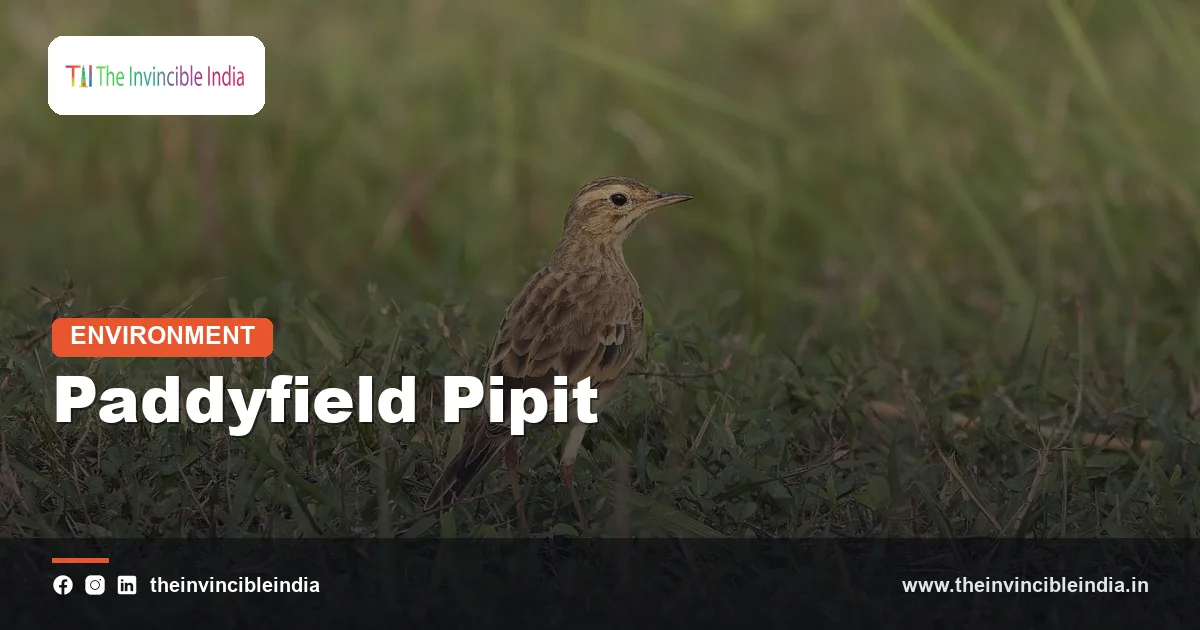
The paddyfield pipit (Anthus rufulus) is a slim, streaky brown ground bird of the pipit and wagtail family that lives in grassland, paddy fields, fallow land and lawns across India and feeds on insects as it walks and runs along the ground. Standing upright on long legs and pumping its tail, it is one of the most familiar small birds of Indian open country, often noticed only when it flies up from a field edge with a thin, chirping call. It is also known as the oriental pipit.
The paddyfield pipit is a resident bird, so it can be seen in most parts of India throughout the year. It was once treated as a form of Richard’s pipit, a larger migrant, but is now recognised as a separate species. This article covers how to identify the paddyfield pipit, where it lives, what it eats, how it nests and why it matters in farmland.
Quick Facts
| Common name | Paddyfield pipit (also oriental pipit) |
|---|---|
| Scientific name | Anthus rufulus |
| Family | Motacillidae (pipits, wagtails and longclaws) |
| Size | About 15 to 16 cm long |
| Range | Resident across India, Nepal, Bangladesh and Sri Lanka, and into Southeast Asia |
| Habitat | Paddy fields, grassland, fallow land, riverbanks, lawns and roadside verges |
| Diet | Insects such as grasshoppers, beetles, ants and termites, plus spiders and some seeds |
| Breeding | Grass-cup nest on the ground, usually three to four eggs; season varies, often tied to the rains |
| Conservation status | Least Concern (IUCN) |
Key Takeaways
- The paddyfield pipit is a slim, streaky brown ground bird about 15 to 16 cm long that is resident across India.
- The paddyfield pipit stands upright on long legs, walks or runs in short bursts and wags its tail up and down.
- The paddyfield pipit feeds mainly on insects such as grasshoppers, beetles, ants and termites, and it also takes spiders and a few seeds.
- The paddyfield pipit nests on the ground in a grass-lined cup hidden under a tuft or clod, and it usually lays three to four eggs.
- The male paddyfield pipit performs a song-flight in which it climbs, sings a repeated chipping phrase and then parachutes back to the ground.
- The paddyfield pipit is listed as Least Concern and is common wherever open, short vegetation remains.
What is the paddyfield pipit?
The paddyfield pipit is a small, ground-living songbird in the family Motacillidae, which includes the pipits, wagtails and longclaws. Pipits are slender, mostly brown and streaky birds that live in open habitats and walk on the ground rather than hopping. The paddyfield pipit is the commonest resident pipit of the Indian plains.
The scientific name Anthus rufulus was given in the early nineteenth century by the French ornithologist Louis Jean Pierre Vieillot. For many years the bird was classed as a subspecies of Richard’s pipit (Anthus richardi), a larger migratory species. Differences in size, voice and migratory habit led modern authorities to split the two, and the resident bird of Asia became the paddyfield pipit, sometimes called the oriental pipit.
The name “paddyfield” refers to the bird’s fondness for rice fields, especially after harvest or when the fields are damp and short, but the bird is not limited to paddy. It occupies a wide set of open habitats across the subcontinent.
How can you identify the paddyfield pipit?
You can identify the paddyfield pipit by its upright stance, long legs, streaked buff-brown plumage, pale eyebrow stripe, streaked breast and constant tail-wagging as it walks. The bird is about the size of a sparrow but looks longer and more elegant because of its slender build and long tail.
Plumage
The upperparts are brown with dark streaks, and the feathers have pale edges that give a scaly look. The underparts are buff or whitish with a band of fine dark streaks across the breast. A pale stripe runs above the eye, and the outer tail feathers are white or buff, visible when the bird flies or lands. The bill is slender and pointed, pale at the base of the lower mandible.
Legs and claws
The legs are long and pale pinkish or yellowish. Like other pipits, the bird has a long hind claw that helps it balance on uneven ground and in thick grass.
Voice
The commonest call is a thin, sharp “chip” or “tseep” given in flight and when the bird is disturbed. The song is a simple, repeated “chip-chip-chip” or “tzip-tzip” phrase delivered during the display flight.
Where does the paddyfield pipit live?
The paddyfield pipit lives in open, short-vegetation habitats across India, from coastal plains to hills and foothills, and it also occurs in Nepal, Bangladesh, Sri Lanka and parts of Southeast Asia. It is a resident species, though some local movements occur in response to rain, cultivation cycles and food supply.
The bird uses several kinds of habitat:
- Paddy fields and their bunds: especially after harvest, when stubble is short and insects are exposed.
- Grassland and pasture: grazed meadows and open scrub are natural strongholds.
- Fallow and cultivated land: field margins, newly ploughed soil and young crops.
- Waterside edges: muddy banks of ponds, canals and rivers.
- Lawns, playgrounds and roadsides: even in towns, if the ground is open and quiet.
The paddyfield pipit avoids dense forest, tall thick grass and very dry desert. It prefers ground that is short enough to see over and damp or fertile enough to support insects.
What does the paddyfield pipit eat?
The paddyfield pipit eats mainly insects, which it catches on the ground, and it also takes spiders and small quantities of seeds. Typical prey includes grasshoppers, beetles, ants, termites, flies, caterpillars and small bugs. Insects are the main food in all seasons, and they are particularly important when the bird is feeding young.
The bird forages by walking steadily, stopping to look, then running forward a few steps to snatch prey. It will also leap up to catch a flying insect and often follows grazing cattle or tractors to take insects disturbed from the soil. Near water it may pick insects from wet mud.
In rice-growing regions, this insect diet helps to control pests of paddy and other crops. Though a single pipit makes a very small dent, a farmland full of pipits, wagtails and other ground-feeding birds consumes large numbers of insects across a season.
How does the paddyfield pipit move and behave?
The paddyfield pipit moves by walking or running rather than hopping, often with a distinct tail-wagging action, and it flies up with a bounding, undulating flight when disturbed. It stands erect and alert, stretching its neck to look over grass, and it freezes briefly when it senses danger.
Outside the breeding season the bird is seen singly or in loose groups that may gather where food is plentiful. When flushed it flies a short distance, calls with a thin chip and lands again, often on a post, rock or clod of earth. Perching on a small elevation gives the bird a good view of its surroundings.
The male performs a display flight in the breeding season. He rises steeply from the ground, singing as he climbs, and then glides down on spread wings and a raised tail, still singing, to land near his starting point. The display marks his territory and attracts a mate. In many parts of India it is most obvious around the start of the rains.
How does the paddyfield pipit breed and nest?
The paddyfield pipit breeds by building a cup-shaped nest of grass on the ground, well hidden under a tuft, clod or low bush, and the female usually lays three to four eggs. The nest is lined with finer grass and sometimes hair, and it often has a small overhanging cover of vegetation that shields it from the sun and from sight.
The breeding season differs between regions. In many areas it follows the monsoon, when insects are abundant and vegetation provides cover, but in some regions breeding takes place at other times of the year. The eggs are whitish or greyish with dark speckles. The female does most of the incubation, and both parents feed the nestlings with insects.
The chicks leave the nest before they can fly well and scatter into nearby vegetation, where the parents continue to feed them. Because the nest lies on the ground, it is at risk from trampling, grazing animals, farm machinery, snakes, crows and stray dogs.
How is the paddyfield pipit different from other pipits?
The paddyfield pipit differs from other Indian pipits mainly in its smaller size, resident status, buffy underparts with a streaked breast and relatively short, slender build. The table below compares it with other pipits that can be seen in the same fields.
| Bird | Size | Key features | Status in India |
|---|---|---|---|
| Paddyfield pipit | About 15 to 16 cm | Streaked breast, buffy underparts, upright stance | Resident across most of the country |
| Richard’s pipit | About 18 to 20 cm | Larger and heavier, longer legs, bolder breast streaking | Winter visitor |
| Tawny pipit | About 16 to 17 cm | Plainer, sandy, fewer streaks on the breast | Winter visitor, mainly in the north and west |
| Olive-backed pipit | About 15 cm | Olive-tinged back, dark and light spots on the ear coverts, habit of bobbing the tail | Winter visitor and migrant |
To separate these birds in the field, observers look at size, leg length, call and the pattern of streaking. The paddyfield pipit is the smallest and the most likely to be present in summer and the rainy season.
Why does the paddyfield pipit matter?
The paddyfield pipit matters because it is a common indicator of open, insect-rich farmland and grassland, and it helps to control insect populations. As a resident ground-feeder, it responds quickly to changes in land use, so its numbers can reveal how well a landscape supports wildlife.
The bird is also an important prey species for raptors such as shikras, kestrels and harriers, and for mammals like mongooses and cats. In turn it links the insects of a field to the birds of prey above it. Along with larks, wagtails and francolins, it forms part of the community of ground birds that depend on short vegetation.
Because it lives alongside people and crops, the paddyfield pipit is a good species for beginning birdwatchers. It can be found in a village, on a university lawn or beside a paddy bund, with little travel.
Is the paddyfield pipit threatened?
No, the paddyfield pipit is not threatened and is classed as Least Concern, because its range is vast and it adapts to many open habitats. It remains common across most of India.
Possible local pressures include the conversion of grassland and farmland to buildings, heavy pesticide use that reduces insects, the spread of tall invasive weeds and the loss of field margins. Ground nests can also be lost during harvesting or mowing in the breeding season. Maintaining field edges, reducing chemical use and keeping some short grass and fallow patches helps the species.
Where and when can you see the paddyfield pipit?
You can see the paddyfield pipit all year round in open fields, grassland, lawns and riverbanks across India. It is easiest to find in the early morning and evening, when it is active and calling, and after rain, when insects are plentiful.
A good approach is to scan field edges, bunds, tracks and short grass for a slim bird standing upright and wagging its tail. Walk slowly and stop often, since the bird tends to run ahead rather than fly. Listening for the thin chip call can lead you to birds that are otherwise well camouflaged.
Bottom Line
The paddyfield pipit is a common, slim, streaky resident of Indian fields, grasslands and lawns, recognised by its upright stance and tail-wagging. It feeds on insects, nests on the ground and is Least Concern, but it relies on the continued availability of open, short vegetation.
Frequently Asked Questions
What is the paddyfield pipit?
The paddyfield pipit is a small, streaky brown songbird of the pipit family, scientifically named Anthus rufulus. It lives on the ground in fields, grassland and lawns across India and southern Asia. It is also called the oriental pipit.
Where does the paddyfield pipit live?
The paddyfield pipit lives in open habitats such as paddy fields, grassland, fallow land, riverbanks and lawns across India. It is mostly a resident bird. It avoids dense forest and very tall grass.
What does the paddyfield pipit eat?
The paddyfield pipit eats mainly insects such as grasshoppers, beetles, ants and termites, along with spiders and some seeds. It catches prey by walking and running on the ground. Insects are especially important when it is feeding chicks.
How can I tell a paddyfield pipit from Richard’s pipit?
The paddyfield pipit is smaller, shorter-legged and a resident, whereas Richard’s pipit is larger, heavier and a winter visitor to India. Richard’s pipit also has bolder breast streaking and a deeper call. The two were once treated as a single species.
Where does the paddyfield pipit nest?
The paddyfield pipit nests on the ground, in a grass-lined cup hidden under a tuft, clod or low bush. The female usually lays three to four speckled eggs. The nest is vulnerable to trampling and predators because it is not raised off the ground.
Is the paddyfield pipit common in India?
Yes, the paddyfield pipit is one of the commonest resident pipits in India and is found in most states. It is classed as Least Concern. It is easy to see in fields and grassy places throughout the year.
{“@context”:”https://schema.org”,”@graph”:[{“@type”:”FAQPage”,”mainEntity”:[{“@type”:”Question”,”name”:”What is the paddyfield pipit?”,”acceptedAnswer”:{“@type”:”Answer”,”text”:”The paddyfield pipit is a small, streaky brown songbird of the pipit family, scientifically named Anthus rufulus. It lives on the ground in fields, grassland and lawns across India and southern Asia. It is also called the oriental pipit.”}},{“@type”:”Question”,”name”:”Where does the paddyfield pipit live?”,”acceptedAnswer”:{“@type”:”Answer”,”text”:”The paddyfield pipit lives in open habitats such as paddy fields, grassland, fallow land, riverbanks and lawns across India. It is mostly a resident bird. It avoids dense forest and very tall grass.”}},{“@type”:”Question”,”name”:”What does the paddyfield pipit eat?”,”acceptedAnswer”:{“@type”:”Answer”,”text”:”The paddyfield pipit eats mainly insects such as grasshoppers, beetles, ants and termites, along with spiders and some seeds. It catches prey by walking and running on the ground. Insects are especially important when it is feeding chicks.”}},{“@type”:”Question”,”name”:”How can I tell a paddyfield pipit from Richard’s pipit?”,”acceptedAnswer”:{“@type”:”Answer”,”text”:”The paddyfield pipit is smaller, shorter-legged and a resident, whereas Richard’s pipit is larger, heavier and a winter visitor to India. Richard’s pipit also has bolder breast streaking and a deeper call. The two were once treated as a single species.”}},{“@type”:”Question”,”name”:”Where does the paddyfield pipit nest?”,”acceptedAnswer”:{“@type”:”Answer”,”text”:”The paddyfield pipit nests on the ground, in a grass-lined cup hidden under a tuft, clod or low bush. The female usually lays three to four speckled eggs. The nest is vulnerable to trampling and predators because it is not raised off the ground.”}},{“@type”:”Question”,”name”:”Is the paddyfield pipit common in India?”,”acceptedAnswer”:{“@type”:”Answer”,”text”:”Yes, the paddyfield pipit is one of the commonest resident pipits in India and is found in most states. It is classed as Least Concern. It is easy to see in fields and grassy places throughout the year.”}}]}]}


