

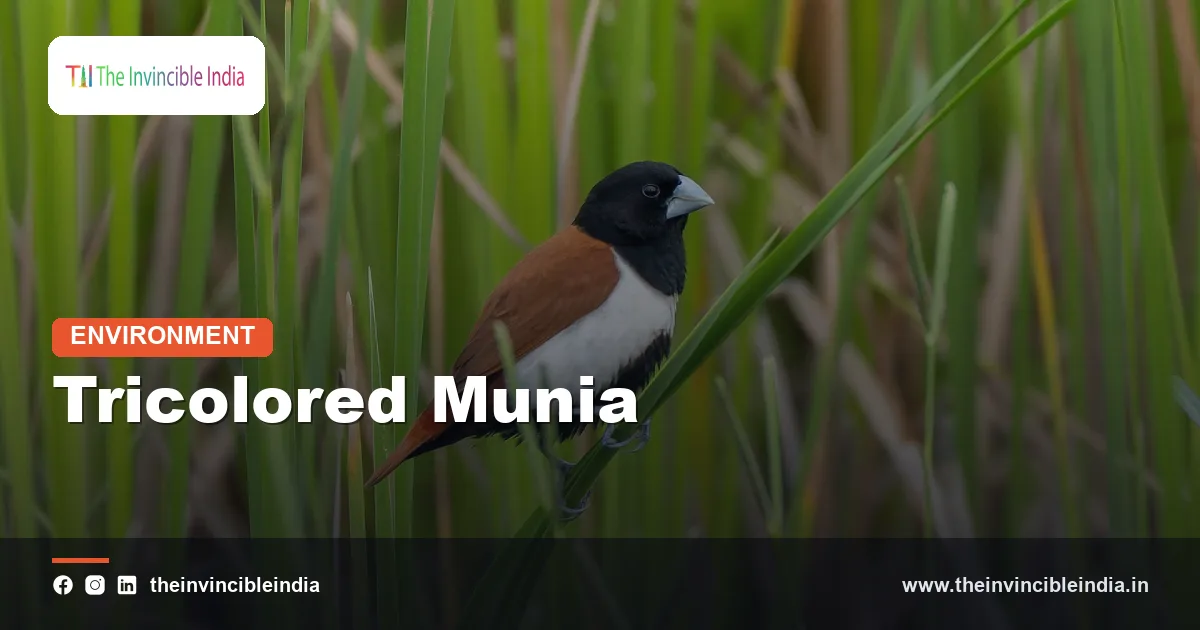
The tricolored munia (Lonchura malacca) is a tiny, sociable finch of southern and peninsular India that is recognised by its black head, chestnut body and white or pale belly patch, and it lives in flocks in grasslands, reed beds, marshes and paddy fields. Also called the black-headed munia, the tricolored munia feeds on grass and rice seed and weaves a ball-shaped nest of grass with a small side entrance.
This explainer covers what the tricolored munia is, how to identify it, where it lives in India, what it eats, how it nests and roosts, how it differs from other munias, and what its conservation outlook is.
| Quick Fact | Detail |
|---|---|
| Common name | Tricolored munia (also tricoloured munia, black-headed munia) |
| Scientific name | Lonchura malacca |
| Family | Estrildidae (waxbills, munias and relatives) |
| Indian names | Munia is the usual Hindi and English term; the bird is also called black-headed munia in older books |
| Size | About 11 to 12 cm, smaller than a house sparrow |
| Range and habitat | Southern and peninsular India and Sri Lanka; grassland, reed beds, marshes, paddy fields and sugarcane |
| Diet | Grass seeds, rice and millets, plus occasional small insects |
| Breeding season | Varies with rain; often during and after the monsoon, in a domed grass nest |
| Conservation status | Least Concern (IUCN) |
Key Takeaways
- The tricolored munia (Lonchura malacca) is a small finch-like bird of the family Estrildidae that has a black head, a chestnut back and a pale belly with a dark centre.
- Tricolored munias live in noisy flocks, often of dozens of birds, and feed on the seeds of wild grasses, sedges and cultivated grains such as rice.
- The tricolored munia builds a ball-shaped nest of woven grass with a side entrance, and sometimes several birds share a night roost.
- In India the tricolored munia is found mainly in the south and the peninsula, in open wet grassland and farmland.
- The tricolored munia can be told apart from other munias by its solid black head, rich chestnut body and absence of scaly patterns on the breast.
- The tricolored munia is listed as Least Concern, and it adapts well to farmland, though wetland loss and trapping for the cage-bird trade can affect local numbers.
What is a tricolored munia?
A tricolored munia is a very small seed-eating bird of the family Estrildidae, a large Old World group of finch-like birds that includes waxbills, mannikins and other munias. These birds have short, thick, conical bills and live in tight flocks.
The name tricolored refers to the three main colours of the adult: the black hood, the chestnut body and the white or pale belly. The scientific name Lonchura malacca refers to Malacca, though the type specimen was not necessarily collected there, and the species has long been known to birdwatchers in India as the black-headed munia.
Taxonomists have debated how many species lie within the black-headed munia group. Modern lists generally treat the southern Indian and Sri Lankan birds as the tricolored munia, while birds of northern India, the northeast and Southeast Asia are placed in a related species, the chestnut munia. Older books lump them all into one, so it is useful to know both names.
How can you identify a tricolored munia?
You can identify a tricolored munia by its black hood, chestnut upperparts and breast, and a white or pale belly with a dark central stripe, combined with a stout blue-grey bill. The tail is chestnut and the rump is a brighter shade of the same colour.
Adult plumage
The head, neck and upper breast are solid black, sometimes with a slightly glossy sheen. The back, wings, rump and tail are bright rich chestnut. The belly is whitish, often with a dark vertical band on the centre of the lower breast and belly, depending on the population. The bill is thick and pale blue-grey, and the legs are grey.
Young birds
Young tricolored munias are plain, pale brown above and buff below, without the black hood. They gradually acquire the adult colours over several weeks. Young birds in flocks are often mistaken for a different species until their black heads appear.
Voice
The call is a soft, thin, piping or whistling note, often written as pee-pee, and it is given in flight and when the flock is feeding. The song is a series of quiet notes, usually noticed only at close range.
Where is the tricolored munia found in India?
The tricolored munia is found in India mainly in the southern and peninsular regions, including the Western Ghats region, Kerala, Tamil Nadu, Karnataka, Goa and adjoining states, and it extends to Sri Lanka. Its stronghold lies in the wetter parts of the south, where grass, reed and paddy habitats are widespread.
Birds in northern and eastern India, including the northeast, are generally treated as a different species, the chestnut munia. As a result, the range of the tricolored munia is smaller than that of the older, broader black-headed munia concept, and it is wise to check the date of any guide you consult.
The species is largely resident. Flocks may move locally depending on rainfall, harvest timing and the availability of seeding grass. In some places it has also been introduced outside its native range through the cage-bird trade.
What habitat does the tricolored munia prefer?
The tricolored munia prefers open, grassy, wet or damp habitats with seeding grasses, reeds and cultivation. It is frequently seen near water, in places where it can find seeds and dense cover for roosting.
- Tall grassland and wet meadows.
- Reed beds and marsh edges.
- Paddy fields and the bunds that separate them.
- Sugarcane, millet and fodder crops.
- Bamboo clumps, scrub and weedy wasteland.
- Gardens and village outskirts with long grass.
The bird avoids dense forest and very dry regions, and is usually found at low to mid elevations. It can live close to people and often feeds beside roads, canals and railway embankments.
What does the tricolored munia eat?
The tricolored munia eats mainly the seeds of grasses and sedges, and it also takes cultivated grains such as rice and millets. Seed heads are often grasped while the bird clings to the stem, and ripe seeds are husked with the stout bill.
Flocks feed together and move through an area in a restless way, pausing to feed on grass tips, then flying to the next patch. In paddy regions, munias visit fields when the grain is ripening, but their effect on crops is usually small compared with that of larger birds and rodents. Their natural food is wild grass seed.
The birds also drink regularly and are often seen at puddles, drains and canal edges. Small insects and green shoots are occasionally taken, particularly by adults raising young, who need a more varied diet.
How does the tricolored munia nest?
The tricolored munia nests in a large, untidy, ball-shaped structure of woven grass with a small round entrance on the side. Both the male and the female take part in building it, and they gather long grass blades, stems and leaves in their bills.
The nest is usually placed low in a clump of reeds, tall grass, sugarcane, bamboo or a thorny shrub, often over or near water. The inside is lined with softer materials such as feathers or fine grass heads. A typical clutch has about four to eight small white eggs, which are laid on the nest floor and incubated by both parents.
The timing of breeding depends on rain and food, so it is often during or just after the monsoon in much of India, and it can occur more than once a year. Pairs may nest close together, and unused nests are sometimes used as roosting shelters.
How do tricolored munias behave in a flock?
Tricolored munias behave as highly social birds that feed, fly, drink, preen and roost together, and a lone munia is rare. Flocks vary in size from a handful of birds to large gatherings of several dozen in good seeding grass.
Within a flock, birds keep in contact by giving soft calls, and the whole group tends to take off and land at the same moment. This synchronised movement helps individuals to watch for hawks, shikras and harriers, because many pairs of eyes spot danger earlier than one. When a predator appears, the flock rises in a tight, twisting cloud and drops again into dense grass.
Pairs often show affection by sitting close together and preening one another, a behaviour known as allopreening. Munias also share nests and roosts, and a bird that finds a good patch of seed attracts others, so information about food spreads quickly. These habits explain why a single sighting of a tricolored munia usually means that many more are close by.
- Flocks feed on the ground and on swaying seed heads.
- Birds call softly to keep the flock together.
- The flock takes off and lands as a unit.
- Pairs preen each other and sit side by side.
- Flocks may mix with other munias and weavers at rich feeding sites.
Why do tricolored munias roost together?
Tricolored munias roost together because group sleeping provides warmth, safety from predators and a shared source of information about food. Roosts can include dozens or even hundreds of munias, sometimes in the company of other small seed eaters.
A roost may be in dense reeds, a bamboo clump, a thorny hedge or even an old nest. In the evening, flocks gather at the roost from different feeding areas, calling and wheeling in the air before dropping in. Birds sometimes sleep in tight rows, side by side.
The birds leave the roost soon after dawn, and a returning flock is one of the pleasant sights of the Indian countryside at dusk. In some regions, the birds will use the same roost for many seasons if it remains undisturbed.
How does the tricolored munia differ from other munias?
The tricolored munia differs from other Indian munias chiefly in its solid black head, chestnut body and the lack of scaled or spotted patterns on its breast. India has several munias, and in the field they are separated by head colour, rump colour and breast pattern.
| Munia | Typical features | Usual habitat in India |
|---|---|---|
| Tricolored munia (Lonchura malacca) | Black hood, chestnut body, pale belly | South and peninsular grassland and paddy |
| Chestnut munia (Lonchura atricapilla) | Black head, chestnut body, solid dark belly patch | North, east and northeast India, grassland and marsh |
| Scaly-breasted munia (Lonchura punctulata) | Brown above, scaly pattern on the breast and flanks | Gardens, scrub and farmland across much of India |
| White-rumped munia (Lonchura striata) | Dark brown with a white rump and belly | Open woodland, forest edge, gardens and cultivation |
| Indian silverbill (Euodice malabarica) | Pale buff with a silvery bill and dark tail | Dry scrub and open country |
| Red avadavat (Amandava amandava) | Red male with white spots, small and sparrow-like | Tall grass near water |
The white-rumped and scaly-breasted munias are mostly brown birds, so the contrast of the black hood and chestnut body of the tricolored munia is a quick guide. The chestnut munia of the north is similar, so geography is often the deciding clue.
Is the tricolored munia a pest or a pet bird?
The tricolored munia is neither a serious pest nor a legal pet bird in India, because crop damage by munias is generally minor and the Wildlife (Protection) Act, 1972 forbids trapping and keeping most native wild birds. Even so, small finches have long been caught for sale in markets.
Flocks do feed on ripening rice and millets, and a large flock in a small field can take a visible share of the grain. On the whole, however, the birds also eat large quantities of weed seeds, and farmers in many regions tolerate them.
The trade in wild munias, often sold as pretty cage birds, causes stress and deaths in transit and takes birds from their natural flocks. Many aviculturists use captive-bred finches of other species instead. Anyone who sees wild munias on sale can report the matter to the local forest department.
Is the tricolored munia threatened?
The tricolored munia is not considered threatened and is listed as Least Concern by the International Union for Conservation of Nature (IUCN), because it is widespread and often locally common. It copes well with farmland and disturbed grassland.
Local pressures exist all the same. The drainage and filling of marshes, conversion of grassland to buildings, burning of reeds in the breeding season and heavy use of pesticides reduce the food and nest sites available to the birds. Trapping also removes birds from some areas.
Protecting wetlands and leaving patches of rough grass, bunds and reed beds around farmland all help the tricolored munia, as well as many other small birds, insects and amphibians. Recording sightings on citizen-science platforms helps track whether the southern populations remain stable.
Bottom Line
The tricolored munia is a small, flocking, grass-seed eating finch of southern India, with a black hood, chestnut body and a woven ball nest. It is still common and secure, but it depends on grasslands, wetlands and field margins that need protection.
Frequently Asked Questions
What is a tricolored munia?
A tricolored munia is a tiny finch-like bird, Lonchura malacca, with a black head, chestnut body and a pale belly. It lives in flocks in grasslands, reed beds and paddy fields of southern India. It feeds on grass and rice seed.
Is the tricolored munia the same as the black-headed munia?
The tricolored munia is the same as the black-headed munia in older books, though modern lists treat it as a separate species from the chestnut munia of northern India. Both belong to the same group and look similar. The name used depends on the date and source of the guide.
Where does the tricolored munia live in India?
The tricolored munia lives mainly in southern and peninsular India, including Kerala, Tamil Nadu, Karnataka and Goa, and in Sri Lanka. It is found in grassland, reed beds, marshes and paddy fields. Birds in the north and northeast are usually treated as chestnut munias.
What does a tricolored munia eat?
A tricolored munia eats mainly the seeds of wild grasses and sedges, as well as rice and millets. It also takes small insects at times, mainly when raising young. Flocks feed together and drink regularly at water edges.
How does the tricolored munia build its nest?
The tricolored munia builds a ball-shaped nest of woven grass with a small side entrance, placed low in reeds, tall grass, sugarcane or shrubs. Both parents build it and line it with soft material. The female lays several small white eggs, usually about four to eight.
Is the tricolored munia endangered?
No, the tricolored munia is not endangered and is rated Least Concern by the IUCN. It is common in many farming and wetland areas. Local threats include loss of marshes and grassland, burning of reeds and trapping for the cage-bird trade.
{“@context”:”https://schema.org”,”@graph”:[{“@type”:”FAQPage”,”mainEntity”:[{“@type”:”Question”,”name”:”What is a tricolored munia?”,”acceptedAnswer”:{“@type”:”Answer”,”text”:”A tricolored munia is a tiny finch-like bird, Lonchura malacca, with a black head, chestnut body and a pale belly. It lives in flocks in grasslands, reed beds and paddy fields of southern India. It feeds on grass and rice seed.”}},{“@type”:”Question”,”name”:”Is the tricolored munia the same as the black-headed munia?”,”acceptedAnswer”:{“@type”:”Answer”,”text”:”The tricolored munia is the same as the black-headed munia in older books, though modern lists treat it as a separate species from the chestnut munia of northern India. Both belong to the same group and look similar. The name used depends on the date and source of the guide.”}},{“@type”:”Question”,”name”:”Where does the tricolored munia live in India?”,”acceptedAnswer”:{“@type”:”Answer”,”text”:”The tricolored munia lives mainly in southern and peninsular India, including Kerala, Tamil Nadu, Karnataka and Goa, and in Sri Lanka. It is found in grassland, reed beds, marshes and paddy fields. Birds in the north and northeast are usually treated as chestnut munias.”}},{“@type”:”Question”,”name”:”What does a tricolored munia eat?”,”acceptedAnswer”:{“@type”:”Answer”,”text”:”A tricolored munia eats mainly the seeds of wild grasses and sedges, as well as rice and millets. It also takes small insects at times, mainly when raising young. Flocks feed together and drink regularly at water edges.”}},{“@type”:”Question”,”name”:”How does the tricolored munia build its nest?”,”acceptedAnswer”:{“@type”:”Answer”,”text”:”The tricolored munia builds a ball-shaped nest of woven grass with a small side entrance, placed low in reeds, tall grass, sugarcane or shrubs. Both parents build it and line it with soft material. The female lays several small white eggs, usually about four to eight.”}},{“@type”:”Question”,”name”:”Is the tricolored munia endangered?”,”acceptedAnswer”:{“@type”:”Answer”,”text”:”No, the tricolored munia is not endangered and is rated Least Concern by the IUCN. It is common in many farming and wetland areas. Local threats include loss of marshes and grassland, burning of reeds and trapping for the cage-bird trade.”}}]}]}


