

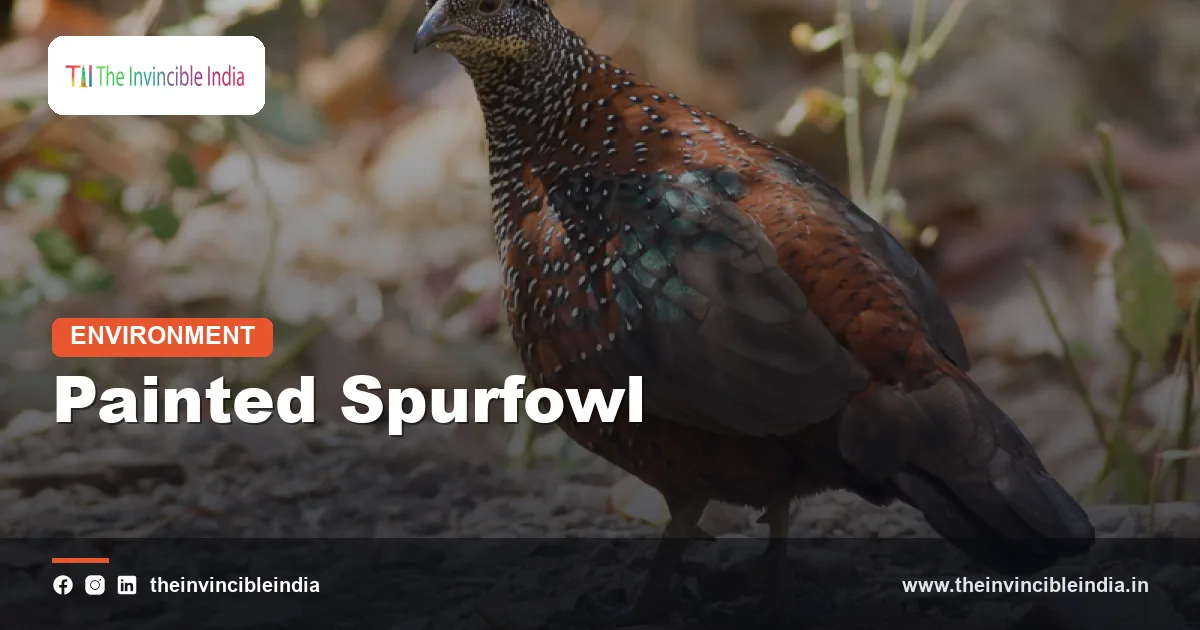
The painted spurfowl (Galloperdix lunulata) is a shy, ground-dwelling gamebird of the pheasant family, endemic to the rocky, scrub-covered hills of peninsular and central India, where the male is marked with white-ringed black spots and both sexes carry sharp, multiple leg spurs. Few people ever see the bird well, because it usually slips away into boulders and thorny cover on foot long before an observer gets close.
The painted spurfowl is one of three species in the spurfowl genus Galloperdix, all of which are confined to India and Sri Lanka. This explainer covers how to identify the painted spurfowl, where it lives, how it feeds and breeds, how it differs from the red spurfowl, and what threatens it.
Quick Facts
| Common name | Painted spurfowl |
|---|---|
| Scientific name | Galloperdix lunulata |
| Family and order | Phasianidae, order Galliformes |
| Indian names | No single widely used Hindi name; regional names vary across states |
| Size | About 32 cm long; male slightly larger than the female |
| Range and habitat | Endemic to India; rocky, scrub-covered hills, dry deciduous forest and bamboo patches of peninsular and central India |
| Diet | Seeds, berries, tubers, termites and other insects |
| Breeding season | Varies by region; a small clutch of about two to four eggs on the ground |
| Conservation status | Least Concern (IUCN); protected under Indian law |
Key Takeaways
- The painted spurfowl is a small gamebird of the pheasant family that is endemic to the rocky scrub hills of peninsular and central India.
- The male painted spurfowl has a black head streaked with white, a chestnut back and underparts spotted with white drops ringed in black, which give the species its name.
- Both sexes of the painted spurfowl carry two or more sharp spurs on each leg, a feature shared by all spurfowl and not seen in most partridges.
- The painted spurfowl prefers to run, climb over rocks and hide in boulders rather than fly, and it roosts in trees or on rock ledges at night.
- The painted spurfowl lays a small clutch of about two to four eggs in a ground scrape, which is fewer than most other Indian gamebirds.
- The painted spurfowl is listed as Least Concern by the IUCN, but loss of scrub hill habitat and hunting threaten its numbers locally.
What is the painted spurfowl?
The painted spurfowl is a ground-living bird in the family Phasianidae, the family of pheasants, partridges and junglefowl. Its genus Galloperdix contains only three living species: the painted spurfowl, the red spurfowl of India’s moist and dry forests, and the Sri Lankan spurfowl of Sri Lanka. The name “spurfowl” comes from the sharp bony spurs on the legs, which are present on both males and females in at least some of the species and are usually more than one per leg.
The species is smaller than a village hen, with a rounded body, a fairly long tail often carried half cocked, strong legs and a short, stout bill. It is a bird of rocks and thorn, and it moves across stony slopes with a speed and sureness that surprises first-time observers. It is secretive and wary, so most records come from sound or from a fleeting view as it crosses a track.
How do you identify a painted spurfowl?
The painted spurfowl is identified by the male’s dark head with white streaks, chestnut back and white-spotted underparts, and by the female’s plain chestnut-brown plumage with a dusky head. Both sexes also have a short, pointed tail and red or reddish legs with several spurs.
The male
- Blackish head and neck marked with fine white streaks.
- Rich chestnut upper back and wings.
- Underparts, flanks and breast marked with white drops edged in black, which look like painted tear-shaped spots.
- A pale or reddish bill and red legs with two or more spurs.
The female
The female painted spurfowl is a more uniform chestnut-brown, with fine scalloping and a darker head. Her plainness is useful camouflage, because she incubates eggs on the ground among dry leaves and stones. She also bears short spurs, though they are less developed than the male’s.
Similar species
The red spurfowl is the species most likely to be confused with the painted spurfowl. The male red spurfowl is a rich chestnut-red bird with a bright red face patch and no spotted body, while the painted spurfowl is boldly spotted. The two species overlap in some hill tracts, but red spurfowl prefers moister, denser forest and painted spurfowl prefers drier, rockier scrub.
Where does the painted spurfowl live in India?
The painted spurfowl lives in the rocky hills and dry scrub forest of peninsular and central India, and it is endemic to the country. Its distribution is patchy, because it depends on stony slopes and thorny cover, and it is absent from the Gangetic plain, the Himalaya and the north-east.
Its typical habitat is a hill covered in dry deciduous forest or scrub, with boulders, rock outcrops, dry stream beds and bamboo clumps. The bird shelters beneath thorny bushes and in rocky crevices during the heat of the day and comes out to feed in the morning and evening. It is often found in low hills in the Eastern Ghats, the Deccan and central Indian hills, and the scrub-covered ranges of states such as Karnataka, Tamil Nadu, Andhra Pradesh, Telangana, Maharashtra and Odisha. In the wetter forests of the Western Ghats, the red spurfowl is the more common spurfowl.
What does the painted spurfowl eat?
The painted spurfowl eats seeds, grain, berries, small tubers and roots, together with termites, ants, beetles and other insects. It feeds by scratching and digging in leaf litter and loose soil, using its strong feet and bill.
Termites are a particular favourite and are taken in large numbers whenever winged swarms emerge after rain. The bird visits dry stream beds and seepage spots to drink, and it will come to the edges of fields to pick up fallen grain. It forages in pairs or in small family parties, moving in a cautious, stop-and-go manner, and it will freeze or sprint for cover at the first sign of danger.
How does the painted spurfowl behave?
The painted spurfowl is a secretive bird that relies on running, rock-climbing and hiding to escape danger, and it flies only when pressed. When alarmed, it dashes across boulders with its tail raised, vanishes into a crevice or thicket, and may reappear some distance away. If forced to fly, it makes a short, noisy, whirring flight and glides down into the next patch of cover.
The bird roosts above the ground at night, usually in a tree, a tall bush or on a rock ledge, to keep clear of jackals, civets and snakes. In the morning it descends and feeds quietly. Its calls are loud and carry well: the male gives a series of rapid, cackling notes, often from a rock or low branch, and pairs may call back and forth. The call is one of the most useful ways to detect the bird, since sighting it directly requires luck and patience.
How does the painted spurfowl breed?
The painted spurfowl breeds by laying a small clutch, usually two to four eggs, in a shallow scrape on the ground among rocks, bushes or bamboo. The breeding season varies from region to region and is often tied to the drier months, when cover is open and food is predictable.
The female incubates the eggs, and the young are precocial, which means that they leave the nest soon after hatching and follow the adults. A pair may be seen leading chicks across stony ground, with the adults alert and the chicks well camouflaged. Because the clutch is small, losses to snakes, mongooses and dogs matter a great deal to the population. Nests are hard to find, and breeding details for the species remain less well documented than for common gamebirds.
How does the painted spurfowl compare with other spurfowl?
The painted spurfowl differs from the other two spurfowl in range, habitat and plumage, as the table below shows. All three are placed in the same genus because of their shared leg spurs and similar build.
| Species | Scientific name | Range | Habitat | Notable feature |
|---|---|---|---|---|
| Painted spurfowl | Galloperdix lunulata | Peninsular and central India | Dry rocky scrub and deciduous hills | Male with white-ringed spots |
| Red spurfowl | Galloperdix spadicea | Peninsular and central India | Scrub, bamboo and moist or dry forest | Chestnut-red male with red face patch |
| Sri Lankan spurfowl | Galloperdix bicalcarata | Sri Lanka only | Wet forest | Two spurs per leg, dark brown plumage |
This pattern of closely related ground birds occupying neighbouring habitats is a common feature of Indian gamebirds, and it shows how rock, scrub and forest types divide the available space among species.
What threatens the painted spurfowl?
The painted spurfowl is threatened by the loss and degradation of scrub hill habitat, hunting and trapping, and disturbance of nesting sites. The IUCN lists the species as Least Concern because its range is large and the bird tolerates dry, rugged country, but local declines are widely suspected.
- Habitat loss: Quarrying, mining, road building and conversion of rocky scrub to cultivation shrink suitable hill habitat.
- Hunting and snaring: The bird is hunted for food in some areas, even though it is legally protected under the Wildlife (Protection) Act, 1972.
- Fire and grazing: Repeated burning and heavy livestock grazing remove ground cover and nesting sites.
- Predators and dogs: Feral dogs and egg predators take a toll, especially because the clutch is small.
Because the painted spurfowl is so secretive, population counts are difficult, and many records come from call surveys. Better monitoring of dry scrub hills is therefore one of the practical needs for the species.
Why does the painted spurfowl matter?
The painted spurfowl matters because it is an endemic bird of dry rocky habitats that are often undervalued, and its presence points to scrub hills that are still reasonably intact. These areas support many other species, including bushquails, hares, lizards and raptors, and they protect soil on steep slopes.
The spurfowl also feeds on termites and other insects and acts as a food source for leopards, jackals, wild cats and snakes. For birdwatchers, hearing or glimpsing a painted spurfowl is a memorable experience, since it is among the less frequently seen gamebirds of India. Protecting dry scrub hills, which are often classed as wasteland, is therefore directly linked to protecting species like this one.
Wildlife photographers and field researchers often locate the painted spurfowl by sitting quietly near a waterhole or dry stream bed at first light, when pairs come out to drink and feed. Remote cameras placed on forest paths have also produced many of the best records of this elusive bird, and they show that it is more widespread in rugged scrub than casual sightings suggest.
Bottom Line
The painted spurfowl is a spotted, spurred and secretive gamebird of the dry rocky hills of peninsular and central India. It is not globally threatened, but it depends on scrub, boulders and quiet, and it can disappear where hills are quarried, burnt or heavily hunted.
Frequently Asked Questions
What is a painted spurfowl?
A painted spurfowl is a small, shy gamebird of the pheasant family, Galloperdix lunulata, endemic to the rocky scrub hills of peninsular and central India. The male has white-ringed black spots on a chestnut body, and both sexes have sharp leg spurs.
Why is it called a spurfowl?
It is called a spurfowl because of the sharp, bony spurs on its legs, with two or more on each leg in many individuals. Spurs are used in defence and in contests between birds, and they distinguish spurfowl from most partridges.
Where does the painted spurfowl live?
The painted spurfowl lives in dry, rocky and scrub-covered hills across peninsular and central India, including parts of the Eastern Ghats and the Deccan. It is absent from the Gangetic plain, the Himalaya and the north-east, and the red spurfowl replaces it in moister forests.
What does the painted spurfowl eat?
The painted spurfowl eats seeds, berries, tubers, termites and other insects. It scratches in leaf litter and loose soil to find food, and it also picks up fallen grain near field edges.
Can the painted spurfowl fly?
Yes, the painted spurfowl can fly, but it prefers to run and hide among rocks. When pressed, it takes off with a whirr of wings, flies a short distance and drops back into cover. At night it roosts in trees or on rock ledges.
Is the painted spurfowl endangered?
No, the painted spurfowl is not endangered, and the IUCN lists it as Least Concern. Even so, it is protected under the Wildlife (Protection) Act, 1972, and local populations can decline where scrub hills are quarried, burnt or hunted.
{“@context”:”https://schema.org”,”@graph”:[{“@type”:”FAQPage”,”mainEntity”:[{“@type”:”Question”,”name”:”What is a painted spurfowl?”,”acceptedAnswer”:{“@type”:”Answer”,”text”:”A painted spurfowl is a small, shy gamebird of the pheasant family, Galloperdix lunulata, endemic to the rocky scrub hills of peninsular and central India. The male has white-ringed black spots on a chestnut body, and both sexes have sharp leg spurs.”}},{“@type”:”Question”,”name”:”Why is it called a spurfowl?”,”acceptedAnswer”:{“@type”:”Answer”,”text”:”It is called a spurfowl because of the sharp, bony spurs on its legs, with two or more on each leg in many individuals. Spurs are used in defence and in contests between birds, and they distinguish spurfowl from most partridges.”}},{“@type”:”Question”,”name”:”Where does the painted spurfowl live?”,”acceptedAnswer”:{“@type”:”Answer”,”text”:”The painted spurfowl lives in dry, rocky and scrub-covered hills across peninsular and central India, including parts of the Eastern Ghats and the Deccan. It is absent from the Gangetic plain, the Himalaya and the north-east, and the red spurfowl replaces it in moister forests.”}},{“@type”:”Question”,”name”:”What does the painted spurfowl eat?”,”acceptedAnswer”:{“@type”:”Answer”,”text”:”The painted spurfowl eats seeds, berries, tubers, termites and other insects. It scratches in leaf litter and loose soil to find food, and it also picks up fallen grain near field edges.”}},{“@type”:”Question”,”name”:”Can the painted spurfowl fly?”,”acceptedAnswer”:{“@type”:”Answer”,”text”:”Yes, the painted spurfowl can fly, but it prefers to run and hide among rocks. When pressed, it takes off with a whirr of wings, flies a short distance and drops back into cover. At night it roosts in trees or on rock ledges.”}},{“@type”:”Question”,”name”:”Is the painted spurfowl endangered?”,”acceptedAnswer”:{“@type”:”Answer”,”text”:”No, the painted spurfowl is not endangered, and the IUCN lists it as Least Concern. Even so, it is protected under the Wildlife (Protection) Act, 1972, and local populations can decline where scrub hills are quarried, burnt or hunted.”}}]}]}


