

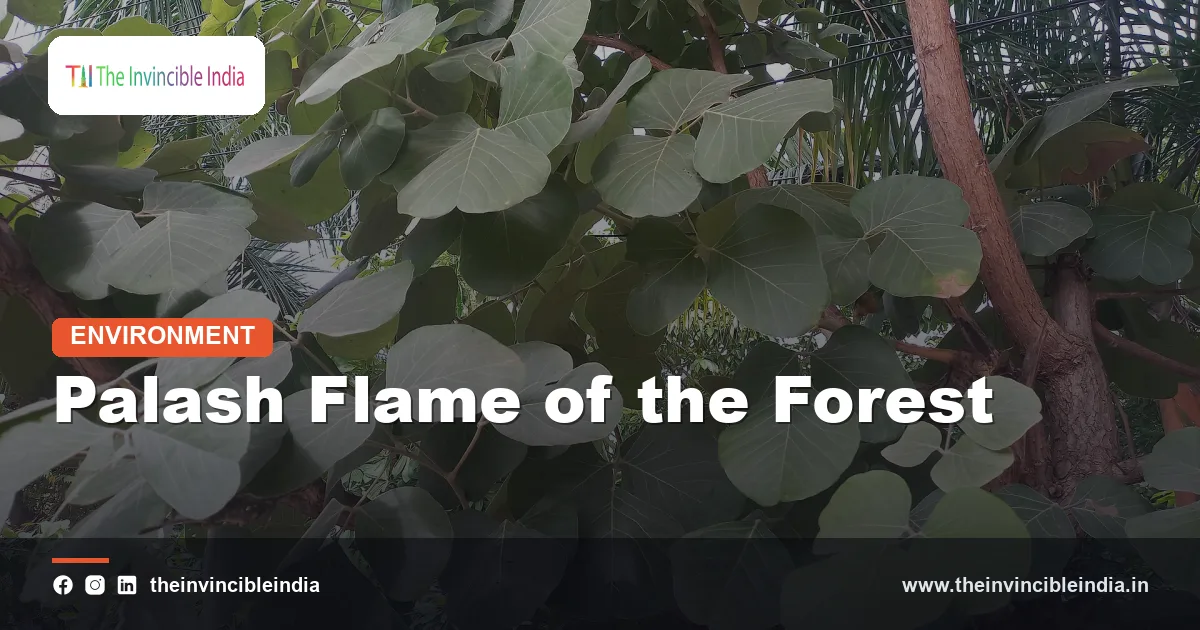
The palash (Butea monosperma), widely known as the flame of the forest, is a medium-sized deciduous tree of the Indian subcontinent that bursts into fiery orange-red flowers on bare branches in late winter and early spring. Its blossoms colour dry forests, roadsides and fields from January to April, and they have long been collected to make the natural dyes used at the festival of Holi.
The palash is also called dhak, tesu, kesu and kimshuka in different Indian languages, and it carries cultural, medicinal and economic importance far beyond its looks. Its leaves make traditional plates, its gum and fibre are used in crafts and trade, and the tree is a recognised host for the lac insect. This article explains the tree’s appearance, range, uses and cultural meaning.
Quick Facts
| Common name | Palash, flame of the forest, parrot tree, bastard teak |
|---|---|
| Scientific name | Butea monosperma |
| Family | Fabaceae (the legume or pea family) |
| Indian names | Palash, dhak, tesu, kesu (Hindi); palash (Bengali); palas (Marathi); moduga (Telugu); parasu (Tamil); kimshuka or palasha (Sanskrit) |
| Height and form | A deciduous tree, typically 8 to 15 m tall, with a crooked trunk and an irregular crown |
| Flowering season | Roughly January to April, on leafless branches; pods ripen in the following hot season |
| Native range | The Indian subcontinent and parts of Southeast Asia; common in dry deciduous forest |
| State flower | Official state flower of Uttar Pradesh and Jharkhand |
| Main uses | Holi dye, leaf plates, gum (Bengal kino), fibre, lac host, fuel and traditional medicine |
Key Takeaways
- The palash is a deciduous legume tree whose scientific name, Butea monosperma, refers to its one-seeded pods.
- The palash flowers on bare branches between roughly January and April, producing clusters of orange-red blooms with velvety black calyces.
- The palash is called dhak, tesu and kesu in Hindi and is the official state flower of Uttar Pradesh and Jharkhand.
- Palash flowers have been traditionally soaked and boiled to produce a yellow-orange dye used for Holi colours.
- The palash is one of the traditional host trees of the lac insect, and its leaves are stitched into plates and cups.
- The palash tolerates poor, dry, saline and waterlogged soils, which makes it a hardy tree for degraded land.
What is the palash tree?
The palash tree is a deciduous member of the legume family that is native to the Indian subcontinent and is best known for its brilliant orange-red spring flowers. Botanists place it in the genus Butea of the family Fabaceae, the same large family that includes peas, beans, tamarind and many other Indian trees.
The scientific name Butea monosperma has two parts. The genus name Butea honours John Stuart, the Earl of Bute, a patron of botany in eighteenth-century Britain. The species name monosperma means “one-seeded”, and describes the flat pod that holds a single seed.
The tree is sometimes called the “parrot tree” because the curved, beak-like shape of the flowers resembles a parrot’s bill, and sometimes the “bastard teak”, an old English name that is still seen in forestry books. It should not be confused with true teak, which is a very different tree in another family.
What does the palash tree look like?
The palash tree looks like a rugged, medium-sized tree with a twisted trunk, rough greyish bark and an open, irregular crown, and in the flowering season it appears covered in orange flames because the branches are leafless. Mature trees usually reach 8 to 15 metres in height, although individuals on poor soil may stay much smaller.
Leaves
The leaves of the palash are trifoliate, meaning each leaf is made up of three large leaflets on a long stalk. The leaflets are leathery, rounded or diamond-shaped, and the terminal one is the largest, often 10 to 20 centimetres long. Young leaves are silky and the older ones become rough. The tree sheds its leaves in winter and stays bare until after the flowering peak.
Flowers
The flowers grow in dense clusters, called racemes, near the ends of the bare branches. Each flower has a thick, velvety, dark grey or black calyx and five petals in the pea-flower pattern: a standard petal, two wings and a curved keel. The keel is strongly arched and pointed, like the beak of a parrot. The colour ranges from deep orange to scarlet, and rare forms bear yellow or even white flowers.
Fruit and seed
The fruit is a flat, papery, velvety pod, about 10 to 15 centimetres long, with a single flat seed near the tip. The pods turn from green to buff and ripen in the hot season, before the monsoon, and the seeds germinate readily with the first rains.
When does the palash flower?
The palash flowers from about January to April, depending on the region, and the peak usually comes in February and March when the tree is completely leafless. Because the flowers appear on bare branches, the tree is visible from far away, and whole hillsides and forest patches seem to glow orange in the dry season.
The timing of flowering matches the arrival of spring in the northern and central plains, so the palash has become a natural marker of the season. In the south and in humid regions the flowering may start a little earlier or later. A cooler winter followed by warm, dry days tends to bring a heavier bloom.
New leaves appear soon after flowering, from March or April, and the tree spends the rainy season in full green foliage. In the cool season the leaves turn yellowish and fall, and the cycle begins again.
Where does the palash grow in India?
The palash grows across most of India, especially in dry deciduous forests, open woodland, scrubland, grassy plains and along roadsides, from the plains up to moderate elevations. It is native to the Indian subcontinent and extends into other parts of South and Southeast Asia, including Nepal, Sri Lanka, Bangladesh and Myanmar.
The tree is notable for its hardiness. It tolerates:
- Dry spells and drought, because of its deep roots.
- Poor, stony or shallow soils.
- Saline and alkaline soils, where many other trees fail.
- Periods of waterlogging in low-lying areas.
- Fire and grazing, since young trees resprout vigorously.
In central India, parts of Jharkhand, Odisha, Chhattisgarh, Madhya Pradesh and the Gangetic plains, the palash is a conspicuous tree of the dry forests. It is a pioneer on degraded land, which has led foresters to consider it for restoring poor soils, although it is slow growing and rarely valued as timber.
Why is the palash called the flame of the forest?
The palash is called the flame of the forest because its massed orange-red flowers, opening on bare branches in the dry season, make the tree look like it is on fire against the pale landscape. The name also appears in English writing about South Asia and is shared with a few other flaming-flowered trees, such as the African tulip tree, which is called “flame of the forest” in some places.
In India the description carries a seasonal meaning. The first blooms of the palash announce spring, and poets and writers have long linked its colour to warmth, passion and the festival of colour. The tree has featured in classical Sanskrit literature, in regional poems and in folk songs, usually as a symbol of the arrival of the vasant (spring) season.
What is the palash used for?
The palash is used for natural dyes, plates and cups, gum, fibre, lac cultivation, fuel and traditional medicine, which makes it one of the most useful multipurpose trees of rural India. Almost every part of the tree has been used in some way for generations.
| Part of the tree | Traditional use |
|---|---|
| Flowers | Boiled to make yellow-orange dye for Holi and for colouring textiles; used in traditional remedies |
| Leaves | Stitched into plates (patal) and cups (dona) for food; used as fodder in some areas |
| Bark and sap | Red gum known as Bengal kino, used for tanning and in traditional medicine |
| Bark and roots | Fibre for ropes and caulking material |
| Seeds | Used in some traditional systems of medicine; should not be consumed without expert guidance |
| Branches and twigs | Host for lac insects; firewood and, in ritual use, sacred sticks |
| Wood | Fuel and rough, light construction; seldom used as quality timber |
Leaf plates remain popular in many villages and at community feasts, and they have the advantage of being fully biodegradable. The gum, known as Bengal kino, hardens into ruby-red lumps and has been used for tanning and in folk medicine. These traditional uses also support rural livelihoods, because collecting and processing palash products is a seasonal source of income for forest communities.
The medicinal claims for palash come from traditional Ayurvedic and folk practice. Readers should treat them as part of cultural knowledge rather than as proven medical advice, and should consult a qualified practitioner before using any part of the plant for treatment.
How is the palash linked to Holi?
The palash is linked to Holi because its flowers bloom just before the festival and were traditionally boiled in water to produce a bright, skin-safe yellow-orange dye. Holi falls in the month of Phalguna, in late winter or early spring, exactly when the palash is in peak bloom.
The flowers, known as tesu ke phool in many Hindi-speaking regions, were gathered, soaked overnight and boiled to extract the colour. The liquid was then used to splash friends and family. The dye was entirely plant-based, in contrast to the synthetic colours and chemical powders that have become common in recent decades and sometimes irritate skin and eyes.
In recent years there has been renewed interest in natural Holi colours made from palash, turmeric and other plants. Some self-help groups and forest communities now sell herbal colours made from palash flowers. The revival reflects the tree’s old role in the festival and growing concern about chemical dyes.
What is the palash’s cultural and religious significance?
The palash has a long cultural and religious significance in India, appearing in Vedic rituals, regional festivals, folk traditions and place names. In Sanskrit texts the tree is known as palasha or kimshuka and was used for sacrificial fires and ritual objects.
Several lasting associations stand out:
- Ritual use: palash wood and sticks have been used in traditional Hindu fire rituals, and a palash staff is mentioned in the sacred thread (upanayana) ceremony.
- State symbol: the flower is the state flower of Uttar Pradesh and Jharkhand.
- Place names: the town of Palashi in West Bengal, anglicised as Plassey and famous for the 1757 battle, is widely believed to be named after the palash trees that grew there.
- Literature and art: the tree appears in Sanskrit poetry, in Bengali and Hindi verse and in folk songs about spring.
Although its fiery colour is sometimes compared to a forest fire, the tree itself is regarded as benign and auspicious, and it is often left standing when other trees are cleared from fields and village edges.
How does the palash help lac production and wildlife?
The palash helps lac production by serving as one of the main host trees for the lac insect (Kerria lacca), which feeds on the sap of its young twigs and secretes the resin from which lac is made. Lac is used for shellac, sealing wax, bangles and traditional handicrafts, and it has been a forest-based industry in Jharkhand, Chhattisgarh, Madhya Pradesh and nearby states.
The tree also supports wildlife. Its flowers produce abundant nectar in the dry season, when little else is in bloom, and birds such as mynas, bulbuls, crows, sunbirds and parakeets visit the blossoms for the nectar. In doing so they carry pollen from tree to tree. Insects feed on the flowers, and the pods and seeds attract other animals.
Because it blooms when forests are dry and food is scarce, the palash plays a role as a seasonal food source, in much the same way as the mahua and the silk-cotton tree do.
How is the palash grown and cared for?
The palash is grown mostly from seed, which should be sown fresh at the start of the rains, and the tree needs sun, well-drained soil and little care once established. Seeds are usually soaked in water for a day before sowing, since the seed coat is hard.
Gardeners and foresters follow a few simple practices:
- Plant in full sun, as shade reduces flowering.
- Water young plants during the first dry seasons, then leave established trees alone.
- Avoid overwatering, which encourages leaf growth at the expense of flowers.
- Prune lightly after flowering if shape needs to be improved.
Young trees grow at a moderate pace and may take several years before they flower. The palash is not a good choice for small urban gardens because of its irregular shape, but it is a fine tree for large compounds, farm bunds, parks and waste land.
Bottom Line
The palash is a hardy, deciduous legume tree whose orange-red spring flowers have made it a symbol of the Indian dry season. It provides dye, leaf plates, gum and lac habitat, and it grows where many trees cannot. Its role in Holi, in state symbolism and in rural livelihoods ensures that it remains one of India’s best-loved native trees.
Frequently Asked Questions
What is the palash tree?
The palash tree, Butea monosperma, is a deciduous tree of the legume family that is native to the Indian subcontinent. It is famous for its orange-red flowers that bloom on bare branches in late winter and spring. It is also called dhak, tesu and the flame of the forest.
Why is the palash called the flame of the forest?
The palash is called the flame of the forest because its dense clusters of orange-red flowers cover the leafless branches in spring and make the tree look as if it is on fire. The effect is most striking in dry forests, where little else is in bloom.
When does the palash bloom in India?
The palash blooms from about January to April, with a peak in February and March. The tree is leafless at the time, and new leaves appear soon after the flowers fade.
What is the connection between palash and Holi?
Palash flowers bloom just before Holi and were traditionally boiled in water to make a natural yellow-orange dye for the festival. This plant-based colour, called tesu ke phool in many regions, is now being revived as an alternative to synthetic Holi powders.
Is the palash a state flower?
Yes, the palash is the official state flower of Uttar Pradesh and Jharkhand. It is also widely regarded as a cultural symbol of spring across large parts of northern and central India.
What are the uses of the palash tree?
The palash is used for natural dyes, leaf plates and cups, red gum known as Bengal kino, fibre and fuel, and it is a host tree for the lac insect. Parts of the tree are also used in traditional medicine, but these uses come from folk and Ayurvedic practice and should be approached with care.
{“@context”:”https://schema.org”,”@graph”:[{“@type”:”FAQPage”,”mainEntity”:[{“@type”:”Question”,”name”:”What is the palash tree?”,”acceptedAnswer”:{“@type”:”Answer”,”text”:”The palash tree, Butea monosperma, is a deciduous tree of the legume family that is native to the Indian subcontinent. It is famous for its orange-red flowers that bloom on bare branches in late winter and spring. It is also called dhak, tesu and the flame of the forest.”}},{“@type”:”Question”,”name”:”Why is the palash called the flame of the forest?”,”acceptedAnswer”:{“@type”:”Answer”,”text”:”The palash is called the flame of the forest because its dense clusters of orange-red flowers cover the leafless branches in spring and make the tree look as if it is on fire. The effect is most striking in dry forests, where little else is in bloom.”}},{“@type”:”Question”,”name”:”When does the palash bloom in India?”,”acceptedAnswer”:{“@type”:”Answer”,”text”:”The palash blooms from about January to April, with a peak in February and March. The tree is leafless at the time, and new leaves appear soon after the flowers fade.”}},{“@type”:”Question”,”name”:”What is the connection between palash and Holi?”,”acceptedAnswer”:{“@type”:”Answer”,”text”:”Palash flowers bloom just before Holi and were traditionally boiled in water to make a natural yellow-orange dye for the festival. This plant-based colour, called tesu ke phool in many regions, is now being revived as an alternative to synthetic Holi powders.”}},{“@type”:”Question”,”name”:”Is the palash a state flower?”,”acceptedAnswer”:{“@type”:”Answer”,”text”:”Yes, the palash is the official state flower of Uttar Pradesh and Jharkhand. It is also widely regarded as a cultural symbol of spring across large parts of northern and central India.”}},{“@type”:”Question”,”name”:”What are the uses of the palash tree?”,”acceptedAnswer”:{“@type”:”Answer”,”text”:”The palash is used for natural dyes, leaf plates and cups, red gum known as Bengal kino, fibre and fuel, and it is a host tree for the lac insect. Parts of the tree are also used in traditional medicine, but these uses come from folk and Ayurvedic practice and should be approached with care.”}}]}]}


