

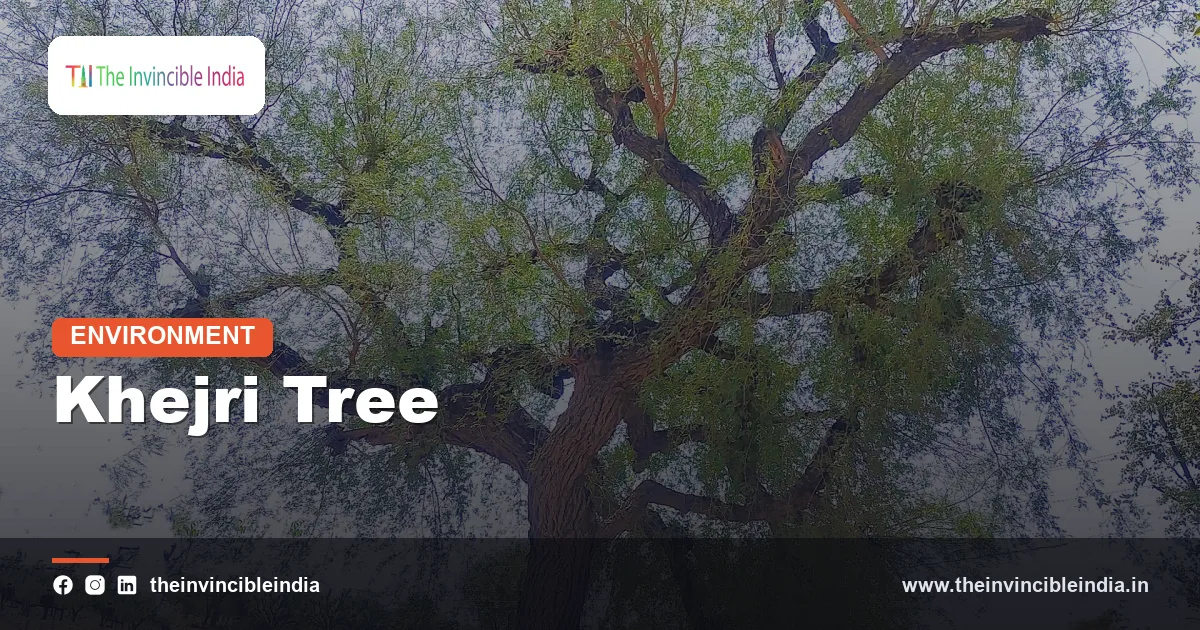
The khejri tree (Prosopis cineraria) is a hardy, deep-rooted, thorny desert tree of the pea family that grows across the dry plains of north-western India and is the official state tree of Rajasthan. It stays green through the hottest months, feeds goats, camels and cattle with its leaves, gives people the prized sangri pods and fixes nitrogen that keeps desert farmland fertile. Because so much of rural life in the Thar Desert depends on it, the khejri is often called the lifeline, or even the “kalpavriksha” (wish-fulfilling tree), of the desert.
The tree is also tied to one of the best-known acts of environmental sacrifice in Indian history, the 1730 Khejarli incident, in which villagers of the Bishnoi community gave their lives to stop khejri trees from being felled. This explainer covers what the khejri tree is, how it survives drought, what it is used for, its place in religion and conservation history, and the pressures it faces today.
Quick Facts
| Scientific name | Prosopis cineraria |
|---|---|
| Family | Fabaceae (legume or pea family) |
| Common Indian names | Khejri, khejra (Hindi and Rajasthani); shami (Sanskrit); jand (Punjabi and Haryanvi); kandi (Sindhi); vanni (Tamil); jammi (Telugu); banni (Kannada) |
| Typical height | About 5 to 12 metres, with a short trunk and a spreading, rounded crown |
| Native range | Arid and semi-arid parts of the Indian subcontinent, Iran and the Arabian Peninsula, where it is known as ghaf |
| Main uses | Fodder (leaf lopping), edible pods (sangri), fuelwood, small timber, shade and soil improvement |
| Official status | State tree of Rajasthan |
| Notable features | Very deep taproot, nitrogen fixation, retains green foliage in summer, central to the Bishnoi Khejarli story |
Key Takeaways
- The khejri tree (Prosopis cineraria) is the state tree of Rajasthan and a nitrogen-fixing member of the legume family that thrives in very dry regions.
- A khejri tree sends a very deep taproot down towards the water table, which lets it stay green when most other plants of the Thar Desert have dried out.
- The green, unripe pods of the khejri tree are called sangri and are an essential ingredient of the Rajasthani dish ker sangri.
- In 1730, in the village of Khejarli near Jodhpur, members of the Bishnoi community, led by Amrita Devi, died trying to protect khejri trees from being cut.
- Farmers in Rajasthan traditionally grow bajra (pearl millet) and other crops beneath khejri trees because the tree improves the soil beneath its crown.
- The khejri tree is revered as the shami tree in Hindu tradition, and its worship is part of Dussehra rituals in many regions.
What Is the Khejri Tree and Where Does It Grow?
The khejri tree is a medium-sized, drought-resistant tree, scientifically named Prosopis cineraria, that is native to the arid zones of western India, Pakistan, Iran and the Arabian Peninsula. In India it is most closely associated with Rajasthan, but it also grows naturally in Gujarat, Haryana, Punjab, western Uttar Pradesh and parts of Madhya Pradesh, Maharashtra, Karnataka and Tamil Nadu where conditions are dry enough.
The tree prefers sandy or loamy soils and low rainfall, and it is a characteristic feature of the Thar Desert landscape. Fields in Marwar, Shekhawati and Bikaner are often dotted with isolated khejri trees left standing among crops, a practice that reflects how valuable the tree is to farmers. In the Arabian Peninsula the same species is known as ghaf and is a national symbol of the United Arab Emirates, which shows how widely this one species has shaped desert cultures.
Botanically, the khejri belongs to the genus Prosopis in the family Fabaceae. This genus also includes the mesquite trees of the Americas and the invasive Prosopis juliflora, which was introduced to India and is a different species from the native khejri.
How Does the Khejri Tree Survive in the Desert?
The khejri tree survives in the desert mainly because of its extremely deep taproot, which reaches moisture far below the surface, together with small, waxy leaves that lose little water. Young seedlings invest most of their early growth in the root, so that the plant can reach deeper, cooler and wetter soil layers before the first harsh summer.
Several other adaptations help the khejri tree cope with heat, wind and scarce rain:
- Deep and wide roots: The taproot is accompanied by lateral roots that spread out to catch the occasional rain shower.
- Small compound leaves: Each leaf is divided into many tiny leaflets, which reduces water loss and heat load.
- Thorns: Small, scattered thorns on the branches discourage browsing animals from stripping the tree entirely.
- Nitrogen fixation: Like other legumes, the khejri works with root bacteria to convert atmospheric nitrogen into a form plants can use, which lets it grow in poor sandy soil.
- Tolerance of heat: The tree continues to grow during very high summer temperatures that would kill many other species.
These traits explain why the khejri is among the few trees that can be relied on to stay green in May and June, when grazing land has often turned brown.
What Does the Khejri Tree Look Like?
The khejri tree has a short, often crooked trunk, a dense rounded crown, greyish rough bark and feathery, finely divided leaves that give a light, lacy shade. Mature trees usually stand between about five and twelve metres tall, though stunted specimens are common in the driest zones.
Leaves, flowers and pods
The leaves are bipinnate, meaning that small leaflets are arranged along side branches of the main leaf stalk. The flowers are small, pale yellow or cream and arranged in slender spikes that appear in the spring months. After flowering, the tree produces long, slender, cylindrical pods. When these are young and green they are harvested as sangri. When they ripen they turn pale brown and contain a sweetish, dry pulp around the seeds that animals eat readily.
The annual cycle
The khejri is nearly evergreen in its natural habitat. New leaves tend to appear around the end of winter, flowering follows in spring, and pods develop in the early summer months. Because fresh foliage and pods are available when other fodder is scarce, the tree matters most precisely in the season when pastoralists need it most.
Why Is the Khejri Called the Lifeline of the Thar Desert?
The khejri tree is called the lifeline of the Thar Desert because it supplies food, animal fodder, fuel and shade, and it also improves the soil, all from a single tree that needs almost no care. Few other species in the region deliver so many benefits at the same time, which is why farmers deliberately protect it.
The main uses of the khejri tree include the following:
- Fodder (loong): The leaves, locally called loong, are lopped and fed to goats, sheep, camels and cattle. Lopping is a traditional skill, and the tree normally recovers if the cutting is moderate.
- Food (sangri): The tender pods are dried and cooked as a vegetable and form part of the traditional Rajasthani diet.
- Fuelwood: Dry branches and pruned twigs provide firewood, which is scarce in the desert.
- Small timber: The wood is hard and is used for agricultural implements, house posts and fences.
- Shade and shelter: A khejri tree offers one of the few patches of shade for people and animals during the hot season.
- Soil improvement: Leaf fall and nitrogen fixation enrich the soil under the crown.
In many villages the khejri is part of a traditional agroforestry system. Crops such as bajra, moth bean, guar and mung are grown in the shade zone beneath scattered trees, and farmers often report that yields near the tree are better than in open sand. This mixed use of land and trees has been practised for centuries.
What Is Sangri and How Is It Used?
Sangri is the name given to the young, tender pods of the khejri tree, which are harvested green, boiled and sun-dried and then used as a vegetable in Rajasthani cooking. The best-known dish is ker sangri, in which dried sangri pods are cooked with ker, the small berries of the caper-like desert shrub Capparis decidua.
The pods are picked in the early summer, typically from April to June. After a quick boil they are spread out in the sun until they dry hard, which allows them to be stored for months. Before cooking, the dried pods are soaked and cooked slowly with spices, curd or dried mango powder, and the dish is traditionally eaten with bajra roti or in festive thalis.
Sangri has become a recognised regional food, sold in markets in Jaipur, Jodhpur and beyond, and is also valued as a source of dietary fibre and protein in an arid zone where fresh vegetables are hard to grow. Dried sangri is an example of how desert communities designed a food system around what the landscape reliably provides.
What Was the Khejarli Sacrifice of the Bishnoi?
The Khejarli sacrifice was an event in 1730 in which a large group of Bishnoi villagers, led by a woman named Amrita Devi, died while trying to prevent soldiers of the Jodhpur ruler from cutting khejri trees in the village of Khejarli. It is widely regarded as one of the earliest recorded acts of organised tree protection in India, and it is commemorated each year.
Background: the Bishnoi community
The Bishnoi are a community of Rajasthan and neighbouring states who follow the teachings of Guru Jambheshwar, also called Jambhoji, who founded the sect in the late fifteenth century. The name is commonly explained as derived from the numbers twenty and nine, referring to the twenty-nine principles that the community follows. These include protecting green trees and showing compassion to animals. Bishnoi villages are known for the fearless presence of blackbuck and chinkara near homes.
What happened at Khejarli
According to the account handed down by the community, the Maharaja of Marwar, Abhay Singh, needed a great quantity of wood for a new building project and sent men to cut khejri trees at Khejarli, a village near Jodhpur. Amrita Devi is said to have embraced a tree to stop the cutting, and when she was killed her daughters and then many other villagers did the same. The number of martyrs is traditionally given as 363. When news reached the ruler, the cutting was stopped, and a ban on felling trees and hunting animals in Bishnoi villages was reportedly put in place.
A popular saying linked to the event, in rough translation, holds that if a tree is saved at the cost of a head, the price is still cheap. Historians note that details differ between oral and written accounts, but the core story of villagers dying to protect khejri trees is central to Bishnoi identity and to Indian environmental history.
Legacy
The Khejarli story is often cited as an inspiration for later tree-protection movements, including the Chipko movement of the 1970s in the Himalaya, in which villagers hugged trees to stop felling. A memorial exists at Khejarli, an annual gathering is held there around the Bhadrapad month (usually September), and the Government of India has named a national wildlife conservation award in honour of Amrita Devi Bishnoi.
Why Is the Khejri Tree Important in Culture and Religion?
The khejri tree is important in Hindu tradition because it is identified with the shami tree, which is worshipped around Dussehra and is mentioned in the Mahabharata. According to the epic, the Pandavas hid their weapons in a shami tree before beginning their final year of exile in disguise, and retrieved them from it afterwards.
On Dussehra many communities perform shami puja, offering prayers to the tree and exchanging its leaves as a symbol of victory and good fortune. In some regions the leaves are exchanged as a symbolic “gold”. The wood of the shami has also traditionally been used in fire rituals, since the tree is associated with the fire element in ancient texts.
Beyond formal religion, the khejri features in folk songs, proverbs and village traditions of Rajasthan. Many households avoid cutting a healthy khejri tree, and in Bishnoi villages the tree is treated as sacred. The khejri was declared the state tree of Rajasthan in 1983, which formally recognised what rural communities had long practised.
How Does the Khejri Compare With Other Desert Trees?
The khejri differs from other common dryland trees of India in being native, deep-rooted, non-invasive and highly useful for fodder and food. The table below compares it with four trees that people often confuse with it or plant alongside it.
| Tree | Scientific name | Origin | Key points |
|---|---|---|---|
| Khejri | Prosopis cineraria | Native to India | State tree of Rajasthan; sangri pods; leaf fodder; deep taproot |
| Vilayati babul | Prosopis juliflora | Introduced from tropical America | Spreads aggressively in dry land; considered invasive in many areas |
| Babul | Vachellia nilotica | Native to India and Africa | Long white thorns; tannin-rich bark and pods; useful timber and gum |
| Rohida | Tecomella undulata | Native to India | Orange-yellow flowers; state flower of Rajasthan; valued timber |
| Ber | Ziziphus mauritiana | Native to India | Edible fruit; thorny; fodder from leaves |
The confusion with Prosopis juliflora is common, because both belong to the same genus and are sometimes both called “babul” in everyday speech. Ecologists point out that the native khejri is beneficial in desert farms, whereas the introduced juliflora has spread widely and often crowds out native vegetation.
Is the Khejri Tree Under Threat?
Yes, the khejri tree faces pressure in many parts of Rajasthan from excessive lopping, falling groundwater levels, land-use change, disease and clearing for roads, mining and farm expansion. Although the khejri is protected by tradition and by state rules that restrict felling, the number of mature trees has been reported to decline in some districts.
Researchers and foresters have identified several issues:
- Overlopping: Heavy and repeated cutting of branches for fodder during drought years can exhaust a tree.
- Dying-back and pests: Fungal infections and insect attacks have been reported to weaken or kill khejri trees in some areas.
- Groundwater decline: A fall in the water table can leave even a deep taproot without reach.
- Land clearing: Expansion of irrigated farming, industry and infrastructure removes the old scattered trees.
- Poor regeneration: Free grazing of seedlings and pods can leave few young trees to replace old ones.
Conservation efforts include nursery raising of seedlings, community protection of trees, and awareness campaigns that draw on the Khejarli story. Planting native khejri rather than invasive species is encouraged by many agricultural and forestry institutions in arid regions.
How Is the Khejri Tree Grown and Conserved?
The khejri tree is grown mainly from seed, which is sown in nurseries or directly in the field, and it needs very little care once its roots reach deeper soil. Seeds have a hard coat, so they are usually treated, for example by soaking in water or scarifying, to speed up germination before sowing.
Young khejri plants grow slowly above ground during the first years because the root is developing first. Protection from grazing, a little watering in the first summer, and sowing at the start of the monsoon improve survival. Once established, the tree can live for many decades, and old specimens in villages are often several generations old.
Good practice for keeping khejri trees healthy includes moderate, rotational lopping rather than stripping the whole crown, retaining mature trees in fields, and replanting where trees have been lost. In this way, a living tree continues to yield fodder and pods without being damaged.
Bottom Line
The khejri tree is the native desert tree that sustains life in the Thar, giving food, fodder, soil fertility and shade from a single deep-rooted plant. Its story, from the shami worship of Dussehra to the Bishnoi martyrs of Khejarli, shows how a tree can become both an ecological backbone and a cultural symbol, and why protecting the species still matters in arid India.
Frequently Asked Questions
What is the khejri tree known for?
The khejri tree is known for being the state tree of Rajasthan and a deep-rooted, drought-resistant desert tree. It provides sangri pods for food, leaves for animal fodder, shade and soil enrichment. It is also linked to the Bishnoi Khejarli sacrifice of 1730.
What is the scientific name of the khejri tree?
The scientific name of the khejri tree is Prosopis cineraria. It belongs to the legume family, Fabaceae. In Sanskrit it is called shami, and in the Arabian Peninsula it is known as ghaf.
What is sangri and is it made from the khejri tree?
Yes, sangri is made from the tender green pods of the khejri tree. The pods are boiled, sun-dried and later cooked as a vegetable, most famously in the Rajasthani dish ker sangri. Drying allows the pods to be stored for months in a region where fresh vegetables are scarce.
Why did the Bishnoi people sacrifice their lives for khejri trees?
The Bishnoi died at Khejarli in 1730 because their faith requires them to protect green trees and animals. When the ruler’s men came to cut khejri trees, Amrita Devi and many villagers embraced the trees to stop the felling, and the number of martyrs is traditionally given as 363. The event is remembered as an early act of environmental protection in India.
Is the khejri tree the same as the shami tree?
Yes, the shami tree of Hindu tradition is identified with the khejri tree, Prosopis cineraria. It is worshipped around Dussehra and is mentioned in the Mahabharata as the tree in which the Pandavas hid their weapons. Its leaves are exchanged as a sign of good fortune in many regions.
Is the khejri tree the same as vilayati babul?
No, the khejri tree is a different species from vilayati babul, which is Prosopis juliflora. The khejri is native to India and highly useful, while vilayati babul was introduced from tropical America and is considered invasive in many dry areas. Both belong to the same genus, which is the source of the confusion.
{“@context”:”https://schema.org”,”@graph”:[{“@type”:”FAQPage”,”mainEntity”:[{“@type”:”Question”,”name”:”What is the khejri tree known for?”,”acceptedAnswer”:{“@type”:”Answer”,”text”:”The khejri tree is known for being the state tree of Rajasthan and a deep-rooted, drought-resistant desert tree. It provides sangri pods for food, leaves for animal fodder, shade and soil enrichment. It is also linked to the Bishnoi Khejarli sacrifice of 1730.”}},{“@type”:”Question”,”name”:”What is the scientific name of the khejri tree?”,”acceptedAnswer”:{“@type”:”Answer”,”text”:”The scientific name of the khejri tree is Prosopis cineraria. It belongs to the legume family, Fabaceae. In Sanskrit it is called shami, and in the Arabian Peninsula it is known as ghaf.”}},{“@type”:”Question”,”name”:”What is sangri and is it made from the khejri tree?”,”acceptedAnswer”:{“@type”:”Answer”,”text”:”Yes, sangri is made from the tender green pods of the khejri tree. The pods are boiled, sun-dried and later cooked as a vegetable, most famously in the Rajasthani dish ker sangri. Drying allows the pods to be stored for months in a region where fresh vegetables are scarce.”}},{“@type”:”Question”,”name”:”Why did the Bishnoi people sacrifice their lives for khejri trees?”,”acceptedAnswer”:{“@type”:”Answer”,”text”:”The Bishnoi died at Khejarli in 1730 because their faith requires them to protect green trees and animals. When the ruler’s men came to cut khejri trees, Amrita Devi and many villagers embraced the trees to stop the felling, and the number of martyrs is traditionally given as 363. The event is remembered as an early act of environmental protection in India.”}},{“@type”:”Question”,”name”:”Is the khejri tree the same as the shami tree?”,”acceptedAnswer”:{“@type”:”Answer”,”text”:”Yes, the shami tree of Hindu tradition is identified with the khejri tree, Prosopis cineraria. It is worshipped around Dussehra and is mentioned in the Mahabharata as the tree in which the Pandavas hid their weapons. Its leaves are exchanged as a sign of good fortune in many regions.”}},{“@type”:”Question”,”name”:”Is the khejri tree the same as vilayati babul?”,”acceptedAnswer”:{“@type”:”Answer”,”text”:”No, the khejri tree is a different species from vilayati babul, which is Prosopis juliflora. The khejri is native to India and highly useful, while vilayati babul was introduced from tropical America and is considered invasive in many dry areas. Both belong to the same genus, which is the source of the confusion.”}}]}]}


