

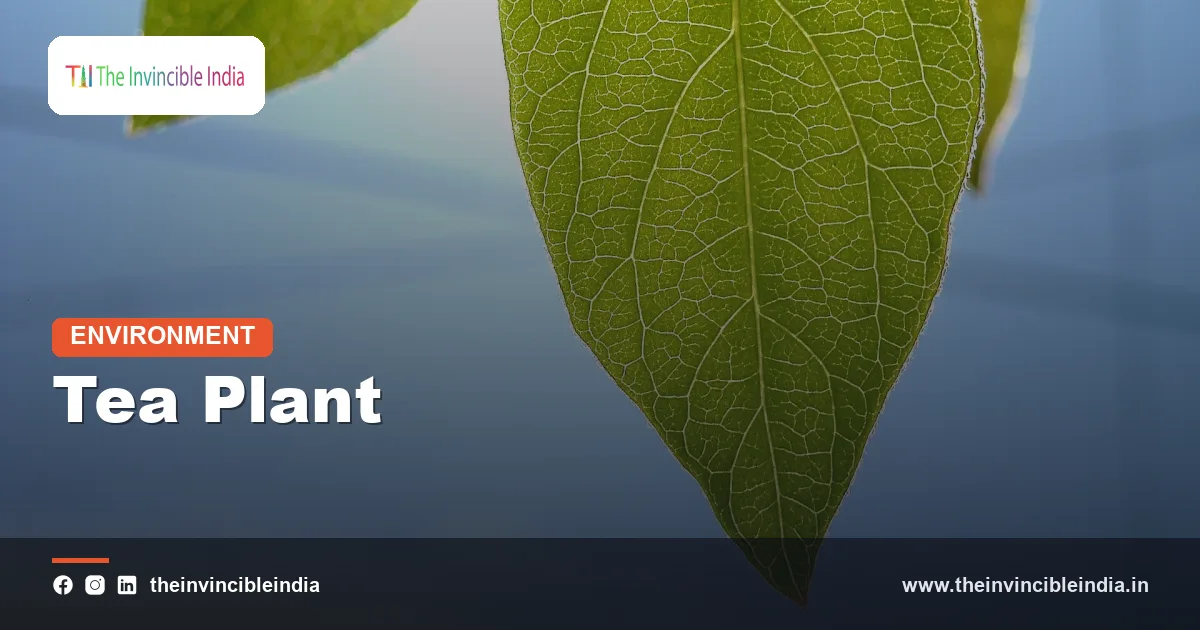
The tea plant (Camellia sinensis) is an evergreen shrub of the Theaceae family whose young leaves and leaf buds are plucked, processed and brewed to make tea, one of the most widely drunk beverages in India. In India the tea plant is grown on organised estates in Assam, West Bengal’s Darjeeling and Dooars regions, the Nilgiris and Kerala, and a few other hill districts, and it is the single plant behind black, green, white and oolong tea.
The same species gives very different teas depending on the variety, soil, altitude, season of plucking and method of processing. This article explains how the tea plant grows, how it is harvested, how its leaves become the tea sold in shops, and why Assam and Darjeeling became world-famous names.
| Quick Facts | Details |
|---|---|
| Scientific name | Camellia sinensis (varieties sinensis and assamica) |
| Family | Theaceae (the camellia family) |
| Origin | The region spanning southwestern China, northern Myanmar and north-eastern India; wild Assam-type tea has long been known in the Brahmaputra valley |
| Where grown in India | Assam, Darjeeling and Dooars (West Bengal), Nilgiris (Tamil Nadu), Munnar and Wayanad (Kerala), Kangra (Himachal Pradesh), Tripura and other north-eastern states |
| Part used | Young terminal shoots, usually two leaves and a bud |
| Season and cycle | Perennial bush plucked in repeated rounds; main seasonal flushes in spring, early summer, monsoon and autumn in north India, with a longer picking year in the south |
| Main products | Black tea (CTC and orthodox), green tea, white tea, oolong tea and speciality teas |
| Notable facts | Darjeeling tea was among the first Indian products to receive a Geographical Indication (GI) tag; the Tea Board of India, headquartered in Kolkata, regulates the industry |
Key Takeaways
- The tea plant is Camellia sinensis, a single species that yields black, green, white and oolong tea depending on how the harvested leaves are processed.
- Assam-type tea plants (variety assamica) have large leaves and thrive in the warm Brahmaputra valley, while China-type plants (variety sinensis) have smaller leaves and suit the cooler Darjeeling hills.
- Tea pluckers in India traditionally pick “two leaves and a bud”, the tender tip of each shoot, because this part gives the best flavour.
- Commercial tea cultivation in Assam began in the 1830s after British officials documented wild tea plants growing in the region, and the Assam Company was formed in 1839.
- The Tea Board of India, set up under the Tea Act of 1953 and based in Kolkata, regulates and promotes tea production, quality and export.
- Darjeeling tea, grown in the hills of West Bengal, received a Geographical Indication tag in the early 2000s, protecting the name for tea grown in the demarcated area.
What Is the Tea Plant?
The tea plant is a perennial evergreen shrub, Camellia sinensis, that grows wild as a small tree but is pruned to a waist-high, flat-topped bush on plantations to make plucking easy. Its glossy, serrated leaves contain caffeine, polyphenols and aromatic compounds that give tea its taste and its mild stimulating effect.
Left alone, the plant can grow into a tree of several metres, particularly in the Assam type. On estates, however, workers prune it regularly so that it forms a dense, level “plucking table” of fresh shoots. A well-managed bush can stay productive for several decades, and some old estate bushes in Assam and Darjeeling are well over a century old.
The plant belongs to the same genus as the ornamental camellia, and it bears small, fragrant white flowers with yellow centres. Estates usually do not let many bushes flower or set seed heavily, because that diverts energy from leaf production, although seed bushes are kept in some places for propagation.
Where Does the Tea Plant Come From?
The tea plant is believed to have originated in the broad region where southwestern China, northern Myanmar and north-eastern India meet, and it has been used as a drink and medicine in China for many centuries. Wild tea of the Assam type was known to local communities such as the Singpho long before commercial planting began in India.
Two major varieties are recognised. China-type tea (Camellia sinensis var. sinensis) has small leaves and tolerates cold, and it spread outward from China. Assam-type tea (Camellia sinensis var. assamica) has larger leaves, suits hot and humid lowlands, and is native to the Assam-Myanmar region. Many Indian bushes are hybrids between the two, often called Cambod or hybrid types.
How Did Tea Cultivation Begin in India?
Commercial tea cultivation began in India in the 1830s, when British administrators in Assam, after Robert Bruce reported indigenous tea plants in the 1820s, set up experimental gardens and the first Assam tea was shipped to London in 1838 and sold there in 1839. The Assam Company, formed in the same year, became one of the first joint-stock tea companies in India.
Local knowledge played an important role. The Singpho people already drank tea from wild plants, and Maniram Dewan, an Assamese nobleman, assisted early planters before later becoming a figure in the 1857 uprising. In the 1840s and 1850s, planters began tea estates in the Darjeeling hills using seed of the China type, and the Nilgiris, Dooars, Terai and Kerala highlands followed in the later nineteenth century.
By the late nineteenth century, India had become a major tea-producing country, and the industry shaped the economy, migration and landscape of regions such as the Brahmaputra valley and north Bengal. The labour system, which brought workers from other parts of India to the estates, left a lasting social legacy that is still discussed in studies of plantation history.
Where Is the Tea Plant Grown in India?
The tea plant is grown in India mainly in the north-east (Assam and neighbouring states), north Bengal (Darjeeling, Terai and Dooars), and the southern hills (Nilgiris and Kerala), with smaller areas in Himachal Pradesh and elsewhere. India is among the world’s largest tea producers, and Assam is the biggest tea-growing state by area and output.
| Region | Typical tea type | Character of the cup |
|---|---|---|
| Assam (Brahmaputra valley) | Assam-type, mostly black CTC and orthodox | Strong, malty, full-bodied and dark liquor |
| Darjeeling (West Bengal hills) | China-type and hybrids, mostly orthodox | Light, aromatic and muscatel-like, often called the “champagne of teas” |
| Dooars and Terai (West Bengal plains) | Mostly CTC black tea | Strong and bright, widely used in blends |
| Nilgiris (Tamil Nadu) | Black tea, some orthodox | Brisk, fragrant and medium-bodied |
| Kerala (Munnar, Wayanad, Peermade) | Mostly black CTC | Strong and coloury, used in blends |
| Kangra (Himachal Pradesh) | Black and green tea | Delicate with a mild aroma |
What Climate and Soil Does the Tea Plant Need?
The tea plant needs a warm, humid climate with well-distributed rainfall, acidic well-drained soil and some shade or mist, and it generally does best on gentle slopes where water does not stand around its roots. The soil is typically acidic, with a pH roughly between 4.5 and 5.5, which suits the camellia family.
- Rainfall: Tea bushes need abundant, well-spread rain, and areas with a long dry spell rely on irrigation or accept lower yields.
- Temperature: Moderate warmth is ideal, and growth slows or stops in cold winters, especially at higher altitudes such as Darjeeling’s hills.
- Altitude: Estates range from near sea level in the Assam plains to well over a thousand metres in Darjeeling and the Nilgiris, and slow growth at altitude contributes to finer flavour.
- Shade: Many Assam and Dooars estates plant tall shade trees, such as Albizia species, to protect bushes from harsh midday sun.
- Drainage: Hill slopes allow water to drain, whereas waterlogged soil damages the roots and encourages disease.
How Is the Tea Plant Plucked?
The tea plant is plucked by hand or machine by removing the terminal bud and the two youngest leaves, a standard known as “two leaves and a bud”, at intervals of about a week to ten days during the growing season. This tender tip contains the most flavour compounds and produces the best tea.
Plucking is skilled work, mostly done by women pluckers who carry baskets on their backs and work through the rows of bushes. If plucking is too coarse and includes older leaves, the tea becomes harsher. If it is too fine, yield drops. Estate managers therefore set standards and monitor them closely.
What are the tea flushes?
A flush is a period of rapid new growth after a rest or pruning, and tea from each flush has a recognisable character. In Darjeeling, the first flush appears in spring, usually around March and April, and gives pale, floral tea. The second flush, around May and June, gives a fuller, muscatel-like cup. The monsoon flush gives stronger but less delicate leaf, and the autumn flush produces a mellow, coppery cup.
How Is Tea Made From the Plant?
Tea is made from the tea plant by withering the plucked leaf, shaping it, allowing controlled oxidation (often called fermentation), and then drying it to stop the process. The main steps are the same for most teas, but the amount of oxidation decides whether the end product is green, oolong or black tea.
- Withering: Fresh leaves are spread on troughs or trays so that they lose moisture and become soft.
- Rolling or CTC cutting: In orthodox tea, rollers twist the leaf and release its juices. In CTC (crush, tear, curl) manufacture, the leaf passes through toothed rollers that produce small hard granules.
- Oxidation: Enzymes in the bruised leaf react with air and turn it coppery brown, which builds colour and flavour in black tea.
- Drying: Hot air stops oxidation and reduces moisture so that the tea can be stored.
- Sorting and grading: The dried tea is sifted into grades, such as whole leaf, broken leaf, fannings and dust, and then packed for auction or sale.
What Is the Difference Between Black, Green, White and Oolong Tea?
The difference between these teas lies in how much the leaf is oxidised after plucking, not in the plant itself. Black tea is fully oxidised, green tea is heated early to prevent oxidation, white tea is lightly processed from young buds, and oolong tea is partly oxidised.
India produces mostly black tea, with CTC accounting for a large share of output because it brews strongly and quickly, which suits the Indian habit of boiled milk tea. Orthodox teas, especially from Darjeeling and the Nilgiris, are more often sold as premium loose-leaf teas. Green tea, white tea and oolong are produced in smaller quantities but have grown in popularity.
Who Regulates Tea in India?
The Tea Board of India regulates tea in India. It is a statutory body under the Ministry of Commerce and Industry, established under the Tea Act of 1953 and headquartered in Kolkata. The Board supports research, quality control, marketing, export promotion and the welfare of workers.
Tea is sold through public auctions at centres such as Kolkata, Guwahati, Siliguri, Coonoor and Kochi, as well as through private sales. Research institutions such as the Tea Research Association in Jorhat, the Darjeeling Tea Research and Management Association, and the UPASI Tea Research Foundation in the south help growers manage pests, plant improvement and sustainable practice.
Darjeeling tea was among the earliest Indian products to receive a Geographical Indication tag, and it is protected by a logo and certification mark that identify tea grown and processed in the designated hill area. Assam tea and Nilgiri tea have also been registered as geographical indications.
What Problems Do Tea Plants Face?
Tea plants face pests, diseases, weather swings and ageing bushes. The tea mosquito bug (Helopeltis), red spider mite and thrips damage young shoots, while blister blight can hit hill estates in cool, wet weather. Many plantations are also dealing with old bushes that give declining yield and need replanting.
Climate variation affects tea directly, since changes in rainfall pattern, temperature and drought influence flush timing and quality. Growers therefore invest in irrigation, shade management, integrated pest control and replanting with improved clones. Concerns about pesticide residues have also pushed the industry toward stricter food-safety standards and organic or sustainable certification.
Bottom Line
The tea plant, Camellia sinensis, is a hardy evergreen shrub whose tender shoots become the black, green and speciality teas that India grows and drinks in huge quantities. Assam’s malty teas, Darjeeling’s delicate cups and the brisk teas of the Nilgiris all come from this single species, shaped by climate, altitude and craft.
Frequently Asked Questions
What is the tea plant called scientifically?
The tea plant is called Camellia sinensis, and it belongs to the Theaceae family. Two main varieties are grown: China-type (sinensis) and Assam-type (assamica). Black, green, white and oolong tea all come from this one species.
Do black tea and green tea come from the same plant?
Yes, black tea and green tea both come from the leaves of Camellia sinensis. The difference lies in processing: black tea leaves are fully oxidised, while green tea leaves are heated early to stop oxidation. Climate and plant variety also affect the flavour of each.
Where is tea grown in India?
Tea is grown in India mainly in Assam, West Bengal (Darjeeling, Terai and Dooars), Tamil Nadu (the Nilgiris) and Kerala, with smaller areas in Himachal Pradesh and the north-eastern states. Assam is the largest tea-producing state. India is among the world’s major tea-producing countries.
What does two leaves and a bud mean in tea plucking?
Two leaves and a bud means plucking the unopened terminal bud and the two youngest leaves of each shoot. This tender tip holds the most flavour compounds and gives the best quality tea. Pluckers return to the same bushes every week or two during the growing season.
Why is Darjeeling tea so famous?
Darjeeling tea is famous for its light, aromatic, muscatel-like flavour, which comes from China-type bushes grown on cool, misty Himalayan slopes. It received a Geographical Indication tag, which protects the name for tea grown in the designated hill area. First-flush Darjeeling, plucked in spring, is especially prized.
How long does a tea plant live?
A tea plant can live and remain productive for several decades, and some estate bushes in India are over a hundred years old. Yield usually declines as bushes age, so growers eventually uproot and replant with improved clones. Regular pruning keeps the bush at plucking height.
{“@context”:”https://schema.org”,”@graph”:[{“@type”:”FAQPage”,”mainEntity”:[{“@type”:”Question”,”name”:”What is the tea plant called scientifically?”,”acceptedAnswer”:{“@type”:”Answer”,”text”:”The tea plant is called Camellia sinensis, and it belongs to the Theaceae family. Two main varieties are grown: China-type (sinensis) and Assam-type (assamica). Black, green, white and oolong tea all come from this one species.”}},{“@type”:”Question”,”name”:”Do black tea and green tea come from the same plant?”,”acceptedAnswer”:{“@type”:”Answer”,”text”:”Yes, black tea and green tea both come from the leaves of Camellia sinensis. The difference lies in processing: black tea leaves are fully oxidised, while green tea leaves are heated early to stop oxidation. Climate and plant variety also affect the flavour of each.”}},{“@type”:”Question”,”name”:”Where is tea grown in India?”,”acceptedAnswer”:{“@type”:”Answer”,”text”:”Tea is grown in India mainly in Assam, West Bengal (Darjeeling, Terai and Dooars), Tamil Nadu (the Nilgiris) and Kerala, with smaller areas in Himachal Pradesh and the north-eastern states. Assam is the largest tea-producing state. India is among the world’s major tea-producing countries.”}},{“@type”:”Question”,”name”:”What does two leaves and a bud mean in tea plucking?”,”acceptedAnswer”:{“@type”:”Answer”,”text”:”Two leaves and a bud means plucking the unopened terminal bud and the two youngest leaves of each shoot. This tender tip holds the most flavour compounds and gives the best quality tea. Pluckers return to the same bushes every week or two during the growing season.”}},{“@type”:”Question”,”name”:”Why is Darjeeling tea so famous?”,”acceptedAnswer”:{“@type”:”Answer”,”text”:”Darjeeling tea is famous for its light, aromatic, muscatel-like flavour, which comes from China-type bushes grown on cool, misty Himalayan slopes. It received a Geographical Indication tag, which protects the name for tea grown in the designated hill area. First-flush Darjeeling, plucked in spring, is especially prized.”}},{“@type”:”Question”,”name”:”How long does a tea plant live?”,”acceptedAnswer”:{“@type”:”Answer”,”text”:”A tea plant can live and remain productive for several decades, and some estate bushes in India are over a hundred years old. Yield usually declines as bushes age, so growers eventually uproot and replant with improved clones. Regular pruning keeps the bush at plucking height.”}}]}]}


