

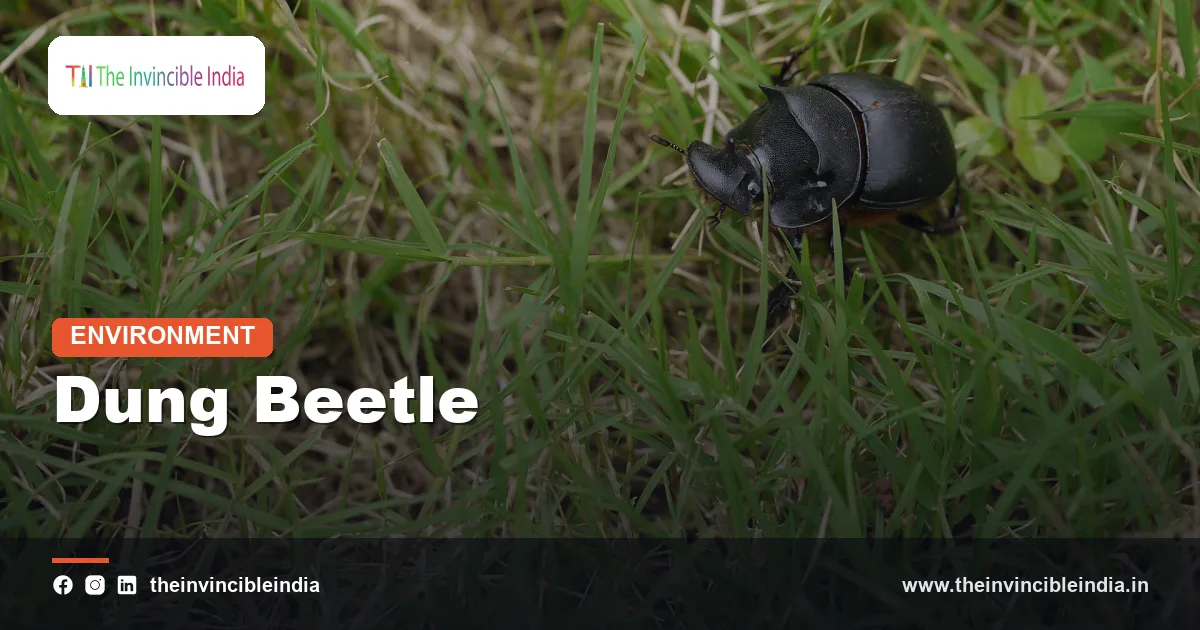
A dung beetle is a beetle, mostly of the family Scarabaeidae, that feeds on and breeds in animal dung, which it rolls, buries or lives in, and in doing so recycles nutrients back into the soil. Across Indian pastures, forests and village outskirts, dung beetles quietly remove huge quantities of cattle, buffalo, goat, deer and elephant droppings.
The work of the dung beetle is easy to overlook, but it supports soil fertility, controls flies and parasites, and helps scatter seeds. This article explains what a dung beetle is, how rolling and tunnelling beetles differ, how they navigate, how they breed and why the group matters so much to India’s grazing lands and wildlife.
| Attribute | Details |
|---|---|
| Order and family | Coleoptera (beetles); mainly the scarab family Scarabaeidae, subfamilies Scarabaeinae and Aphodiinae, plus the earth-boring beetles of Geotrupidae |
| Common Indian genera | Onthophagus, Catharsius, Heliocopris, Gymnopleurus, Sisyphus and Oniticellus, among many others |
| Typical size | From a few millimetres in tiny species to several centimetres in the giant Heliocopris beetles |
| Habitat in India | Pastures, grasslands, farmland, scrub, forests and the edges of villages, wherever dung is available |
| Diet | Mainly the liquid and fine particles of fresh dung; some species use carrion, rotting fruit or fungi |
| Life cycle | Complete metamorphosis: egg, larva (a C-shaped grub), pupa, adult; the larva feeds on a buried dung ball |
| Ecological role | Dung removal, nutrient recycling, soil aeration, seed dispersal and fly and parasite control |
| Notable features | Shovel-shaped head, strong legs, orientation by sun, moon and sky light, and some of the strongest pulling power known in any animal |
Key Takeaways
- A dung beetle feeds and breeds on animal dung, and its burying or rolling of dung returns nutrients to the soil.
- Dung beetles are grouped into rollers, tunnellers and dwellers according to how they handle dung.
- Some dung beetles steer a straight line while rolling a dung ball by using the sun, the moon’s polarised light and even the Milky Way as compasses.
- A female dung beetle usually lays one egg in each buried dung ball, which the larva eats as it grows.
- Dung beetles reduce breeding sites for flies and some livestock parasites by breaking up and burying fresh droppings.
- Residues of certain veterinary drugs in dung, along with loss of grazing land and forest, threaten dung beetle populations.
What Is a Dung Beetle?
A dung beetle is any of several thousand species of beetles that depend on animal dung for food and for raising their young. Most belong to the true dung beetles, the subfamily Scarabaeinae of the scarab family Scarabaeidae, although related groups such as the Aphodiinae and some earth-boring beetles also use dung.
The beetles have a compact, rounded or oval body, a hard outer shell, short clubbed antennae that carry smell receptors, and strongly toothed front legs designed for digging and shaping dung. Many are black, brown or dull metallic, while a few are bright green, copper or blue.
India has a rich dung beetle fauna, with hundreds of species recorded. One of the largest groups is the genus Onthophagus, which contains a very large number of small to medium species worldwide. The giant tunnelling beetles of the genus Heliocopris, which can be several centimetres long, are among the largest in the country and are associated with elephant and cattle dung in forests and grasslands.
What Are the Three Types of Dung Beetle?
Dung beetles are divided into three groups by behaviour: rollers, tunnellers and dwellers. Each group uses dung differently, and each leaves a distinct mark on the soil.
| Type | Scientific term | What it does with dung | Indian examples |
|---|---|---|---|
| Rollers | Telecoprids | Cut a ball of dung, roll it away from the pile and bury it elsewhere | Gymnopleurus, Sisyphus and some Scarabaeus species |
| Tunnellers | Paracoprids | Dig a tunnel directly under or beside the dung pile and pull dung down into it | Onthophagus, Catharsius, Heliocopris |
| Dwellers | Endocoprids | Live and breed inside the dung pat itself without burying it | Many Aphodius species |
Rollers shape dung into a ball using their legs and head, then push it with their hind legs while walking backwards, headstand style. Tunnellers are strong diggers that stock deep underground chambers with dung, and these produce the most soil mixing. Dwellers do not bury dung but still break it up and speed its decomposition.
How Does a Dung Beetle Roll and Bury Dung?
A dung beetle rolls dung by shaping a round ball, climbing on top or standing behind it, and pushing it along the ground with its hind legs until it finds soft soil in which to bury it. This is usually done quickly, because rival beetles may try to steal the ball.
The process runs through a few steps. The beetle arrives at fresh dung, often within minutes of it being dropped, and cuts a piece with its head and front legs. It shapes the piece into a ball, rolls it away in a straight line, digs into the ground, and pulls the ball into the hole. In species that tunnel, the beetle digs first and carries dung into the burrow in lumps.
Dung is food for both adults and larvae. Adults feed on the liquid part and fine particles, which they sieve through specialised mouthparts. The larvae of the next generation feed on the solid part of the dung ball in which they develop.
How strong is a dung beetle?
Dung beetles are among the strongest animals for their size. Experiments have shown that males of some Onthophagus species can pull many hundreds of times their own body weight, and a male Onthophagus taurus was recorded in 2010 pulling about 1,140 times its weight. Strong legs and thick body muscles let these beetles move dung balls far larger than themselves and fight rivals for burrows and females.
How Does a Dung Beetle Navigate in a Straight Line?
A dung beetle rolling a ball keeps to a straight path by using light in the sky as a compass, including the sun, the moon’s polarised light and, in at least one African species, the pattern of the Milky Way. A straight route helps the beetle escape competition at the dung pile as quickly as possible.
Researchers studying rolling beetles found that when the beetle cannot see these light cues, its path wanders in circles. When the beetle is given a small cardboard cap that blocks the sky, it loses direction at once. The beetles often climb on top of the ball and perform a short “dance”, turning on the spot to take a fix on the sky before setting off.
This work was carried out mainly on African species, but the principle of using the sun and polarised light as orientation aids applies widely among insects. Dung beetles in India, including the roller genera Gymnopleurus and Sisyphus, are also seen rolling balls in straight lines across paths and bare ground, particularly early in the morning and in the evening.
Where Do Dung Beetles Live in India?
Dung beetles live almost everywhere in India that large grazing animals leave droppings, from the cattle-grazed plains and village commons to the grasslands of the Deccan, the forests of the Western Ghats and the savannas of central India. Different species prefer different habitats, soils and dung types.
Some are generalists that use the dung of cattle, buffalo, sheep and goats, while others specialise in the dung of wild herbivores such as deer, antelope, rhinoceros and elephants. In national parks and sanctuaries, the abundance of large mammals directly shapes which dung beetle species occur, and a decline in large herbivores often reduces beetle diversity too.
Beetle activity changes with the seasons. Many species are most active in the warm, moist months of the monsoon and just after, when soil is soft enough to dig and dung stays moist. In hot dry spells, the beetles wait underground and emerge after rain. Many dung beetles fly at dusk or at night and are often attracted to lights.
How Does a Dung Beetle Breed and Grow?
A dung beetle breeds by preparing a buried dung ball, called a brood ball, in which the female lays a single egg, so that the larva that hatches has its own food store. The life cycle has four stages: egg, larva, pupa and adult.
- Pairing: the male and female work together, and in some species the pair share the job of burying dung and shaping brood balls.
- Brood ball: the female forms a ball or chamber of dung underground and lays one egg inside it.
- Larva: the egg hatches into a pale, curved grub that eats the dung ball and grows through several stages.
- Pupa: the fully grown larva pupates within a hardened chamber of the brood ball.
- Adult: the new beetle breaks out of the ball, digs to the surface and begins to feed, often after the next rains.
Parental care is notable in many species. Some tunnellers guard brood chambers, and in a few, both parents work for the offspring. This is unusual among insects and is one reason why dung beetles are used for studies of evolution and behaviour. The larval period can last weeks to months, and adults can live for a year or more in some species.
Why Are Dung Beetles Important for Nutrient Recycling?
Dung beetles are important for nutrient recycling because they move nutrient-rich dung from the soil surface into the soil, where plant roots and soil organisms can use it. Without them, dung dries into hard crusts, loses nitrogen to the air and decomposes slowly.
The benefits stack up in several ways:
- Soil fertility: buried dung supplies nitrogen, phosphorus and organic matter directly to the root zone.
- Soil structure: tunnels aerate the ground, improve water entry and reduce runoff.
- Pasture growth: grass grows better where dung is buried than where it lies as a crust on the surface.
- Seed dispersal: seeds contained in dung are buried and moved, which helps plant regeneration, a process known as secondary seed dispersal.
- Lower methane and ammonia loss: burying dung can reduce the greenhouse gases and ammonia that escape from fresh droppings.
Agricultural scientists regard dung beetles as ecosystem engineers, meaning that their activity changes the physical environment for other living things. A large herd of cattle produces a great deal of dung, and where beetles are absent the pats can remain on the surface for months.
How Do Dung Beetles Help Control Flies and Parasites?
Dung beetles help control flies and parasites by competing with them for dung and by removing fresh droppings before fly larvae can develop. Many flies lay eggs in fresh dung, and once the dung is buried, shredded or dried out the maggots have little chance to survive.
Beetles also reduce the risk of certain parasites of livestock. Many gut worms spread when their eggs, passed in dung, hatch and the larvae climb onto grass eaten by animals. Burying the dung interrupts that cycle. In this way, dung beetles help to keep cattle, buffalo and other grazing animals healthier, which matters to rural livelihoods across India.
This benefit was demonstrated dramatically in Australia, where introduced cattle produced large amounts of dung that native beetles could not handle. In the 1960s and after, a national programme introduced African and European dung beetles to bury it, improving pastures and lowering fly numbers. The story is often cited as a case of an insect providing a large and measurable service.
What Threatens Dung Beetles?
The main threats to dung beetles are the loss of grazing lands and forests, the use of certain veterinary medicines whose residues remain in dung, and the decline of the large animals whose dung they depend on. Because the beetles are linked so tightly to dung, anything that changes the supply or quality of dung affects them.
- Drug residues: some deworming drugs, such as ivermectin-type compounds given to cattle, pass into the dung and can harm or kill beetle larvae and adults.
- Habitat loss: conversion of grassland, scrub and forest to roads, crops and buildings removes breeding ground.
- Loss of large herbivores: fewer wild grazers mean fewer droppings of the kind some beetle species need.
- Pesticides and artificial light: pesticide use and bright night lighting can reduce survival and disrupt the beetles’ movements.
- Mechanisation: a decrease in free-grazing livestock around villages cuts the supply of dung.
Because dung beetles respond quickly to environmental change, ecologists use them as indicator species, and surveys of dung beetle communities help to monitor the condition of forests and grasslands.
Do Dung Beetles Have a Cultural Meaning?
Dung beetles have a well-known cultural meaning in ancient Egypt, where the sacred scarab was linked to the sun god and to rebirth, but in India they have no equally famous religious role. In Indian farming communities, however, the beetle is part of the everyday background of cattle country.
The Egyptian image drew on the sight of a beetle rolling a ball and emerging from the ground, which seemed to echo the sun’s daily journey across the sky. In India, where cattle are central to rural life and dung itself is widely used as fuel, manure and plaster, the dung beetle’s work parallels human use of the same material. Farmers often notice that fields grazed by cattle in the monsoon are enriched by the beetles’ labour, even if they do not name the insect.
How Can You Help Dung Beetles?
You can help dung beetles by protecting grazing land and field margins, avoiding unnecessary use of insect-killing drugs on animals, and allowing dung to lie where it falls instead of removing it all. Small changes in land and herd management can bring beetles back.
- Leave patches of rough grass and open soil around fields and gardens.
- Use veterinary medicines only when needed and follow professional advice on timing and choice.
- Reduce harsh insecticides near pastures and animal sheds.
- Turn off unneeded outdoor lights at night where beetles fly.
- Keep free-ranging livestock and natural grazing patterns where possible.
Anyone can watch a dung beetle at work by checking a fresh cow pat early in the morning. Within minutes, a small team of beetles may arrive, and within hours much of the pat can be reduced to a crumbly mass or vanish underground.
Bottom Line
The dung beetle turns waste into soil fertility. By rolling, burying and feeding on dung, it cleans pastures, feeds plants, limits flies and parasites and spreads seeds. Protecting the beetles means protecting grazing land and the grazing animals that make them possible.
Frequently Asked Questions
What is a dung beetle?
A dung beetle is a beetle, mostly of the scarab family Scarabaeidae, that eats and breeds in animal dung. It rolls, buries or lives within droppings. India has hundreds of species, ranging from tiny Onthophagus beetles to giant Heliocopris beetles.
Why do dung beetles roll dung balls?
Dung beetles roll dung balls to move food away from the crowded dung pile and bury it in a safe place. The buried ball becomes food for the adult or a nursery for the egg and larva. Rolling quickly also helps the beetle avoid thieves and predators.
How do dung beetles help the environment?
Dung beetles help the environment by recycling dung nutrients into the soil, aerating the ground and spreading seeds. They also reduce fly breeding and interrupt the life cycles of some livestock parasites. These services improve pasture growth and soil health.
How do dung beetles find their way?
Dung beetles find their way by using light in the sky, including the sun, the moon’s polarised light and, in some species, the Milky Way. This allows them to roll dung in a straight line away from the pile. Without a view of the sky, a rolling beetle tends to wander in circles.
How strong is a dung beetle?
A dung beetle is among the strongest animals relative to its size. A male Onthophagus taurus was recorded in 2010 pulling about 1,140 times its own body weight. This strength helps beetles move dung and compete for mates.
Are dung beetles harmful to humans?
Dung beetles are not harmful to humans. They do not bite or sting, and they do not damage crops or property. They benefit farmers by improving soil and by reducing flies and parasites around livestock.
{“@context”:”https://schema.org”,”@graph”:[{“@type”:”FAQPage”,”mainEntity”:[{“@type”:”Question”,”name”:”What is a dung beetle?”,”acceptedAnswer”:{“@type”:”Answer”,”text”:”A dung beetle is a beetle, mostly of the scarab family Scarabaeidae, that eats and breeds in animal dung. It rolls, buries or lives within droppings. India has hundreds of species, ranging from tiny Onthophagus beetles to giant Heliocopris beetles.”}},{“@type”:”Question”,”name”:”Why do dung beetles roll dung balls?”,”acceptedAnswer”:{“@type”:”Answer”,”text”:”Dung beetles roll dung balls to move food away from the crowded dung pile and bury it in a safe place. The buried ball becomes food for the adult or a nursery for the egg and larva. Rolling quickly also helps the beetle avoid thieves and predators.”}},{“@type”:”Question”,”name”:”How do dung beetles help the environment?”,”acceptedAnswer”:{“@type”:”Answer”,”text”:”Dung beetles help the environment by recycling dung nutrients into the soil, aerating the ground and spreading seeds. They also reduce fly breeding and interrupt the life cycles of some livestock parasites. These services improve pasture growth and soil health.”}},{“@type”:”Question”,”name”:”How do dung beetles find their way?”,”acceptedAnswer”:{“@type”:”Answer”,”text”:”Dung beetles find their way by using light in the sky, including the sun, the moon’s polarised light and, in some species, the Milky Way. This allows them to roll dung in a straight line away from the pile. Without a view of the sky, a rolling beetle tends to wander in circles.”}},{“@type”:”Question”,”name”:”How strong is a dung beetle?”,”acceptedAnswer”:{“@type”:”Answer”,”text”:”A dung beetle is among the strongest animals relative to its size. A male Onthophagus taurus was recorded in 2010 pulling about 1,140 times its own body weight. This strength helps beetles move dung and compete for mates.”}},{“@type”:”Question”,”name”:”Are dung beetles harmful to humans?”,”acceptedAnswer”:{“@type”:”Answer”,”text”:”Dung beetles are not harmful to humans. They do not bite or sting, and they do not damage crops or property. They benefit farmers by improving soil and by reducing flies and parasites around livestock.”}}]}]}


