

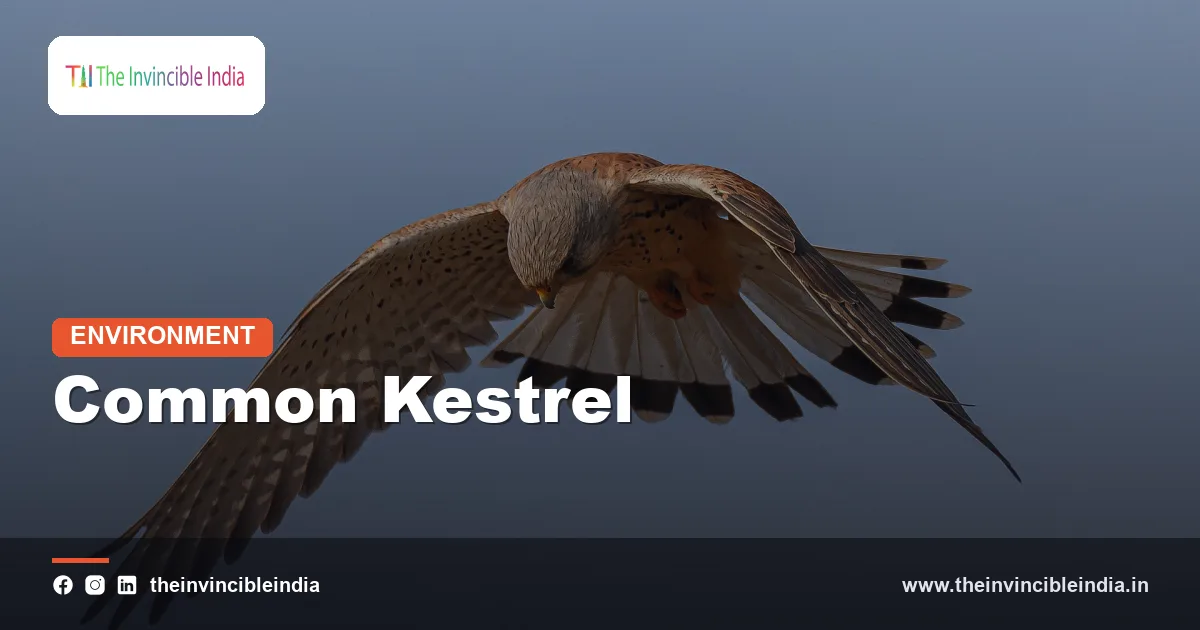
The common kestrel (Falco tinnunculus) is a small, slender falcon, also called the Eurasian kestrel, that is famous for hovering in one spot in the air while it searches open ground for rodents, lizards and insects. It is one of the most widely seen birds of prey in India during the cooler months, when resident birds are joined by large numbers of winter visitors from the north.
The common kestrel can be recognised in fields, on wires and along roadsides across the country by its pointed wings, long tail and rufous-brown colouring. This article explains how to identify the bird, how its hovering works, what it eats, where it lives and nests in India, and how it differs from similar falcons.
| Quick Facts: Common Kestrel | |
|---|---|
| Common name | Common kestrel (also called Eurasian kestrel) |
| Scientific name | Falco tinnunculus |
| Family | Falconidae (falcons and caracaras) |
| Size | About 32 to 39 cm in length, with a wingspan of roughly 65 to 82 cm |
| Range and habitat in India | Open country, farmland, grassland, scrub, cliffs and hill slopes; widespread in winter, with breeding birds in the Himalaya |
| Diet | Small rodents, large insects, lizards and small birds |
| Breeding and movement | No nest built; uses cliff ledges, tree holes, old crow nests or buildings; Himalayan birds breed in summer and many Indian birds are winter visitors |
| Conservation status | Least Concern on the IUCN Red List; protected under the Wildlife (Protection) Act, 1972 |
Key Takeaways
- The common kestrel is a small falcon of the family Falconidae that is found widely across India, especially in open country during winter.
- A common kestrel hunts by hovering on rapidly beating wings, with its head held almost still, before dropping onto small prey on the ground.
- The male common kestrel has a blue-grey head and tail and a chestnut back spotted with black, while the female is browner and barred.
- The common kestrel eats mainly small rodents and large insects, which makes it a natural ally of farmers in grain-growing regions.
- The common kestrel does not build its own nest; it lays three to six eggs on a ledge, in a hole, in an old nest of another bird or on a building.
- The common kestrel is listed as Least Concern globally, but pesticides, loss of grassland and changes in farming can reduce the number of kestrels in a region.
What is the common kestrel?
The common kestrel is a small falcon in the genus Falco and the most widespread kestrel in the world, found across Europe, Asia and Africa. The name kestrel is thought to be linked to old words for a rattling or clamouring cry. Falco tinnunculus is the scientific name, and tinnunculus is Latin for a “ringing” bird, a reference to the repeated, high-pitched call.
Kestrels belong to the family Falconidae, which is separate from the family Accipitridae that contains hawks, eagles and kites. Falcons are generally built for speed and have long, pointed wings. The common kestrel, however, is more of a patient watcher than a speedster, and it prefers to hover and drop on slow-moving prey.
An adult weighs only about 150 to 300 grams, roughly the weight of a few oranges. The female is a little larger than the male. In India, the bird is a familiar companion of farmland, roadside fields and open hill slopes, and it is often the first falcon that new birdwatchers learn to recognise.
How can you identify a common kestrel?
A common kestrel is identified by its slim body, long tail, pointed wings, rufous or chestnut upperparts with dark spots, and the habit of hovering over open ground. Adult males and females look noticeably different, which is unusual among birds of prey and makes sexing kestrels in the field fairly easy.
Male
The adult male has a blue-grey head, a pale grey tail with a broad black band near the tip and a white edge, and a chestnut-brown back and wing coverts with small black spots. The underparts are buff to pale cinnamon with fine dark streaks. A thin dark moustache streak runs below each eye.
Female and young birds
The adult female is more uniformly rufous-brown above, with dark bars across the back and tail. The head is brown, with streaks, and the tail is barred with a dark band near the tip. Young birds resemble the female and are often indistinguishable at a distance.
Other field marks
- Yellow legs, feet and eye-ring
- Dark, round eyes that give the face a gentle look
- Wingtips that are dark from below, with a pale underwing
- A short, hooked bill with a small notch (the tomial tooth) typical of falcons
How does the common kestrel hover?
The common kestrel hovers by facing into the wind, beating its wings rapidly and adjusting its tail and wing angle so that its head stays almost perfectly still while the body moves slightly. This allows the bird to scan a small patch of ground for prey, and it can maintain the position for many seconds at a time.
The technique is called wind-hovering when a breeze is present, and the bird often barely flaps. When the air is still, the kestrel flaps harder and may have to move more. The stillness of the head is the key. The bird’s eyes are fixed on the ground, and its brain receives a stable picture, much like a camera on a stabiliser.
Researchers have shown that kestrels in some regions can detect ultraviolet light and may use it to notice the trails of urine left by small rodents. The idea is widely cited, though ongoing research continues to refine what the bird actually sees in the wild. Whatever the mechanism, the bird’s eyesight is excellent, and it can spot a small insect or rodent from a height of 10 to 20 metres.
What does the common kestrel eat?
The common kestrel eats mainly small rodents such as mice, voles and gerbils, together with large insects, lizards and sometimes small birds. The exact diet varies with season, region and prey availability.
| Prey group | Examples in the Indian setting |
|---|---|
| Rodents | Field mice, gerbils, young rats and voles |
| Insects | Grasshoppers, crickets, beetles, locusts and termites on the wing |
| Reptiles | Small lizards and skinks |
| Birds | Small sparrows, larks and finches, usually in the cooler months |
| Other | Earthworms and frogs on rare occasions |
The bird hunts by hovering and then diving in a swift but controlled glide onto its target. It also hunts from fence posts, wires or poles, from where it can watch an area and drop to the ground. During insect swarms the kestrel may catch prey in flight or on the ground with its feet.
Since many of its prey animals damage crops, the kestrel is useful in agricultural areas. A single bird can remove a large number of rodents in a season.
Where is the common kestrel found in India?
The common kestrel is found across India in open habitats, with breeding populations in the Himalaya and large numbers of winter visitors elsewhere. It prefers farmland, grassland, scrub, stony hill slopes, coastal flats and the outskirts of towns.
The bird is both resident and migratory in India. In the Himalayan region, including Kashmir, Himachal Pradesh and the high-altitude areas of Ladakh, kestrels breed in summer. Over the rest of the country, the majority of birds are seen between about October and March, when migrants from Central Asia and further north arrive. These birds then return to their breeding grounds as spring advances.
Typical Indian habitats include:
- Open farmland and harvested fields
- Dry grassland and semi-desert
- Rocky hills, ravines and cliffs
- Edges of towns, ruins and old forts
- Roadside wires and bare trees
Dense forest is avoided because the bird needs open ground for hovering. It can adapt to human landscapes, and it is regularly seen hunting in open lots, along highways and around ancient monuments.
How does the common kestrel nest and breed?
The common kestrel breeds by laying its eggs in an existing site such as a cliff ledge, a hole, an old nest of another bird or a ledge on a building, because it does not build a nest itself. This habit makes the species flexible and allows it to breed in many landscapes.
The female usually lays three to six eggs, which are creamy white with reddish-brown blotches. She incubates them for about four weeks, while the male brings food. After hatching, the chicks are fed by both parents and fly at about four to five weeks of age. They stay close to their parents for some weeks after leaving the nest.
In the Indian Himalaya, breeding generally takes place from spring into early summer. Because kestrels reuse cliffs and buildings, they are often seen around old fortresses, temples and ruined walls where ledges are available.
What sound does the common kestrel make?
The common kestrel makes a sharp, repeated, high-pitched call, usually written as “kee-kee-kee” or “kli-kli-kli”, often given near the nest or during interactions with other kestrels. The sound is clear and ringing, which fits the Latin name tinnunculus.
Kestrels call most frequently in the breeding season, when pairs defend nest sites and perform display flights. Outside the breeding season, the bird is mostly quiet. Birdwatchers often detect a kestrel first by sight, because the hovering silhouette is distinctive, and only later by sound.
How is the common kestrel different from similar falcons?
The common kestrel differs from similar falcons mainly in its larger size than the lesser kestrel, its hovering habit, the dark spots on its back and, in males, its pale blue-grey head. Several small raptors share open habitats in India, so careful comparison helps.
| Bird | How it differs from the common kestrel |
|---|---|
| Lesser kestrel | Slightly smaller; male has an unspotted rufous back and a grey patch on the wing, and the species is a passage migrant |
| Red-necked falcon | Has a chestnut cap and nape, a barred grey body and a more direct, fast flight |
| Peregrine falcon | Larger and heavier, with a dark hood and moustache, and hunts birds in fast stoops |
| Shikra | A hawk with short, rounded wings and a barred chest; flies fast in woodland, not hovering |
| Black-winged kite | Pale grey and white with black shoulders and red eyes; also hovers but has a white tail |
A useful check is the combination of long pointed wings, a long tail, rufous colour and sustained hovering over open ground. If the bird hovers in a fixed spot with its head still, it is almost certainly a kestrel.
Is the common kestrel threatened?
The common kestrel is not threatened globally and is listed as Least Concern by the IUCN, and it is protected in India under the Wildlife (Protection) Act, 1972. Its large range and adaptability have helped it remain common.
Some pressures can still reduce local numbers:
- Loss of grassland and rough farmland that supports rodents and insects
- Pesticides and rodenticides, which can poison birds that eat contaminated prey
- Loss of nesting ledges and holes when old buildings are renovated or trees are cut
- Collisions with vehicles and power lines when birds hunt along roads
Simple measures such as leaving field margins, avoiding rodent poison and keeping old walls with ledges help kestrels. In several countries, nest boxes have increased kestrel numbers in farmland, and similar ideas can be used in India.
Bottom Line
The common kestrel is a small, hovering falcon that hunts rodents and insects across India’s open country and is easily recognised by its pointed wings, rufous colouring and fixed-head hover. It is common in winter, breeds in the Himalaya and does not build a nest of its own. Keeping open fields, old ledges and chemical-free farmland helps it thrive.
Frequently Asked Questions
What is a common kestrel?
A common kestrel is a small falcon of the family Falconidae with the scientific name Falco tinnunculus. It is also known as the Eurasian kestrel. The bird is known for hovering over open ground while searching for rodents and insects.
Why does the common kestrel hover?
The common kestrel hovers to hold a fixed position above the ground so that it can scan for prey. It faces the wind and beats its wings quickly while keeping its head almost still. When it spots a rodent or insect, it drops quickly to catch it.
What does a common kestrel eat?
A common kestrel eats mainly small rodents and large insects, along with lizards and occasionally small birds. Mice, voles, gerbils, grasshoppers and crickets are typical food. This diet makes the bird helpful in controlling crop pests.
Is the common kestrel found in India all year?
The common kestrel is found in India throughout the year in the Himalaya, where it breeds, but most of the country sees it mainly in winter. Migrant birds arrive from the north around October and leave by spring. The bird is therefore easiest to see in the cooler months.
How can I tell a male from a female common kestrel?
You can tell a male common kestrel by its blue-grey head and tail and its chestnut back with black spots. The female has a brown head and a rufous back that is barred rather than spotted. The female is also slightly larger.
Does the common kestrel build a nest?
No, the common kestrel does not build a nest of its own. It lays three to six eggs on a cliff ledge, in a hole, in an old nest of another bird or on a ledge of a building. The female incubates the eggs for about four weeks.
{“@context”:”https://schema.org”,”@graph”:[{“@type”:”FAQPage”,”mainEntity”:[{“@type”:”Question”,”name”:”What is a common kestrel?”,”acceptedAnswer”:{“@type”:”Answer”,”text”:”A common kestrel is a small falcon of the family Falconidae with the scientific name Falco tinnunculus. It is also known as the Eurasian kestrel. The bird is known for hovering over open ground while searching for rodents and insects.”}},{“@type”:”Question”,”name”:”Why does the common kestrel hover?”,”acceptedAnswer”:{“@type”:”Answer”,”text”:”The common kestrel hovers to hold a fixed position above the ground so that it can scan for prey. It faces the wind and beats its wings quickly while keeping its head almost still. When it spots a rodent or insect, it drops quickly to catch it.”}},{“@type”:”Question”,”name”:”What does a common kestrel eat?”,”acceptedAnswer”:{“@type”:”Answer”,”text”:”A common kestrel eats mainly small rodents and large insects, along with lizards and occasionally small birds. Mice, voles, gerbils, grasshoppers and crickets are typical food. This diet makes the bird helpful in controlling crop pests.”}},{“@type”:”Question”,”name”:”Is the common kestrel found in India all year?”,”acceptedAnswer”:{“@type”:”Answer”,”text”:”The common kestrel is found in India throughout the year in the Himalaya, where it breeds, but most of the country sees it mainly in winter. Migrant birds arrive from the north around October and leave by spring. The bird is therefore easiest to see in the cooler months.”}},{“@type”:”Question”,”name”:”How can I tell a male from a female common kestrel?”,”acceptedAnswer”:{“@type”:”Answer”,”text”:”You can tell a male common kestrel by its blue-grey head and tail and its chestnut back with black spots. The female has a brown head and a rufous back that is barred rather than spotted. The female is also slightly larger.”}},{“@type”:”Question”,”name”:”Does the common kestrel build a nest?”,”acceptedAnswer”:{“@type”:”Answer”,”text”:”No, the common kestrel does not build a nest of its own. It lays three to six eggs on a cliff ledge, in a hole, in an old nest of another bird or on a ledge of a building. The female incubates the eggs for about four weeks.”}}]}]}


