

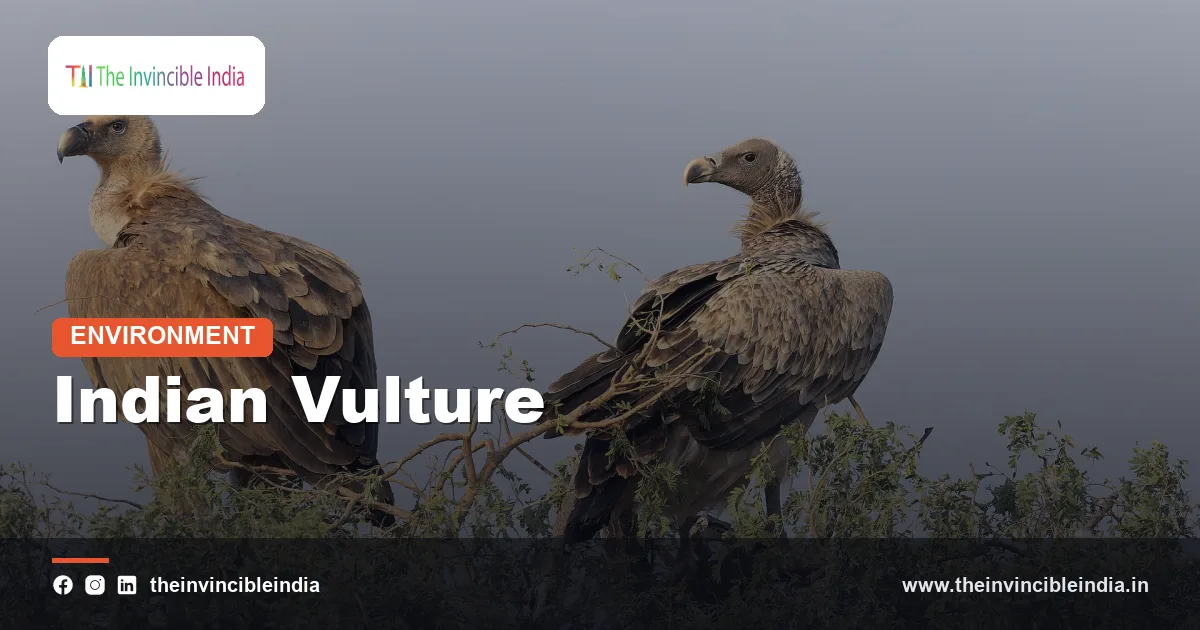
The Indian vulture (Gyps indicus), also called the long-billed vulture, is a large scavenging bird of prey that nests on cliffs and rocky hills across peninsular and central India and is now classified as Critically Endangered. Once common around villages and carcass dumps, the Indian vulture suffered a steep population collapse from the 1990s, mainly traced to the veterinary drug diclofenac, and it now survives in much smaller numbers with the help of bans, safe zones and captive breeding.
This explainer describes what the Indian vulture is, how it differs from other Indian vultures, where it lives and breeds, what it eats, why its numbers crashed, and what has been done to help it recover.
Quick Facts
| Common names | Indian vulture, long-billed vulture |
|---|---|
| Scientific name | Gyps indicus |
| Family | Accipitridae (hawks, eagles, kites and Old World vultures) |
| Size | About 80 to 100 cm long, with a wingspan of roughly 2 metres or more and a weight of about 5 to 6.5 kg |
| India range and habitat | Resident in peninsular and central India, especially rocky hills, ravines, cliffs and open country near villages |
| Diet | Carrion, mostly the carcasses of domestic cattle and other large animals |
| Breeding | Nests on cliff ledges and sometimes in ruins or trees; lays a single egg, generally in the cooler months |
| Conservation status | Critically Endangered on the IUCN Red List; protected under the Wildlife (Protection) Act, 1972 |
Key Takeaways
- The Indian vulture (Gyps indicus) is a cliff-nesting Old World vulture also known as the long-billed vulture.
- The Indian vulture was split from the slender-billed vulture (Gyps tenuirostris) into a separate species in the early 2000s, so older records often combine the two.
- The Indian vulture is classified as Critically Endangered, having lost the great majority of its population since the early 1990s.
- The main driver of the Indian vulture decline was kidney failure after eating carcasses of cattle treated with the painkiller diclofenac.
- India banned veterinary diclofenac in 2006, and conservation breeding centres and vulture safe zones now support the recovery of the Indian vulture.
- The Indian vulture provides a public-health service by removing carcasses quickly and cleanly from villages and farmland.
What is the Indian vulture?
The Indian vulture is a large, bare-headed scavenging bird of prey in the genus Gyps that feeds almost entirely on dead animals and nests on cliff faces in the Indian peninsula. It is one of several vultures found in India and belongs to the same family, Accipitridae, as eagles, hawks and kites.
The common name can be confusing. In everyday speech, “Indian vulture” is sometimes used loosely for any vulture seen in India, but in bird classification it refers specifically to Gyps indicus. The same bird is widely called the long-billed vulture because its bill is relatively long and stout. For many years it was treated as a single species together with the slender-billed vulture of the Gangetic plains and Southeast Asia, but the two were separated into distinct species, and scientists now recognise them as separate birds with different ranges.
Vultures are often thought of as ugly, but their features have clear functions. The bare head and neck stay cleaner when the bird feeds inside a carcass, and the strong hooked bill tears hide and flesh. The stomach acid of a vulture is extremely strong, which allows it to digest meat that would sicken most other animals.
How can you identify the Indian vulture?
The Indian vulture can be identified by its pale, sandy-brown body, dark bare head and neck with a thin ruff of down at the base of the neck, long bill and large soaring wings. Adults look tawny or buff on the body, while the flight feathers are dark.
Several features separate it from other vultures in India.
- The head and neck are dull, dark and almost naked, with only sparse short down.
- A white ruff of feathers sits at the base of the neck.
- The back and wing coverts are pale buff or sandy, contrasting with darker flight feathers.
- The bill is long and slender-looking compared with the stubby bill of many other vultures, which gives the species its alternative name.
- Juveniles are darker and streaked, and they become paler with age.
In flight, the Indian vulture looks broad-winged and short-tailed, with the pale body and underwing coverts contrasting with dark flight feathers. Because several vulture species look alike from a distance, accurate identification usually depends on bill shape, head colour, rump colour and the habitat.
Where does the Indian vulture live?
The Indian vulture lives mainly in central and peninsular India, where it occupies rocky hills, gorges, ravines and open plains. It is a resident species, meaning it stays in the same region year-round rather than migrating over long distances.
It prefers dry, open country, typically in places where cliffs and rock faces provide nest sites and where villages, farms and grazing lands provide a steady supply of carcasses. Its range extends northward into parts of the Indian plains and into neighbouring countries, though its stronghold has been the Deccan plateau and nearby uplands. Today, remaining birds are concentrated in a small number of colonies and protected landscapes, rather than being spread widely as in earlier decades.
Because the bird uses thermals, it can travel long distances daily, often tens of kilometres, searching for food and returning to a cliff roost at night.
What does the Indian vulture eat?
The Indian vulture eats carrion, mainly the carcasses of cattle, buffalo, goats and other domestic animals, along with the remains of wild animals. It does not hunt live prey and is therefore classified as an obligate scavenger.
It finds food by soaring high and watching the ground and also by watching other vultures. When one bird descends toward a carcass, others see it and follow, so a large group can gather within minutes. Several vulture species often feed together, with each tending to favour different parts of the body. The Indian vulture tends to use its long neck and bill to reach deep inside the carcass.
In rural India, cattle that die of disease or old age were traditionally left in designated places outside villages. Vultures consumed these carcasses quickly, which reduced the risk of disease spread by decay and by feral dogs. A single large carcass could be reduced to bones in a matter of hours when many vultures were present.
How does the Indian vulture breed?
The Indian vulture breeds once a year, building a nest on a cliff ledge or similar rocky site and laying a single egg, typically during the cooler months of the year. Pairs often nest in loose colonies, with several nests on the same cliff.
The nest is a rough platform of sticks, usually lined with leaves or grass. Both parents take turns incubating the egg, which takes about seven weeks, and both feed the chick by regurgitating food. The chick stays in the nest for roughly three to four months before fledging, and it remains dependent on its parents for some time afterwards.
This slow breeding rate is a key reason the species recovers poorly from sharp declines. A pair raises at most one young bird a year, and the birds do not breed until they are several years old. When adult mortality rises, even a small increase can drive a population downward quickly, and rebuilding takes many years.
Why did the Indian vulture population crash?
The Indian vulture population crashed mainly because vultures were poisoned by diclofenac, a non-steroidal anti-inflammatory drug (NSAID) used to treat sick cattle, which causes fatal kidney failure in the birds that feed on the treated carcasses. The decline began in the early 1990s and was extremely rapid.
The cause was identified in the early 2000s by researchers who found that vultures in the region, including the Indian vulture, were dying with signs of visceral gout, a condition linked to kidney damage. Studies in Pakistan and India traced the effect to diclofenac residues in livestock carcasses. Even a small number of contaminated carcasses among many safe ones could kill a significant share of vultures because the birds feed in groups and eat large quantities.
The story is often described even-handedly in conservation literature. Diclofenac was a cheap and effective drug that genuinely helped farmers keep working animals healthy, and nobody intended to harm vultures. The harm came as an unexpected side effect that became clear only after population surveys revealed a collapse.
Other factors may also have contributed to the decline, including loss of nesting habitat, changes in how carcasses are disposed of, reduced availability of food in some areas, and the toxicity of other drugs. However, scientists generally agree that diclofenac was the principal cause of the large-scale collapse across the subcontinent.
Why does the Indian vulture matter?
The Indian vulture matters because it removes dead animals quickly and safely, which reduces the spread of disease, limits contamination of water and soil, and keeps feral dog and rat numbers lower. These benefits were largely invisible until vultures disappeared.
When vultures vanished from many areas, carcasses lay unconsumed for days. In some regions, this was associated with larger populations of feral dogs and more human-animal contact at carcass sites, and concerns were raised about public-health effects, including the risk of rabies. The size of these knock-on effects continues to be studied, and researchers describe them cautiously, but the broad point is that a service once provided for free had to be replaced by other means.
Vultures also have a cultural presence in India. They appear in epics and folklore, and they have long been part of the landscape. Their decline is therefore both an ecological and a cultural loss.
What has been done to save the Indian vulture?
The main steps taken to save the Indian vulture are a ban on veterinary diclofenac, the creation of vulture safe zones, captive breeding programmes and monitoring of surviving colonies. These measures together form the core of India’s vulture action plans.
| Measure | What it does |
|---|---|
| Ban on veterinary diclofenac (2006) | Removes the main source of poison from cattle carcasses |
| Limits on human diclofenac vials and other drug reviews | Reduces illegal diversion of human formulations to livestock |
| Promotion of safer drugs such as meloxicam | Gives vets an effective painkiller that has been tested as safe for vultures |
| Vulture safe zones | Areas where carcass food is kept free of toxic drugs and nests are protected |
| Conservation breeding centres | Breed vultures in captivity, such as at Pinjore in Haryana, to support future release |
| Population monitoring | Tracks surviving colonies and checks whether recovery is happening |
The Bombay Natural History Society (BNHS) played a leading role in research and in setting up breeding centres. Government agencies, state forest departments and conservation groups have also contributed, and national action plans for vulture conservation have been issued in successive periods.
Progress has been real but fragile. Some other veterinary drugs have also been found to be harmful to vultures, so monitoring of drug use remains necessary. Conservationists describe the situation as stabilising in some areas but still far from secure, and recovery will take decades given the bird’s slow breeding.
Can the Indian vulture recover?
The Indian vulture can recover only if its food remains safe and its breeding colonies are protected, and any recovery is likely to be slow because each pair raises just one chick a year. Early signs after the diclofenac ban have been mildly encouraging in some places, with the pace of decline slowing.
Three conditions matter most. First, veterinary drugs must continue to be monitored, because a new toxic drug could cause fresh losses. Second, nesting cliffs and trees must be left undisturbed. Third, captive-bred birds, where used, must be released into areas with safe food and with community support.
Local communities have an important role. Farmers, veterinarians, pharmacists and villagers can help by using safe drugs, reporting dead vultures and protecting nest sites.
Bottom Line
The Indian vulture is a cliff-nesting scavenger whose rapid decline showed how a single drug can reshape an ecosystem. Its future depends on keeping carcass food safe and on patient, long-term conservation work.
Frequently Asked Questions
What is the Indian vulture?
The Indian vulture is a large scavenging bird of prey, scientifically named Gyps indicus and also called the long-billed vulture. It nests on cliffs in peninsular and central India and feeds mainly on the carcasses of livestock.
Is the Indian vulture endangered?
Yes, the Indian vulture is classified as Critically Endangered on the IUCN Red List. Its population fell sharply from the 1990s onward, and it survives today in much smaller numbers than before.
Why did Indian vultures die in large numbers?
Indian vultures died mainly because they fed on carcasses of cattle treated with the veterinary drug diclofenac, which causes fatal kidney failure in vultures. Other factors such as habitat loss and food changes may also have played a smaller part.
What is the difference between the Indian vulture and the white-rumped vulture?
The Indian vulture nests on cliffs and has a pale buff body with a long bill, while the white-rumped vulture nests in trees and shows a white lower back. Both belong to the genus Gyps, and both were badly affected by diclofenac.
What did India do to protect vultures?
India banned veterinary diclofenac in 2006 and has since set up vulture safe zones, breeding centres and monitoring programmes. Safer alternatives such as meloxicam have also been promoted for treating livestock.
What does the Indian vulture eat?
The Indian vulture eats carrion, mostly the carcasses of cattle and other domestic animals. It does not kill live prey and plays an important role in clearing dead animals from the countryside.
{“@context”:”https://schema.org”,”@graph”:[{“@type”:”FAQPage”,”mainEntity”:[{“@type”:”Question”,”name”:”What is the Indian vulture?”,”acceptedAnswer”:{“@type”:”Answer”,”text”:”The Indian vulture is a large scavenging bird of prey, scientifically named Gyps indicus and also called the long-billed vulture. It nests on cliffs in peninsular and central India and feeds mainly on the carcasses of livestock.”}},{“@type”:”Question”,”name”:”Is the Indian vulture endangered?”,”acceptedAnswer”:{“@type”:”Answer”,”text”:”Yes, the Indian vulture is classified as Critically Endangered on the IUCN Red List. Its population fell sharply from the 1990s onward, and it survives today in much smaller numbers than before.”}},{“@type”:”Question”,”name”:”Why did Indian vultures die in large numbers?”,”acceptedAnswer”:{“@type”:”Answer”,”text”:”Indian vultures died mainly because they fed on carcasses of cattle treated with the veterinary drug diclofenac, which causes fatal kidney failure in vultures. Other factors such as habitat loss and food changes may also have played a smaller part.”}},{“@type”:”Question”,”name”:”What is the difference between the Indian vulture and the white-rumped vulture?”,”acceptedAnswer”:{“@type”:”Answer”,”text”:”The Indian vulture nests on cliffs and has a pale buff body with a long bill, while the white-rumped vulture nests in trees and shows a white lower back. Both belong to the genus Gyps, and both were badly affected by diclofenac.”}},{“@type”:”Question”,”name”:”What did India do to protect vultures?”,”acceptedAnswer”:{“@type”:”Answer”,”text”:”India banned veterinary diclofenac in 2006 and has since set up vulture safe zones, breeding centres and monitoring programmes. Safer alternatives such as meloxicam have also been promoted for treating livestock.”}},{“@type”:”Question”,”name”:”What does the Indian vulture eat?”,”acceptedAnswer”:{“@type”:”Answer”,”text”:”The Indian vulture eats carrion, mostly the carcasses of cattle and other domestic animals. It does not kill live prey and plays an important role in clearing dead animals from the countryside.”}}]}]}


