

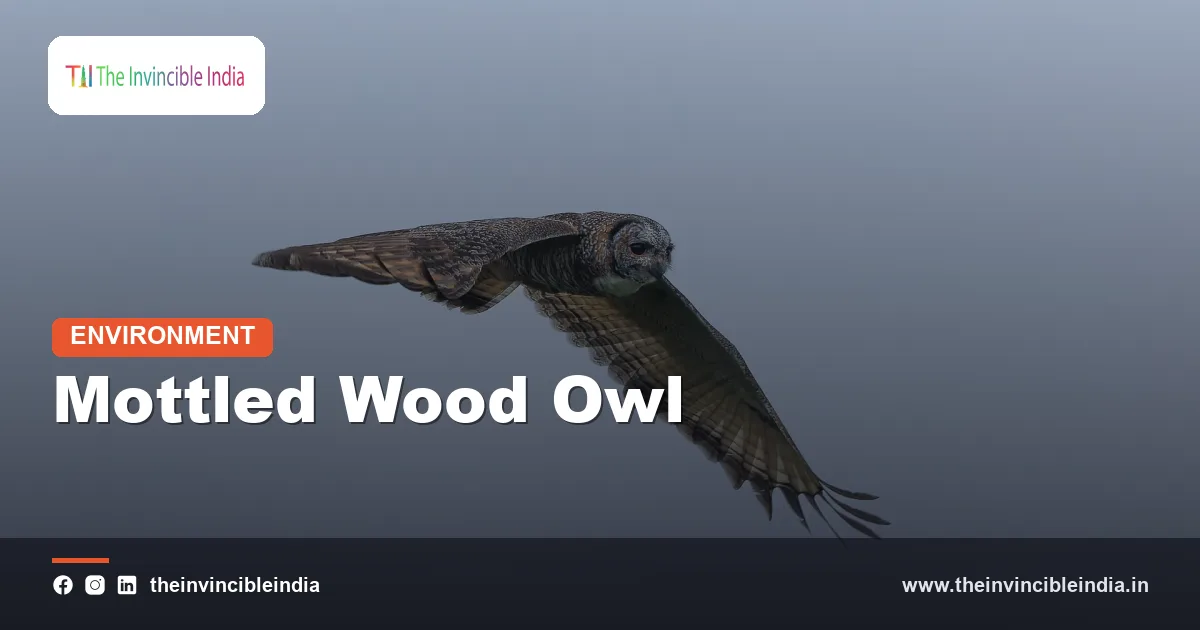
The mottled wood owl is a medium-large, round-headed owl (Strix ocellata) of the Indian subcontinent, found in groves, old trees and wooded country, whose richly patterned plumage and eerie, quavering night call make it one of India’s most atmospheric birds. It has no ear tufts, dark brown eyes and a boldly ringed facial disc, and it spends the day hidden in thick foliage or a tree hollow before hunting rodents and other small animals after dark.
Because it nests and roosts in big old trees, the mottled wood owl is often found around mango groves, village woodlots, temple gardens and roadside avenues. This guide explains how to identify the bird, where it lives, what it eats, what its strange call means and how it breeds.
| Common name | Mottled wood owl |
|---|---|
| Scientific name | Strix ocellata |
| Family | Strigidae (typical owls) |
| Size | About 40 to 48 cm long; stocky with a rounded head and no ear tufts |
| Range in India | Widespread across peninsular and northern India, from the Himalayan foothills southward; largely absent from the far northeast and arid west |
| Habitat | Groves, mango orchards, old avenues, village woods, open forest and wooded gardens |
| Diet | Rats and mice, small birds, bats, lizards, frogs and large insects |
| Breeding | Nests in large tree hollows; usually 2 to 3 white eggs, laid in the dry season |
| Conservation status | Least Concern (IUCN); protected under the Wildlife (Protection) Act, 1972 |
Key Takeaways
- The mottled wood owl (Strix ocellata) is a medium-large Indian owl with a rounded head, no ear tufts and densely mottled, barred plumage.
- The mottled wood owl is found mainly in India, where it lives in groves, old avenue trees and open woodland.
- The mottled wood owl is known for an eerie, quavering, almost human-like call heard at night.
- The mottled wood owl hunts mainly rats, mice, small birds, bats and large insects, which makes it a useful natural pest controller.
- The mottled wood owl nests in large hollows of old trees, so its survival depends on keeping mature trees standing.
- The mottled wood owl is rated Least Concern and is protected under the Wildlife (Protection) Act, 1972, like all owls in India.
What is the mottled wood owl?
The mottled wood owl is a species of true owl in the family Strigidae, belonging to the genus Strix, the group of round-headed forest and woodland owls that includes the tawny owl of Europe and the brown wood owl of South and Southeast Asia. It is largely endemic to the Indian subcontinent, which means that India holds most of its world population.
Wood owls of the genus Strix typically have large rounded heads, dark eyes and no ear tufts. The mottled wood owl is one of the more heavily patterned members of the group, with a pale facial disc and strongly contrasting marks on the body that give it its name.
Two features make it especially recognisable to Indian readers: it is common in old, shady groves close to human settlements, and its voice is one of the most distinctive and unsettling sounds of the Indian night.
How can you identify a mottled wood owl?
A mottled wood owl can be identified by its round head without ear tufts, its dark eyes, its boldly marked facial disc and its mottled brown, buff and white plumage. The facial disc has rings of dark and pale feathers that give the owl a “target” look, and the chest is whitish with fine dark barring.
Useful identification points include:
- No ear tufts: The round, smooth head separates it from eagle-owls, fish owls and scops owls.
- Dark brown eyes: The eyes are dark rather than yellow or orange, a trait shared with other wood owls.
- Ringed face: The facial disc is made up of concentric dark and pale bands, with a whitish area around the bill.
- Mottled upperparts: The back and wings are dark chocolate brown, spotted and barred with white and buff.
- Barred underparts: The breast and belly are whitish to buff with dark brown barring.
- Sturdy build: It has a compact body, rounded wings and a fairly short tail.
The bird is slightly smaller than the brown fish owl and the Indian eagle-owl, and larger than the spotted owlet. Males and females look similar, though females tend to be slightly larger.
Where does the mottled wood owl live in India?
The mottled wood owl lives across much of India, from the base of the Himalaya through the Gangetic plains, central India and the peninsula down to the south, wherever there are old trees to roost and nest in. It generally avoids dense evergreen forest, high mountains and very dry desert regions.
Its typical habitats are:
- Mango groves and other orchards with large, old trees.
- Avenues of banyan, peepal, tamarind and neem along roads and canals.
- Village woodlots, sacred groves and temple compounds.
- Open deciduous forest and scrub woodland near farmland.
- Large gardens, campuses and old parks in towns and cities.
The species is able to live near people provided mature trees survive and there is enough food. It is mostly a lowland and foothill bird, and does not usually occur at high elevations in the Himalaya.
What does the mottled wood owl eat?
The mottled wood owl eats rats, mice and other small mammals, together with small birds, bats, lizards, frogs and large insects. It is a sit-and-wait hunter that scans the ground from a perch and drops on its prey silently.
Its diet can be summarised as follows:
- Rodents: Rats and mice from fields, orchards and godowns form the bulk of its meals where available.
- Birds: Roosting sparrows, doves and other small birds are sometimes taken from branches at night.
- Bats: Bats leaving roosts or feeding near trees may be caught in flight.
- Reptiles and amphibians: Lizards, geckos and frogs are taken opportunistically.
- Insects: Large beetles, moths, crickets and termite swarms provide additional food.
Like other owls, the mottled wood owl swallows small prey whole and later coughs up the indigestible bones, fur and insect parts as compact pellets. Under roosting trees, pellets can reveal what the owl has been eating.
Why does the mottled wood owl have such an eerie call?
The mottled wood owl has an eerie call because it uses a loud, drawn-out, quavering and sometimes shrieking voice to advertise its territory and keep in contact with its mate across dark woodland. The sound is often compared to a human laugh or scream, which is why the bird has featured in so many village stories.
Observers describe a range of calls:
- Territorial call: A loud, wavering or hooting series of notes that rises and falls and may end abruptly.
- Duets: A pair may call back and forth, producing an overlapping chorus of eerie sounds.
- Alarm and defensive calls: Harsh screeches, hisses and bill-snapping when the bird is disturbed.
- Chick begging calls: Rasping, hissing notes made by young owls waiting for food.
Calling is most intense at dusk and in the early part of the night, and it increases in the breeding season. Hearing the call is the most reliable way of knowing that a mottled wood owl is living in a nearby grove.
Is the mottled wood owl nocturnal?
The mottled wood owl is nocturnal, meaning it hunts mainly after dark, and it spends the daytime roosting quietly in dense foliage or in a tree hollow. At dusk it leaves the roost, often perching on a bare branch for a time before starting to hunt.
Several features suit it to night life:
- Large, forward-facing eyes that gather light well in dim conditions.
- A facial disc that works like a dish, directing sound into its ears.
- Asymmetrically placed ear openings in some owls that help to locate the exact position of a sound.
- Soft, fringed flight feathers that muffle the sound of wingbeats.
Daytime roosts are generally in the thickest part of a tree, close to the trunk, where the mottled plumage blends with bark and shadow. A bird disturbed by day may sit motionless, but mobbing crows and babblers can reveal its position.
How does the mottled wood owl breed?
The mottled wood owl breeds in a large hollow or cavity in an old tree, laying usually two or three white eggs on the bare wood or a thin layer of debris. Nesting typically happens in the dry season, from about February to April in much of India, though the timing differs between regions.
Key points about its breeding include:
- Nest site: A natural hollow in a big tree trunk or major branch, sometimes a hollow in a ruined building or old nest of another bird.
- Clutch size: Two or three rounded white eggs are typical.
- Incubation: The female sits on the eggs for roughly a month while the male brings food.
- Chick development: The downy chicks are fed by both parents and leave the hollow after several weeks, remaining near the nest and calling for food for a long time.
- Territory: Pairs stay in the same area throughout the year and often reuse good nest trees.
Female owls are fierce nest defenders and may attack intruders, including people, who come too close to an active hollow. Anyone who finds a nest should keep a respectful distance.
Why does the mottled wood owl matter?
The mottled wood owl matters because it controls rodents, insects and other pests around farms and villages, and because its presence indicates old trees and a living landscape. A single owl can consume a large number of rats and mice in a year, reducing crop losses.
Its ecological and cultural importance includes:
- Natural pest control: Owls reduce rat and mouse numbers without poison or traps.
- Indicator of old trees: The bird needs big hollow trees, so it is a sign of mature groves worth keeping.
- Link in the food web: It preys on smaller animals and is itself sometimes taken by large raptors.
- Cultural presence: In many Indian traditions owls carry symbolism, from the vahana of Goddess Lakshmi to being treated as omens, both positive and negative.
Unfortunately, superstition has led to owls being killed, captured or used in black-magic practices. Such acts are illegal because owls are protected under the Wildlife (Protection) Act, 1972, and awareness campaigns encourage people to see owls as useful neighbours.
What threats does the mottled wood owl face?
The mottled wood owl faces threats from the felling of old trees, rodenticide poisoning, road accidents, hunting for superstitious reasons and disturbance at nests. It remains common enough to be rated Least Concern, but its numbers can fall locally when mature groves are cleared.
The main problems include:
- Loss of nest trees: Old hollow trees are removed for roads, construction and timber, and are not quickly replaced.
- Rodenticides: Owls that eat poisoned rats can be harmed by secondary poisoning.
- Vehicle collisions: Birds hunting along roads at night may be struck by traffic.
- Persecution: Beliefs about bad luck or magical powers can lead people to harm or capture owls.
- Light and noise: Bright lighting and loud activity can disturb roosting and hunting.
Practical conservation measures include retaining old trees, using natural pest control rather than poisons and teaching communities about the value of owls.
How does the mottled wood owl compare with other Indian owls?
The mottled wood owl differs from other common Indian owls in its round head without ear tufts, its dark eyes and its association with groves and old trees. The table below compares it with three other owls often seen in the same regions.
| Owl | Ear tufts | Eye colour | Typical habitat |
|---|---|---|---|
| Mottled wood owl | No | Dark brown | Groves, old avenues, village woods |
| Brown fish owl | Yes | Golden-yellow | Rivers, ponds and wooded streams |
| Spotted owlet | No | Yellow | Towns, villages and farmland |
| Collared scops owl | Yes | Dark brown | Gardens and open woods |
The comparison shows that eye colour and ear tufts are the quickest ways to separate India’s common owls, with call and habitat adding confirmation.
How can you see a mottled wood owl?
The best way to see a mottled wood owl is to visit an old mango grove, tree-lined avenue or wooded garden at dusk, listen for its call and then look for a roosting bird in thick foliage during the day. Birds often return to the same roost tree for long periods.
Some practical suggestions are:
- Check big trees with dense leaves and thick branches, particularly near the trunk.
- Look for white streaks of droppings or pellets under favoured roosts.
- Watch for groups of crows or small birds mobbing a hidden shape, which often points to a roosting owl.
- Keep a good distance, avoid flash photography and do not play recorded calls, which can stress the birds.
- Visit during the cooler months, when calling and breeding activity increase.
Bottom Line
The mottled wood owl is a handsome, round-headed owl of old Indian groves, known for its haunting call and its useful appetite for rodents. Protecting mature trees and rejecting the myths that threaten owls will help it remain a regular voice of the Indian night.
Frequently Asked Questions
What is a mottled wood owl?
A mottled wood owl is a medium-large owl of the species Strix ocellata, found mainly in India. It has a rounded head with no ear tufts, dark eyes, a ringed facial disc and heavily mottled brown, buff and white plumage.
Where does the mottled wood owl live?
The mottled wood owl lives in groves, old avenue trees, village woodlots and open woodland across much of India. It needs large old trees for roosting and nesting and is usually absent from the far northeast, the high Himalaya and desert regions.
What does the mottled wood owl eat?
The mottled wood owl eats mainly rats, mice and other small mammals. It also catches small birds, bats, lizards, frogs and large insects, hunting at night from a perch.
What does the mottled wood owl sound like?
The mottled wood owl makes a loud, quavering, drawn-out call that is often described as eerie, laughing or scream-like. Pairs may duet at dusk and during the night, and the sound is most frequent in the breeding season.
How is the mottled wood owl different from the spotted owlet?
The mottled wood owl is larger and has dark eyes and a round head with a ringed facial disc, while the spotted owlet is a small owl with yellow eyes and white spots. The wood owl prefers old groves and trees, whereas the spotted owlet is common around towns and villages.
Is the mottled wood owl protected in India?
The mottled wood owl is protected under the Wildlife (Protection) Act, 1972, so it is illegal to hunt, capture or trade it. The IUCN rates the species Least Concern, but local populations depend on the survival of mature trees.
{“@context”:”https://schema.org”,”@graph”:[{“@type”:”FAQPage”,”mainEntity”:[{“@type”:”Question”,”name”:”What is a mottled wood owl?”,”acceptedAnswer”:{“@type”:”Answer”,”text”:”A mottled wood owl is a medium-large owl of the species Strix ocellata, found mainly in India. It has a rounded head with no ear tufts, dark eyes, a ringed facial disc and heavily mottled brown, buff and white plumage.”}},{“@type”:”Question”,”name”:”Where does the mottled wood owl live?”,”acceptedAnswer”:{“@type”:”Answer”,”text”:”The mottled wood owl lives in groves, old avenue trees, village woodlots and open woodland across much of India. It needs large old trees for roosting and nesting and is usually absent from the far northeast, the high Himalaya and desert regions.”}},{“@type”:”Question”,”name”:”What does the mottled wood owl eat?”,”acceptedAnswer”:{“@type”:”Answer”,”text”:”The mottled wood owl eats mainly rats, mice and other small mammals. It also catches small birds, bats, lizards, frogs and large insects, hunting at night from a perch.”}},{“@type”:”Question”,”name”:”What does the mottled wood owl sound like?”,”acceptedAnswer”:{“@type”:”Answer”,”text”:”The mottled wood owl makes a loud, quavering, drawn-out call that is often described as eerie, laughing or scream-like. Pairs may duet at dusk and during the night, and the sound is most frequent in the breeding season.”}},{“@type”:”Question”,”name”:”How is the mottled wood owl different from the spotted owlet?”,”acceptedAnswer”:{“@type”:”Answer”,”text”:”The mottled wood owl is larger and has dark eyes and a round head with a ringed facial disc, while the spotted owlet is a small owl with yellow eyes and white spots. The wood owl prefers old groves and trees, whereas the spotted owlet is common around towns and villages.”}},{“@type”:”Question”,”name”:”Is the mottled wood owl protected in India?”,”acceptedAnswer”:{“@type”:”Answer”,”text”:”The mottled wood owl is protected under the Wildlife (Protection) Act, 1972, so it is illegal to hunt, capture or trade it. The IUCN rates the species Least Concern, but local populations depend on the survival of mature trees.”}}]}]}


