

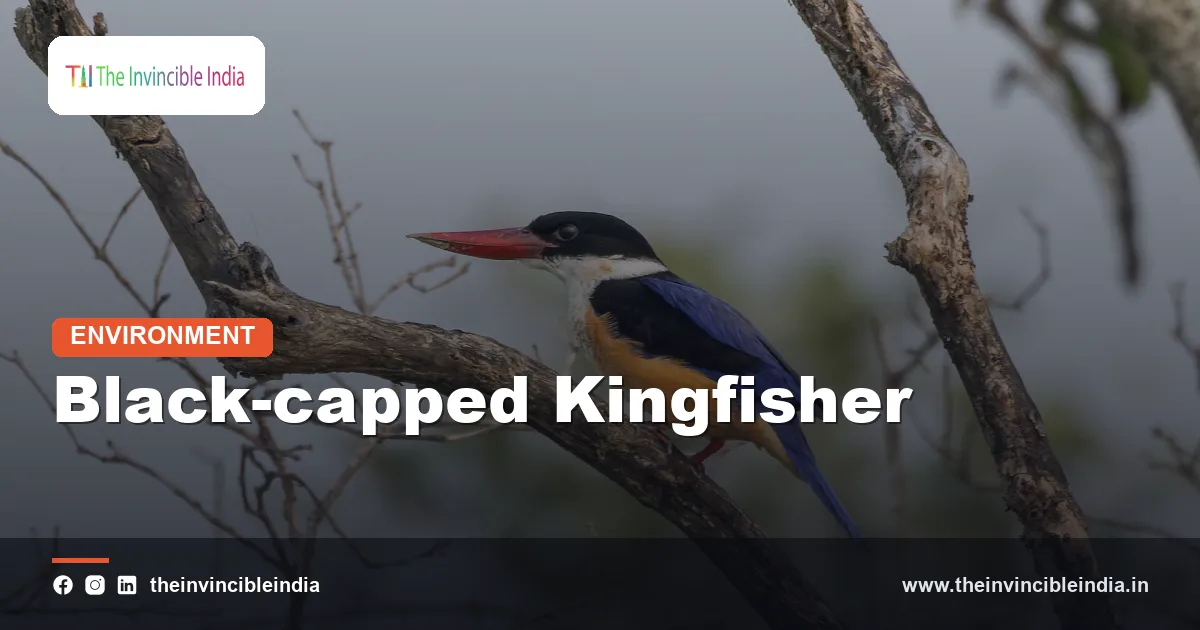
The black-capped kingfisher (Halcyon pileata) is a stocky, noisy kingfisher of Asian coasts and estuaries, easily recognised by its glossy black cap, deep purple-blue back, white collar and throat, orange-buff underparts and heavy coral-red bill. In India it is mainly a bird of mangroves, tidal creeks, backwaters and brackish lagoons, where it perches on a bare branch or post and watches the water for fish and crabs.
The black-capped kingfisher is larger and bulkier than the common kingfisher and is far more tied to saltwater and brackish habitats than the white-throated kingfisher. This explainer covers how to identify the bird, where it lives in India, what it eats, how it hunts and breeds, how it compares with other Indian kingfishers and where to look for it.
| Quick Facts: Black-capped Kingfisher | |
|---|---|
| Common name | Black-capped kingfisher |
| Scientific name | Halcyon pileata |
| Family | Alcedinidae (kingfishers), subfamily of tree kingfishers |
| Size | About 28-30 cm long; a medium-large kingfisher with a heavy bill |
| Key field marks | Black cap and face, purple-blue upperparts, white collar and throat, buff-orange belly, red bill, white wing patches in flight |
| India range and habitat | Coastal India, especially mangroves, estuaries, tidal creeks, backwaters and lagoons on both coasts and in the Sundarbans |
| Diet | Fish, crabs, prawns, large insects, frogs and other small animals |
| Breeding | Nests in tunnels dug into earth banks; breeds mainly in East Asia, so Indian birds are largely non-breeding visitors |
| Conservation status | Least Concern (IUCN); legally protected under the Wildlife (Protection) Act, 1972 |
Key Takeaways
- The black-capped kingfisher is a medium-large Asian kingfisher with a black cap, purple-blue back, white collar and red bill.
- The black-capped kingfisher is strongly associated with saltwater and brackish habitats such as mangroves, estuaries and tidal creeks.
- In India the black-capped kingfisher is mainly a non-breeding visitor to coastal wetlands, because the species breeds largely in East Asia.
- The black-capped kingfisher eats fish, crabs, prawns and large insects, which it catches by plunging from an exposed perch.
- The black-capped kingfisher shows a bold white wing patch and a black wingtip in flight, a reliable way to separate it from other Indian kingfishers.
- The black-capped kingfisher is classed as Least Concern by the IUCN, but it depends on healthy mangroves and coastal wetlands that are under pressure from development.
What is the black-capped kingfisher?
The black-capped kingfisher is a tree kingfisher in the family Alcedinidae, placed in the genus Halcyon alongside the white-throated kingfisher of Indian towns and fields. It is a stout, short-tailed bird with a large head and a thick, dagger-shaped red bill built for gripping slippery prey.
The species is widespread in tropical and subtropical Asia, from the coasts of the Indian subcontinent through Southeast Asia to eastern China and the Korean peninsula. Unlike the tiny common kingfisher that darts low over streams, the black-capped kingfisher is a bird of tidal shores and mangrove edges, and its size and loud voice make it easy to notice once you know where to look.
The English name comes from its most distinctive feature: a solid black cap that covers the crown, the face and the sides of the head. The scientific species name pileata refers to the same capped appearance, from a Latin word for a felt cap.
How can you identify the black-capped kingfisher?
You can identify the black-capped kingfisher by the combination of a jet-black head, a vivid purple-blue back and wings, a clean white throat and collar, and a strong red bill. The underparts below the white throat are warm orange-buff, and the legs and feet are red as well.
Key field marks
- Head: a black cap that reaches below the eye and ends sharply against the white collar and throat.
- Upperparts: glossy purple-blue on the back, wings and tail, which can look nearly black in poor light and electric blue in sunlight.
- Underparts: white throat and collar, followed by a buff to orange breast and belly.
- Bill: thick, long and coral red, noticeably heavier than the bill of a common kingfisher.
- In flight: a white patch at the base of the flight feathers, contrasting with black wingtips, and a blue back.
Male and female look very similar in the field. Young birds are duller, with a browner bill and some dusky barring on the breast, and they gradually acquire the full adult colours.
The black-capped kingfisher is most often confused with the white-throated kingfisher, which has a chestnut-brown head and body and a turquoise back, and with the stork-billed kingfisher, a bigger bird with a huge red bill, a brown head and a green-blue back. The black cap is the quickest clue.
Where does the black-capped kingfisher live in India?
The black-capped kingfisher lives along the coasts of India, in mangroves, estuaries, tidal creeks, backwaters and brackish lagoons, and it is rarely found far from the sea. It is recorded on both the east and west coasts and is a characteristic bird of the Sundarbans delta in West Bengal.
Within these coastal belts the bird prefers places where it has an open view of water from a perch. Typical habitats include:
- Mangrove forests with exposed roots and overhanging branches, such as the Sundarbans, Bhitarkanika in Odisha and the creeks of Maharashtra and Goa.
- Tidal creeks and mudflats where small fish and crabs are stranded or concentrated at low tide.
- Lagoons and backwaters such as Chilika in Odisha, the Kerala backwaters and the estuaries of peninsular rivers.
- Fish ponds, salt pans and aquaculture tanks near the coast, where perches and shallow water are easy to find.
Occasionally the black-capped kingfisher moves a short distance inland along large rivers and wetlands, especially in eastern India, but sightings far from tidal water are less usual. Its dependence on brackish and tidal habitats is one reason the species is useful as an indicator of coastal wetland health.
Is the black-capped kingfisher a resident or a migrant in India?
The black-capped kingfisher is mainly a non-breeding visitor to India, arriving in the cooler months from its breeding grounds further east, although some birds may be present through much of the year in favoured coastal areas. Bird records show the greatest numbers in the post-monsoon and winter period, roughly from autumn to early spring.
The breeding range of the species is centred in East Asia, including parts of China, Korea and neighbouring regions. Birds from the northern part of that range move south for the winter, while populations in tropical Asia are more settled. Because bird movements are complex and not fully tracked, observers describe the Indian status as a winter visitor in most coastal regions, with local variation.
For a bird watcher, the practical point is that the best season to look for the black-capped kingfisher in India is the winter half of the year, from about October to March. During this period coastal birding sites are also at their richest for waders, herons and other migrants, so a single trip can produce many species.
What does the black-capped kingfisher eat?
The black-capped kingfisher eats mainly fish and crabs, supplemented by prawns, large insects, frogs and other small animals. Its stout bill and strong build allow it to handle prey larger than the small fish taken by the common kingfisher.
Typical prey
- Fish: small estuarine fish, including mudskippers that stay on exposed mud at low tide.
- Crustaceans: fiddler crabs, other small crabs, shrimps and prawns found in creeks and on mudbanks.
- Insects and other invertebrates: large beetles, grasshoppers, dragonflies and similar prey picked from the ground or the air.
- Small vertebrates: frogs and occasionally small lizards or nestling birds.
The diet changes with the tide and the season. At low tide the black-capped kingfisher often forages on mudflats, taking crabs and mudskippers, while at high tide it works the edges of creeks and mangrove channels. Feeding on crustaceans is a clear difference from the common kingfisher, which relies almost entirely on tiny fish.
How does the black-capped kingfisher hunt?
The black-capped kingfisher hunts by sitting motionless on a perch, spotting prey on the water or mud, and then dropping or flying down to seize it with its bill. This sit-and-wait method uses little energy and works well in tidal habitats where food appears and disappears with the water level.
Typical hunting perches are bare mangrove branches, stakes, fishing nets, wires and posts close to the water. After catching a fish or crab, the bird usually returns to a perch and beats the prey against the branch to kill or stun it before swallowing. Hard-shelled crabs are often battered several times, and the bird may remove the claws before eating.
The black-capped kingfisher does not always dive completely under water. Many catches are made by a shallow plunge or by picking prey from the surface of the mud. Its flight is fast and direct, with rapid wingbeats, and the bird often calls loudly as it flies between perches.
Voice and behaviour
The call of the black-capped kingfisher is a loud, harsh, rattling cry, often written as a ringing laugh or a series of shrill notes. Birds call frequently from their perches and in flight, and the sound carries well across open water, which often reveals the bird before it is seen. Outside the breeding season individuals usually defend a feeding territory along a creek or shoreline and are seen alone or in pairs.
How does the black-capped kingfisher breed?
The black-capped kingfisher breeds by digging a nesting tunnel in an earth bank, and it does so mainly in the northern and eastern parts of its range rather than in India. Like many kingfishers, the pair excavates a horizontal burrow, often near water, with a small chamber at the end where the eggs are laid.
The clutch generally consists of a handful of round white eggs, which both parents incubate. After hatching, the chicks are fed fish, crabs and insects by both adults and leave the burrow when they are able to fly. Because most breeding takes place outside India, observers in India mostly see adults in non-breeding plumage and behaviour, though local breeding records are discussed by ornithologists in some regions.
Nesting banks are vulnerable to flooding, erosion and disturbance, and the loss of suitable river and estuary banks in the breeding range can affect the numbers that reach Indian wintering grounds.
How does the black-capped kingfisher differ from other Indian kingfishers?
The black-capped kingfisher differs from other Indian kingfishers mainly in its black cap, purple-blue back and brackish-water habitat. The table below compares it with three kingfishers that share some of its territory.
| Species | Size | Head and body | Bill | Typical habitat |
|---|---|---|---|---|
| Black-capped kingfisher | About 28-30 cm | Black cap, purple-blue back, white throat, buff belly | Heavy, red | Mangroves, estuaries, tidal creeks |
| White-throated kingfisher | About 27-28 cm | Chestnut head and belly, white throat and breast, turquoise back | Heavy, red | Fields, gardens, rivers, towns |
| Stork-billed kingfisher | About 35-38 cm | Brown head, green-blue back, buff underparts | Very large, red | Forest streams, rivers, mangroves |
| Common kingfisher | About 16-17 cm | Bright blue back, orange underparts, white neck patch | Slim, black | Streams, ponds, rivers |
The black-capped kingfisher is therefore a specialist of the tidal zone among India’s kingfishers, whereas the white-throated kingfisher is a generalist that thrives in open country and even in cities.
Is the black-capped kingfisher threatened?
The black-capped kingfisher is not currently considered threatened, because the IUCN lists it as Least Concern on account of its very large range and widespread presence across Asia. Its Indian population, however, depends on coastal habitats that continue to face pressure.
The main concerns for the species and its habitat include:
- Mangrove loss from coastal development, aquaculture ponds, reclamation and wood cutting.
- Pollution of creeks, estuaries and backwaters, which reduces fish and crab populations.
- Disturbance from boat traffic, fishing activity and tourism in sensitive sites.
- Bank destruction at nesting areas in the breeding range.
In India, kingfishers and other wild birds are protected by the Wildlife (Protection) Act, 1972, which prohibits hunting, trapping and trade. Protecting mangroves, such as those in the Sundarbans and Bhitarkanika, benefits the black-capped kingfisher along with fish, crabs, otters and many other coastal species.
Where can you see a black-capped kingfisher in India?
The best places to see a black-capped kingfisher in India are mangrove and estuarine sites on the coast, particularly during the winter months. Reliable areas include the Sundarbans in West Bengal, Bhitarkanika and Chilika in Odisha, the mangrove creeks near Mumbai, the estuaries of Goa, and the backwaters and coastal wetlands of Kerala and Tamil Nadu.
Tips for watching
- Visit in the cooler months, from about October to March, when numbers are highest.
- Scan exposed mangrove branches, stakes and wires along creeks, because the bird sits openly while hunting.
- Listen for the loud rattling call and then follow it with binoculars.
- Go out at low tide, when crabs and mudskippers are active and the bird forages on open mud.
- Keep a respectful distance and avoid disturbing the bird or damaging mangrove habitat.
A boat trip through a mangrove creek in the early morning is often the most productive method, as the perches along the channel edge give clear views at close range without flushing the bird.
Bottom Line
The black-capped kingfisher is the handsome, bold kingfisher of India’s tidal coasts, easy to recognise by its black cap, purple-blue back and red bill. It is mainly a winter visitor that feeds on fish and crabs, and its future in India is tied to the health of mangroves and estuaries.
Frequently Asked Questions
What is the black-capped kingfisher?
The black-capped kingfisher is a medium-large tree kingfisher with a black cap, purple-blue back, white throat and red bill. It lives along Asian coasts and is common in mangroves and estuaries. In India it is seen mostly on coastal wetlands in the cooler months.
How can you tell a black-capped kingfisher from a white-throated kingfisher?
You can tell them apart by the head: the black-capped kingfisher has a black cap, while the white-throated kingfisher has a chestnut-brown head and belly. The black-capped bird also has a deeper purple-blue back, whereas the white-throated kingfisher has a turquoise back. Both have heavy red bills, so the head colour and habitat are the best clues.
What does the black-capped kingfisher eat?
The black-capped kingfisher eats mainly fish and crabs, along with prawns, large insects and frogs. It often feeds on mudskippers and fiddler crabs on tidal mudflats. It hunts by sitting on a perch and swooping on prey.
Is the black-capped kingfisher found only on the coast in India?
The black-capped kingfisher is found mainly on the coast, in mangroves, estuaries, creeks and lagoons. It is only occasionally recorded some distance inland along large rivers and wetlands. Its strong link to saltwater and brackish habitats makes it a good indicator of coastal wetland health.
When is the best time to see the black-capped kingfisher in India?
The best time to see the black-capped kingfisher in India is the cooler half of the year, from about October to March. Most Indian birds are non-breeding visitors that arrive after the monsoon. Early mornings and low tide at mangrove creeks usually give the best views.
Is the black-capped kingfisher endangered?
The black-capped kingfisher is not endangered and is classified as Least Concern by the IUCN because of its wide range. However, it depends on mangroves and coastal wetlands, which face loss from development and pollution. In India the species is protected under the Wildlife (Protection) Act, 1972.
{“@context”:”https://schema.org”,”@graph”:[{“@type”:”FAQPage”,”mainEntity”:[{“@type”:”Question”,”name”:”What is the black-capped kingfisher?”,”acceptedAnswer”:{“@type”:”Answer”,”text”:”The black-capped kingfisher is a medium-large tree kingfisher with a black cap, purple-blue back, white throat and red bill. It lives along Asian coasts and is common in mangroves and estuaries. In India it is seen mostly on coastal wetlands in the cooler months.”}},{“@type”:”Question”,”name”:”How can you tell a black-capped kingfisher from a white-throated kingfisher?”,”acceptedAnswer”:{“@type”:”Answer”,”text”:”You can tell them apart by the head: the black-capped kingfisher has a black cap, while the white-throated kingfisher has a chestnut-brown head and belly. The black-capped bird also has a deeper purple-blue back, whereas the white-throated kingfisher has a turquoise back. Both have heavy red bills, so the head colour and habitat are the best clues.”}},{“@type”:”Question”,”name”:”What does the black-capped kingfisher eat?”,”acceptedAnswer”:{“@type”:”Answer”,”text”:”The black-capped kingfisher eats mainly fish and crabs, along with prawns, large insects and frogs. It often feeds on mudskippers and fiddler crabs on tidal mudflats. It hunts by sitting on a perch and swooping on prey.”}},{“@type”:”Question”,”name”:”Is the black-capped kingfisher found only on the coast in India?”,”acceptedAnswer”:{“@type”:”Answer”,”text”:”The black-capped kingfisher is found mainly on the coast, in mangroves, estuaries, creeks and lagoons. It is only occasionally recorded some distance inland along large rivers and wetlands. Its strong link to saltwater and brackish habitats makes it a good indicator of coastal wetland health.”}},{“@type”:”Question”,”name”:”When is the best time to see the black-capped kingfisher in India?”,”acceptedAnswer”:{“@type”:”Answer”,”text”:”The best time to see the black-capped kingfisher in India is the cooler half of the year, from about October to March. Most Indian birds are non-breeding visitors that arrive after the monsoon. Early mornings and low tide at mangrove creeks usually give the best views.”}},{“@type”:”Question”,”name”:”Is the black-capped kingfisher endangered?”,”acceptedAnswer”:{“@type”:”Answer”,”text”:”The black-capped kingfisher is not endangered and is classified as Least Concern by the IUCN because of its wide range. However, it depends on mangroves and coastal wetlands, which face loss from development and pollution. In India the species is protected under the Wildlife (Protection) Act, 1972.”}}]}]}


