

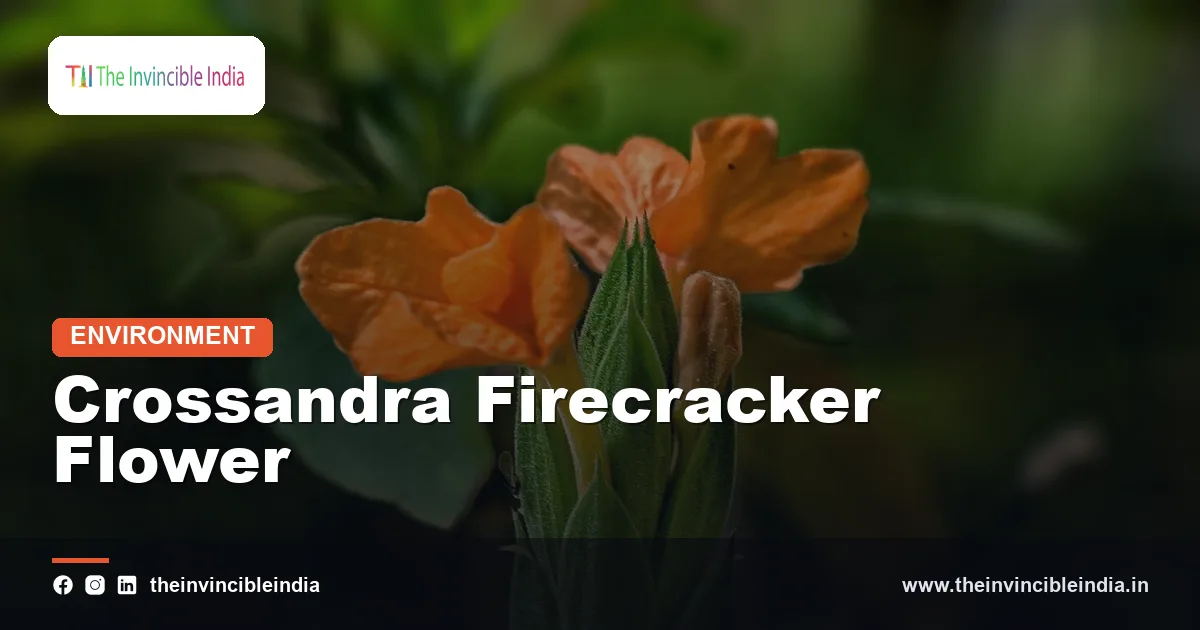
In South India, crossandra, widely known as the firecracker flower and called kanakambaram, is a small evergreen flowering shrub whose bright orange, fan-shaped blooms are strung into garlands and worn in the hair across Tamil Nadu, Karnataka, Andhra Pradesh, Telangana and Kerala. The plant belongs to the acanthus family, is native to the warm south of the subcontinent and Sri Lanka, and is grown both as a garden ornamental and as a commercial cut-flower crop.
Unlike jasmine or tuberose, crossandra carries almost no scent. Its value lies in colour, a long flowering season and the fact that the blooms hold their shape for hours after plucking, which makes them ideal for weaving. This explainer covers what crossandra is, how it grows, where it is cultivated in India, how it is used, and how to look after it.
Quick Facts
| Common names | Crossandra, firecracker flower, kanakambaram (Tamil, Telugu, Malayalam), kanakambara (Kannada), aboli (Marathi) |
|---|---|
| Scientific name | Crossandra infundibuliformis (a synonym, Crossandra undulifolia, is also seen) |
| Family | Acanthaceae (the acanthus family) |
| Native range | Southern India and Sri Lanka |
| Where grown in India | Tamil Nadu, Karnataka, Andhra Pradesh, Telangana, Kerala and parts of Maharashtra |
| Growth form | Perennial, evergreen, bushy shrub, usually 0.5 to 1 metre tall |
| Flowering | Nearly year-round in warm climates, in upright spikes of fan-shaped flowers |
| Flower colours | Orange, salmon, red-orange, yellow and, in some cultivars, a pale lemon shade |
| Main uses | Garlands and hair adornment, temple offerings, garden borders, pot plants and cut flowers |
Key Takeaways
- Crossandra infundibuliformis is a perennial shrub of the acanthus family, native to southern India and Sri Lanka.
- Kanakambaram, the South Indian name for crossandra, is the plant behind the orange flowers woven into garlands and hair adornments across the southern states.
- Crossandra flowers have little or no fragrance, and the plant is valued instead for its colour, its long flowering season and the durability of its blooms after picking.
- The nickname firecracker flower comes from the ripe seed capsule, which splits open with a snap and flings its seeds some distance from the plant.
- Crossandra thrives in warm, humid conditions with filtered light and well-drained soil, and it is damaged by frost, cold winds and waterlogged roots.
- Commercial crossandra cultivation in India is concentrated in the peninsula, where the flower is sold fresh in local markets by the strand or by weight.
What is crossandra?
Crossandra is a genus of flowering plants in the acanthus family, and the species most people mean is Crossandra infundibuliformis, a low, glossy-leaved shrub grown for its orange flower spikes. The genus name comes from two Greek roots meaning fringe and male, a reference to the fringed anthers of its flowers. The species name infundibuliformis means funnel-shaped and describes the narrow tube at the base of each bloom.
The genus contains roughly fifty species, mostly from tropical Africa, Madagascar and southern Asia. Only a few have entered gardens and trade, and the Indian species is by far the best known. In everyday use, crossandra almost always refers to the cultivated orange-flowered shrub rather than to the wild relatives.
The plant is an evergreen perennial. Its leaves are dark green, glossy and slightly wavy at the edges, arranged in opposite pairs along the stem. A mature plant forms a rounded clump rarely taller than a metre, which suits it to borders, pots and neat rows in a field.
Why is crossandra called the firecracker flower?
Crossandra is called the firecracker flower because of its blazing orange blooms and because its ripe seed pods burst open with a small explosive pop. The common name therefore captures two features at once: the colour that glows against dark green foliage and the mechanism by which the plant spreads its seeds.
The fruit is a small, hard capsule that dries on the plant. When it ripens and gets wet or dry enough, the walls of the capsule split suddenly and the seeds are thrown outwards. This kind of explosive dehiscence is common in the acanthus family and is a useful way for a plant to scatter seeds without depending on animals or wind. Gardeners who keep seed from their plants often tie a small paper bag around the ripening pods so that the seeds are caught rather than lost.
Other names in India
Crossandra has many regional names. In Tamil, Telugu and Malayalam it is kanakambaram, and in Kannada it is kanakambara. The word is usually understood to mean a golden or gold-coloured cloth, a reference to the golden-orange shade of the most common variety. In Maharashtra the flower is called aboli and is a favourite for hair adornment, especially among women in Pune and the Konkan region. English-language nurseries use firecracker flower and crossandra interchangeably.
What does a crossandra plant look like?
A crossandra plant is a compact, bushy shrub with glossy green leaves and upright spikes of fan-shaped flowers that open a few at a time from the base of the spike upward. The flowers have a slim tube that opens into a lopsided flat face made up of lobes, so that the bloom appears to fan out to one side.
The spikes arise from the tips of the stems and are made up of overlapping, green, slightly spiny bracts. Each bract shelters a bud, and the flowers emerge one by one from the lower bracts. Because the spike keeps opening over many days, a single stem can carry flowers for several weeks. This staggered habit is one reason the plant looks full and colourful for most of the year in warm regions.
Main colour forms seen in India include the following:
- Orange, the classic kanakambaram shade, ranging from deep saffron to a softer apricot.
- Salmon or coral, a paler pinkish-orange favoured in some nurseries.
- Red-orange, a rich shade that appears in selected cultivars.
- Yellow, from the cultivar often sold as Lutea, which is less common in garland markets than orange.
Where is crossandra grown in India?
Crossandra is grown mainly in the southern peninsular states, with Tamil Nadu, Karnataka, Andhra Pradesh and Telangana being the best-known centres, and smaller plantings in Kerala and Maharashtra. The plant fits regions with a warm to hot climate, moderate rainfall or reliable irrigation, and little or no frost.
Flower growing around Dindigul, Madurai and Coimbatore in Tamil Nadu, around Bengaluru and its surrounding districts in Karnataka, and in parts of coastal and interior Andhra Pradesh supplies the large flower markets of the south. Crossandra is typically cultivated on small and medium farms, often alongside jasmine, marigold and chrysanthemum, which gives growers a mix of fragrant and colour-led flowers to sell through the year.
In the north, crossandra is grown mostly as a pot plant or a seasonal bedding plant, because winter cold and frost interrupt flowering and can kill the shoots. In Indian botanical and horticultural research, the Indian Institute of Horticultural Research (IIHR) in Bengaluru has worked on improved flower crops, including crossandra cultivars selected for flower colour and yield.
How is crossandra used in Indian culture?
Crossandra is used mainly in garlands and hair adornment, and it is closely tied to everyday dress and festive traditions in South India. Strings of orange kanakambaram flowers, often alternated with white jasmine, are a familiar sight on women entering temples, attending weddings and walking through market streets in Chennai, Bengaluru, Hyderabad and Kochi.
The reasons for this popularity are practical. Crossandra blooms are light, flat and easy to thread on a string. They hold their form for many hours, so a garland made in the morning still looks fresh by evening. Because the flower does not have a strong scent, it combines well with fragrant flowers, and a common pairing is kanakambaram with jasmine or with the green fragrant leaves of davana.
The flower is also used in several other ways:
- Temple decoration, where garlands and loose flowers are used on idols and at entrances.
- Festive decoration, including door hangings and floral arrangements at weddings and religious events.
- Ornamental planting in gardens, courtyards and on terraces.
- Sale as a cut flower or in mixed bunches in local markets.
Crossandra is not a significant medicinal or food plant. Its role is decorative and cultural, and it should not be treated as an Ayurvedic remedy on the basis of its popularity as a flower.
How do you grow crossandra?
Crossandra grows best in warm, humid conditions with bright but filtered light, well-drained soil rich in organic matter, and regular watering that never leaves the roots standing in water. A temperature range of roughly 20 to 35 degrees Celsius suits the plant, and growth slows markedly when it turns cold.
Soil, light and water
A loose, loamy soil with plenty of compost is ideal, and a slightly acidic to neutral reaction suits the plant well. Heavy clay that holds water leads to root rot, which is the most common cause of failure among beginners. Partial shade is best in the hottest regions, since very harsh afternoon sun can scorch the leaf edges, while too much shade gives long, leggy stems and fewer flowers.
Water should be given regularly during the growing season, allowing the top layer of soil to dry slightly between waterings. In dry weather commercial growers irrigate frequently, because the plant flowers heavily and does not tolerate prolonged drought.
Propagation
Crossandra can be raised from seed or from stem cuttings. Seed is slow and uneven to germinate, so many nurseries prefer cuttings or choose seed lots with a reputation for good germination. Seedlings are transplanted to the field or to pots once they have developed several pairs of leaves.
Feeding and pruning
Regular light feeding with a balanced fertiliser supports continuous flowering. Pinching back the tips of young plants encourages branching, and light pruning after a heavy flush of flowers keeps the shrub compact. Removing old spikes also encourages fresh flowering shoots.
What are the common problems with crossandra?
The common problems with crossandra are root rot from overwatering, poor flowering from too much shade or cold, and attacks from pests such as mealybugs, whiteflies and spider mites. Most of these problems can be avoided with good drainage, correct spacing and attention to the plant in the early stages of infestation.
The table below summarises the typical problems and the usual responses.
| Problem | Likely cause | Usual remedy |
|---|---|---|
| Yellowing leaves and soft stems | Waterlogged soil or root rot | Improve drainage, reduce watering, avoid heavy soil |
| Few flowers, long leggy growth | Too much shade or excess nitrogen | Move to brighter light, balance the feed |
| Brown scorched leaf edges | Harsh midday sun or dry air | Give light shade, water more regularly |
| Sticky leaves and white cottony patches | Mealybugs or whiteflies | Wash off with water, use soap spray or recommended treatments |
| Fine webbing and speckled leaves | Spider mites in dry, hot weather | Raise humidity, wash the leaves, treat if severe |
| Wilting and dying shoots in winter | Frost or prolonged cold | Shelter the plant indoors or in a warm spot |
Wilt diseases caused by soil fungi are also reported in crossandra fields, and growers manage them through crop rotation, clean planting material and well-drained beds.
How does crossandra compare with other garland flowers?
Crossandra differs from other Indian garland flowers mainly in being unscented but long-lasting and brightly coloured, whereas jasmine and tuberose are valued for fragrance and marigold for its sturdy, showy heads. Each flower plays a different role in a garland or a temple offering, and many traditional garlands combine several of them.
| Flower | Main appeal | Fragrance | Typical colours |
|---|---|---|---|
| Crossandra (kanakambaram) | Colour and durability | Very faint or none | Orange, salmon, yellow |
| Jasmine (mallige, malli) | Fragrance | Strong and sweet | White |
| Marigold (genda) | Large showy heads, easy cultivation | Mild, earthy | Yellow, orange |
| Tuberose (rajnigandha) | Fragrance and long stalks | Strong, heavy | White |
The practical lesson for growers is that crossandra serves the colour end of the flower trade. It sells steadily because it complements fragrant flowers rather than competing with them.
Is crossandra good for gardens and pots?
Crossandra is a good choice for gardens and pots in warm regions because it is compact, tolerant of partial shade, free-flowering and easy to maintain. It fits borders, containers on balconies, and mixed plantings with foliage plants such as ferns or coleus.
Gardeners in cooler regions grow it as a seasonal plant or bring it indoors for winter. Indoors it needs a bright position and regular watering without soggy soil. The plant is considered safe to grow around homes in general, although, as with any ornamental, small children and pets should not be allowed to chew on it. Because the foliage stays attractive even when the plant is not in flower, crossandra gives structure to a planting between flushes of bloom.
Why does crossandra matter?
Crossandra matters because it supports a livelihood chain of small flower growers, market vendors and garland makers in South India, and because it is a living part of everyday cultural practice. Flower farming gives regular income to small landholders, since crossandra can be harvested daily over many months once the plants are established.
The crop also illustrates how a plant native to the region can become a commercially important ornamental. Its natural range in southern India and Sri Lanka matches the zones where it is grown today, and its demand in markets depends on festivals, weddings and everyday dress rather than on export. For readers interested in India’s plant heritage, crossandra is a reminder that important cultural plants are not always fragrant, rare or ancient; sometimes they are simply cheerful, hardy and reliable.
Bottom Line
Crossandra is the orange firecracker flower of South India, a hardy acanthus shrub grown for garlands, hair adornment and garden colour. It prefers warmth, light shade and well-drained soil, and it rewards simple care with months of flowers.
Frequently Asked Questions
What is crossandra?
Crossandra is a flowering shrub of the acanthus family, best known for its bright orange, fan-shaped flowers. The cultivated species is Crossandra infundibuliformis, which is native to southern India and Sri Lanka. In India it is mostly grown for garlands, hair adornment and garden decoration.
Why is crossandra called kanakambaram?
Crossandra is called kanakambaram in Tamil, Telugu and Malayalam because the name is generally understood to mean a golden-coloured cloth, which matches the golden-orange of the most common flowers. In Kannada it is kanakambara, and in Marathi it is aboli. All these names refer to the same plant.
Does crossandra have a fragrance?
No, crossandra has little or no fragrance. It is valued for its colour and for the way its flowers stay fresh for many hours. This is why it is often woven together with scented flowers such as jasmine.
How often does crossandra flower?
Crossandra can flower for most of the year in warm climates, producing new flower spikes in repeated flushes. Flowering slows or stops in cold weather and when the plant is shaded too much. Light pruning and regular feeding help the plant keep producing blooms.
Can crossandra be grown in pots?
Yes, crossandra grows well in pots if the container has good drainage and the potting mix is loose and rich in compost. The pot should sit in bright but filtered light, and the soil should be kept moist but not waterlogged. In cooler regions the pot can be moved indoors during winter.
Where is crossandra commonly cultivated in India?
Crossandra is commonly cultivated in the southern states, especially Tamil Nadu, Karnataka, Andhra Pradesh and Telangana, with some cultivation in Kerala and Maharashtra. These regions have the warm climate and steady demand for garlands that the crop needs. In the north it is grown mainly as a pot or seasonal plant.
{“@context”:”https://schema.org”,”@graph”:[{“@type”:”FAQPage”,”mainEntity”:[{“@type”:”Question”,”name”:”What is crossandra?”,”acceptedAnswer”:{“@type”:”Answer”,”text”:”Crossandra is a flowering shrub of the acanthus family, best known for its bright orange, fan-shaped flowers. The cultivated species is Crossandra infundibuliformis, which is native to southern India and Sri Lanka. In India it is mostly grown for garlands, hair adornment and garden decoration.”}},{“@type”:”Question”,”name”:”Why is crossandra called kanakambaram?”,”acceptedAnswer”:{“@type”:”Answer”,”text”:”Crossandra is called kanakambaram in Tamil, Telugu and Malayalam because the name is generally understood to mean a golden-coloured cloth, which matches the golden-orange of the most common flowers. In Kannada it is kanakambara, and in Marathi it is aboli. All these names refer to the same plant.”}},{“@type”:”Question”,”name”:”Does crossandra have a fragrance?”,”acceptedAnswer”:{“@type”:”Answer”,”text”:”No, crossandra has little or no fragrance. It is valued for its colour and for the way its flowers stay fresh for many hours. This is why it is often woven together with scented flowers such as jasmine.”}},{“@type”:”Question”,”name”:”How often does crossandra flower?”,”acceptedAnswer”:{“@type”:”Answer”,”text”:”Crossandra can flower for most of the year in warm climates, producing new flower spikes in repeated flushes. Flowering slows or stops in cold weather and when the plant is shaded too much. Light pruning and regular feeding help the plant keep producing blooms.”}},{“@type”:”Question”,”name”:”Can crossandra be grown in pots?”,”acceptedAnswer”:{“@type”:”Answer”,”text”:”Yes, crossandra grows well in pots if the container has good drainage and the potting mix is loose and rich in compost. The pot should sit in bright but filtered light, and the soil should be kept moist but not waterlogged. In cooler regions the pot can be moved indoors during winter.”}},{“@type”:”Question”,”name”:”Where is crossandra commonly cultivated in India?”,”acceptedAnswer”:{“@type”:”Answer”,”text”:”Crossandra is commonly cultivated in the southern states, especially Tamil Nadu, Karnataka, Andhra Pradesh and Telangana, with some cultivation in Kerala and Maharashtra. These regions have the warm climate and steady demand for garlands that the crop needs. In the north it is grown mainly as a pot or seasonal plant.”}}]}]}


