

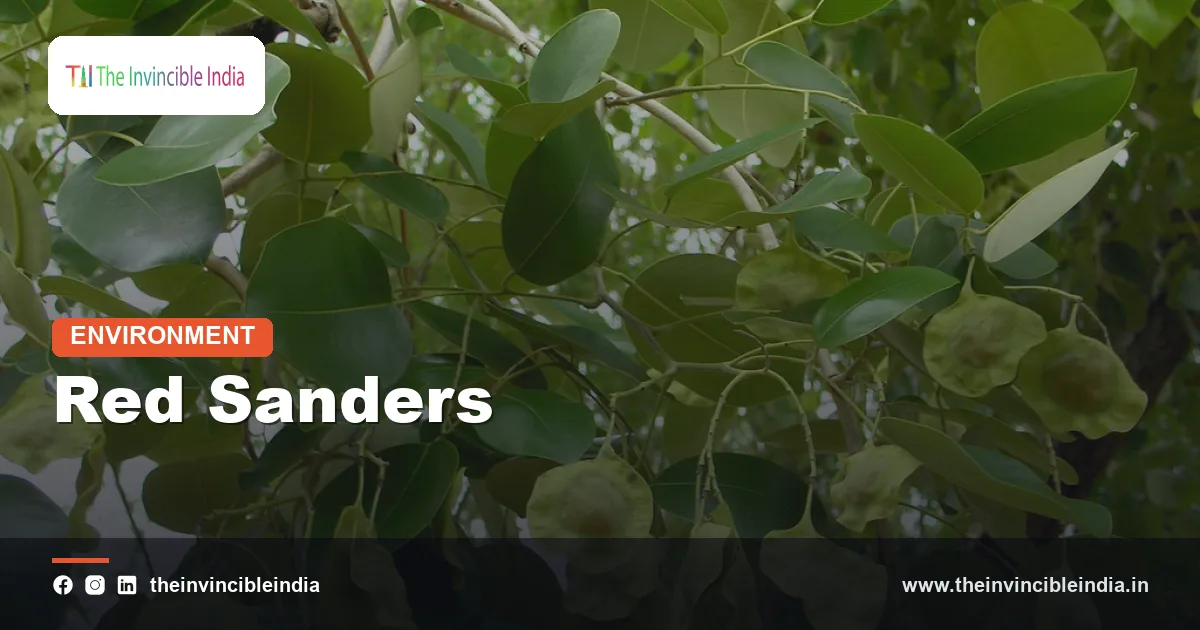
In India, red sanders, also called red sandalwood or rakta chandan, is a slow-growing tree, Pterocarpus santalinus, that is endemic to a limited stretch of the Eastern Ghats in southern Andhra Pradesh and is prized for its dense, deep red heartwood. Despite the name, the tree is not a true sandalwood: it belongs to the pea family, and its wood is valued for its colour, density and natural dye rather than for fragrance.
Red sanders is one of the most heavily protected timber species in India because of the high prices its wood fetches in international markets and the illegal felling this has encouraged. This explainer covers what the tree is, where it grows, how it differs from true sandalwood, how its wood is used, and how it is protected under Indian and international rules.
Quick Facts
| Common names | Red sanders, red sandalwood, rakta chandan or lal chandan (Hindi), raktachandana (Sanskrit), erra chandanam (Telugu), sivappu chandanam (Tamil) |
|---|---|
| Scientific name | Pterocarpus santalinus |
| Family | Fabaceae (the pea or legume family) |
| Native range | Endemic to the Eastern Ghats of southern Andhra Pradesh, in districts such as Kadapa, Chittoor, Kurnool and Nellore, with the Seshachalam hills as the best-known area |
| Tree form | Small to medium deciduous tree, often 5 to 10 metres tall, with a rough dark bark and compound leaves of three leaflets |
| Wood | Very hard, dense, fine-grained heartwood that is deep red to purplish-brown and largely unscented |
| Main uses | Fine furniture, carved items, musical instruments, natural red dye, cosmetics and traditional medicine |
| Conservation status | Listed in CITES Appendix II; assessed as Endangered in earlier IUCN assessments and as Near Threatened in a later reassessment |
| Protection | Strict forest laws, export controls and a dedicated anti-smuggling task force in Andhra Pradesh |
Key Takeaways
- Red sanders is the common name for Pterocarpus santalinus, a tree of the pea family that is endemic to the Eastern Ghats of southern Andhra Pradesh.
- Red sanders is not related to true sandalwood, Santalum album, and its deep red heartwood is valued for colour and hardness rather than for fragrance.
- The heartwood of red sanders contains red pigments called santalins, which have long been used as a natural dye for cloth, food and cosmetics.
- International trade in red sanders is regulated under CITES Appendix II, and India controls its export and transport through strict forest and trade rules.
- Illegal felling and smuggling have been the main threats to red sanders, which led Andhra Pradesh to create a dedicated task force against smuggling.
- Red sanders is slow-growing and its heartwood forms only after many years, so the species recovers slowly once mature trees are removed.
What is red sanders?
Red sanders is a medium-sized tree, Pterocarpus santalinus, that grows only in a small region of the southern Eastern Ghats in India and is known for its heavy, deep red heartwood. The tree belongs to the Fabaceae family, the same large family that includes peas, beans, tamarind and rosewood.
The common name red sanders comes from the older English word sanders, used for sandalwood, together with the red colour of the wood. The tree is also called red sandalwood, and the Sanskrit and Hindi names raktachandana and rakta chandan literally mean red sandal. These names reflect the similarity in cultural use of the wood to that of white sandalwood, but they do not indicate a botanical relationship.
The genus Pterocarpus includes several timber trees found in tropical Asia, Africa and the Americas. In India other members include Pterocarpus marsupium (the Indian kino tree or bijasal) and Pterocarpus dalbergioides (the Andaman padauk). Red sanders differs from these in its restricted range and its richly coloured, very dense heartwood.
Where does red sanders grow?
Red sanders grows naturally only in a restricted belt of the Eastern Ghats in southern Andhra Pradesh, in dry, hilly and rocky terrain, mainly in the Seshachalam and Palakonda ranges and neighbouring areas of Kadapa, Chittoor, Kurnool and Nellore districts. This narrow distribution is why the species is called endemic to India.
The region has a hot, semi-arid climate, with a long dry season and moderate monsoon rainfall, and the soils are poor, shallow, gravelly and red. Red sanders is adapted to these tough conditions. It can grow on rocky slopes where few other timber trees thrive, and it is often found mixed with other dry deciduous species.
The Seshachalam hills, near Tirupati, are recognised as an important habitat, and the Seshachalam region has been designated a biosphere reserve. The tree has also been planted in other parts of southern India, including parts of Tamil Nadu and Karnataka, and in some other tropical countries, but the natural population is confined to Andhra Pradesh and its immediate surroundings.
What does a red sanders tree look like?
A red sanders tree is a small to medium deciduous tree with rough, dark bark, a rounded crown and compound leaves made up of three leaflets, and it bears small yellow flowers followed by flat, winged pods. The tree is usually between 5 and 10 metres tall, though old trees can be larger.
The trunk is often crooked, and the bark is dark brown to blackish and fissured. The wood has a thin pale sapwood outside and a dark red to purplish-brown heartwood inside, and cutting a log reveals this striking contrast. The leaves are glossy and the tree sheds them in the dry season.
The flowers are small and yellow, borne in clusters, and they are followed by round, flat pods with a wing around the seed. The wing helps the pod to travel short distances in the wind. Because the tree grows slowly and flowers only after some years, natural regeneration is gradual.
How is red sanders different from true sandalwood?
Red sanders differs from true sandalwood in family, colour, scent and use: red sanders is a legume tree with dark red, mostly unscented heartwood, whereas sandalwood is a hemiparasitic tree of the sandalwood family with pale, strongly fragrant heartwood. The two trees are often confused because of the shared word sandal in their names.
| Feature | Red sanders | Sandalwood (white sandalwood) |
|---|---|---|
| Scientific name | Pterocarpus santalinus | Santalum album |
| Family | Fabaceae (pea family) | Santalaceae (sandalwood family) |
| Heartwood colour | Deep red to purplish-brown | Pale yellow to light brown |
| Fragrance | Little or none | Strong, lasting fragrance |
| Main value | Timber, dye, instruments | Oil, incense, ritual paste |
| Natural range in India | Eastern Ghats of southern Andhra Pradesh | Peninsular India, especially Karnataka and Tamil Nadu |
| Parasitic habit | None | Hemiparasite on host roots |
Red sanders and sandalwood may both be used in rituals, and both can be ground into a paste, but they are separate species with different laws and markets. Buyers who want fragrance should not expect it from red sanders.
What is red sanders used for?
Red sanders is used for making fine furniture, carved items, musical instruments, natural red dye and traditional medicines, as well as for ritual and cosmetic purposes. The combination of a hard, dense, fine-grained wood and a rich colour that deepens with polishing makes it a luxury material.
Furniture and craft
The heartwood takes a high polish and is used for decorative furniture, carved figurines and inlaid work. Its hardness and fine grain also suit small ornamental objects. Because the wood is costly, it is generally reserved for high-value pieces rather than everyday items.
Musical instruments
The wood is valued for the necks and other parts of certain stringed instruments, including the Japanese shamisen, and this overseas demand is a key driver of the international market. Traditional furniture in East Asia has also long used rich, dark red woods.
Dye, cosmetics and medicine
The red colour of the heartwood comes from pigments called santalins. Powdered red sanders has been used as a natural dye for textiles, as a colouring in foods and sweets, and as an ingredient in cosmetics and face packs. In Ayurveda, rakta chandan is used in pastes and preparations for its cooling character. These uses reflect traditional practice and should not be taken as medical advice.
Ritual use
Red sanders paste is applied as a tilak in some traditions and offered to deities, and the wood has symbolic importance in several rituals.
Why is red sanders so heavily protected?
Red sanders is heavily protected because its high value has led to large-scale illegal felling and smuggling, which has reduced mature trees in the wild, and because the species grows in a very small natural range. A tree that is slow to mature and restricted in distribution cannot easily replace what is removed.
The demand comes largely from overseas markets, particularly in East Asia, where the wood is used for furniture, instruments and traditional items. Because the wood is heavy and its price is high, smugglers have targeted forests in Andhra Pradesh and moved logs across state borders and ports.
The IUCN Red List assessed the species as Endangered in earlier assessments, and a later reassessment placed it in the Near Threatened category. Regardless of the category, the species remains subject to strict controls because of its vulnerability and its market value.
What laws protect red sanders?
Red sanders is protected by state forest laws in Andhra Pradesh and other states, by national export controls on the wood, and by its listing in Appendix II of the Convention on International Trade in Endangered Species of Wild Fauna and Flora (CITES). Together these rules restrict felling, transport, sale and export.
CITES Appendix II covers species that may become threatened unless trade is controlled. For red sanders, exports require permits showing that the wood was legally and sustainably sourced. In India, the export of red sanders in the form of logs and many products is prohibited or tightly restricted, with limited exceptions for authorised sales of seized or legally held stock.
Andhra Pradesh set up a Red Sanders Anti-Smuggling Task Force in 2014 to patrol forests, investigate cases and prosecute offenders. Forest departments also use patrolling, watchtowers, technology and cooperation with neighbouring states and customs authorities. Seized wood is generally stored by the state and may be sold through approved auctions under central government rules.
Can red sanders be grown on farms?
Red sanders can be grown on farms and plantations, and several states have encouraged cultivation to reduce pressure on wild stands, but growers must follow state rules on registration, felling and transport. The tree is slow-growing, so farmers need patience and security over many years.
Plantations in southern India use seedlings raised in nurseries and planted on dry, well-drained soils, often with attention to protection from fire and grazing. The tree tolerates drought but does poorly in waterlogged soil. Heartwood forms with age, and the proportion of coloured heartwood increases over the decades, so the timing of harvest affects value.
Legal clarity is important for growers. Rules on cutting and selling cultivated red sanders have changed over time, and farmers should check with the state forest department and the relevant authorities before planting or harvesting.
What is the ecological role of red sanders?
Red sanders is a hardy tree of dry Eastern Ghats forests that stabilises rocky soil, provides flowers for pollinating insects and forms part of the local dry deciduous forest community. Its roots help to hold thin, gravelly slopes together, which matters on the steep hills where it grows.
The tree’s restricted range makes it a species of special conservation importance. Protecting the Seshachalam and neighbouring forests protects not only red sanders but also the plants and animals that share these hills. Conservation efforts therefore combine law enforcement with community engagement, since people living near the forest are essential partners in protecting it, and economic hardship has been reported as one reason some are drawn into illegal felling.
How long does red sanders take to mature?
Red sanders takes a long time to mature, and the coloured heartwood that gives the tree its commercial value usually develops only over several decades. Young trees have mostly pale wood, and the dark red core widens gradually as the trunk thickens.
This slow pace affects both conservation and farming. A tree cut when young yields little valuable timber, while a tree allowed to grow produces a larger, richer core. Illegal felling is especially damaging because it removes the oldest and best trees, which are also the main seed producers. Recovery of a forest stand after heavy felling can therefore take generations.
The key points about the growth cycle can be summarised as follows.
- Seeds germinate slowly and seedlings grow gradually in dry, rocky soil.
- Flowering and fruiting begin only after the tree has put on several years of growth.
- Heartwood formation and its depth of colour increase with age.
- Fire, grazing and felling in the early years can wipe out regeneration.
Bottom Line
Red sanders is an endemic Indian tree of the Eastern Ghats whose deep red heartwood is prized for furniture, dye and instruments. Its value, slow growth and narrow range explain why it is closely guarded by Indian forest law and by CITES rules.
Frequently Asked Questions
What is red sanders?
Red sanders is the common name for Pterocarpus santalinus, a tree of the pea family that is endemic to the Eastern Ghats of southern Andhra Pradesh. It is valued for its dense, deep red heartwood, which is used for furniture, instruments and natural dye. It is also called red sandalwood or rakta chandan.
Is red sanders the same as sandalwood?
No, red sanders is not the same as sandalwood. Red sanders belongs to the pea family and has red, mostly unscented heartwood, while true sandalwood belongs to the sandalwood family and has pale, fragrant heartwood. The two trees are unrelated despite the similar names.
Where is red sanders found?
Red sanders is found naturally in a limited area of the Eastern Ghats in southern Andhra Pradesh, especially the Seshachalam hills and neighbouring districts such as Kadapa, Chittoor, Kurnool and Nellore. It has also been planted elsewhere in southern India. The wild population is confined to this small region.
Why is red sanders so expensive?
Red sanders is expensive because the tree grows slowly, has a very limited natural range and produces a rare, dense red heartwood in high demand abroad. Strict legal controls limit legal supply. Illegal trade and overseas demand have also pushed prices up.
Is it legal to export red sanders from India?
Export of red sanders from India is tightly restricted and, for logs and many products, generally prohibited, with limited exceptions for authorised sales of legally held stock. The species is also listed in CITES Appendix II, so international trade requires permits. Anyone dealing in the wood should confirm the current rules with the forest and trade authorities.
What is red sanders used for?
Red sanders is used for fine furniture, carved items, musical instruments, natural red dye, cosmetics and traditional medicine. The red pigment in the heartwood, santalin, is the source of the dye. It is also used in some rituals as a paste.
{“@context”:”https://schema.org”,”@graph”:[{“@type”:”FAQPage”,”mainEntity”:[{“@type”:”Question”,”name”:”What is red sanders?”,”acceptedAnswer”:{“@type”:”Answer”,”text”:”Red sanders is the common name for Pterocarpus santalinus, a tree of the pea family that is endemic to the Eastern Ghats of southern Andhra Pradesh. It is valued for its dense, deep red heartwood, which is used for furniture, instruments and natural dye. It is also called red sandalwood or rakta chandan.”}},{“@type”:”Question”,”name”:”Is red sanders the same as sandalwood?”,”acceptedAnswer”:{“@type”:”Answer”,”text”:”No, red sanders is not the same as sandalwood. Red sanders belongs to the pea family and has red, mostly unscented heartwood, while true sandalwood belongs to the sandalwood family and has pale, fragrant heartwood. The two trees are unrelated despite the similar names.”}},{“@type”:”Question”,”name”:”Where is red sanders found?”,”acceptedAnswer”:{“@type”:”Answer”,”text”:”Red sanders is found naturally in a limited area of the Eastern Ghats in southern Andhra Pradesh, especially the Seshachalam hills and neighbouring districts such as Kadapa, Chittoor, Kurnool and Nellore. It has also been planted elsewhere in southern India. The wild population is confined to this small region.”}},{“@type”:”Question”,”name”:”Why is red sanders so expensive?”,”acceptedAnswer”:{“@type”:”Answer”,”text”:”Red sanders is expensive because the tree grows slowly, has a very limited natural range and produces a rare, dense red heartwood in high demand abroad. Strict legal controls limit legal supply. Illegal trade and overseas demand have also pushed prices up.”}},{“@type”:”Question”,”name”:”Is it legal to export red sanders from India?”,”acceptedAnswer”:{“@type”:”Answer”,”text”:”Export of red sanders from India is tightly restricted and, for logs and many products, generally prohibited, with limited exceptions for authorised sales of legally held stock. The species is also listed in CITES Appendix II, so international trade requires permits. Anyone dealing in the wood should confirm the current rules with the forest and trade authorities.”}},{“@type”:”Question”,”name”:”What is red sanders used for?”,”acceptedAnswer”:{“@type”:”Answer”,”text”:”Red sanders is used for fine furniture, carved items, musical instruments, natural red dye, cosmetics and traditional medicine. The red pigment in the heartwood, santalin, is the source of the dye. It is also used in some rituals as a paste.”}}]}]}


