

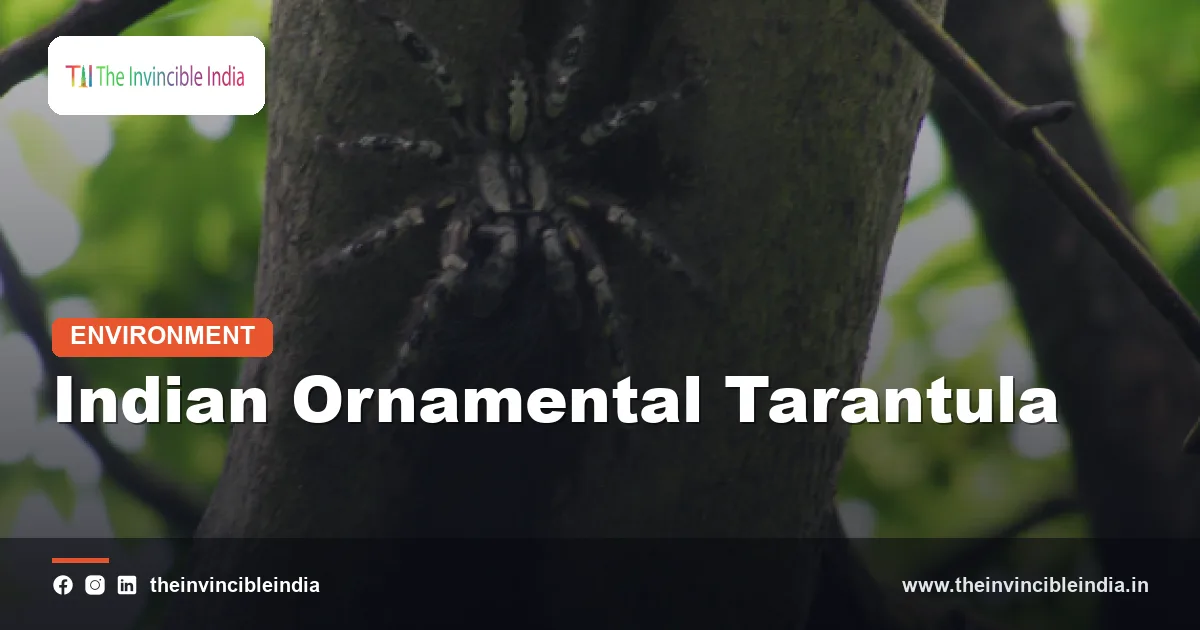
An Indian ornamental tarantula is a large, tree-dwelling spider of the genus Poecilotheria, family Theraphosidae, found in the forests of the Western and Eastern Ghats and neighbouring parts of southern India, and recognised by the intricate, banded patterns on its long legs. The name “ornamental” refers to this decoration, and the genus is often nicknamed “pokies” by hobbyists.
Although Indian ornamental tarantulas are shy, secretive animals that spend their lives in tree hollows and behind loose bark, several species are threatened by loss of forest and illegal collection. This article explains what an Indian ornamental tarantula is, how it lives and hunts, which species occur in India, how dangerous its venom is, and why its conservation matters.
Quick Facts
| Common name | Indian ornamental tarantula (genus Poecilotheria; also called ornamental tree spider) |
|---|---|
| Scientific classification | Class Arachnida; order Araneae; family Theraphosidae; genus Poecilotheria |
| Size | Body roughly 5 to 7 cm; leg span of about 15 to 20 cm in the larger species |
| Habitat in India | Tropical forests of the Western Ghats and Eastern Ghats and parts of southern and eastern India, in tree holes and under bark |
| Diet | Large insects such as beetles, crickets and moths, plus lizards, geckos and other small vertebrates |
| Life cycle | Egg sac, spiderlings, repeated moulting; females live many years, males much less |
| Ecological role | Arboreal ambush predator of insects and small vertebrates in forest canopy and trunks |
| Notable features | Patterned legs, fast and defensive behaviour, silk-lined retreats and medically significant but non-lethal venom |
Key Takeaways
- The Indian ornamental tarantula belongs to the genus Poecilotheria in the family Theraphosidae and is a tree-dwelling spider rather than a ground burrower.
- Indian ornamental tarantulas are found mainly in the Western Ghats, the Eastern Ghats and the forests of southern India, and a few species have very small ranges.
- The venom of an Indian ornamental tarantula can cause severe pain, cramps and swelling, but it is not known to have caused human deaths.
- Female Indian ornamental tarantulas can live well over a decade, whereas males usually live only a few years after reaching maturity.
- The Gooty sapphire ornamental tarantula, Poecilotheria metallica, is assessed as Critically Endangered because it is known from a very small area of forest in Andhra Pradesh.
- Habitat loss from felling of old trees and illegal collection for the pet trade are the main threats to Indian ornamental tarantulas.
What is an Indian ornamental tarantula?
An Indian ornamental tarantula is any member of the genus Poecilotheria that occurs in India, a group of large, fast, arboreal tarantulas whose legs are marked with contrasting bands, spots and patches. The genus belongs to the family Theraphosidae, the true tarantulas, in the order Araneae, which contains all spiders.
The genus Poecilotheria comprises roughly a dozen or more species, and all are native to India and Sri Lanka. The name comes from Greek words meaning “variegated” and “wild animal”, an apt description of the patterned creatures. Several are found only in India, and some have very restricted distributions inside the Ghats. The group is sometimes called the “Old World arboreal tarantulas”, to separate it from the many ground-dwelling tarantulas of the Americas.
Unlike the hairy tarantulas of films, Indian ornamental species are slender-legged and fast-moving. They are quite different from the heavy-bodied burrowing tarantulas of dry regions, and they spend most of their life above the ground.
What does an Indian ornamental tarantula look like?
An Indian ornamental tarantula has a moderately sized body covered with short hairs, long legs with strongly contrasting patterns, and a broad carapace marked by pale or dark bands, depending on the species. The underside of the front legs often carries bright yellow, orange or white patches that may be visible when the spider is threatened.
The key physical features include:
- Size: The body length of adults is around five to seven centimetres, and the leg span in large females can be fifteen to twenty centimetres.
- Colour: Overall shades range from grey, silver and brown to metallic blue-violet in a few species, with patterns on the legs that look like a mix of stripes and blotches.
- Legs: Long, slender legs with hairs and scopulae (adhesive pads) that allow the spider to run up smooth bark and even glass.
- Abdomen: A patterned abdomen, often with a central folium of dark markings.
Some individuals are strikingly blue. This colour is not a pigment, but arises from tiny structures on the hairs, which reflect certain wavelengths of light. The effect is called structural colour, and it explains why the sheen changes when the spider is seen from different angles.
Where does the Indian ornamental tarantula live?
The Indian ornamental tarantula lives in tropical and subtropical forests, mostly in the hill ranges of southern India known as the Western Ghats and Eastern Ghats, where it shelters in old, large trees. The spiders prefer deep hollows, crevices and spaces behind peeling bark, which they line with silk.
Different species occupy different regions. The table below summarises some of the best-known species.
| Species | Common name | Region in India |
|---|---|---|
| Poecilotheria metallica | Gooty sapphire ornamental tarantula | Small forest area near Gooty in the Eastern Ghats of Andhra Pradesh |
| Poecilotheria regalis | Indian ornamental tarantula | Forests of southern India, including parts of the Eastern Ghats |
| Poecilotheria striata | Mysore ornamental tarantula | Western Ghats of Karnataka, Kerala and Tamil Nadu |
| Poecilotheria rufilata | Red slate ornamental tarantula | Western Ghats, mainly Kerala and parts of Karnataka |
| Poecilotheria formosa | Salem ornamental tarantula | Eastern Ghats region of Tamil Nadu |
The most celebrated is the Gooty sapphire, which was first described in 1899 from a specimen collected near Gooty. For over a century, scientists knew of it from the single specimen until live spiders were located again in the early twenty-first century. Its range is very small and scattered, which makes it especially vulnerable.
How does an Indian ornamental tarantula hunt and feed?
An Indian ornamental tarantula hunts at night by ambush, waiting near the entrance of its retreat or moving along a trunk until it senses a passing animal, then seizing it with a quick strike. The spider detects prey by vibrations and touch through the hairs on its legs, since its eyesight is poor.
The spider bites with a pair of large fangs, called chelicerae, that inject venom to subdue the prey. It then secretes digestive enzymes into the victim and sucks up the liquefied tissues, leaving behind a small pellet of undigested remains. Typical prey includes large beetles, crickets, cockroaches, moths and caterpillars. Larger spiders can also kill geckos, lizards and small tree frogs, and there are occasional reports of them taking small birds or bats.
Tarantulas can survive for many weeks without feeding. After a good meal, an adult may not need to feed again for a fortnight or longer, and the animal’s slow metabolism helps it to endure poor seasons. Water is obtained from prey and from dew or rain on bark.
How does the life cycle of an Indian ornamental tarantula work?
The Indian ornamental tarantula grows through repeated moulting from a spiderling to an adult, and the female lays eggs in a silk sac that she guards until the young hatch. Spiders do not undergo metamorphosis in the way insects do; they simply moult their hard outer skin, or exoskeleton, as they grow.
Mating and eggs
When a male reaches maturity, he stops feeding and wanders in search of a female, which is when he is most likely to be seen on the ground or inside buildings near forests. He approaches the female’s retreat cautiously, since females may attack and eat males. After mating, the female lays an egg sac with from around fifty to over a hundred eggs, depending on size and species, and guards it for several weeks until the spiderlings hatch.
Spiderlings and adults
The young leave the sac after their first moults and disperse. They may take two to four years to reach maturity, depending on food and climate. Males generally die within a year or two after the final moult, whereas females continue to moult occasionally and may live fifteen years or more in captivity. Longevity in the wild is less well documented, but is likely to be long for females in undisturbed forest.
Is the Indian ornamental tarantula venomous and dangerous?
The Indian ornamental tarantula is venomous, and its bite can be medically significant, but the venom is not known to be lethal to healthy adult humans. Reports of bites, mostly from the keeping of these spiders in captivity, describe severe local pain, swelling, muscle cramps and sometimes nausea, headache and fatigue.
Compared with many American tarantulas, Poecilotheria species rely less on irritating hairs and more on speed and venom. They tend to retreat when disturbed, but if cornered they will rear up and bite, and their defensive strikes are very fast. For this reason they are considered unsuitable for handling and are regarded as a defensive and “hot” group even among experienced keepers.
Key points about risk:
- Bites are rare in nature, since the spiders live high in trees and avoid contact with people.
- Symptoms usually appear within minutes and can persist for several days, with muscle cramps being the most characteristic effect.
- No human fatalities are documented from the bite of Poecilotheria species.
- Medical attention should be sought for any bite, especially if pain, cramps or swelling are severe, or if the victim is a child, elderly or has an allergy.
Anyone who finds one of these spiders in a house or shed should avoid touching it. Keeping calm, placing a container over the spider and sliding card beneath is the safest way to move it outdoors, or the local forest department can be asked for help.
Why is the Indian ornamental tarantula endangered?
Several species of Indian ornamental tarantula are threatened mainly because the old forest trees that they depend upon are being felled and because they are collected for the exotic pet trade. Because some species occupy only small pockets of forest, a small amount of habitat loss can affect an entire species.
The International Union for Conservation of Nature (IUCN) has assessed the Gooty sapphire ornamental tarantula as Critically Endangered, and other Indian species of the genus are listed in threatened categories or are poorly known. The major pressures are as follows:
- Loss of old trees: Spiders need large trees with hollows and crevices, and fuelwood collection and clearing of forest remove them.
- Fragmented forest: Isolated patches prevent males from finding females, which lowers breeding.
- Illegal collection: Their striking appearance makes them prized by collectors, and wild-caught animals are sold in the international pet trade.
- Persecution through fear: Some spiders are killed on sight, even though they pose little risk to people.
Protection of forest habitat is therefore the most effective conservation measure. Indian wildlife law restricts the collection of wild animals from protected areas, and conservation groups and forest departments have worked to survey populations and raise awareness in the Ghats.
How is an Indian ornamental tarantula different from other Indian spiders?
An Indian ornamental tarantula differs from most other Indian spiders in its size, its hairy mygalomorph body plan and its fangs that point downward and move parallel to one another. Most common spiders, such as orb-weavers and jumping spiders, are araneomorphs, whose fangs pinch together sideways.
Tarantulas belong to the infraorder Mygalomorphae, a more ancient lineage that also includes trapdoor spiders, funnel-web spiders and the burrowing tarantulas of India’s drier regions. Other large Indian spiders, such as huntsman spiders, have a flat body and lateral legs and are usually found in houses and under bark, but are araneomorphs. The Indian ornamental species are distinguished by their patterned legs, thick covering of short hairs and tree-dwelling habit.
Bottom Line
The Indian ornamental tarantula is one of the most remarkable spiders of the Indian subcontinent, a patterned arboreal predator whose venom is painful but not deadly. It is best admired from a distance in the forest, and protecting the old trees it lives in is the key to ensuring that species such as the Gooty sapphire survive.
Frequently Asked Questions
What is an Indian ornamental tarantula?
An Indian ornamental tarantula is a large, tree-dwelling spider of the genus Poecilotheria that lives in the forests of southern India. Its legs are marked with bold, decorative patterns. It belongs to the tarantula family Theraphosidae.
Is the Indian ornamental tarantula poisonous or deadly?
The Indian ornamental tarantula is venomous, not poisonous, and its bite can cause severe pain, cramps and swelling. No human deaths have been documented from its bite. Anyone bitten should still seek medical attention.
Where are Indian ornamental tarantulas found?
Indian ornamental tarantulas are found mainly in the Western Ghats, the Eastern Ghats and other forests of southern India. They live in tree hollows and behind loose bark. The Gooty sapphire is known only from a small forest area in Andhra Pradesh.
How long does an Indian ornamental tarantula live?
A female Indian ornamental tarantula can live well over ten years, and some in captivity have lived beyond fifteen. Males usually live only a few years and die soon after maturity. Lifespans in the wild are less well documented.
Why is the Gooty sapphire ornamental tarantula endangered?
The Gooty sapphire ornamental tarantula is endangered because it occupies a very small area of forest in Andhra Pradesh that has been degraded by tree felling. Collection for the pet trade adds to the pressure. The IUCN lists it as Critically Endangered.
Can an Indian ornamental tarantula be kept as a pet in India?
Wild-caught Indian ornamental tarantulas should not be kept, since collecting them from the forest harms wild populations and is restricted by wildlife law. The spiders are also fast and defensive, with a bite that is painful. Anyone interested in spiders is better advised to observe them in nature or support conservation.
{“@context”:”https://schema.org”,”@graph”:[{“@type”:”FAQPage”,”mainEntity”:[{“@type”:”Question”,”name”:”What is an Indian ornamental tarantula?”,”acceptedAnswer”:{“@type”:”Answer”,”text”:”An Indian ornamental tarantula is a large, tree-dwelling spider of the genus Poecilotheria that lives in the forests of southern India. Its legs are marked with bold, decorative patterns. It belongs to the tarantula family Theraphosidae.”}},{“@type”:”Question”,”name”:”Is the Indian ornamental tarantula poisonous or deadly?”,”acceptedAnswer”:{“@type”:”Answer”,”text”:”The Indian ornamental tarantula is venomous, not poisonous, and its bite can cause severe pain, cramps and swelling. No human deaths have been documented from its bite. Anyone bitten should still seek medical attention.”}},{“@type”:”Question”,”name”:”Where are Indian ornamental tarantulas found?”,”acceptedAnswer”:{“@type”:”Answer”,”text”:”Indian ornamental tarantulas are found mainly in the Western Ghats, the Eastern Ghats and other forests of southern India. They live in tree hollows and behind loose bark. The Gooty sapphire is known only from a small forest area in Andhra Pradesh.”}},{“@type”:”Question”,”name”:”How long does an Indian ornamental tarantula live?”,”acceptedAnswer”:{“@type”:”Answer”,”text”:”A female Indian ornamental tarantula can live well over ten years, and some in captivity have lived beyond fifteen. Males usually live only a few years and die soon after maturity. Lifespans in the wild are less well documented.”}},{“@type”:”Question”,”name”:”Why is the Gooty sapphire ornamental tarantula endangered?”,”acceptedAnswer”:{“@type”:”Answer”,”text”:”The Gooty sapphire ornamental tarantula is endangered because it occupies a very small area of forest in Andhra Pradesh that has been degraded by tree felling. Collection for the pet trade adds to the pressure. The IUCN lists it as Critically Endangered.”}},{“@type”:”Question”,”name”:”Can an Indian ornamental tarantula be kept as a pet in India?”,”acceptedAnswer”:{“@type”:”Answer”,”text”:”Wild-caught Indian ornamental tarantulas should not be kept, since collecting them from the forest harms wild populations and is restricted by wildlife law. The spiders are also fast and defensive, with a bite that is painful. Anyone interested in spiders is better advised to observe them in nature or support conservation.”}}]}]}


