

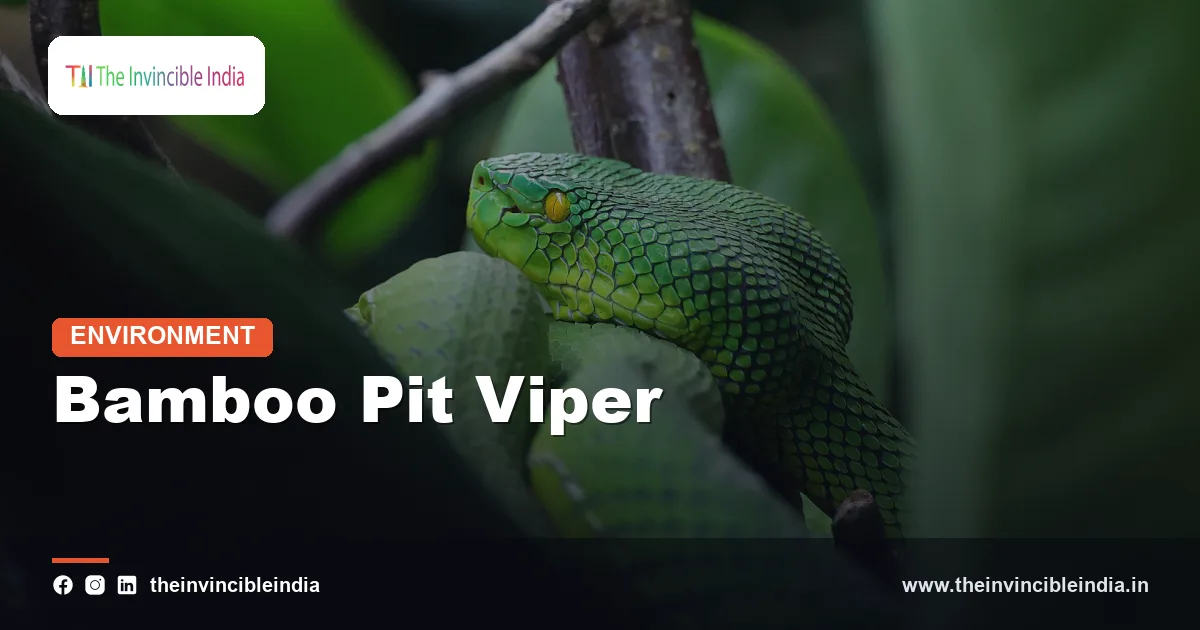
The bamboo pit viper (Trimeresurus gramineus), also called the Indian green pit viper, is a slender, bright green venomous snake of the family Viperidae that lives in the shrubs, bamboo and forests of peninsular India, including the Western Ghats. It is a nocturnal ambush hunter with a pair of heat-sensing pits on its face, and its green colour makes it almost invisible among leaves.
The bamboo pit viper is not an aggressive snake, but it may bite when people brush against or grab vegetation where it rests, especially in the dark. Its venom is painful rather than usually fatal. This article explains how to recognise the bamboo pit viper, where it lives, what it eats, how its venom acts, how to tell it from harmless green snakes and what to do after a bite.
| Common name | Bamboo pit viper (also Indian green pit viper) |
|---|---|
| Scientific name | Trimeresurus gramineus |
| Family | Viperidae, subfamily Crotalinae (pit vipers) |
| Typical size | About 60 to 90 centimetres; females are generally larger than males |
| Range in India | Peninsular India, especially the Western Ghats and some hill ranges of the Eastern Ghats |
| Habitat | Bamboo clumps, shrubs, low trees, forest edges, plantations and gardens near forest |
| Venom type | Haemotoxic, causing mainly local pain and swelling |
| Diet | Frogs, lizards, small rodents and birds |
| Conservation status | Not considered globally threatened; protected under the Wildlife (Protection) Act, 1972 |
Key Takeaways
- The bamboo pit viper (Trimeresurus gramineus) is a green, tree-dwelling venomous snake of peninsular India, including the Western Ghats.
- The bamboo pit viper can be told from harmless green snakes by its triangular head, vertical pupils and a heat-sensing pit between each eye and nostril.
- The bamboo pit viper is nocturnal and hunts by ambush, resting in bushes and bamboo during the day and striking at frogs, lizards and rodents at night.
- Bamboo pit viper venom is haemotoxic and typically causes painful swelling, with deaths rare when the bite is treated in hospital.
- After any pit viper bite, the person should stay calm, keep the limb still and go to hospital, without cutting, sucking, tying a tourniquet or using folk remedies.
- The bamboo pit viper is ecologically useful and legally protected, so it should be left alone instead of being killed.
What is the bamboo pit viper?
The bamboo pit viper is a small-to-medium sized, green, venomous pit viper found in the forests and hill country of peninsular India. It was described scientifically by the English naturalist George Shaw in 1802, and it belongs to the group of green tree-dwelling pit vipers of Asia.
Pit vipers are vipers that have a heat-sensing pit organ on each side of the face. They differ from the true or Old World vipers, such as Russell’s viper, which lack these pits. Several green pit viper species live in Asia, and in some regions the name “bamboo pit viper” is used for different, closely related snakes. Readers should note that common names vary, and the scientific name is the reliable identifier.
Indian herpetologists have revised the classification of the country’s pit vipers in recent years as genetic evidence has accumulated, and some green pit vipers once grouped together are now treated as separate species. The bamboo pit viper described here is the green pit viper of peninsular India, known as Trimeresurus gramineus.
How can you identify a bamboo pit viper?
A bamboo pit viper can be identified by its leaf-green body, a distinctly triangular head, vertical pupils, a heat pit between each eye and nostril, and a short, grasping tail that is often tinged red or brown. These features separate it from harmless green snakes, which have narrow heads and round pupils.
Key identification features
- Colour: bright green above, usually paler yellowish-green or whitish below, often with a pale stripe along the lower flank in some individuals.
- Head: broad and triangular, covered in small scales, and clearly wider than the neck.
- Eyes: bright, often golden-yellow or reddish, with vertical slit-like pupils.
- Heat pits: a small pit on each side of the face between the eye and the nostril.
- Body: slender but muscular, with keeled scales and a prehensile tail.
- Size: usually under a metre, with females larger and heavier-bodied.
The green colour is excellent camouflage in foliage and bamboo, and the snake often remains still for long periods, which makes it hard to see. Colour alone should never decide identification, since many harmless snakes are also green. Getting close enough to check the head shape and eyes is not safe, so photographs taken with a zoom lens are a better method.
Where does the bamboo pit viper live?
The bamboo pit viper lives in peninsular India, mainly in the evergreen, semi-evergreen and moist deciduous forests of the Western Ghats and some hill ranges of the Eastern Ghats. It tends to occur from the foothills to moderate elevations, wherever dense vegetation offers cover and humidity.
Within these forests, the snake favours low bushes, bamboo clumps, vines, tree branches and thick undergrowth. It is usually found from ground level up to a few metres above the ground. Plantations of coffee, tea and cardamom, as well as gardens and farms that border forest, often provide suitable habitat.
The snake may enter human-modified areas, particularly in the monsoon, when the vegetation is thick and prey such as frogs is abundant. It is seldom seen in open or dry country.
What does the bamboo pit viper eat?
The bamboo pit viper eats frogs, lizards, small rodents, birds and occasionally large insects, which it ambushes from a perch among leaves or branches. It remains motionless, often in a loose S-shaped coil, until prey comes close, then strikes with great speed.
- Frogs: a major food, especially in the monsoon when amphibians gather near water.
- Lizards: including garden lizards and geckos living in shrubs and trees.
- Small mammals: such as rats and mice, which are detected by their body heat.
- Birds and nestlings: taken in thickets and low trees.
After a strike, the snake often lets go of the prey and tracks it by scent while the venom takes effect. The prey is then swallowed whole, headfirst. Pit vipers have a low energy requirement, so one large meal can last for weeks.
By eating rodents, frogs and lizards, the bamboo pit viper helps to regulate the numbers of animals in forest and plantation ecosystems. In turn, it is eaten by birds of prey, mongooses, civets and larger snakes such as the king cobra.
How do the heat pits of the bamboo pit viper work?
The heat pits of the bamboo pit viper work as infrared sensors that detect the body warmth of nearby animals, which lets the snake locate and strike at prey accurately in complete darkness. Each pit holds a thin, nerve-rich membrane that responds to very small differences in temperature.
Because the pits are on both sides of the face, the brain compares the signals to judge the direction and distance of a warm target. These signals are blended with visual information, giving the snake a sort of thermal image. The pits are the clearest feature that separates pit vipers from other green snakes in India, none of which have them.
How does the bamboo pit viper reproduce?
The bamboo pit viper is viviparous, meaning females give birth to live young instead of laying eggs. Births usually take place during or soon after the monsoon, when there is abundant food for the newborns.
A litter commonly consists of several young, each around 15 centimetres long, and they are venomous from birth. The newborn snakes are often greener and sometimes more brightly marked than adults, with a reddish or whitish tail tip in some individuals. They disperse at once and feed on small frogs, lizards and insects. Mothers do not guard their young.
How dangerous is bamboo pit viper venom?
Bamboo pit viper venom is painful but seldom life-threatening, because it is a haemotoxic venom that usually causes swelling, pain and bruising around the bite without paralysing the muscles. Deaths from bamboo pit viper bites are rare.
Typical effects of a bite
- Local pain and swelling: often marked, and may spread along the limb over several hours.
- Bruising and blistering: around the bite, sometimes with small areas of tissue damage.
- Blood changes: occasional, usually temporary, effects on blood clotting that doctors can monitor with a simple test.
- Dry bites: some defensive bites deliver little or no venom.
Bites usually happen at night or in the early morning, when someone brushes a branch, reaches into bamboo, clears undergrowth or steps off a path without light. The bite is often on the hand, arm or foot. Plantation workers, farmers, trekkers and forest staff are the most exposed.
The standard Indian polyvalent antivenom is raised against the “Big Four” snakes of the plains, which do not include pit vipers, and is therefore not designed for bamboo pit viper bites. Treatment normally focuses on pain relief, elevation and care of the limb, monitoring of the blood and watching for infection. Specialist advice at a hospital determines what is needed.
How can you tell a bamboo pit viper from harmless green snakes?
A bamboo pit viper can be told from harmless green snakes by its triangular head, vertical pupils, short thick body and visible facial pits, whereas harmless green snakes have narrow heads, round or keyhole pupils, long slim bodies and no pits.
| Snake | Head and eyes | Body and tail | Venomous to people? |
|---|---|---|---|
| Bamboo pit viper | Triangular head, vertical pupils, heat pits | Thick for its length, short tail | Yes, painful local effects |
| Green vine snake | Long pointed head, horizontal keyhole pupils, no pits | Extremely slender, very long tail | Rear-fanged, rarely harmful to people |
| Green keelback | Narrow head, round pupils, no pits | Slim body, longer tail | Not dangerous to people |
| Bronzeback tree snakes | Narrow head, large round eyes, no pits | Slim body, very long thin tail | Mildly venomous, not dangerous to people |
Even experts avoid relying on a single feature, and it is wise to treat any unidentified green snake with care. Several other green pit vipers also occur in northeast India and the Himalayan foothills, and they look similar, so the area where the snake is found is a useful clue.
What should you do after a bamboo pit viper bite?
After a bamboo pit viper bite, the person should stay calm, the limb should be kept still and at about heart level, and the victim should be taken to the nearest hospital without delay. India’s snakebite guidance uses the phrase “Do it RIGHT”: reassure, immobilise, get to hospital immediately and tell the doctor about symptoms.
Responsible first-aid steps
- Move away from the snake and keep the person calm and at rest.
- Immobilise the limb with a splint or sling, as for a broken bone.
- Remove rings, bangles, watches and tight clothing before swelling starts.
- Go to hospital promptly, preferably one with a laboratory to check blood clotting and with antivenom in stock.
- Tell the doctor when the bite happened, what the snake looked like if known and how the swelling is progressing.
What not to do
- Do not cut the wound, suck out venom or apply chemicals.
- Do not tie a tight tourniquet, which can cause serious damage.
- Do not use herbs, ice, charms or other folk remedies, and do not delay a hospital visit for them.
- Do not try to catch or kill the snake.
Hospital treatment is important even for a bite that seems mild, because swelling can spread, blood clotting can change and wounds can become infected. Antivenom, where a doctor considers it appropriate, must be given in hospital.
How can people avoid bamboo pit viper bites?
People can avoid bamboo pit viper bites by checking vegetation before touching it, wearing gloves and boots when working in undergrowth, using a torch at night and keeping a respectful distance from any snake. Most bites occur when a well-camouflaged snake is grabbed or brushed by accident.
- Wear gloves and sturdy footwear when cutting bamboo, clearing scrub or harvesting in plantations.
- Look before grabbing branches, vines or fruit, especially at dawn, dusk and at night.
- Use a torch and stay on cleared paths in forest areas after dark.
- Use a long stick or tool to move foliage before reaching in with a hand.
- Keep gardens and paths near homes trimmed and free of dense tangles.
- Never pick up a snake, even when it appears to be asleep or dead.
Why is the bamboo pit viper important, and is it protected?
The bamboo pit viper is important because it controls frogs, lizards and rodents in forest ecosystems and serves as food for larger predators, and it is protected in India under the Wildlife (Protection) Act, 1972. It is not considered globally threatened, but its forest habitat is under pressure in many places.
Clearing of forests, expansion of plantations and roads, and the death of snakes struck by vehicles or killed by people who fear them are the main local threats. Because the bamboo pit viper is so well camouflaged, it is often found by accident and killed unnecessarily, even though it usually tries to stay hidden.
Snakes of all kinds play important roles in healthy ecosystems. Where a bamboo pit viper turns up in a garden or on a path, keeping away and allowing it to move on, or calling a trained rescuer or the forest department, protects both people and wildlife.
Bottom Line
The bamboo pit viper is a green, well-camouflaged, nocturnal ambush hunter of peninsular India, with heat pits and a venom that causes painful local effects. Bites are rarely fatal, but they deserve hospital assessment. The species is protected, useful in controlling prey animals and best left undisturbed.
Frequently Asked Questions
What is a bamboo pit viper?
The bamboo pit viper (Trimeresurus gramineus) is a bright green, venomous pit viper found in peninsular India, including the Western Ghats. It has a triangular head, vertical pupils and heat-sensing pits. It is nocturnal and hunts frogs, lizards and rodents by ambush.
Is the bamboo pit viper poisonous or venomous?
The bamboo pit viper is venomous, not poisonous, because it injects venom through its fangs when it bites. Its haemotoxic venom causes pain, swelling and bruising, and deaths are rare. A bitten person should still go to hospital for assessment.
How do I tell a bamboo pit viper from a green vine snake?
A bamboo pit viper has a triangular head, vertical pupils, heat pits and a thick body with a short tail. A green vine snake has a long pointed head, horizontal keyhole pupils, no pits and a very slender body. When in doubt, treat the snake as dangerous and keep away.
Where is the bamboo pit viper found in India?
The bamboo pit viper is found in peninsular India, mainly in the Western Ghats and some hill ranges of the Eastern Ghats. It lives in forests, bamboo clumps, shrubs and plantations with dense vegetation. It is rarely seen in open or dry country.
What should I do if a bamboo pit viper bites someone?
Keep the person calm, immobilise the bitten limb and go to a hospital promptly. Do not cut the wound, suck out the venom, tie a tourniquet or use folk remedies. Indian polyvalent antivenom is not made for pit viper venom, so doctors decide on supportive care and monitoring.
Is it illegal to kill a bamboo pit viper in India?
Yes, killing or capturing a wild bamboo pit viper without permission is an offence under the Wildlife (Protection) Act, 1972. The snake also helps control frogs, lizards and rodents. If one is found near a home, the safest course is to keep away and call the forest department or a trained rescuer.
{“@context”:”https://schema.org”,”@graph”:[{“@type”:”FAQPage”,”mainEntity”:[{“@type”:”Question”,”name”:”What is a bamboo pit viper?”,”acceptedAnswer”:{“@type”:”Answer”,”text”:”The bamboo pit viper (Trimeresurus gramineus) is a bright green, venomous pit viper found in peninsular India, including the Western Ghats. It has a triangular head, vertical pupils and heat-sensing pits. It is nocturnal and hunts frogs, lizards and rodents by ambush.”}},{“@type”:”Question”,”name”:”Is the bamboo pit viper poisonous or venomous?”,”acceptedAnswer”:{“@type”:”Answer”,”text”:”The bamboo pit viper is venomous, not poisonous, because it injects venom through its fangs when it bites. Its haemotoxic venom causes pain, swelling and bruising, and deaths are rare. A bitten person should still go to hospital for assessment.”}},{“@type”:”Question”,”name”:”How do I tell a bamboo pit viper from a green vine snake?”,”acceptedAnswer”:{“@type”:”Answer”,”text”:”A bamboo pit viper has a triangular head, vertical pupils, heat pits and a thick body with a short tail. A green vine snake has a long pointed head, horizontal keyhole pupils, no pits and a very slender body. When in doubt, treat the snake as dangerous and keep away.”}},{“@type”:”Question”,”name”:”Where is the bamboo pit viper found in India?”,”acceptedAnswer”:{“@type”:”Answer”,”text”:”The bamboo pit viper is found in peninsular India, mainly in the Western Ghats and some hill ranges of the Eastern Ghats. It lives in forests, bamboo clumps, shrubs and plantations with dense vegetation. It is rarely seen in open or dry country.”}},{“@type”:”Question”,”name”:”What should I do if a bamboo pit viper bites someone?”,”acceptedAnswer”:{“@type”:”Answer”,”text”:”Keep the person calm, immobilise the bitten limb and go to a hospital promptly. Do not cut the wound, suck out the venom, tie a tourniquet or use folk remedies. Indian polyvalent antivenom is not made for pit viper venom, so doctors decide on supportive care and monitoring.”}},{“@type”:”Question”,”name”:”Is it illegal to kill a bamboo pit viper in India?”,”acceptedAnswer”:{“@type”:”Answer”,”text”:”Yes, killing or capturing a wild bamboo pit viper without permission is an offence under the Wildlife (Protection) Act, 1972. The snake also helps control frogs, lizards and rodents. If one is found near a home, the safest course is to keep away and call the forest department or a trained rescuer.”}}]}]}


