

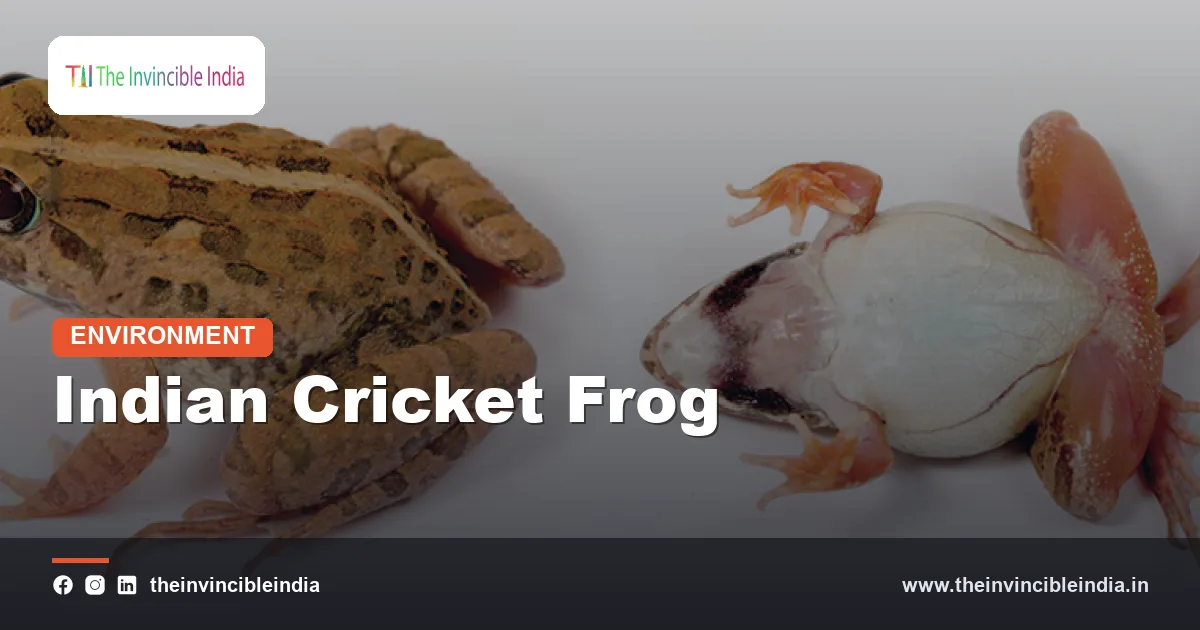
The Indian cricket frog is a small, common amphibian of the Indian subcontinent, named for the clicking, cricket-like call of the males, and it lives in ponds, ditches, marshes and paddy fields where its sounds fill the night during the monsoon. It has nothing to do with the sport of cricket; the name comes entirely from the sound, which resembles the chirp of an insect.
In scientific usage the frogs sold under this name belong to a group of small dicroglossid frogs that were long placed in the genus Fejervarya and are now often assigned to Minervarya. Researchers have found that what was once treated as a single widespread species is really a complex of several closely similar species. This article explains how to recognise an Indian cricket frog, where it lives, what it eats, how it breeds and why such small frogs matter to farmers and wetlands.
| Quick Facts | Details |
|---|---|
| Common name | Indian cricket frog (often shortened to cricket frog) |
| Scientific group | Minervarya (formerly Fejervarya) species complex, historically listed as Fejervarya limnocharis |
| Family | Dicroglossidae (fork-tongued frogs) |
| Size | Small; adults are usually only about 3 cm to 5 cm long, with females larger than males |
| Range and habitat in India | Ponds, puddles, ditches, marshes, grassland and paddy fields across much of the country, mainly at low elevations |
| Diet | Insects, ants, termites, beetles, spiders and other small invertebrates |
| Breeding and life cycle | Breeds in the monsoon; eggs are laid in shallow water, hatch into tadpoles and metamorphose into froglets |
| Call | A series of sharp clicks, like a cricket or two pebbles being tapped together |
| Conservation status | Generally common and of low conservation concern, though sensitive to pesticides and wetland loss |
Key Takeaways
- The Indian cricket frog is a small amphibian, named for its clicking call, that belongs to the family Dicroglossidae and not to the sport or insect of the same name.
- An adult Indian cricket frog is usually only about 3 cm to 5 cm long, with a warty, brown to grey skin marked with dark patches.
- Indian cricket frogs live in ponds, ditches, marshes and paddy fields across much of India, and they are among the most frequently heard frogs of the monsoon.
- The Indian cricket frog eats insects and other small invertebrates, which means it helps to control mosquitoes, beetles and crop pests.
- Indian cricket frogs breed during the monsoon, when males call from the water’s edge and females lay eggs in shallow, rain-filled pools.
- The skin of the Indian cricket frog absorbs substances from air and water, so pesticides, pollution and the loss of wetlands pose the main risks to it.
What is the Indian cricket frog?
The Indian cricket frog is a small, ground-dwelling frog found in wet places across the Indian subcontinent, and it is known for the metallic clicking calls that males make in the rains. It is one of the commonest frogs near villages, farmland and roadside pools.
The group belongs to the family Dicroglossidae, a large family of Asian and African frogs that includes bullfrogs and skipper frogs. Members of this family tend to have a sturdy body, strong hind legs and skin with raised ridges or warts. The name “cricket frog” is used in different parts of the world for unrelated frogs, and the Indian version refers specifically to small Asian frogs of the Minervarya and Fejervarya group.
Why the scientific name is complicated
For many years, scientists treated the cricket frogs of South and Southeast Asia as one widespread species, Fejervarya limnocharis. Genetic studies later showed that this group is made up of many cryptic species, which look almost the same but differ in their DNA, calls and distribution. Several of these are now recognised separately in India, and the genus name has also been revised. As a result, the safest way to describe the animal is as the Indian cricket frog species complex, with the exact species depending on the region.
How can you identify an Indian cricket frog?
An Indian cricket frog can be identified by its small size, its warty brown or grey skin with dark blotches, the ridges running along its back and the dark bars on its hind legs. It often has a pale line running down the middle of the back and a pointed snout.
The skin on the back is usually rough, with long ridges that run lengthwise, and the colour matches the soil, mud and leaf litter where the frog sits. The hind legs are long and strong, and they carry dark crossbars. The toes are partly webbed, which allows the frog to swim and hop with equal ease. Males are smaller than females and have a vocal sac under the throat that swells when they call.
- Size: Small, rarely larger than the length of a thumb joint to the base of the hand.
- Skin: Dry-looking and warty, with raised folds along the back.
- Colour: Brown, olive or grey, often with a pale stripe on the back.
- Legs: Strong hind legs with dark bars and partly webbed toes.
- Behaviour: A quick, long jump, often in a zigzag path, towards the nearest water.
Because its camouflage is so effective, the frog is often noticed only when it jumps. Many people hear Indian cricket frogs long before they see one.
Where does the Indian cricket frog live?
The Indian cricket frog lives in low-lying, damp and open habitats across much of India, including paddy fields, ponds, ditches, marshes, grassy verges and the edges of lakes. It is a species of human-altered landscapes as much as of natural ones.
These frogs thrive in places where shallow water and short vegetation exist side by side. They are especially numerous around rice fields, where flooded paddies provide breeding pools, food and cover in a single habitat. They also appear in gardens, roadside drains and temporary rain pools, and they can colonise new water bodies very quickly after the first showers of the monsoon.
During the dry months, Indian cricket frogs shelter in cracks in the soil, under stones, in damp leaf litter or along the moist edges of ponds. Some dig into the ground and remain inactive until the rains return. This period of inactivity helps the animals to survive heat and drought, but it also means that they depend on the soil staying free of heavy chemicals.
What does the Indian cricket frog eat?
The Indian cricket frog eats small invertebrates, especially insects such as ants, termites, beetles, flies, grasshoppers and moths, along with spiders and other tiny creatures. It is an active, opportunistic predator that catches whatever moves within reach.
Hunting usually takes place on the ground at dusk or after dark. The frog sits and waits, then leaps forward and flicks out its sticky tongue to snatch the prey. The tongue is attached near the front of the mouth, allowing it to flip out and back in a fraction of a second. The frog swallows its meal whole and uses its eyes to help push the food down the throat.
The feeding habits of the Indian cricket frog make it valuable to farmers. By eating insects that damage crops or carry disease, the frog contributes to natural pest control. A single paddy field may contain many frogs, and together they consume large numbers of insects every night.
How does the Indian cricket frog breed?
The Indian cricket frog breeds mainly during the monsoon, when males call from the edges of shallow water to attract females and the eggs are laid in rain-filled pools, ditches and flooded fields. Heavy rain acts as the signal that begins the breeding season.
Males gather in large choruses, each one producing a series of sharp clicks. Females select a mate by his call and then lay a batch of eggs in shallow water. The fertilised eggs hatch within a few days into tadpoles, which feed on algae and tiny particles, grow legs, absorb their tails and then leave the water as small froglets.
The stages of the life cycle
- Egg: Laid in shallow, warm water, often in loose clusters or a thin film at the surface.
- Tadpole: A swimming larva with gills, a tail and no legs at first, which feeds on algae.
- Metamorphosis: Hind legs, then front legs appear, the gills are replaced by lungs and the tail shrinks.
- Froglet: A tiny air-breathing frog that leaves the water and begins to hunt on land.
- Adult: A mature frog that is ready to breed within its first year or two.
The rapid life cycle suits temporary monsoon pools, which may dry up within weeks. If the pool vanishes before the tadpoles transform, they die, so timing and rainfall are crucial. The high number of eggs and the speed of development help the species to recover quickly after dry spells.
Why can you hear cricket frogs at night?
You can hear cricket frogs at night because the males call after dark during the breeding season, when cooler air and higher humidity help sound travel and protect their skin from drying. The calls attract females and also warn rival males to stay away.
The call is a series of sharp, dry clicks that sound like crickets, or like pebbles being tapped together. It is produced when the male forces air over his vocal cords and into the vocal sac, which acts as a resonating chamber and makes the sound louder. Each male has his own rhythm, and neighbours often alternate their calls to avoid overlap. A pond full of cricket frogs can make a continuous, rattling chorus that is audible from far away.
The calls of closely related species differ slightly in pitch, speed and pattern. Scientists therefore use recordings to separate look-alike species, since the call often tells them apart more clearly than the appearance of the frog. For the ordinary listener, the clicking chorus is a reliable sign that the monsoon has begun.
How is the Indian cricket frog different from other common Indian frogs?
The Indian cricket frog differs from other common Indian frogs mainly in its small size, its clicking call and its warty, ridged skin. Larger amphibians such as the Indian bullfrog and the common Indian toad have different calls, sizes and habits.
| Frog | Size | Skin and look | Call | Typical habitat |
|---|---|---|---|---|
| Indian cricket frog | Small, about 3 cm to 5 cm | Warty, ridged, brown or grey | Sharp clicks like a cricket | Paddy fields, ponds, ditches |
| Indian bullfrog | Large, often over 10 cm | Stout, olive with yellow breeding colour in males | Deep, loud croak | Ponds, tanks, large pools |
| Common Indian toad | Medium to large | Dry, warty, with large glands | Long, trilling call | Gardens, fields, houses |
The key identifying clues are the animal’s small size, the ridges on the back and its clicking call. Toads, in contrast, have dry, bumpy skin, walk rather than hop and have large glands behind the eyes.
Why are frogs like the Indian cricket frog important?
Frogs like the Indian cricket frog are important because they control insect populations, serve as food for snakes, birds and fish, and act as sensitive indicators of environmental health. Amphibians connect the water and the land in the food chain.
As predators, cricket frogs eat vast numbers of insects, including mosquitoes, flies, beetles and crop pests. As prey, they feed snakes, monitor lizards, herons, egrets, owls, fish and mammals such as mongooses. Losing them would remove a major food source for many of the animals that live around wetlands.
Amphibians also have thin, moist skin that absorbs water and gases, which makes them very sensitive to pollution. Because of this, a decline in frog numbers can give an early warning that pesticides, fertilisers or industrial waste are building up in the water. Researchers study frog calls and populations to monitor the condition of wetlands and farmland.
What threatens the Indian cricket frog?
The main threats to the Indian cricket frog are pesticides and fertilisers, the drainage and filling of ponds and wetlands, road deaths and, in some areas, collection for food. Although the group is common, local populations can still vanish when breeding pools are lost.
- Agrochemicals: Insecticides and herbicides harm tadpoles and adults, and fertilisers can alter the water chemistry.
- Loss of breeding sites: Filling ponds, concrete drains and the conversion of paddy land into housing remove shallow breeding pools.
- Traffic: Frogs crossing roads on rainy nights are often run over.
- Collection: Frogs are sometimes caught in large numbers for food or school dissection.
- Disease and climate change: Fungal disease and shifting monsoon patterns can reduce breeding success.
Simple steps can help. Farmers can reduce pesticide use, communities can protect village ponds, and drivers can slow down on wet nights. Conservation of the Indian cricket frog depends mostly on the conservation of ordinary wetlands, not of remote wilderness.
Bottom Line
The Indian cricket frog is a small but valuable amphibian whose clicking chorus marks the arrival of the monsoon across India. Protecting village ponds, paddy fields and clean water is the most effective way to keep these insect-eating frogs, and the animals that depend on them, thriving.
Frequently Asked Questions
What is the Indian cricket frog?
The Indian cricket frog is a small, common frog of the Indian subcontinent that belongs to the family Dicroglossidae. It is named for the clicking, cricket-like call of the males and has no connection with the sport. It lives in ponds, ditches, marshes and paddy fields.
Why is it called a cricket frog?
It is called a cricket frog because the male’s call sounds like the chirping of a cricket insect or like pebbles being tapped together. The name comes from the sound and not from the game of cricket. The call is made to attract females during the breeding season.
How big does an Indian cricket frog get?
An Indian cricket frog usually grows to only about 3 cm to 5 cm in length. Females are larger than males. The small size allows it to hide easily in grass, mud and leaf litter.
What do Indian cricket frogs eat?
Indian cricket frogs eat insects and other small invertebrates such as ants, termites, beetles, flies and spiders. They catch prey with a quick flick of the sticky tongue. This diet helps to control pests in paddy fields and gardens.
When do Indian cricket frogs breed?
Indian cricket frogs breed mainly during the monsoon, when rain fills ponds, ditches and fields with shallow water. Males call at night to attract females, who lay eggs in the water. The eggs hatch into tadpoles that develop into froglets within a few weeks.
Are Indian cricket frogs poisonous?
No, Indian cricket frogs are not dangerous to humans and are not known to be poisonous in any harmful way. They have no venomous bite and pose no real risk. Like all amphibians, they should be handled as little as possible, because their delicate skin is easily harmed by soap, lotions and dirty hands.
{“@context”:”https://schema.org”,”@graph”:[{“@type”:”FAQPage”,”mainEntity”:[{“@type”:”Question”,”name”:”What is the Indian cricket frog?”,”acceptedAnswer”:{“@type”:”Answer”,”text”:”The Indian cricket frog is a small, common frog of the Indian subcontinent that belongs to the family Dicroglossidae. It is named for the clicking, cricket-like call of the males and has no connection with the sport. It lives in ponds, ditches, marshes and paddy fields.”}},{“@type”:”Question”,”name”:”Why is it called a cricket frog?”,”acceptedAnswer”:{“@type”:”Answer”,”text”:”It is called a cricket frog because the male’s call sounds like the chirping of a cricket insect or like pebbles being tapped together. The name comes from the sound and not from the game of cricket. The call is made to attract females during the breeding season.”}},{“@type”:”Question”,”name”:”How big does an Indian cricket frog get?”,”acceptedAnswer”:{“@type”:”Answer”,”text”:”An Indian cricket frog usually grows to only about 3 cm to 5 cm in length. Females are larger than males. The small size allows it to hide easily in grass, mud and leaf litter.”}},{“@type”:”Question”,”name”:”What do Indian cricket frogs eat?”,”acceptedAnswer”:{“@type”:”Answer”,”text”:”Indian cricket frogs eat insects and other small invertebrates such as ants, termites, beetles, flies and spiders. They catch prey with a quick flick of the sticky tongue. This diet helps to control pests in paddy fields and gardens.”}},{“@type”:”Question”,”name”:”When do Indian cricket frogs breed?”,”acceptedAnswer”:{“@type”:”Answer”,”text”:”Indian cricket frogs breed mainly during the monsoon, when rain fills ponds, ditches and fields with shallow water. Males call at night to attract females, who lay eggs in the water. The eggs hatch into tadpoles that develop into froglets within a few weeks.”}},{“@type”:”Question”,”name”:”Are Indian cricket frogs poisonous?”,”acceptedAnswer”:{“@type”:”Answer”,”text”:”No, Indian cricket frogs are not dangerous to humans and are not known to be poisonous in any harmful way. They have no venomous bite and pose no real risk. Like all amphibians, they should be handled as little as possible, because their delicate skin is easily harmed by soap, lotions and dirty hands.”}}]}]}


