

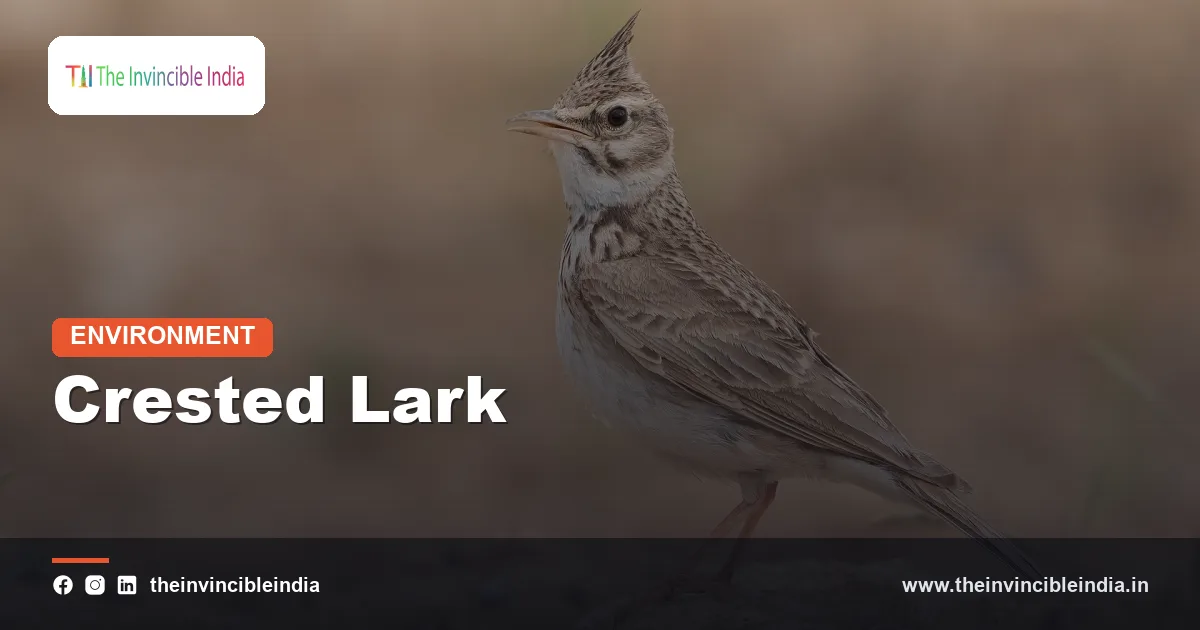
The crested lark (Galerida cristata) is a stocky, streaky sandy-brown lark with a spiky, pointed crest that lives on the ground in dry open country, and in India it is a resident bird of the drier north-western plains, where it walks along roadsides, fallow fields and village edges. The bird belongs to the lark family Alaudidae, a group of ground-dwelling songbirds famous for singing in flight, and it is one of the most widespread larks in the world, with a range that runs from western Europe and North Africa across Asia.
The crested lark is easy to miss because its colour matches dry earth so well, yet it is bold enough to feed on tracks and roads and to stand on a clod of earth to sing. It is a year-round neighbour rather than a seasonal visitor. This article explains what the species is, where it lives in India, how to identify it and to separate it from other larks, what it eats, how it sings and breeds, and whether it is under threat.
Quick Facts
| Common name | Crested lark |
|---|---|
| Scientific name | Galerida cristata |
| Family | Alaudidae (larks) |
| Size | About 17-18 cm long, with a body weight of roughly 35-45 grams |
| Habitat in India | Dry open country: fallow and ploughed fields, wasteland, road verges, semi-desert and short grassland, mainly in the north-west and north |
| Diet | Seeds and grain, plus insects, especially in the breeding season |
| Movement | Resident; makes only small local movements |
| Breeding | Cup nest in a ground scrape, usually 3-5 eggs; may raise more than one brood |
| Conservation status | Least Concern (IUCN), though declining in parts of Europe |
Key Takeaways
- The crested lark is a resident ground-dwelling songbird of dry open country in the north-western and northern plains of India, and it does not migrate.
- A pointed, upright crest, streaked sandy-brown upperparts, a long slightly curved bill and buff-rufous underwings are the main field marks of the crested lark.
- Crested lark feeds on the ground on seeds, grain and insects, and it often walks on roads and tracks, where it looks for food and takes dust baths.
- The crested lark sings melodious, whistling phrases, often in the air and sometimes imitating other birds, and also sings from a clod, mound or low perch.
- The crested lark builds its nest in a shallow scrape on the ground, often sheltered by a tuft of grass or a clod, and lays about three to five eggs.
- The species is classed as Least Concern by the IUCN because it is very widespread, even though it has declined in some parts of its range.
What is the crested lark?
The crested lark is a medium-sized lark with a streaked brown body and a long, pointed crest, built for life on open, dry ground. Larks are a very old group of songbirds that live mainly in open habitats, nest on the ground and are known for their musical flight songs, and the crested lark is one of the more robust and familiar members.
The upperparts are sandy-grey or pale brown, finely streaked with darker brown. The breast is buffy with dark streaks, and the belly is whitish. The face is rather plain with a pale eyebrow, and the bill is relatively long, slender and slightly curved down. When the crest is raised, it forms a pointed spike on the back of the head; when relaxed, it lies flat and the head looks smooth. Males and females look alike, though males are often slightly larger.
The name “crested” does not mean the bird has a showy ornament. The crest is a modest tuft that is erected when the bird is alarmed, excited or singing. Subspecies of the crested lark differ in shade, with desert populations paler and those in damper areas darker. The Indian form is usually listed under a local subspecies name, chendoola, taken from a vernacular name for the bird.
Where does the crested lark live in India?
The crested lark lives mainly in the drier north-western and northern parts of India, including Punjab, Haryana, Rajasthan, Gujarat, Delhi and adjoining areas of the Gangetic plain, where it occupies flat, open and sparsely vegetated land. Its range then extends west through Pakistan and onwards to Europe and Africa.
Within India, the typical places to find a crested lark are:
- Fallow fields and stubble after harvest.
- Rough pasture, wasteland and the edges of villages.
- Roadsides, tracks, railway embankments and canal banks.
- Semi-desert and dry scrub with plenty of bare soil.
- Airfields, open industrial areas and other flat, cleared ground.
The crested lark generally avoids dense forest, tall grass and wet places. In peninsular India, a related species, Sykes’s lark, takes its place in many areas. Because the two are close relatives, observers should check the range and the details of the bird before naming it.
How can you identify a crested lark?
The crested lark can be identified by its pointed crest, streaked sandy-brown plumage, upright stance on the ground, long slightly curved bill and the buffy-rufous underside of its wings and edges of its tail in flight. The bird runs or walks rather than hops.
The useful features are:
- Crest: a long, narrow, sharply pointed crest that sticks up like a small spike.
- Bill: longer and thinner than that of many other larks, with a slight downward curve.
- Plumage: streaked above and on the upper breast, with a pale belly.
- In flight: rounded, broad wings with a buff or rufous underwing, and a tail with buff outer feathers and a darker centre.
- Behaviour: runs quickly, stands erect to look around, and is often seen alone or in pairs.
In the field the bird is easier to find in the early morning, when it sings from a mound, or near the edges of roads where it feeds. Its sandy colour merges with the earth, so observers who stand still often see it first when it moves.
Which larks look like the crested lark in India?
The crested lark is most commonly confused with Sykes’s lark, the Oriental skylark, the greater short-toed lark and, less often, the Malabar lark. These are all brown, streaked ground birds of open country that sometimes feed in the same fields.
| Species | Key difference from the crested lark |
|---|---|
| Sykes’s lark (also called tawny lark) | Slightly smaller and more rufous with a shorter crest; mostly found in the peninsular and central regions and the west |
| Oriental skylark | Has only a small, blunt crest, a shorter bill and white outer tail feathers; prefers grassland |
| Greater short-toed lark | Has no crest, a pale plain face and a shorter, stouter bill; often forms flocks |
| Malabar lark | Has a long crest like the crested lark but is darker and more richly marked; found along the Western Ghats and the west coast |
The best clue is the long, spiky crest combined with the slender bill and the buff underwings. Where ranges overlap, bird watchers often depend on comparing photographs and recordings.
What does the crested lark eat?
The crested lark eats seeds, grain and insects, which it collects from the ground as it walks. Seeds of weeds and grasses make up much of the diet through the year, while insects such as grasshoppers, beetles and caterpillars become more important in the breeding season, when the young need protein.
The bird also picks up spilt grain along roads, farm tracks and threshing areas, and it eats the green shoots of some plants. It does not scratch the ground much but picks and probes the surface with its bill. In the heat of the day, a crested lark rests in the shade of a clod or a bush and may take a dust bath, which helps to keep the feathers in good order.
Because it feeds on weed seeds and insects, the crested lark has a mild beneficial effect on farmland. It rarely harms crops, as its food is mostly taken from fallow land and the margins of fields.
How does the crested lark sing?
The crested lark sings a clear, musical song of whistling and trilling phrases, usually from the air, from a mound or from a low post, and it often mimics other birds. The most noticeable call is a liquid, whistling “tee-tee-tu” or a similar three-part phrase.
During the breeding season, the male rises into the air on fluttering wings, circles while singing, and then drops back to the ground. He may also sing from a clod, wall or wire. Song can be heard at any time of the year but is loudest in the breeding months and in the cooler hours of the day. The bird also gives a short contact call when feeding and when flushed.
The song of the crested lark is varied and may include imitations of the notes of other birds, such as sparrows, waders and shrikes. Birders sometimes find that a song from a bare field belongs to a lark that is hard to see against the earth.
How does the crested lark breed?
The crested lark breeds by building a small cup nest in a shallow scrape on the ground, usually sheltered by a tuft of grass, a clod or a stone, where the female lays about three to five eggs. The breeding season varies with rainfall and region, and in India it generally takes place between spring and the monsoon months.
The nest is lined with fine grass, roots and sometimes hair or feathers. The eggs are pale with fine speckles that blend with the soil. The female does most of the incubation, which lasts about two weeks, and both parents feed the young on insects. Chicks leave the nest at about nine or ten days, before they can fly well, and hide on the ground nearby while the parents continue to feed them.
A pair may raise two or even three broods in a good season. Ground nests are vulnerable to trampling by livestock, farm machinery, dogs and predators such as snakes and crows, so many nests fail and the pair tries again.
Is the crested lark threatened?
No, the crested lark is not globally threatened and is listed as Least Concern by the International Union for Conservation of Nature (IUCN). The species has an enormous range across three continents and a very large population.
However, declines have been noted in parts of Europe, where changes in farming, loss of fallow land and increased use of chemicals have reduced the numbers of many open-country birds. In India, conversion of waste ground to buildings, intensive cultivation and the loss of open scrub could affect local populations over time. Protecting patches of rough grassland and avoiding the disturbance of ground nests in spring help larks and other birds that live on bare earth.
How can you watch crested larks in India?
The best way to watch crested larks in India is to walk or drive slowly along quiet roads and tracks through dry open country in the early morning, scanning the verges and bare patches. The bird is most active and most vocal in the first hours after sunrise.
- Scan fields and road edges with binoculars before getting close.
- Look for the upright crest when the bird stands to survey its surroundings.
- Listen for the whistling song from a mound or from above.
- Stay on tracks during the breeding season so that you do not tread on camouflaged nests.
- Photograph the bill and crest to help separate similar larks later.
Dry-country reserves and grassland sites in Rajasthan and Gujarat are good places to compare larks side by side and to learn the differences between species.
Why does the crested lark matter?
The crested lark matters because it is a common indicator of the health of dry grassland and farmland, and because its song is part of the sound of the Indian countryside. Birds of open ground react quickly to changes in land use, so their numbers say much about how land is managed.
Larks also have a place in culture and poetry across Asia and Europe, where their songs are linked with open skies and the start of spring. In India, the crested lark is a quiet reminder that dry lands, which are sometimes seen as empty, support a rich community of wild life.
Bottom Line
The crested lark is a resident, ground-living songbird of the dry north-west whose crest, curved bill and melodious flight song set it apart from other larks. It is secure globally, but it relies on open ground, so the way land is used affects its future.
Frequently Asked Questions
What is a crested lark?
A crested lark is a medium-sized, streaked brown lark with a long pointed crest that lives on the ground in dry open country. It belongs to the family Alaudidae and is found from Europe and Africa across Asia. In India it is a resident of the drier north-west and north.
Is the crested lark a migratory bird in India?
No, the crested lark is not a migratory bird in India. It is a resident that stays in the same general area throughout the year and makes only small local movements in response to food and weather.
How do you tell a crested lark from Sykes’s lark?
You can tell a crested lark from Sykes’s lark mainly by size, crest and range. The crested lark is slightly larger, has a longer and more pointed crest, and is found mostly in the north-west and north. Sykes’s lark is smaller and more rufous, and lives more in the peninsula and the west.
What does the crested lark eat?
The crested lark eats seeds, grain and insects, which it picks from the ground. Weed seeds form much of its diet, while grasshoppers, beetles and caterpillars become important when it feeds young. It also takes spilt grain along roads and tracks.
Where does the crested lark build its nest?
The crested lark builds its nest on the ground in a shallow scrape, usually sheltered by a clod, stone or tuft of grass. The cup is lined with fine grass and roots, and the female lays about three to five speckled eggs. The camouflage is good, but many nests are lost to trampling and predators.
Is the crested lark endangered?
No, the crested lark is not endangered and is listed as Least Concern by the IUCN. It has a huge range and a large population. Some regional declines have been recorded, mainly in Europe, because of changes in farming and the loss of open ground.
{“@context”:”https://schema.org”,”@graph”:[{“@type”:”FAQPage”,”mainEntity”:[{“@type”:”Question”,”name”:”What is a crested lark?”,”acceptedAnswer”:{“@type”:”Answer”,”text”:”A crested lark is a medium-sized, streaked brown lark with a long pointed crest that lives on the ground in dry open country. It belongs to the family Alaudidae and is found from Europe and Africa across Asia. In India it is a resident of the drier north-west and north.”}},{“@type”:”Question”,”name”:”Is the crested lark a migratory bird in India?”,”acceptedAnswer”:{“@type”:”Answer”,”text”:”No, the crested lark is not a migratory bird in India. It is a resident that stays in the same general area throughout the year and makes only small local movements in response to food and weather.”}},{“@type”:”Question”,”name”:”How do you tell a crested lark from Sykes’s lark?”,”acceptedAnswer”:{“@type”:”Answer”,”text”:”You can tell a crested lark from Sykes’s lark mainly by size, crest and range. The crested lark is slightly larger, has a longer and more pointed crest, and is found mostly in the north-west and north. Sykes’s lark is smaller and more rufous, and lives more in the peninsula and the west.”}},{“@type”:”Question”,”name”:”What does the crested lark eat?”,”acceptedAnswer”:{“@type”:”Answer”,”text”:”The crested lark eats seeds, grain and insects, which it picks from the ground. Weed seeds form much of its diet, while grasshoppers, beetles and caterpillars become important when it feeds young. It also takes spilt grain along roads and tracks.”}},{“@type”:”Question”,”name”:”Where does the crested lark build its nest?”,”acceptedAnswer”:{“@type”:”Answer”,”text”:”The crested lark builds its nest on the ground in a shallow scrape, usually sheltered by a clod, stone or tuft of grass. The cup is lined with fine grass and roots, and the female lays about three to five speckled eggs. The camouflage is good, but many nests are lost to trampling and predators.”}},{“@type”:”Question”,”name”:”Is the crested lark endangered?”,”acceptedAnswer”:{“@type”:”Answer”,”text”:”No, the crested lark is not endangered and is listed as Least Concern by the IUCN. It has a huge range and a large population. Some regional declines have been recorded, mainly in Europe, because of changes in farming and the loss of open ground.”}}]}]}


