

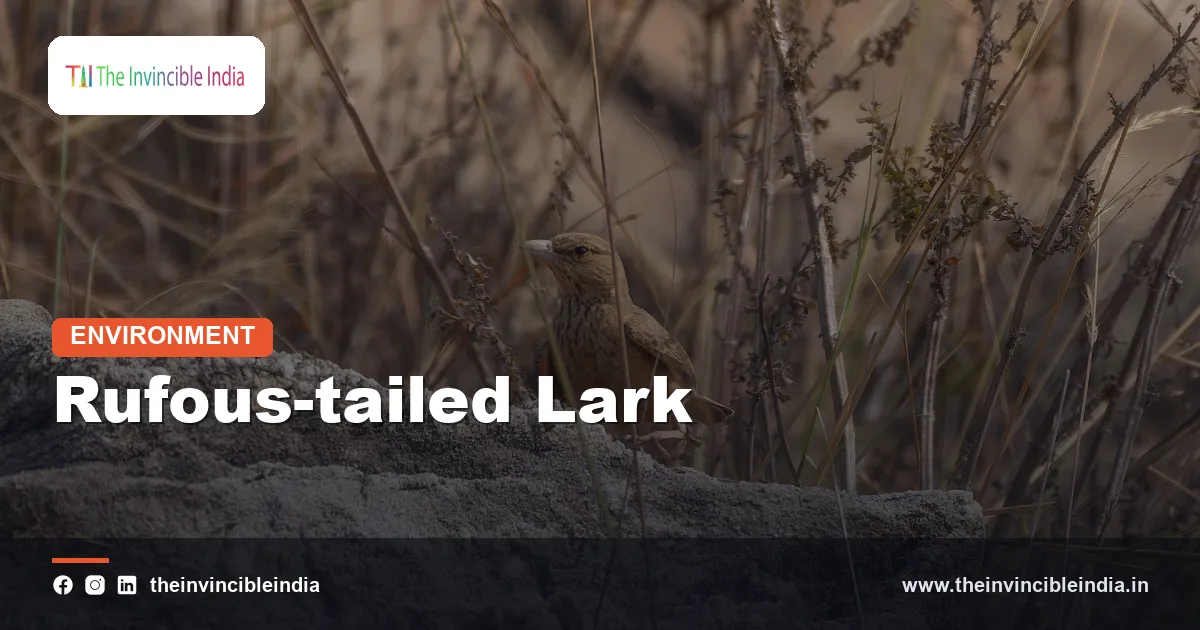
The rufous-tailed lark (Ammomanes phoenicura), also known as the rufous-tailed finch-lark, is a sturdy, thick-billed, sandy-brown lark of the Indian subcontinent that lives on the ground in dry open country such as ploughed fields, stony wasteland and bare hillsides. It is a resident bird, found over much of India throughout the year, and it is named after the warm rufous colour of its tail and wing patches, which flash into view when it flies.
The rufous-tailed lark is often described as a lark with a finch’s bill, because its short, deep, conical beak looks quite unlike the slender bill of a typical lark. It walks upright on stony ground, sings during a rising song-flight and builds a ground nest that is sometimes bordered with tiny pebbles. This article explains what the species is, where it lives in India, how to identify it, what it eats, how it breeds and whether it is secure.
Quick Facts
| Common name | Rufous-tailed lark (also rufous-tailed finch-lark) |
|---|---|
| Scientific name | Ammomanes phoenicura |
| Family | Alaudidae (larks) |
| Size | About 16 cm long, a stocky bird weighing roughly 25-35 grams |
| Habitat in India | Dry open country: ploughed and fallow fields, stony and gravelly ground, dry scrub, bare hillsides and roadsides |
| Diet | Seeds and grain, plus insects such as ants, beetles and grasshoppers |
| Movement | Resident; makes only local movements |
| Breeding | Ground nest, often with a pebble platform; roughly 2-3 eggs; season varies by region |
| Conservation status | Least Concern (IUCN) |
Key Takeaways
- The rufous-tailed lark is a resident lark of the Indian subcontinent that lives in dry, open, stony or ploughed country and is found over much of peninsular and northern India.
- A short, stout, finch-like bill and a rufous tail and wing patches are the main features that distinguish the rufous-tailed lark from other brown larks.
- Rufous-tailed lark feeds on the ground, eating seeds, grain and insects, and it walks and runs in an upright posture instead of hopping.
- The male rufous-tailed lark performs a song-flight, rising into the air while singing and then gliding or dropping back to the ground.
- The rufous-tailed lark makes its nest on the ground, often in the shelter of a stone or clod, and sometimes lays a small platform of pebbles beside or under the cup.
- The species is classed as Least Concern by the IUCN because it is widespread and common in suitable habitat across India.
What is the rufous-tailed lark?
The rufous-tailed lark is a small to medium-sized songbird of the lark family Alaudidae, which feeds, rests and nests on the ground in open country. It belongs to the genus Ammomanes, a group of plain, sandy-coloured larks that live in dry regions of Africa and Asia and that are noted for their strong bills and their close match with the soil.
The bird is sandy or earthy brown above, with darker streaks on the crown and back, and whitish below, with a streaked buffy breast. The face is plain with a faint pale eyebrow. The wings show rufous patches, and the tail is rufous, which gives the species its name. The bill is short, deep and conical, closer to a finch’s than to the thin bill of many larks. Males and females look much alike.
It is sometimes called a finch-lark because of this bill. The name helps to separate it from the bush larks, which belong to a different genus, and from the sparrow-larks, which are smaller and show clear sex differences. The rufous-tailed lark has no crest to speak of, and its smooth head and heavy build give it a plump, steady look.
Where is the rufous-tailed lark found in India?
The rufous-tailed lark is found across much of India, mainly in the dry plains and plateaus of the peninsula and the north, and it is largely a bird of the Indian subcontinent. It avoids dense forest, the high Himalaya, the wettest regions of the north-east and the rainiest strip of the western coast.
Its typical habitats include:
- Ploughed and fallow fields, especially those with a gravelly or stony surface.
- Rocky and stony wasteland with sparse grass and low scrub.
- Bare hillsides, laterite plateaus and the edges of dry riverbeds.
- Roadsides, tracks, quarries and railway embankments.
- Open dry deciduous woodland with bare ground between trees.
The rufous-tailed lark is at home on poor soil that is of little use for farming. In many parts of India, it can be seen in pairs on the sides of village roads, standing on small rises of earth and moving about with quick runs. The species is not migratory, though some birds move short distances after rain or during very dry periods.
How can you identify a rufous-tailed lark?
The rufous-tailed lark can be identified by its thick, conical bill, plain sandy-brown plumage, streaked breast, rufous tail and wing patches, and its upright running walk on bare or stony ground. The tail colour is usually most obvious in flight or when the bird stretches its wings.
The main features to watch are:
- Bill: short, deep and stout, like a finch’s, with a pale base.
- Colour: sandy-brown above with fine streaks, a pale throat and a lightly streaked breast.
- Rufous areas: a rufous tail and rufous edges to the flight feathers, visible when the bird takes off or lands.
- Posture: stands upright, runs quickly, stops, then runs again, and often flicks its tail.
- Behaviour: often seen in pairs or small groups, close to bare earth, stones or clods.
The bird blends in well when still, so observers often notice it only when it moves. Looking at a field edge through binoculars, in good light, is an effective way to find one.
Which birds look like the rufous-tailed lark?
The rufous-tailed lark is most often confused with the crested lark, the greater short-toed lark, the Indian bush lark and, in the north-west, the desert lark. All are brown, streaked or sandy birds that feed on the ground in the same open habitats.
| Species | Key difference from the rufous-tailed lark |
|---|---|
| Crested lark | Has a long pointed crest and a longer, slender bill; lacks the strongly rufous tail and the stout finch-like bill |
| Greater short-toed lark | Slimmer and paler, with a smaller bill, a dark patch at the side of the breast and no rufous tail |
| Indian bush lark | Perches on bushes and stones, has a bold rufous wing patch, a heavily streaked back and a different song |
| Desert lark | Plainer, paler and unstreaked, found in the arid north-west; its body colour matches the soil |
The most reliable combination is the heavy conical bill together with a rufous tail and an upright stance. Photographs of the bill and the tail from above often settle doubts quickly.
What does the rufous-tailed lark eat?
The rufous-tailed lark eats seeds, grain and insects, which it collects from the ground as it walks and runs. The thick bill is well suited to cracking small seeds, and the bird also takes ants, termites, beetles, grasshoppers and other small invertebrates, especially when it has young to feed.
It forages alone, in pairs or in small family groups on bare soil and sparse grass. It picks food from the surface and scratches or probes the soil lightly. Ploughed fields are rewarding places because the turning of the soil exposes seeds and insects, and the lark often follows the plough at a distance or visits fresh furrows.
Like many desert and dry-country birds, the species can survive on little water. It gets some moisture from its food but drinks when water is available, usually in the cool of the morning or evening. In the heat of the day, it rests in the shade of a stone, a clod or a shrub.
How does the rufous-tailed lark sing?
The rufous-tailed lark sings a short, pleasant, whistling song, usually during a rising song-flight, and it also gives soft contact calls when feeding. The male rises into the air with fluttering wings, sings as he climbs and circles, and then glides or drops back to the ground.
The song is neither as long nor as varied as that of the skylark or the crested lark, but it is sweet and carries well across open land. Males also sing from a low perch such as a stone, a mound or a fence post, and the song is heard most in the breeding season and at dawn. Out of season, the bird is quiet and gives only short calls when disturbed.
The song-flight serves two purposes. It advertises the territory to other males, and it attracts the female. Because the ground gives no height from which to be seen, the aerial display makes the singer visible across a wide area.
How does the rufous-tailed lark breed?
The rufous-tailed lark breeds by building a small cup nest on the ground, usually in the shelter of a stone, a clod or a tuft of grass, and it lays about two or three eggs. The breeding season differs across India and generally falls in the hot, dry months and around the start of the rains.
The nest is made of fine grass and roots. The bird often arranges small pebbles or bits of earth in a loose ring or ramp near the nest, an unusual habit that gives the nest a paved look. The reason is not fully settled, but the stones may help to keep the nest dry, to give it a stable base or to blend it with the surroundings. The eggs are pale with speckles, which help them to blend with the soil.
Both parents are involved in raising the young, which are fed on insects. The chicks leave the nest early and hide in the vegetation or among the stones, where the parents continue to feed them. As with other ground-nesting birds, losses are high because of trampling by grazing animals, predators and ploughing.
Is the rufous-tailed lark threatened?
No, the rufous-tailed lark is not threatened and is listed as Least Concern by the International Union for Conservation of Nature (IUCN). The bird is widespread and fairly common in suitable habitat in India, and no major decline is known across its range.
Even so, the species depends on open dry land, which is changing quickly. Conversion of wasteland to housing, plantations and industry, the spread of dense scrub and invasive plants on open ground, and heavy use of pesticides can all reduce suitable habitat and food. Leaving patches of open stony ground and rough grassland, and protecting nests during the breeding season, helps larks and other ground birds.
How can you see rufous-tailed larks in India?
The best way to see rufous-tailed larks in India is to walk slowly along the edges of ploughed or stony fields and quiet roads in dry country in the early morning, scanning bare ground with binoculars. The birds are easiest to find when they sing or when they stop and stand upright.
- Visit dry open plateaus, scrub and rocky hillsides rather than irrigated land.
- Look for pairs on small rises, stones and clods at the field edge.
- Check the tail and wing colour when the bird takes off.
- Stay on paths in spring and summer, as nests are hard to see.
- Keep dogs on leads and avoid driving over open nesting ground.
Records of the rufous-tailed lark uploaded to citizen-science checklists help scientists follow the status of open-country birds, which are often under-recorded compared with forest birds.
Why does the rufous-tailed lark matter?
The rufous-tailed lark matters because it is a characteristic bird of Indian dry open lands and because it shows the value of habitats that are often dismissed as wasteland. Open stony ground and rough fields support a distinct community of birds, reptiles and insects that cannot live in forests or irrigated fields.
The bird is also an example of adaptation. Its colour, bill, running walk, pebble-lined nest and ability to live with little water all show how a species fits a harsh environment. For observers, it offers a chance to learn the fine points of lark identification in a setting that is easy to reach near almost any Indian town.
Bottom Line
The rufous-tailed lark is a resident, finch-billed lark of dry Indian fields and stony ground, recognised by its heavy bill, rufous tail and upright running walk. It is common and secure, and its future depends on keeping some open, uncultivated land.
Frequently Asked Questions
What is a rufous-tailed lark?
A rufous-tailed lark is a sturdy sandy-brown lark with a short, thick, finch-like bill and a rufous tail that lives on dry open ground in India. It belongs to the family Alaudidae and is also called the rufous-tailed finch-lark. It is a resident bird and does not migrate.
Why is it called the rufous-tailed lark?
The bird is called the rufous-tailed lark because its tail, and parts of its wings, are a warm rufous or reddish-brown colour. The colour is most visible when the bird flies or stretches its wings. The older name, finch-lark, refers to its stout, finch-like bill.
Where can you find the rufous-tailed lark in India?
You can find the rufous-tailed lark across much of India in dry, open habitats such as ploughed fields, stony wasteland, bare hillsides and roadsides. It is mainly a bird of the peninsular and northern plains and plateaus. It avoids dense forest, the high Himalaya and very wet regions.
What does the rufous-tailed lark eat?
The rufous-tailed lark eats seeds, grain and small insects such as ants, beetles and grasshoppers. It picks food from the ground and follows ploughed furrows, where seeds and insects are exposed. Insects become more important when the birds feed their young.
How does the rufous-tailed lark build its nest?
The rufous-tailed lark builds its nest as a small cup of fine grass on the ground, usually sheltered by a stone or clod. It often arranges tiny pebbles near the nest like a platform. The female lays about two or three speckled eggs, and both parents feed the chicks.
Is the rufous-tailed lark a rare bird?
No, the rufous-tailed lark is not a rare bird and is listed as Least Concern by the IUCN. It is widespread and fairly common in suitable dry habitat across India. Loss of open land and heavy pesticide use could affect local populations over time.
{“@context”:”https://schema.org”,”@graph”:[{“@type”:”FAQPage”,”mainEntity”:[{“@type”:”Question”,”name”:”What is a rufous-tailed lark?”,”acceptedAnswer”:{“@type”:”Answer”,”text”:”A rufous-tailed lark is a sturdy sandy-brown lark with a short, thick, finch-like bill and a rufous tail that lives on dry open ground in India. It belongs to the family Alaudidae and is also called the rufous-tailed finch-lark. It is a resident bird and does not migrate.”}},{“@type”:”Question”,”name”:”Why is it called the rufous-tailed lark?”,”acceptedAnswer”:{“@type”:”Answer”,”text”:”The bird is called the rufous-tailed lark because its tail, and parts of its wings, are a warm rufous or reddish-brown colour. The colour is most visible when the bird flies or stretches its wings. The older name, finch-lark, refers to its stout, finch-like bill.”}},{“@type”:”Question”,”name”:”Where can you find the rufous-tailed lark in India?”,”acceptedAnswer”:{“@type”:”Answer”,”text”:”You can find the rufous-tailed lark across much of India in dry, open habitats such as ploughed fields, stony wasteland, bare hillsides and roadsides. It is mainly a bird of the peninsular and northern plains and plateaus. It avoids dense forest, the high Himalaya and very wet regions.”}},{“@type”:”Question”,”name”:”What does the rufous-tailed lark eat?”,”acceptedAnswer”:{“@type”:”Answer”,”text”:”The rufous-tailed lark eats seeds, grain and small insects such as ants, beetles and grasshoppers. It picks food from the ground and follows ploughed furrows, where seeds and insects are exposed. Insects become more important when the birds feed their young.”}},{“@type”:”Question”,”name”:”How does the rufous-tailed lark build its nest?”,”acceptedAnswer”:{“@type”:”Answer”,”text”:”The rufous-tailed lark builds its nest as a small cup of fine grass on the ground, usually sheltered by a stone or clod. It often arranges tiny pebbles near the nest like a platform. The female lays about two or three speckled eggs, and both parents feed the chicks.”}},{“@type”:”Question”,”name”:”Is the rufous-tailed lark a rare bird?”,”acceptedAnswer”:{“@type”:”Answer”,”text”:”No, the rufous-tailed lark is not a rare bird and is listed as Least Concern by the IUCN. It is widespread and fairly common in suitable dry habitat across India. Loss of open land and heavy pesticide use could affect local populations over time.”}}]}]}


