

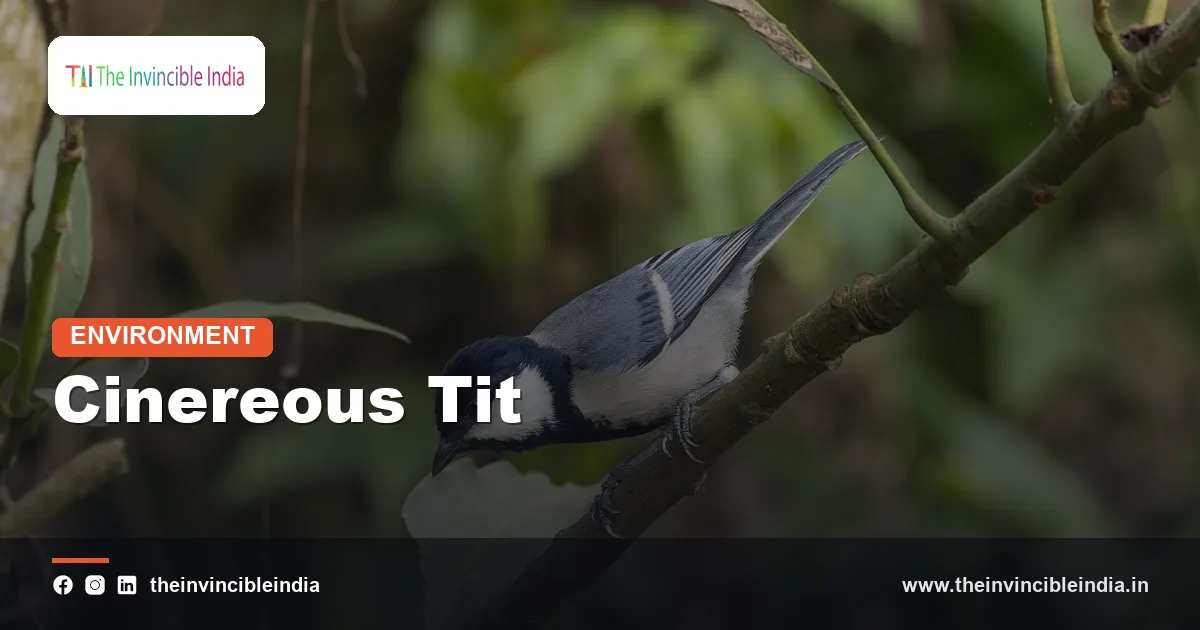
The cinereous tit (Parus cinereus) is a small, lively, grey-and-white songbird of Indian gardens, scrub and open woodland, closely related to the great tit and easily recognised by its black head, white cheek patch and bold black stripe running down the centre of its breast and belly. It is a resident, hole-nesting bird that feeds mainly on insects, and it is one of the commonest tits of the Indian plains and foothills.
For many years the cinereous tit was treated as a subspecies of the great tit, and older Indian books still describe it that way. It is now widely regarded as a separate species within the great tit group. This explainer describes how to identify the cinereous tit, where it lives in India, what it eats, how its ringing song works, how it nests and how it differs from the great tit and the green-backed tit.
| Quick Fact | Detail |
|---|---|
| Common name | Cinereous tit (also called the grey tit; formerly treated as part of the great tit) |
| Scientific name | Parus cinereus |
| Family | Paridae (tits and chickadees) |
| Size | About 13 to 14 cm long, a little smaller than a house sparrow |
| India range and habitat | Gardens, groves, scrub, open woodland and village trees across much of the peninsula, plains and foothills |
| Diet | Insects, caterpillars and spiders; also seeds, fruit and nectar at times |
| Breeding | Nests in tree holes, wall cavities and artificial hollows; clutch usually three to six eggs |
| Movements | Mainly resident, with only local seasonal movements |
| Conservation status | Least Concern on the IUCN Red List |
Key Takeaways
- The cinereous tit is a small, grey-backed, white-underparted songbird with a black head, a white cheek patch and a black stripe down the middle of the underparts.
- The cinereous tit was long classed as a form of the great tit, and it is now generally recognised as a distinct species named Parus cinereus.
- The cinereous tit lives in gardens, groves, scrub and open woodland across much of India and is a resident rather than a migrant.
- The cinereous tit feeds mainly on insects and spiders gleaned from leaves and bark, and it often hangs upside down while foraging.
- The cinereous tit nests in cavities such as tree holes, wall crevices and pipes, and it readily uses nest boxes.
- The cinereous tit is classified as Least Concern by the IUCN and adapts well to gardens and towns that retain mature trees.
What is the cinereous tit?
The cinereous tit is a small songbird in the tit family, Paridae, and its scientific name is Parus cinereus. The word cinereous means ash-coloured or grey, which refers to the grey back and wings that distinguish this bird from the green-backed and yellow-bellied relatives found in other parts of Asia.
Tits are compact, active, insect-eating birds with short, strong bills and a habit of foraging in trees and shrubs. They are found across Europe, Asia and Africa, with a similar group in North America called chickadees. The great tit group is among the best known, and in Asia it has been divided into several species, including the great tit of the north, the Japanese tit and the cinereous tit of southern Asia.
The cinereous tit is often called the grey tit in everyday speech. The shift in classification came from studies of genes, songs and plumage showing that the southern and tropical forms differ from the northern great tit, even though they look alike at first glance.
How can you identify the cinereous tit?
The cinereous tit is identified by its glossy black head and throat, large white cheek patch, grey back, pale underparts and a black stripe from the chin to the vent. Males have a broad, bold stripe, while females have a narrower, less complete one.
Plumage features
- Head: glossy black cap and throat, contrasting with a clean white cheek patch and a small pale nape spot.
- Back and wings: grey, with a white wing bar and white edges to the tail.
- Underparts: whitish to pale grey, with a black central stripe that widens on the lower belly in males.
- Bill: short, black and pointed, suited to picking insects and cracking small seeds.
- Legs: dark grey and strong, adapted for clinging to twigs and bark.
Males, females and young birds
The male cinereous tit has a wider and more glossy breast stripe, whereas the female has a thinner stripe and slightly duller colours. Young birds are duller still, with a yellowish tinge on the cheeks and a weaker stripe, and they gain adult colours after their first moult.
Where does the cinereous tit live in India?
The cinereous tit lives across a large part of India, including the peninsula, parts of the plains and the foothills, in habitats such as gardens, parks, orchards, groves, scrub jungle, dry deciduous forest and village trees. It generally avoids dense evergreen forest and higher mountain forests, where related tits take over.
Its range extends from India into Sri Lanka, South-East Asia and parts of the Indonesian archipelago, and it is one of the tits most often seen at low elevations. In the Himalaya, the cinereous tit gives way to other members of the great tit group, such as the green-backed tit, which occupies higher mountain forests.
Typical Indian habitats include:
- Urban gardens and campuses with mature trees such as neem, mango and tamarind.
- Thorn scrub and dry deciduous woodland.
- Orchards, village groves and roadside avenues.
- Mangrove and riverine trees in coastal and lowland areas.
- Temples, ruins and old buildings that offer nest cavities.
The bird is bold and adaptable, and it often lives close to people. A single pair can hold a territory in a medium-sized garden, as long as there are trees for foraging and a hole for nesting.
What does the cinereous tit eat?
The cinereous tit eats mainly insects and spiders, including caterpillars, beetles, bugs, aphids and small moths, and it adds seeds, fruit and sometimes nectar when animal food is scarce. Insects are especially important during the breeding season, when the chicks need a protein-rich diet.
Foraging is restless and acrobatic. The bird hops along branches, pecks at bark crevices, probes leaf clusters and often hangs upside down from twigs. It may hold larger items against a branch with its feet and hammer them open with its bill. In the cooler months it often joins mixed-species hunting parties along with warblers, babblers and flycatchers.
By eating large numbers of caterpillars and other insects, the cinereous tit helps to protect trees in gardens and orchards from defoliating pests. For this reason, it is welcomed by gardeners who observe its work closely.
How does the cinereous tit sing?
The cinereous tit sings with a loud, ringing series of two- or three-note phrases repeated many times, similar to the song of the great tit, and it also makes harsh scolding calls and thin high notes. The male sings mainly to defend a territory and to attract a mate, most frequently in the breeding season.
The repeated, metallic quality of the song carries well across gardens, and it is often among the first songs heard on spring mornings. Individual males may have several song types and switch between them. Calls include a sharp chattering when the bird is alarmed and soft contact notes used to keep a pair or family together.
Song is one of the best ways to find the cinereous tit before seeing it, because the bird may stay hidden in leafy canopies. A series of loud, repeated phrases from a tree in a garden is often enough to confirm the bird’s presence.
How does the cinereous tit breed?
The cinereous tit breeds in a hole or cavity, such as a natural tree hollow, a wall crevice, a pipe or a nest box, and builds a cup of moss, hair, feathers and fibre inside. The female usually lays three to six eggs and incubates them, while both parents feed the chicks.
Breeding in India usually takes place in the warm months before and during the early monsoon, although the exact timing varies by region. The eggs are white with small reddish-brown spots. Both parents bring food to the nest repeatedly, and the young leave about two to three weeks after hatching. Some pairs rear a second brood in a favourable season.
| Breeding stage | What happens |
|---|---|
| Territory | The male sings from tree perches to defend an area |
| Nest site | A hole in a tree, wall, post, pipe or nest box |
| Nest building | Mainly by the female using moss, hair, feathers and plant fibre |
| Eggs | Usually three to six, white with reddish-brown speckles |
| Incubation | By the female, while the male brings her food |
| Chick care | Both parents deliver insects until the young fledge |
The bird is known for its readiness to use man-made sites, including letterboxes, meter boxes and drain pipes. Conservation groups often encourage gardeners to put up nest boxes, which can attract the cinereous tit and other cavity-nesting birds.
Is the cinereous tit a migratory bird?
The cinereous tit is not a migratory bird; it is a resident of India that stays in or near its breeding area throughout the year. Individual birds may move short distances in search of food, and young birds disperse to find their own territories.
In the non-breeding season, pairs and family groups often join roving mixed flocks that move through the trees together. These flocks give members extra protection from predators and make it easier to find food. The tit tends to stay within a familiar home range, and ringing data from related tit species suggest that adults are strongly site-faithful.
How is the cinereous tit different from the great tit and the green-backed tit?
The cinereous tit differs from the great tit mainly by its grey back and whitish underparts, whereas the great tit of the north has a green back and yellowish underparts. The green-backed tit of the Himalaya is more strongly coloured, with a green back and yellow belly.
| Feature | Cinereous tit | Great tit (northern forms) | Green-backed tit |
|---|---|---|---|
| Back | Grey | Greenish | Green |
| Underparts | Whitish to pale grey | Yellowish | Yellow |
| Breast stripe | Bold black | Bold black | Bold black |
| Cheek patch | White | White | White to yellowish |
| Typical habitat in India | Plains, foothills, gardens, scrub | Northern Eurasia; absent from most of India | Himalayan forests |
| Status | Resident | Resident elsewhere | Resident, with altitudinal movement |
Because the group is closely related and the plumage differs only in tone, location is a strong clue. In the Indian plains and peninsula, a black-headed tit with a grey back and white underparts is almost always the cinereous tit.
What threats does the cinereous tit face?
The cinereous tit faces few severe threats and is classified as Least Concern by the IUCN, but it can be affected by the loss of old trees, which provide nest holes, and by heavy pesticide use that reduces its insect prey. Competition for nest sites with other cavity-nesting birds such as mynas and parakeets can also limit local numbers.
The main pressures can be summarised as follows:
- Removal of old trees: cutting mature trees takes away natural nesting hollows.
- Pesticide spraying: poison reduces insect food and may harm birds directly.
- Nest-site competition: mynas, parakeets and sparrows also seek holes.
- Predation: crows, snakes, squirrels and domestic cats can take eggs and chicks.
- Extreme heat: very high temperatures can stress nestlings in unshaded cavities.
The species adapts well to gardens, so it remains common in many Indian towns and cities. Planting native trees, keeping dead branches where they are safe, and avoiding chemical sprays all help the cinereous tit and other garden birds.
How can you attract and watch the cinereous tit?
The best way to attract and watch the cinereous tit is to provide mature trees, a source of water and a safe nest box in a quiet part of a garden, and then to listen for its ringing song in the early morning. Birdwatchers can also look for it in mixed hunting flocks in parks and orchards.
The following steps are useful:
- Keep a few native trees such as neem, mango, peepal or tamarind, which host insects and offer cover.
- Place a small bowl of fresh water at a shaded spot and clean it often.
- Fix a nest box with an entrance hole of about 28 to 32 mm on a tree or wall, facing away from the afternoon sun and out of reach of cats.
- Avoid pesticide sprays, which remove the insects the birds rely on.
- Watch quietly with binoculars and note the breast stripe, cheek patch and back colour.
Observers can submit their records to platforms like eBird and to local bird-count events, which build long-term data on common garden birds.
Bottom Line
The cinereous tit is a bold, adaptable and highly visible garden bird of India, distinguished by its grey back, white cheeks and black breast stripe. It is a resident insect-eater that nests in cavities, and it thrives wherever mature trees and nest sites are kept in towns, orchards and scrub.
Frequently Asked Questions
What is the cinereous tit?
The cinereous tit is a small songbird, Parus cinereus, in the tit family. It has a black head, white cheeks, a grey back, pale underparts and a black stripe down the centre of the breast and belly. It is a close relative of the great tit and is common in Indian gardens and open woodland.
Is the cinereous tit the same as the great tit?
The cinereous tit was once treated as a subspecies of the great tit but is now generally regarded as a separate species. It differs from northern great tits by its grey back and whitish underparts. The two share the same black head, white cheek and breast stripe pattern.
What does the cinereous tit eat?
The cinereous tit eats mainly insects and spiders, such as caterpillars, beetles and aphids, picked from leaves and bark. It also eats seeds, small fruits and sometimes nectar. During the breeding season it relies heavily on insects to feed its chicks.
Where does the cinereous tit nest?
The cinereous tit nests in cavities, including tree holes, wall crevices, pipes and nest boxes. The female builds a cup of moss, hair, feathers and fibre and lays about three to six eggs. Both parents feed the chicks until they leave the nest.
Is the cinereous tit found all over India?
The cinereous tit is found over a wide part of India, including the peninsula, much of the plains and the foothills, but it is not found in every habitat. It prefers gardens, scrub and open woodland and avoids dense evergreen forest and high mountains. In the Himalaya, related tits such as the green-backed tit replace it.
Is the cinereous tit a migratory bird?
The cinereous tit is not migratory; it is a resident that stays in the same general area throughout the year. Young birds disperse short distances to find territories. Outside the breeding season, it often joins mixed flocks that roam through trees.
{“@context”:”https://schema.org”,”@graph”:[{“@type”:”FAQPage”,”mainEntity”:[{“@type”:”Question”,”name”:”What is the cinereous tit?”,”acceptedAnswer”:{“@type”:”Answer”,”text”:”The cinereous tit is a small songbird, Parus cinereus, in the tit family. It has a black head, white cheeks, a grey back, pale underparts and a black stripe down the centre of the breast and belly. It is a close relative of the great tit and is common in Indian gardens and open woodland.”}},{“@type”:”Question”,”name”:”Is the cinereous tit the same as the great tit?”,”acceptedAnswer”:{“@type”:”Answer”,”text”:”The cinereous tit was once treated as a subspecies of the great tit but is now generally regarded as a separate species. It differs from northern great tits by its grey back and whitish underparts. The two share the same black head, white cheek and breast stripe pattern.”}},{“@type”:”Question”,”name”:”What does the cinereous tit eat?”,”acceptedAnswer”:{“@type”:”Answer”,”text”:”The cinereous tit eats mainly insects and spiders, such as caterpillars, beetles and aphids, picked from leaves and bark. It also eats seeds, small fruits and sometimes nectar. During the breeding season it relies heavily on insects to feed its chicks.”}},{“@type”:”Question”,”name”:”Where does the cinereous tit nest?”,”acceptedAnswer”:{“@type”:”Answer”,”text”:”The cinereous tit nests in cavities, including tree holes, wall crevices, pipes and nest boxes. The female builds a cup of moss, hair, feathers and fibre and lays about three to six eggs. Both parents feed the chicks until they leave the nest.”}},{“@type”:”Question”,”name”:”Is the cinereous tit found all over India?”,”acceptedAnswer”:{“@type”:”Answer”,”text”:”The cinereous tit is found over a wide part of India, including the peninsula, much of the plains and the foothills, but it is not found in every habitat. It prefers gardens, scrub and open woodland and avoids dense evergreen forest and high mountains. In the Himalaya, related tits such as the green-backed tit replace it.”}},{“@type”:”Question”,”name”:”Is the cinereous tit a migratory bird?”,”acceptedAnswer”:{“@type”:”Answer”,”text”:”The cinereous tit is not migratory; it is a resident that stays in the same general area throughout the year. Young birds disperse short distances to find territories. Outside the breeding season, it often joins mixed flocks that roam through trees.”}}]}]}


