

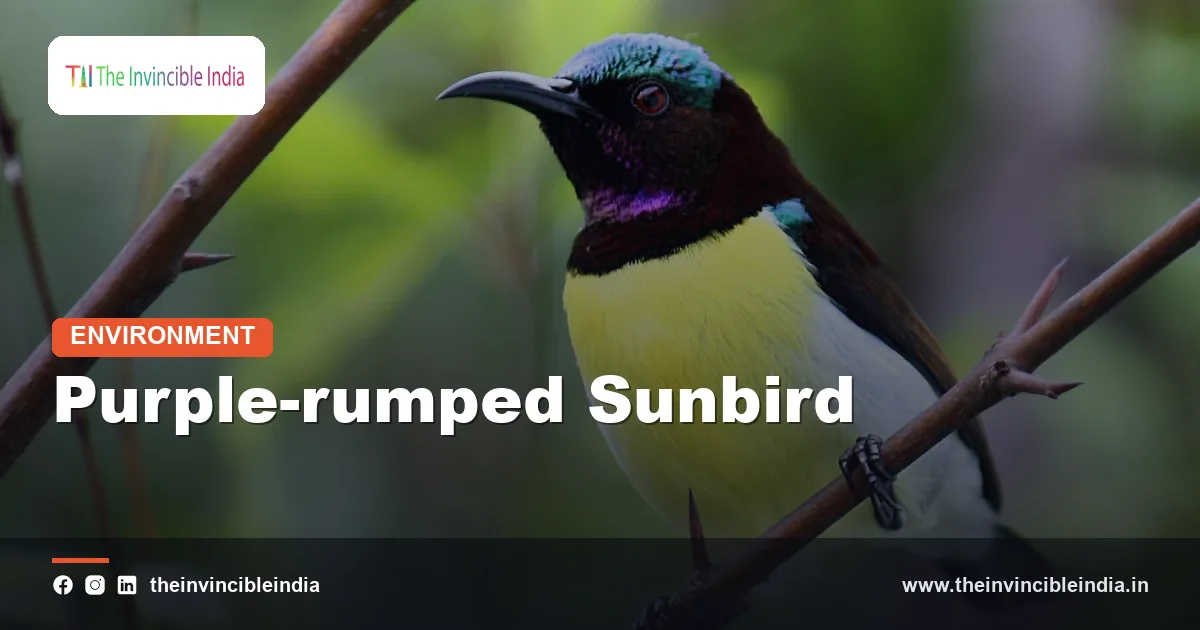
The purple-rumped sunbird (Leptocoma zeylonica) is a tiny, glossy, nectar-feeding bird of Indian gardens and light woodland, whose male shows a maroon back, a metallic green crown, a purple rump and bright yellow underparts. The purple-rumped sunbird is one of the commonest sunbirds of peninsular India and Sri Lanka, measuring only about 10 cm, and it is often seen darting between flowering shrubs in city parks, village gardens and forest edges.
The purple-rumped sunbird is a good bird for beginners because it lives close to people, visits ordinary garden flowers and builds a distinctive hanging nest. This article explains what the purple-rumped sunbird is, how to identify the male and female, where it lives in India, what it eats, how it breeds and why it matters as a pollinator.
| Quick Facts: Purple-rumped Sunbird | |
|---|---|
| Scientific name | Leptocoma zeylonica |
| Family | Nectariniidae (sunbirds) |
| Size | About 10 cm in length, among the smaller Indian sunbirds |
| India range and habitat | Widespread in India south of the Himalaya, most common in peninsular India; gardens, scrub, open woodland and forest edges; also found in Sri Lanka and Bangladesh |
| Diet | Flower nectar, small insects and spiders |
| Breeding | Hanging pear-shaped pouch nest of cobweb, plant fibre and debris; usually 2 eggs; the female builds and incubates |
| Voice | Sharp, metallic chip notes and a fast, high-pitched jumbled song |
| Conservation status | Least Concern on the IUCN Red List |
Key Takeaways
- The purple-rumped sunbird is a roughly 10 cm nectar-feeding bird whose male has a maroon back, metallic green crown, purple rump and yellow belly.
- The purple-rumped sunbird female is olive-brown above and pale yellowish below, with no metallic colour, so the two sexes look very different.
- The purple-rumped sunbird lives in gardens, scrub, open woodland and forest edges across India south of the Himalaya, and is most common in the peninsula.
- The purple-rumped sunbird feeds mainly on flower nectar using a long, curved bill and a tubular tongue, and also eats small insects and spiders for protein.
- The purple-rumped sunbird builds a hanging, pouch-shaped nest of cobweb and plant fibre with a side entrance, and the female usually lays two eggs.
- The purple-rumped sunbird is assessed as Least Concern, and it helps to pollinate many native and garden flowering plants.
What Is the Purple-rumped Sunbird?
The purple-rumped sunbird is a small passerine bird in the sunbird family, Nectariniidae, adapted to feed on the nectar of flowers. Sunbirds are the Old World ecological counterparts of the hummingbirds of the Americas, although the two groups are not closely related and sunbirds usually perch while feeding rather than hover.
The purple-rumped sunbird has a slender, downcurved bill, a brush-tipped tubular tongue and a lightweight body. The species name zeylonica refers to Ceylon, the old name for Sri Lanka, where the bird was first described for science. The bird is sometimes grouped with the small sunbird or crimson-backed sunbird in the genus Leptocoma, and it remains one of the most widely recognised sunbirds of the subcontinent.
The bird is also known by local names in many Indian languages, usually referring to its small size, its bright colours or its habit of visiting flowers. Many people simply call it the sunbird.
How Can You Identify the Purple-rumped Sunbird?
The purple-rumped sunbird is identified by the male’s combination of a maroon back and a bright yellow belly, with a metallic green crown and a purple rump that flashes in sunlight. The throat and upper breast of the male look dark maroon or purplish, and the colours change with the angle of light because they come from the structure of the feathers rather than from pigment.
The female purple-rumped sunbird is plain by comparison, with olive-brown upperparts, a whitish throat and pale yellow underparts. The female lacks the shine of the male but shows the same slender curved bill and small size. Young birds resemble the female.
Male and female compared
| Feature | Male | Female |
|---|---|---|
| Crown | Metallic green | Olive-brown |
| Back | Maroon, with a purple rump | Olive-brown |
| Throat and breast | Dark maroon-purple | Whitish to pale yellow |
| Belly | Bright yellow | Pale yellow |
| Overall look | Glossy and colourful | Plain and subdued |
From a distance, a male purple-rumped sunbird in poor light can look dark and nearly black, and only in direct sun do the green, purple and maroon appear. Patient observation of a perched male usually settles the identification.
Where Does the Purple-rumped Sunbird Live in India?
The purple-rumped sunbird lives across much of India south of the Himalaya, and it is most common in the peninsula, from the Western Ghats and the southern plains to the central and eastern parts of the country. Outside India, the bird occurs in Sri Lanka and Bangladesh.
The bird favours gardens, orchards, scrub, light woodland, forest edges and plantations. It is adaptable and often appears in towns and cities, where flowering trees and shrubs provide a regular supply of nectar. It generally avoids dense, closed evergreen forest and the very dry desert regions of the northwest.
The purple-rumped sunbird is mainly resident, though individuals may move locally to follow flowering trees. Such local movement is common among nectar feeders, because the supply of flowers changes through the year.
What Does the Purple-rumped Sunbird Eat?
The purple-rumped sunbird eats mainly flower nectar, which it collects with a long, curved bill and a tongue that forms a tube. The bird also eats small insects and spiders, which supply the protein that nectar lacks, and it feeds insects to its nestlings.
Nectar is an energy-rich food, and a tiny bird such as a sunbird needs to feed often to keep warm and active. The purple-rumped sunbird visits a wide range of flowers, including garden shrubs and the blossoms of many trees.
- Nectar plants: hibiscus, bottlebrush, coral tree (Erythrina), silk cotton, mistletoes and many garden flowers.
- Insects: small flies, aphids, tiny caterpillars and other soft insects picked from leaves and flowers.
- Spiders: taken from webs and foliage, and sometimes raided from the web material used in nest building.
The bird may occasionally hover briefly at a flower, but it usually clings to the stem or perches beside the bloom while it feeds. It sometimes pierces the base of a long flower to take nectar from the side, which is a behaviour known as nectar robbing.
How Does the Purple-rumped Sunbird Behave?
The purple-rumped sunbird behaves as a quick, energetic and territorial little bird that is usually seen alone, in pairs or in small groups at flowering trees. Males defend a rich flowering plant against other sunbirds, giving sharp calls and chasing intruders in short, rapid flights.
The bird’s call is a sharp, metallic chip or tsit, repeated often, and the male’s song is a jumbled, high-pitched series of notes delivered from a high perch. Males sing most actively in the breeding season.
Sunbirds are often seen reflecting light on their glossy feathers, and males sometimes appear to fight their own reflection in glass windows or car mirrors. This is a territorial response and usually stops once the bird is no longer disturbed.
How Does the Purple-rumped Sunbird Breed?
The purple-rumped sunbird breeds by building a small hanging nest, and the female usually lays two eggs. The nest is a pear-shaped pouch with a side entrance, often with a small overhanging porch, and it hangs from a twig, a creeper, a wire or even a porch ornament.
The female does most of the building, using cobweb, fine plant fibre, plant down and small scraps of material that she binds together. The outer surface is often decorated with bits of bark, dry leaves, lichen or other debris, which helps the nest blend in with its surroundings. The female incubates the eggs for around two weeks, and both parents feed the chicks with insects and nectar.
Breeding takes place over much of the year in the south, with peaks that vary by region and by local flowering. Nests are commonly placed low enough to be seen, so garden owners often notice the nest only when the chicks are being fed.
How Is the Purple-rumped Sunbird Adapted to Feeding on Nectar?
The purple-rumped sunbird is adapted to nectar feeding through its slender curved bill, its tubular, brush-tipped tongue and its light, agile body. The curved bill matches the shape of many tubular flowers, and the tongue is split near the tip so that it can draw up nectar by capillary action.
The purple-rumped sunbird also has strong feet that let it cling to thin twigs and even hang upside down, which allows it to reach flowers that a heavier bird could not use. Its small size means it can perch on delicate flower stalks without breaking them, while its fast metabolism means it must feed many times a day.
These adaptations explain why the bird is such a regular visitor to flowering shrubs. They also explain why it is so dependent on flowers, since a long gap without blossom forces the bird to move to a new area or to rely more heavily on insects.
How Does the Purple-rumped Sunbird Differ From Other Indian Sunbirds?
The purple-rumped sunbird differs from other Indian sunbirds mainly in its size, its colour pattern and the shape of its bill. The table below compares it with three other sunbirds that birdwatchers often meet.
| Sunbird | Typical male appearance | Typical range in India |
|---|---|---|
| Purple-rumped sunbird | Maroon back, green crown, purple rump, yellow belly | Widespread south of the Himalaya, common in the peninsula |
| Purple sunbird | Looks dark and glossy purple-black; much of the body appears dark | Widespread across most of India |
| Crimson-backed sunbird | Crimson back with glittering metallic crown | Western Ghats |
| Loten’s sunbird | Dark upperparts, maroon band on the breast, long curved bill | Southern and coastal peninsular India |
The yellow belly is the quickest way to separate the male purple-rumped sunbird from the purple sunbird, which looks mostly dark. The female purple-rumped sunbird, with its pale yellow underparts and white throat, can be told from the female purple sunbird by the whiter throat and the lack of a dark eye stripe.
Why Does the Purple-rumped Sunbird Matter?
The purple-rumped sunbird matters because it pollinates flowers while feeding, and so contributes to the reproduction of many Indian plants. As the bird probes a flower, pollen sticks to its head and bill and is carried to the next flower it visits.
Plants with red, orange or tubular flowers are especially likely to be pollinated by sunbirds, and many garden and wild trees benefit from their visits. The bird also eats small insects, which gives some control over garden pests.
The purple-rumped sunbird is also a gateway bird for people interested in nature. Because it is bright, small and active, it often attracts children and new birdwatchers, which helps build public interest in conservation.
How Can You Attract the Purple-rumped Sunbird to a Garden?
A garden attracts the purple-rumped sunbird by providing nectar-rich flowering plants throughout the year, together with shelter and water. Planting a mix of shrubs and small trees that flower at different seasons gives the bird a dependable food supply.
- Grow native or long-flowering nectar plants such as hibiscus, lantana, bottlebrush and coral tree.
- Avoid chemical pesticides that kill the insects the bird needs for protein and for its chicks.
- Leave some twigs, creepers and cobwebs undisturbed, since they are used as nest material.
- Provide a shallow dish of clean water for drinking and bathing.
Sugar-water feeders are not generally recommended for wild birds in India, because they can spoil quickly and spread disease. Flowering plants are the safer and more natural option.
Is the Purple-rumped Sunbird Threatened?
The purple-rumped sunbird is not threatened and is assessed as Least Concern on the IUCN Red List because it is widespread, adaptable and common in human-modified habitats. All wild birds in India are given legal protection under the Wild Life (Protection) Act, 1972, and the sunbird is covered along with many other common species.
Local threats include the loss of flowering trees, heavy pesticide use and collisions with glass. Nonetheless, the bird’s ability to live in gardens means that its overall numbers remain healthy across most of its range.
Bottom Line
The purple-rumped sunbird is a tiny, brightly coloured nectar feeder that is common in Indian gardens and woodland and plays a quiet but useful role as a pollinator. It is safe at present, and planting flowering shrubs is one of the simplest ways to keep it close.
Frequently Asked Questions
What is a purple-rumped sunbird?
The purple-rumped sunbird is a tiny nectar-feeding bird of the sunbird family, about 10 cm long, found across much of India. The male has a maroon back, a metallic green crown, a purple rump and a yellow belly. The female is olive-brown above and pale yellowish below.
Where is the purple-rumped sunbird found in India?
The purple-rumped sunbird is found across India south of the Himalaya and is most common in peninsular India. It lives in gardens, scrub, open woodland and forest edges. It also occurs in Sri Lanka and Bangladesh.
What does the purple-rumped sunbird eat?
The purple-rumped sunbird eats mainly flower nectar, collected with a long curved bill and a tubular tongue. It also eats small insects and spiders for protein. The chicks are fed largely on insects.
How does the purple-rumped sunbird build its nest?
The purple-rumped sunbird builds a hanging pear-shaped pouch nest with a side entrance. The female binds cobweb, plant fibre and plant down together and often decorates the outside with debris. She usually lays two eggs.
How can you tell a male purple-rumped sunbird from a female?
A male purple-rumped sunbird is glossy, with a maroon back, a green crown, a purple rump and a yellow belly. A female is plain olive-brown above with pale yellow underparts and no metallic colour. The two sexes look so different that beginners often think they are separate species.
Is the purple-rumped sunbird common?
The purple-rumped sunbird is common across much of India and is assessed as Least Concern. It adapts well to gardens, parks and plantations, so it is often seen in towns. It is protected under Indian wildlife law like other wild birds.
{“@context”:”https://schema.org”,”@graph”:[{“@type”:”FAQPage”,”mainEntity”:[{“@type”:”Question”,”name”:”What is a purple-rumped sunbird?”,”acceptedAnswer”:{“@type”:”Answer”,”text”:”The purple-rumped sunbird is a tiny nectar-feeding bird of the sunbird family, about 10 cm long, found across much of India. The male has a maroon back, a metallic green crown, a purple rump and a yellow belly. The female is olive-brown above and pale yellowish below.”}},{“@type”:”Question”,”name”:”Where is the purple-rumped sunbird found in India?”,”acceptedAnswer”:{“@type”:”Answer”,”text”:”The purple-rumped sunbird is found across India south of the Himalaya and is most common in peninsular India. It lives in gardens, scrub, open woodland and forest edges. It also occurs in Sri Lanka and Bangladesh.”}},{“@type”:”Question”,”name”:”What does the purple-rumped sunbird eat?”,”acceptedAnswer”:{“@type”:”Answer”,”text”:”The purple-rumped sunbird eats mainly flower nectar, collected with a long curved bill and a tubular tongue. It also eats small insects and spiders for protein. The chicks are fed largely on insects.”}},{“@type”:”Question”,”name”:”How does the purple-rumped sunbird build its nest?”,”acceptedAnswer”:{“@type”:”Answer”,”text”:”The purple-rumped sunbird builds a hanging pear-shaped pouch nest with a side entrance. The female binds cobweb, plant fibre and plant down together and often decorates the outside with debris. She usually lays two eggs.”}},{“@type”:”Question”,”name”:”How can you tell a male purple-rumped sunbird from a female?”,”acceptedAnswer”:{“@type”:”Answer”,”text”:”A male purple-rumped sunbird is glossy, with a maroon back, a green crown, a purple rump and a yellow belly. A female is plain olive-brown above with pale yellow underparts and no metallic colour. The two sexes look so different that beginners often think they are separate species.”}},{“@type”:”Question”,”name”:”Is the purple-rumped sunbird common?”,”acceptedAnswer”:{“@type”:”Answer”,”text”:”The purple-rumped sunbird is common across much of India and is assessed as Least Concern. It adapts well to gardens, parks and plantations, so it is often seen in towns. It is protected under Indian wildlife law like other wild birds.”}}]}]}


