

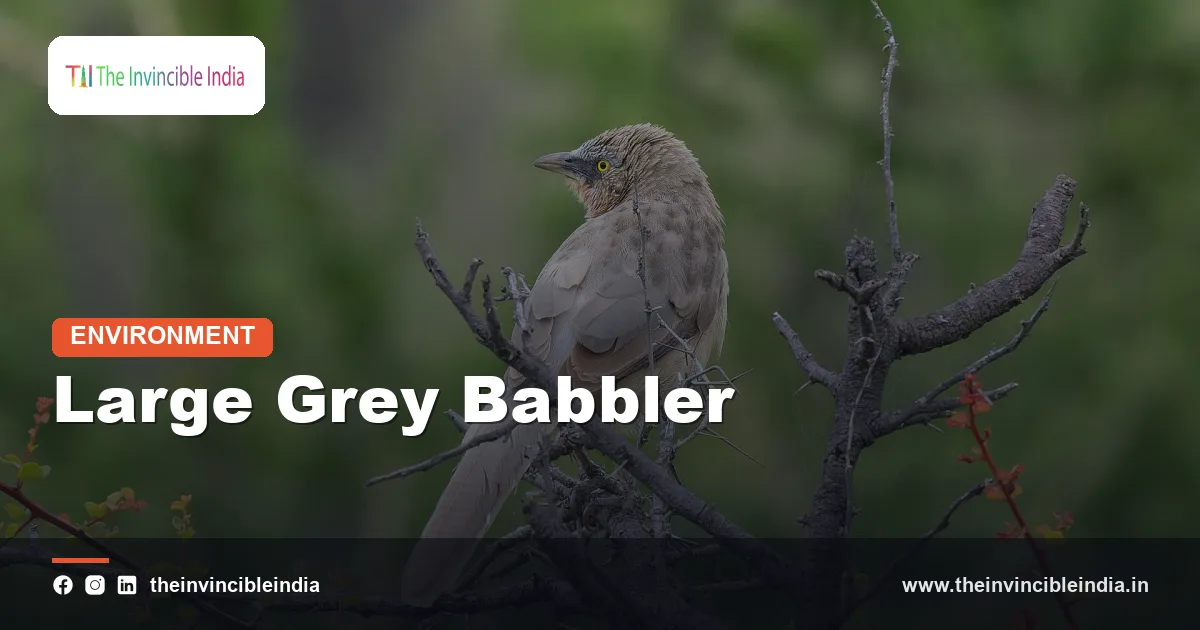
The large grey babbler (Argya malcolmi) is the biggest of the Indian babblers, a noisy, grey-brown songbird of open country with white outer feathers on its tail that lives and feeds in lively flocks. It is found mainly in India, where it is a familiar resident of farmland, scrub and light woodland, and its loud, whining calls often reveal a flock before the birds themselves are seen.
Because it lives in groups, hops about on the ground and calls constantly, the large grey babbler is often lumped with the “seven sisters” of Indian folklore, but it is a separate species with distinct features. This explainer covers how to identify the large grey babbler, where it lives, what it eats, how its flocks behave, how it breeds and how it compares with similar birds. Information was last reviewed on 23 October 2026.
| Attribute | Details |
|---|---|
| Common name | Large grey babbler |
| Scientific name | Argya malcolmi (earlier placed in the genus Turdoides) |
| Family | Leiothrichidae (laughingthrushes and allied babblers) |
| Size | About 28 cm long; the largest babbler of the Indian plains |
| Range and habitat in India | Largely endemic to India; open scrub, cultivation, light deciduous woodland and village edges |
| Diet | Insects and other small invertebrates, plus seeds, fruits and nectar |
| Breeding | Cup nest in a thorny tree or bush; typically three to four blue-green eggs; helpers may assist |
| Conservation status | Least Concern on the IUCN Red List |
Key Takeaways
- The large grey babbler (Argya malcolmi) is the largest babbler of the Indian plains, measuring about 28 cm in length.
- The large grey babbler is a grey-brown bird with a darker face and a long tail whose outer feathers are tipped or edged in white, visible when the bird flies.
- Large grey babblers live in noisy flocks, usually of around six to ten birds, that forage on the ground in open country and cultivated land.
- The large grey babbler eats mainly insects and also takes seeds, fruit and nectar, so it can live close to farms and villages.
- The large grey babbler is found largely in India, where it is a resident that does not migrate.
- The large grey babbler is classified as Least Concern because it is widespread and adapts well to modified landscapes.
What Is the Large Grey Babbler?
The large grey babbler is a big, gregarious, grey-brown songbird in the family Leiothrichidae, and it is one of the most conspicuous babblers of open farmland and scrub in India. Its flocks hop and run on the ground, flick up into low trees and fill the air with squealing, chattering calls.
The scientific name Argya malcolmi honours a person named Malcolm, in line with a long tradition of naming birds after collectors and officials. For many years the species was placed in the genus Turdoides, which is why older books list it as Turdoides malcolmi. Later studies of babbler relationships moved many Asian and African species into the genus Argya.
The large grey babbler is a resident species. Each flock occupies a territory and stays within it for most of the year, so the same group may be seen again and again in the same field or grove.
What Does the Large Grey Babbler Look Like?
The large grey babbler is a large, long-tailed babbler with grey-brown upperparts, a paler underside, a dark face and a tail with white-edged outer feathers. At about 28 cm, it is distinctly larger than most other babblers of the plains.
Features that help identification are:
- Size and build: a big, sturdy bird with a long, rounded tail that makes it look larger than the common or jungle babbler.
- Colour: the head and upperparts are a dull greyish-brown, with some darker mottling on the back.
- Face: darker patches around the face contrast with a paler crown, giving a slightly masked look.
- White-sided tail: the outer tail feathers are white-tipped or white-edged, and the tail pattern shows clearly when the bird takes off or lands.
- Underparts: the breast is greyish and the belly paler and warmer.
Male and female large grey babblers look alike, and young birds resemble adults but tend to look duller and less distinct. Because the flock often flies one by one across a field or track, the repeated flash of white in the tail is a handy way to recognise the species even at a distance.
Where Is the Large Grey Babbler Found in India?
The large grey babbler is found across large parts of peninsular and northern India, in open country, scrub, cultivated land and light woodland. The species is considered largely endemic to India, meaning that most of its range lies within the country.
Typical habitats of the large grey babbler include:
- Open scrub and thorn country with scattered trees.
- Farmland, orchards, hedgerows and field borders.
- Light, dry deciduous woodland and its clearings.
- Village edges, gardens, roadside plantations and canal banks.
- Dry, rocky or sandy ground with sufficient bushes for shelter.
The large grey babbler avoids very dense, wet forest and the high mountains. It prefers places where it can move freely over open ground yet reach cover quickly in a tree or bush. Because farmland provides both insects and shelter, the species has done well in rural landscapes and can be seen close to human settlements. Where its range meets that of the jungle babbler or the common babbler, the three may be found in neighbouring but slightly different habitats.
What Does the Large Grey Babbler Eat?
The large grey babbler eats mainly insects and other small invertebrates, which it catches by searching the ground and low vegetation. Grasshoppers, beetles, ants, caterpillars and termites are typical prey, and the birds sometimes take spiders, small lizards or other small animals.
The diet also includes plant matter. The large grey babbler takes seeds and grain, ripe fruit from trees such as fig and ber, and nectar from certain flowers. This flexibility helps the species cope with changing seasons and food supplies.
Foraging methods of the large grey babbler include:
- Ground searching: the flock spreads out and hops across the soil, turning over leaves and clods.
- Probing: the bill is pushed into loose soil, cracks and grass bases.
- Low gleaning: insects are taken from branches, trunks and leaves close to the ground.
- Fruit feeding: ripe fruit on trees is eaten in season, often by several birds at once.
As an insect-eater the large grey babbler is beneficial around crop fields, since it helps to reduce populations of some pests. Damage to crops by the species is minor and is not usually regarded as a serious problem by farmers.
How Do Large Grey Babblers Behave in Flocks?
Large grey babblers live and move in flocks, usually of around six to ten birds, that forage, rest and call together as a unit. Rarely will a large grey babbler be seen on its own, and the flock holds together through frequent calling.
The social life of the large grey babbler shows several typical babbler habits:
- Follow-the-leader movement: birds cross open ground one after another, flying low and landing in the next bush or tree.
- Mobbing: a flock will gather and call loudly around a snake, cat, owl or hawk until the intruder moves off.
- Social preening: members often groom each other, which strengthens relationships within the group.
- Territory defence: flocks may call and display toward neighbouring groups at the edges of their territory.
- Group roosting: the flock often spends the night together in a dense tree or bush.
This flock life gives the large grey babbler better protection against predators and better access to food and nest sites. Because the birds are bold and noisy, they are among the easiest wild birds for ordinary people to watch.
What Does the Large Grey Babbler Sound Like?
The call of the large grey babbler is a loud, harsh, whining or mewing chatter, often given by several birds together, and it carries a long way across open ground. Observers often describe the sound as squeaky, nasal and slightly comic, with an excited chorus when the flock is alarmed.
The main kinds of call are:
- Contact calls: short, repeated notes exchanged between flock members as they forage.
- Chorus calls: noisy, overlapping chatter when birds greet each other or meet another group.
- Alarm calls: sharp, rapid notes that signal danger and bring the group together.
- Begging calls: thin, high notes from young birds asking for food.
The loud calling of the large grey babbler is useful to birdwatchers, because it is usually heard first. A walker who hears excited squeaking in a field margin can often find the flock by following the sound slowly and quietly.
How Does the Large Grey Babbler Breed?
The large grey babbler builds a cup-shaped nest of twigs, grass and rootlets in a thorny tree or bush and typically lays three to four blue-green eggs. As in other babblers, breeding can be cooperative, so other group members may help to guard the nest and feed the chicks.
Notable points about breeding are:
- Timing: the season differs by region, but breeding often coincides with the rains and a rise in insect numbers.
- Nest site: thorny trees and dense bushes are preferred, as they give protection from predators.
- Clutch: usually three to four eggs of a clean greenish-blue colour.
- Chick care: parents bring insects to the nestlings, often with help from other birds in the group.
- Young birds: fledglings stay with the group and learn to forage and call by following adults.
The tight family unit of the large grey babbler makes it a good example of cooperative breeding in birds. Details such as how many helpers join in and how breeding is shared vary between flocks.
How Do You Tell the Large Grey Babbler from Similar Birds?
The large grey babbler is told from similar babblers by its greater size, grey-brown colour, darker face and white-sided tail. The table below compares it with the species it is most often confused with.
| Species | Size and build | Main identification clues | Typical habitat |
|---|---|---|---|
| Large grey babbler | About 28 cm, largest and sturdy | Grey-brown with white outer tail feathers, darker face | Open country, farmland, light woodland |
| Jungle babbler | About 25 cm, stocky | Plain rufous-grey, no white in tail, pale eyes | Gardens, towns, woodland edges |
| Common babbler | About 23 cm, slim | Streaked brown upperparts, long tail | Dry scrub and thorn country |
| Yellow-billed babbler | About 23 cm | Brownish bird with a yellow bill and no white in the tail | Peninsular and southern scrub |
The jungle babbler is the most frequent source of confusion. The jungle babbler is smaller and lacks the white tail sides, and its colour is plainer and more reddish. When a flock flies across a path, the white in the tails of large grey babblers is often what clinches the identification.
Is the Large Grey Babbler Threatened?
The large grey babbler is not threatened globally and is listed as Least Concern by the International Union for Conservation of Nature (IUCN). It is a widespread resident with a large range and tolerates farmland and disturbed habitat.
Local threats can still arise, including:
- Removal of thorny trees, hedges and field boundaries used for nesting.
- Heavy use of pesticides that reduce insect food.
- Conversion of scrub and open land into dense construction.
- Disturbance of nests during agricultural work or by predators such as dogs and cats.
Keeping hedgerows, native trees and some uncultivated patches helps the large grey babbler and many other birds of rural India. The species has so far coped well with human activity, but this depends on there being enough cover and insects.
How Can You Watch the Large Grey Babbler?
The best way to watch the large grey babbler is to visit farmland, scrub or a village edge in the early morning or late afternoon and follow the sound of the flock’s chatter. The birds are bold and often tolerate a slow, quiet observer at a distance.
Helpful tips include:
- Go early, when the flock is feeding actively and calling loudly.
- Stand still near a bush or tree and let the birds come into view.
- Look for the white tail edges when the birds fly.
- Use binoculars to see the dark face and grey-brown plumage.
- Keep distance from nests so that adults are not frightened away.
Since the large grey babbler is common in rural India, even a short walk is often enough to find a flock. Patient viewing also reveals the group’s interactions, including preening, mobbing and noisy greetings.
Why Does the Large Grey Babbler Matter?
The large grey babbler matters because it is a natural pest controller, a visible indicator of healthy rural habitat and a model species for understanding bird societies. As a large and noisy bird, it also draws people’s attention to the wildlife of ordinary farmland.
By eating many insects, the large grey babbler helps keep field and orchard pests in check. The species’ presence suggests that thorny cover and food are still available in the landscape. Its cooperative flock life, with shared defence and care of young, is also of continuing interest to biologists.
Bottom Line
The large grey babbler is India’s largest plains babbler, a grey-brown, white-tailed flock bird of open country that eats insects, breeds in cooperative groups and calls loudly. It is common and not threatened, and it does best where hedges, thorny trees and uncultivated patches remain.
Frequently Asked Questions
What is the scientific name of the large grey babbler?
The scientific name of the large grey babbler is Argya malcolmi. It was earlier placed in the genus Turdoides, so older books may list it as Turdoides malcolmi. It belongs to the family Leiothrichidae.
How big is the large grey babbler?
The large grey babbler is about 28 cm long, which makes it the largest babbler of the Indian plains. It is noticeably bigger and sturdier than the jungle babbler and the common babbler, and it has a long, rounded tail.
How can I identify the large grey babbler?
The large grey babbler can be identified by its large size, grey-brown plumage, darker face and white-edged outer tail feathers. The white in the tail shows clearly when the bird flies. It is also usually seen in noisy flocks on open ground.
What does the large grey babbler eat?
The large grey babbler eats mainly insects such as grasshoppers, beetles, ants and caterpillars. It also eats seeds, fruit and nectar. This mixed diet allows it to live in farmland and village edges.
Is the large grey babbler found only in India?
The large grey babbler is largely endemic to India, meaning that most of its range lies within the country. It occurs across much of peninsular and northern India in open scrub, farmland and light woodland, and it is a year-round resident.
Is the large grey babbler endangered?
No, the large grey babbler is not endangered and is classified as Least Concern by the IUCN. It is widespread and adapts well to farmland, although local numbers may fall if hedges, thorny trees and scrub are cleared.
{“@context”:”https://schema.org”,”@graph”:[{“@type”:”FAQPage”,”mainEntity”:[{“@type”:”Question”,”name”:”What is the scientific name of the large grey babbler?”,”acceptedAnswer”:{“@type”:”Answer”,”text”:”The scientific name of the large grey babbler is Argya malcolmi. It was earlier placed in the genus Turdoides, so older books may list it as Turdoides malcolmi. It belongs to the family Leiothrichidae.”}},{“@type”:”Question”,”name”:”How big is the large grey babbler?”,”acceptedAnswer”:{“@type”:”Answer”,”text”:”The large grey babbler is about 28 cm long, which makes it the largest babbler of the Indian plains. It is noticeably bigger and sturdier than the jungle babbler and the common babbler, and it has a long, rounded tail.”}},{“@type”:”Question”,”name”:”How can I identify the large grey babbler?”,”acceptedAnswer”:{“@type”:”Answer”,”text”:”The large grey babbler can be identified by its large size, grey-brown plumage, darker face and white-edged outer tail feathers. The white in the tail shows clearly when the bird flies. It is also usually seen in noisy flocks on open ground.”}},{“@type”:”Question”,”name”:”What does the large grey babbler eat?”,”acceptedAnswer”:{“@type”:”Answer”,”text”:”The large grey babbler eats mainly insects such as grasshoppers, beetles, ants and caterpillars. It also eats seeds, fruit and nectar. This mixed diet allows it to live in farmland and village edges.”}},{“@type”:”Question”,”name”:”Is the large grey babbler found only in India?”,”acceptedAnswer”:{“@type”:”Answer”,”text”:”The large grey babbler is largely endemic to India, meaning that most of its range lies within the country. It occurs across much of peninsular and northern India in open scrub, farmland and light woodland, and it is a year-round resident.”}},{“@type”:”Question”,”name”:”Is the large grey babbler endangered?”,”acceptedAnswer”:{“@type”:”Answer”,”text”:”No, the large grey babbler is not endangered and is classified as Least Concern by the IUCN. It is widespread and adapts well to farmland, although local numbers may fall if hedges, thorny trees and scrub are cleared.”}}]}]}


